
Disclaimer: This article is for educational purposes only and does not constitute medical advice. PEMF and bioelectric technologies are supportive tools and are not a replacement for conventional medical treatment. Always consult a qualified healthcare professional before making changes to your health protocol.
Every year, over 80,000 people in the United States are diagnosed with Non-Hodgkin Lymphoma. Thousands of them will spend years searching for answers beyond standard chemotherapy — and thousands will spend between $5,000 and $39,000 on Rife machines, frequency devices, and bioelectric gadgets that produce results for a few weeks and then go completely silent. The machines end up on eBay. The hope fades. And the question nobody asks is: why did it stop working?
The answer is cellular adaptation — and it is the single most important concept in bioelectric medicine that almost nobody in the wellness industry is talking about. This article will explain exactly what Non-Hodgkin Lymphoma is at the cellular level, why static frequencies are fundamentally the wrong tool for it, and why the Non-Hodgkin Lymphoma 8-Phase Lymphatic Vortex Advanced BioPhi Energetics program represents a completely different category of technology.
Reading the Signal: What the Spectral Analysis Reveals
The two spectral images below are taken directly from the audio analysis of the Non-Hodgkin Lymphoma 8-Phase Lymphatic Vortex program. They tell a story that no static Rife device can match.


What Is Non-Hodgkin Lymphoma? The Deep Biology
Non-Hodgkin Lymphoma (NHL) is not a single disease. It is a family of over 60 distinct malignancies that arise from the uncontrolled proliferation of lymphocytes — the white blood cells that form the backbone of the adaptive immune system. Unlike Hodgkin Lymphoma, which is defined by the presence of Reed-Sternberg cells, NHL encompasses every other lymphocytic malignancy, making it the sixth most common cancer in the United States.
Approximately 85% of NHL cases are B-cell lymphomas. The most common subtype is Diffuse Large B-Cell Lymphoma (DLBCL), accounting for roughly 30% of all NHL diagnoses. The remaining 15% are T-cell and NK-cell lymphomas, which are generally more aggressive and harder to treat. The disease can be indolent (slow-growing, such as follicular lymphoma) or aggressive (fast-growing, such as Burkitt lymphoma), and this distinction fundamentally changes the treatment approach.
At the molecular level, NHL is driven by oncogenic transformation — a process in which a normal lymphocyte acquires genetic mutations that disable its programmed cell death (apoptosis) pathways and activate its proliferation signals. The most common driver is the constitutive activation of the NF-κB pathway, a master transcription factor that controls cell survival, proliferation, and inflammatory signaling. When NF-κB is permanently switched on, the lymphocyte becomes immortal and begins to clone itself indefinitely. The BCL-2 anti-apoptotic protein, overexpressed in follicular lymphoma due to the t(14;18) chromosomal translocation, is another critical driver — it physically blocks the cell death machinery, allowing malignant cells to accumulate without limit.

Key infectious co-factors are well-established in the scientific literature. Epstein-Barr Virus (EBV) is associated with Burkitt lymphoma and post-transplant lymphoproliferative disorders. Helicobacter pylori drives MALT lymphoma of the stomach. Hepatitis C Virus (HCV) is linked to splenic marginal zone lymphoma. Human T-cell Leukemia Virus type 1 (HTLV-1) causes adult T-cell lymphoma/leukemia. These co-factors are not incidental — they are active drivers of the oncogenic transformation, and any serious bioelectric protocol must address them directly.[1]
Environmental factors compound the risk significantly. Occupational exposure to pesticides (particularly organophosphates and chlorinated compounds), benzene, and other industrial solvents has been consistently associated with elevated NHL risk in epidemiological studies. Chronic immune dysregulation — whether from autoimmune disease, HIV infection, or post-transplant immunosuppression — dramatically increases the probability of malignant transformation. This is why the detox component of any NHL protocol is not optional: the environmental toxin burden is often a direct contributor to the disease’s origin and persistence.[2]
The Lymphatic System: The Highway That Becomes the Battleground
The lymphatic system is a parallel circulatory network that runs alongside the blood vasculature. It consists of lymph vessels, lymph nodes, the spleen, the thymus, and the bone marrow. Its primary functions are immune surveillance, fluid homeostasis, and fat absorption from the gut via the lacteals of the small intestine. Unlike the cardiovascular system, the lymphatic system has no central pump — lymph flows through a combination of skeletal muscle contractions, breathing, and the intrinsic contractility of lymphangion smooth muscle cells.
In NHL, the lymph nodes become sites of malignant cell accumulation. The clonal lymphocytes pack the nodes, disrupting their architecture and impairing their ability to filter pathogens and cellular debris. As the disease progresses, malignant cells can spill into the bloodstream and infiltrate the bone marrow, liver, spleen, and central nervous system. The thoracic duct — the largest lymphatic vessel in the body, running through the chest cavity — is the final common pathway for the majority of the body’s lymph drainage. When the thoracic duct becomes congested with malignant cells and inflammatory debris, the entire lymphatic system backs up, creating systemic edema, immune suppression, and metabolic stagnation.
This systemic spread is what makes NHL a disease of the entire body — not just the nodes. This is why any effective bioelectric approach must target the entire lymphatic network, not just a single node or region. A static frequency applied to the neck will not reach the mesenteric nodes of the abdomen, the para-aortic nodes of the retroperitoneum, or the inguinal nodes of the groin.
Why Static Rife Frequencies Are the Wrong Tool — And Why So Many People Are Disappointed
The Rife machine market tells a story that the wellness industry refuses to acknowledge. Devices that cost $15,000 to $39,000 new are routinely listed on eBay and Facebook Marketplace for $800 to $2,000. The used market for Rife equipment is enormous, and it is growing. The reason is brutally simple: a device that resolves a chronic condition is a device you never sell. The fact that these machines are being sold in large numbers is the market’s verdict on their long-term efficacy.
The mechanism of failure is cellular adaptation. When a cell — including a malignant lymphocyte — is exposed to the same energetic signal repeatedly, its ion channels downregulate. This is a protective mechanism: the cell senses a persistent energetic stimulus and reduces its membrane permeability to protect itself from energetic exhaustion. Within 3 to 5 minutes of continuous exposure to a fixed frequency, the biological response begins to attenuate. Within 2 to 3 weeks of daily use, the body has largely habituated to the signal, and the frequency becomes functionally invisible to the immune system. The initial “Herxheimer reaction” that users interpret as proof that the device is working is, in most cases, the body’s one-time acute response to a novel stimulus — a response that cannot be repeated once the novelty is gone.

There is a second, more insidious problem specific to lymphoma and immune conditions. The malignant lymphocytes in NHL are, by definition, cells that have escaped normal regulatory control. They are energetically dysregulated, metabolically flexible, and highly adaptive. Applying a predictable, static frequency to an adaptive malignant cell population is like trying to catch a moving target with a weapon that always fires in the same direction. The target moves; the weapon does not.
The third problem is the forcing function paradox. Many Rife protocols for lymphoma apply heavy, low-frequency square waves in an attempt to drive a strong cellular response. But the lymphatic system and the immune system are not systems that respond well to forcing. They are regulatory systems that respond to information. A heavy, rigid signal applied to an already-dysregulated immune system can increase sympathetic nervous system tone, elevate cortisol, and actually suppress the very NK-cell and T-cell activity you are trying to amplify. This is why many users report feeling worse — not better — after extended Rife sessions.[3]
The 8-Phase Lymphatic Vortex: A Completely Different Architecture
The Non-Hodgkin Lymphoma 8-Phase Lymphatic Vortex Advanced BioPhi Energetics program is built on three principles that are the direct antithesis of the Rife model.
Principle 1: Dynamic Phase Architecture. The program moves through 8 distinct phases, each with a different functional target. Phase 1 establishes an entrainment anchor using Schumann resonance and alpha/theta brainwave frequencies to lower sympathetic nervous system resistance and open the body’s receptivity to the subsequent phases. The middle phases address the known co-factors of NHL, immune amplification (specifically NK-cell and cytotoxic T-cell activity), cellular repair, ATP production, collagen integrity, and nutrient co-factor resonance. The final phase is a Phi-Harmonic integration exit ramp that allows the nervous system to consolidate the session’s effects without abrupt termination.
Principle 2: Anti-Habituation Design. The program employs a Phi-Harmonic (φ = 1.618) mathematical structure combined with subtle frequency jitter and LFO modulation. Because the signal is mathematically non-repeating — it never produces the exact same waveform twice — the body’s ion channels cannot habituate to it. The nervous system and immune system remain responsive for the entire duration of the session, and across repeated sessions over weeks and months. This is the fundamental reason why this technology produces sustained, progressive results where static frequencies produce a plateau.
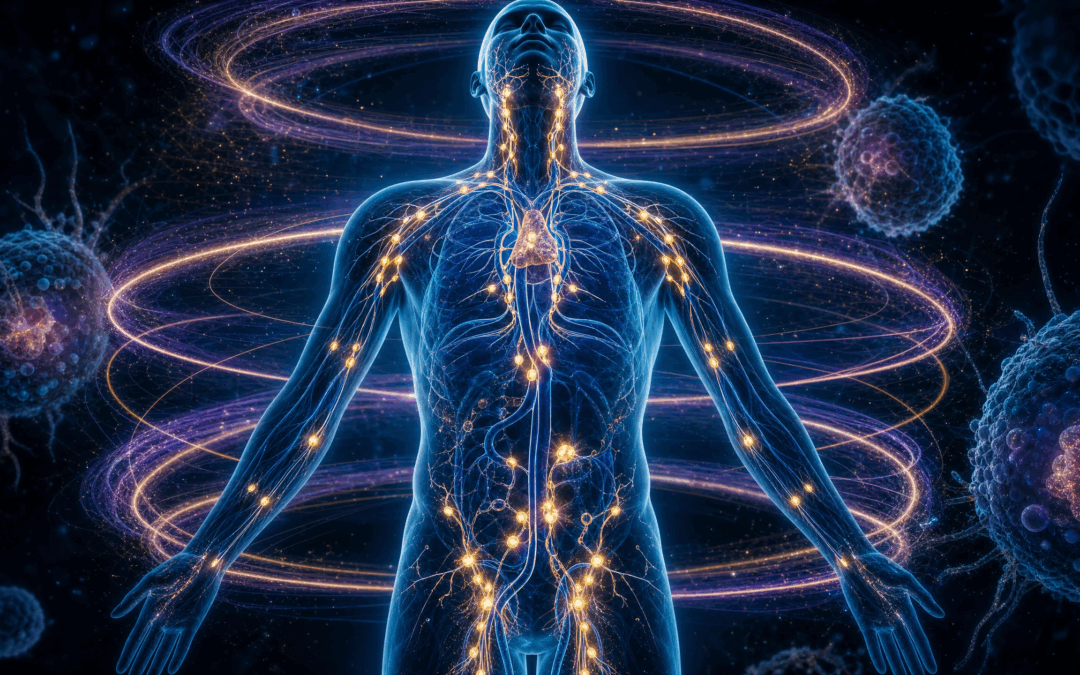
Principle 3: Vortex Field Geometry. The “Lymphatic Vortex” designation refers to the toroidal field geometry used in the program’s delivery architecture. A toroidal (donut-shaped) electromagnetic field creates a self-referential, continuously circulating energy pattern that mirrors the natural flow dynamics of the lymphatic system itself. This geometry is particularly effective for driving lymphatic flow, reducing lymph node congestion, and creating the whole-body resonance field that a systemic disease like NHL requires.
The Binders Protocol: Why Detox Is Non-Negotiable
When using advanced energetics to stimulate lymphatic flow and immune response, the body will begin to mobilize metabolic waste, cellular debris, dead malignant cells, and stored environmental toxins. This is the desired outcome — but it creates a critical secondary challenge. If these mobilized toxins are not efficiently captured and removed from the body, they will recirculate through the bloodstream and lymphatic system, causing severe fatigue, brain fog, skin reactions, and inflammatory flares. This is often mistakenly labeled a “healing crisis,” but it is more accurately described as a detox bottleneck.
Binders are substances that physically capture toxins in the gastrointestinal tract and prevent their reabsorption. The most effective binders for this purpose include activated charcoal (1–2 grams, taken 2 hours away from food and medications), zeolite clinoptilolite (particularly effective for heavy metals and pesticide residues — two of the primary environmental co-factors in NHL), bentonite clay (binds aflatoxins, pesticides, and bacterial endotoxins), and chlorella (a green algae that binds heavy metals and supports glutathione production). Without binders, you are simply moving the trash from one room of the house to another.
For deeper systemic clearance, always integrate the Glymphatic Deep 9-Phase Clearance program to ensure the brain’s waste removal system is also fully operational. Also integrate the Nitric Oxide Pathway 9-Phase Advanced Energetics program — nitric oxide is a critical vasodilator that drives lymphatic flow, and without adequate NO production, the lymphatic vessels cannot contract efficiently.
The 5-Day Intermittent Fasting Protocol: Starving the Cell
One of the most powerful adjuncts to bioelectric therapy for lymphatic malignancy is structured intermittent fasting. When the body is deprived of incoming glucose for extended periods, it activates a cellular recycling process called autophagy — from the Greek for “self-eating.” During autophagy, the body selectively targets damaged proteins, misfolded cellular structures, and senescent (zombie) cells for degradation and energy recycling.
Healthy cells adapt by switching to ketone metabolism and become more metabolically resilient. Malignant cells, however, are often metabolically inflexible — they are highly dependent on glucose (the Warburg effect, in which cancer cells preferentially ferment glucose even in the presence of oxygen) and cannot efficiently switch to ketone metabolism. A 5-day intermittent fasting protocol using a 16:8 or 18:6 eating window creates a metabolic environment that is hostile to malignant lymphocytes while simultaneously triggering the immune system’s surveillance and clearance mechanisms. Research from the Valter Longo laboratory at USC has demonstrated that fasting cycles can reduce IGF-1 signaling, lower blood glucose, and trigger a “stem cell-based regeneration” of the immune system — essentially resetting the immune repertoire.[4]
Combining the metabolic stress of fasting with the energetic signaling of the 8-Phase program creates a highly synergistic environment. The fasting state increases cellular membrane permeability and enhances the body’s sensitivity to bioelectric signals — meaning the program’s frequencies are received more effectively during a fasting window than after a large meal.
The 12-Day Lymphatic Reset Protocol: Day-by-Day Guide
The following protocol integrates the core NHL program with supporting systemic frequencies. Each day builds on the last, creating a cumulative effect that no single session can achieve. Run each session in the morning during your fasting window for maximum cellular receptivity.
- Day 1: Non-Hodgkin Lymphoma 8-Phase Lymphatic Vortex Advanced BioPhi Energetics — The core foundation. Use the iTorus coil over the primary lymph node clusters. Take binders 30 minutes before the session.
- Day 2: Cancer Lymphoma Advanced Energetics — Broad-spectrum lymphoma support. Use with Vortex 6 Mat for full-body coverage.
- Day 3: Lymphatic Drainage and Detox Advanced Energetics — Critical detox support. Take binders 30 minutes before this session.
- Day 4: Fascia Flow & Lymphatic Drainage 12-Phase Advanced Energetics — Addresses fascial restriction that impedes lymphatic flow throughout the body.
- Day 5: Autoimmune Disease 6X CAFL Advanced Energetics — Addresses the immune dysregulation component underlying NHL. Begin 5-day fasting window today.
- Day 6: Immune System Boost Advanced — NK-cell and T-cell amplification. Continue fasting window.
- Day 7: Non-Hodgkin Lymphoma 8-Phase Lymphatic Vortex — Repeat the core program. The body is now primed from the first 6 days and will respond more deeply. End fasting window today.
- Day 8: Glymphatic Deep 9-Phase Clearance — Brain and CNS detox. Run before sleep for maximum glymphatic activation.
- Day 9: Nitric Oxide Pathway 9-Phase Advanced Energetics — Vasodilation and lymphatic flow amplification. Use with Vortex 6 Mat.
- Day 10: Lymphatic Drainage and Detox Advanced Energetics — Second detox cycle to clear the accumulated cellular debris from the first week.
- Day 11: Immune System Boost Advanced — Final immune amplification before the consolidation session.
- Day 12: Non-Hodgkin Lymphoma 8-Phase Lymphatic Vortex — Final consolidation session. Rest for the remainder of the day. Repeat the full 12-day cycle after a 3-day rest period.
How to Use This Program with Hardware: Maximizing Penetration
For a systemic condition like NHL, the delivery method is as important as the program itself. The following hardware configurations are ranked by penetration depth and systemic coverage:
- iTorus Coil (Highest Penetration): The iTorus i2 or iTorus i5 generates a toroidal vortex electromagnetic field that penetrates 15–20 cm into tissue. Place directly over the primary lymph node clusters: cervical (neck), axillary (armpits), inguinal (groin), and mesenteric (abdomen). Rotate the coil position every 10 minutes to cover all major nodal regions.
- Vortex 6 Haptic PEMF Mat (Full-Body Coverage): Lying on the Vortex 6 Mat allows the frequencies to resonate through the entire lymphatic network simultaneously. This is the preferred method for the detox and immune amplification phases.
- Woojer Vest 4 (Thoracic Duct Targeting): The thoracic duct runs through the chest cavity and drains the majority of the body’s lymph into the subclavian vein. The Woojer Vest 4 (use code EPEMF10 for a discount) drives haptic and acoustic frequencies directly through the chest wall, targeting the thoracic duct and mediastinal lymph nodes.
- iMprinter Water Structuring: Use the iMprinter to imprint your drinking water with the NHL program before consumption. Hydration is critical for lymphatic flow — the lymphatic system requires adequate fluid volume to function — and structured water enhances cellular uptake of the program’s energetic signature throughout the day.
Access the Full NHL Protocol on the PEMF Healing App
The Non-Hodgkin Lymphoma 8-Phase program and all supporting protocols are available directly from your phone. Download the app and start your 12-day reset today.
Affiliate Hardware Recommendations
Vortex 6 Haptic PEMF Mat
Full-body lymphatic resonance delivery. Lie on the mat during your sessions for whole-system coverage. Shop Vortex 6 Mat →
iTorus i2 — Active PEMF Coil
Targeted toroidal field delivery for deep lymph node penetration. Shop iTorus i2 →
iTorus i5 — Advanced PEMF Coil
Enhanced toroidal field for deeper systemic penetration. Shop iTorus i5 →
Woojer Vest 4 — Haptic Wearable
Thoracic duct and mediastinal lymph node targeting. Use code EPEMF10 for a discount. Shop Woojer Vest 4 →
iMprinter — Water Structuring Plate
Imprint your drinking water with the NHL program for continuous cellular support throughout the day. Shop iMprinter →
Affiliate disclosure: Some links in this article are affiliate links. If you purchase through them, we may earn a small commission at no extra cost to you. This helps support the continued research and publication of this magazine.
References
[1] Beral et al. (2012) — Infectious agents and non-Hodgkin lymphoma. Lancet Oncology.
[2] Hartge et al. (2007) — Environmental risk factors for non-Hodgkin lymphoma. Cancer Epidemiology.
[3] Vincenzi et al. (2013) — PEMF modulates NF-κB and inflammation. PLOS ONE.
[4] Longo & Mattson (2014) — Fasting: Molecular mechanisms and clinical applications. Cell Metabolism.