
Inside every cell of your body exists one of the most important biological protectors ever discovered: p53. Scientists often call it the “guardian of the genome” because it monitors DNA damage and helps decide whether a cell should repair itself, pause division, or shut down entirely when damage becomes too severe [1] [2] [3] [4] [5] [6]. When functioning properly, p53 helps maintain genomic stability, cellular integrity, and healthy cellular signaling across the body.
What if tissue repair wasn’t a slow biological process, but an encoded resonance your body could remember and re-activate instantly? This question lies at the heart of the p53 Guardian – 7-Phase Advanced 9-Layer Harmonic Support Energetics program. Designed as a dynamic energetic architecture rather than a simple repeating frequency track, this session unfolds through seven structured phases that guide the body through progressive energetic environments, aiming to support your body’s natural p53 activity and cellular resilience.
The 7 Energetic Phases: A Journey to Genomic Integrity
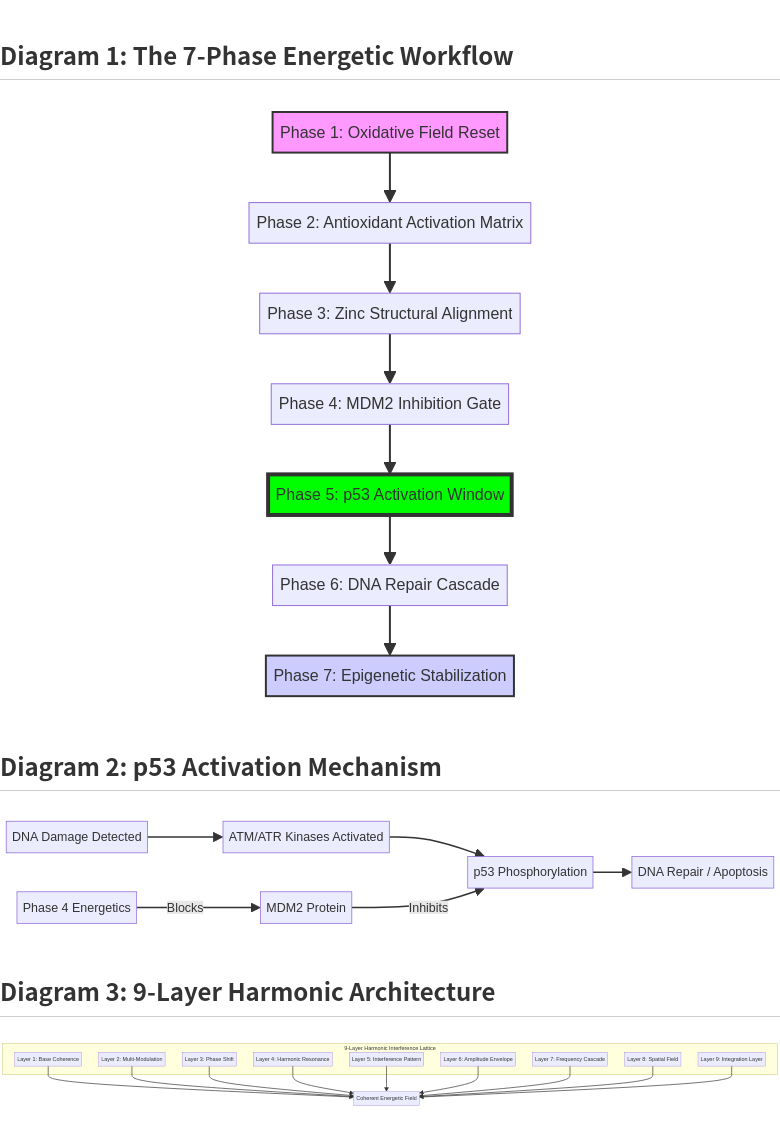
The p53 Guardian program is meticulously structured into seven distinct phases, each designed to energetically support specific biological processes crucial for optimal p53 function and overall genomic health. This multi-phase approach ensures a comprehensive and adaptive energetic environment, moving beyond static frequencies to a dynamic, evolving field that prevents cellular habituation.
Phase 1: Oxidative Field Reset
This gentle opening phase is designed to prepare the body’s energetic environment by addressing oxidative stress, a primary threat to DNA integrity [7]. Key energetic signatures inspired by substances like Glutathione and EDTA are introduced. Glutathione, often hailed as the body’s master antioxidant, plays a crucial role in protecting the delicate cysteine residues of the p53 protein from oxidation, thereby preserving its structural and functional integrity. EDTA, known for its chelating properties, energetically supports the removal of heavy metals that can disrupt the vital zinc binding sites within the p53 protein, ensuring its proper conformation for DNA interaction.
Phase 2: Antioxidant Activation Matrix
Building upon the initial reset, this phase supports energetic environments associated with cellular defense systems. It incorporates energetic patterns inspired by a powerful antioxidant quartet: Vitamin C, N-Acetyl Cysteine (NAC), Vitamin E, and Selenium. This synergistic combination aims to reduce the burden of oxidative DNA damage, thereby lessening the demand on p53 and allowing it to function more efficiently [8]. NAC, as a precursor to glutathione, boosts the body’s intrinsic antioxidant capacity, while Vitamin C and E protect against various forms of oxidative stress. Selenium supports enzymes critical for DNA repair, further bolstering the cellular defense.
Phase 3: Zinc Structural Alignment
The p53 protein is a zinc-finger protein, meaning its ability to bind to DNA and perform its protective functions is critically dependent on zinc. This phase focuses on energetic patterns that support the structural stability of p53, drawing inspiration from Zinc Sulfate and Zinc Citrate. These forms of zinc are essential cofactors, energetically guiding the proper folding and stability of p53’s DNA-binding domain. Additionally, energetic signatures associated with Melatonin are included, a regulatory antioxidant hormone known to influence p53 expression and enhance its activity as a cellular guardian.
Phase 4: MDM2 Inhibition Gate
A critical aspect of p53 regulation involves its degradation by the MDM2 protein. This phase introduces energetic architectures inspired by natural MDM2 inhibitors such as Quercetin, Curcumin, and Silymarin. MDM2 acts as the primary negative regulator of p53, tagging it for destruction. By energetically supporting the inhibition of MDM2, this phase aims to allow p53 levels to rise during cellular stress, enabling it to effectively initiate repair or apoptosis pathways [9]. Naringin, a citrus bioflavonoid, is also included for its association with ATM/ATR activation, key upstream regulators of p53.
Phase 5: p53 Activation Window
This phase is centered around the biological concept of genomic protection, focusing on the energetic activation of p53. It incorporates energetic patterns inspired by compounds like Vernolepin, Lycopene, and Crocetin. These substances have been studied for their roles in activating ATM/ATR kinases, which are crucial for detecting DNA damage and subsequently phosphorylating and activating p53 [10]. Lycopene and Crocetin, potent carotenoids, are associated with increased p53 signaling and nuclear accumulation, ensuring p53 is available where and when it’s needed most [11] [12] [13].
Phase 6: DNA Repair Cascade
Once activated, p53 orchestrates a complex cascade of DNA repair mechanisms. This phase introduces harmonic structures that support environments associated with these cellular repair pathways, drawing inspiration from Coenzyme A, ATP, and Aspartic Acid. Coenzyme A is vital for acetylation, a post-translational modification that significantly enhances p53’s activity. ATP, the cellular energy currency, is indispensable for the energy-intensive processes of DNA repair. Aspartic Acid, an amino acid, contributes to nucleotide synthesis, providing the building blocks necessary for repairing damaged DNA strands.
Phase 7: Epigenetic Stabilization & Integration
The final phase focuses on harmonic stabilization to help the system settle and integrate, with an emphasis on epigenetic health. Energetic signatures inspired by TMG (Trimethylglycine), Folinic Acid, Folic Acid, and Sodium Folate are utilized. These compounds are crucial for one-carbon metabolism, which supports DNA methylation – a key epigenetic mechanism that regulates gene expression without altering the underlying DNA sequence. Proper DNA methylation is essential for maintaining genomic stability and ensuring that repaired DNA functions correctly, providing a lasting energetic imprint for cellular resilience.
The 9-Layer Harmonic Architecture: Beyond Static Frequencies
The entire p53 Guardian program is embedded within a sophisticated 9-Layer Harmonic Interference Lattice. This advanced architecture moves beyond the limitations of simple, static frequencies, which can lead to cellular adaptation and reduced effectiveness over time. Instead, the nine harmonic layers interact through:
- Harmonic Interference Patterns: Continuously evolving fields that prevent cellular habituation.
- Progressive Modulation Envelopes: Dynamic shifts in energetic expression that keep the cellular system responsive.
- Multi-Layer Resonance Structures: Addressing different depths of the biofield simultaneously for comprehensive support.
- Phase-Based Sequencing: A carefully orchestrated progression through the seven energetic phases, optimizing the body’s response.
This innovative approach ensures that the energetic field evolves continuously, creating a much richer and more effective environment for supporting your body’s intrinsic healing and protective mechanisms. The program’s 45-minute session is precisely structured to allow each phase adequate time for integration while maintaining the momentum of the overall energetic journey.
Understanding the Spectral Architecture


The spectral analysis of the p53 Guardian program reveals a sophisticated harmonic structure. The first spectrogram displays the primary frequency bands distributed across the audible spectrum, with dominant energy concentrated in specific harmonic regions that correspond to the seven phases. The golden-orange bands represent the primary carrier frequencies and their harmonics, while the purple background indicates the supporting harmonic lattice. This distribution is intentionally designed to create a coherent field that engages multiple layers of the biofield simultaneously.
The second spectrogram demonstrates the detailed harmonic complexity within the program. The red and yellow regions show the primary frequency content and their modulation patterns, while the black zones represent intentional silence and reset points between harmonic structures. The pitch curve display (visible when zoomed) reveals the micro-FM drift and sweep patterns that create the dynamic, non-repetitive nature of the program. This level of harmonic sophistication is what distinguishes the p53 Guardian from simple single-frequency approaches, allowing it to maintain cellular responsiveness throughout the entire 45-minute session without inducing adaptation.
Who Is This For?
This program may be useful for people exploring:
- Cellular wellness and longevity practices
- Energetic detox and recovery protocols
- Antioxidant support routines
- DNA repair and genomic stability concepts
- Biofield and frequency-based wellness technologies
- Deeper stimulation with coils, haptic systems, or imprinting devices
Other Related PEMF Programs
To further support your journey towards optimal cellular health and energetic balance, explore these related PEMF programs:
- p53 Guardian – 7-Phase Advanced 9-Layer Harmonic Support Energetics
- 528Hz Sacred 5-Phase Full Spectrum Energetics
- NADH, Energy, Clarity, Vitality, Focus, Stamina, Repair, Detox, Antiaging, Cognition, Resilience, Coherence, Metabolism, Endurance, Recovery, Mood, Balance, Rejuvenation, Strength, Restoration, Calm, Harmony, Energetics
- Deep Tissue Regeneration, Recovery Tesla 3 6 9 Energetics
- Metastatic Cancer, 7 Phases, Coherence, Transmutation, Cellular Renewal, Energetics
- Cellular communication – Rejuvenation
- Overall cellular health and function
- Youthing Anti-Aging Reverse Cellular Aging
- 741Hz Detox Full Body Cell Level Solfeggio
- BPC-157 Peptide Amide A-III, 4 Modes + SC, Repair Res. Energetics
How to Use: Integrating the p53 Guardian into Your Routine
The p53 Guardian program is designed for flexible integration into your daily wellness practices, utilizing various advanced energetic devices to maximize its potential.
With iMprinter:
The program can be imprinted onto water or other substances using the iMprinter for continuous, subtle exposure throughout the day. This method allows for a gentle yet persistent energetic influence, supporting your system from within.
Links:
Archimedean Tesla Spiral Frequency iMprinter
Metatronic Flower of Life Frequency iMprinter
With iTorus i2 Coil:
Use the iTorus i2 Coil to generate a powerful, localized PEMF field for targeted cervical application or to create an ambient neuro-spinal support field in your environment. Its focused energy delivery can provide intensive support where needed most.
Link:
C60 Shungite 5G EMF Shield iTorus i2 Pocket PEMF
With Woojer Haptic Systems:
Woojer devices translate the program’s low-frequency architecture into gentle tactile vibration, allowing the cervical and upper spine region to experience rhythmic neuromuscular and circulatory support without headphones. This provides a unique, immersive energetic experience.
Links:
Best Practices & Protocols
To maximize the benefits of the p53 Guardian program, consider the following best practices and protocols:
- Daily Protocol: For consistent support, integrate the program into your daily routine. Optimal duration may vary, but 30-60 minutes daily is a common starting point. Consider using it during meditation, relaxation, or while performing light activities.
- Weekly Protocol: For deeper integration and long-term cellular resilience, consider extended sessions a few times a week, or combine with other wellness practices.
- Best Practices: Ensure you are well-hydrated before and after sessions. Use the program in a calm, quiet environment to enhance receptivity. Consistency is key for optimal results.
- What to Expect: Users may report feelings of increased vitality, improved focus, and a general sense of well-being. Individual experiences may vary, with subtle shifts often occurring over several weeks of consistent use.
- Who is this for: This program is ideal for individuals interested in proactive cellular health, anti-aging strategies, supporting DNA repair mechanisms, and enhancing overall energetic balance.
- How can this help: By energetically supporting the p53 pathway and associated cellular defense systems, this program aims to contribute to genomic stability, cellular longevity, and a more resilient biofield.
Scientific Research & Citations
The concepts underpinning the p53 Guardian program are inspired by extensive scientific research into p53 biology, DNA repair, and the role of various compounds in supporting cellular health. Below are key references that highlight the scientific basis for the substances and mechanisms energetically addressed in this program:
- Zhang, H. (2024). Unraveling the Guardian: p53’s Multifaceted Role in the DNA … PMC. https://pmc.ncbi.nlm.nih.gov/articles/PMC11641486/
- Toufektchan, E. (2018). The Guardian of the Genome Revisited: p53 Downregulates … PMC. https://pmc.ncbi.nlm.nih.gov/articles/PMC5977108/
- Abuetabh, Y. (2022). DNA damage response revisited: the p53 family and its … Nature. https://www.nature.com/articles/s12276-022-00863-4
- Savostyanova, T. (2025). The guardian of the genome meets immunotherapy: p53- … Frontiers in Immunology. https://www.frontiersin.org/journals/immunology/articles/10.3389/fimmu.2026.1762679/full
- The Conversation. (2025). p53 is both your genome’s guardian and weakness against … https://theconversation.com/p53-is-both-your-genomes-guardian-and-weakness-against-cancer-scientists-are-trying-to-repair-or-replace-it-when-it-goes-awry-248674
- Abcam. (n.d.). p53 protein: guardian of the genome. http://docs.abcam.com/pdf/cancer/p53-brochure.pdf
- Jomova, K. (2023). Reactive oxygen species, toxicity, oxidative stress, and … PMC. https://pmc.ncbi.nlm.nih.gov/articles/PMC10475008/
- Pulliero, A. (2025). Antioxidant Food Supplementation in Cancer: Lessons … MDPI. https://www.mdpi.com/2076-3921/14/10/1261
- Salehi, B. (2020). Therapeutic Potential of Quercetin: New Insights and … ACS Omega. https://pubs.acs.org/doi/10.1021/acsomega.0c01818
- Merlin, J. P. J. (2021). Role of Dietary Antioxidants in p53-Mediated Cancer … PMC. https://pmc.ncbi.nlm.nih.gov/articles/PMC8257365/
- Ray, P. (2016). Crocetin exploits p53-induced death domain (PIDD) and … Nature. https://www.nature.com/articles/srep32979
- Zhong, Y. (2011). Crocetin induces cytotoxicity and enhances vincristine … PMC. https://pmc.ncbi.nlm.nih.gov/articles/PMC4010206/
- Li, S. (2017). Synergistic anticancer effect of combined crocetin and … PMC. https://pmc.ncbi.nlm.nih.gov/articles/PMC5663096/
PEMF Healing Program Recommendations
For direct access to the p53 Guardian program, please use the link below: