
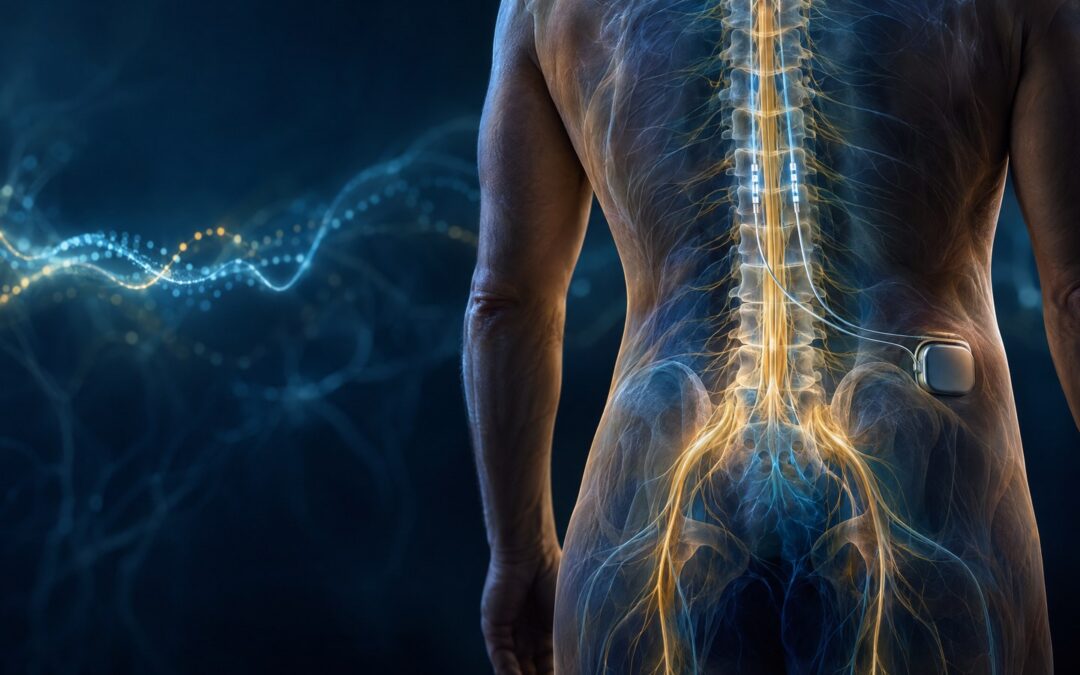
A nerve-pain treatment does not have to produce a constant buzzing sensation to produce a meaningful clinical response. That is one of the important advances behind 10,000 Hz spinal cord stimulation. In the SENZA-PDN randomized trial, an implanted electrical system added to conventional medical management helped substantially more participants with difficult-to-treat painful diabetic neuropathy reach a prespecified pain-relief endpoint than conventional management alone.[6]
Quick answer: the FDA approved specific implanted Senza systems, programmed to include 10 kHz, for chronic intractable lower-limb pain associated with diabetic neuropathy. At three months, 79% versus 5% met the trial’s composite endpoint of at least 50% pain relief without clinically meaningful worsening of baseline neurological deficits. This is a real device-specific clinical advance. It is not FDA approval of a frequency on its own, or evidence that an audio track or PEMF Healing App programme produces the same result.[1] [6]
This guide explains the approval, the engineering, the exact meaning of the headline percentages, and the encouraging two-year follow-up. It also provides questions for a specialist appointment and a separate, practical app-wellness orientation for readers who want a manageable routine without confusing home playback with an implanted medical treatment.
Why this research matters for painful diabetic neuropathy
Diabetic peripheral neuropathy can cause burning, tingling, electric-shock-like pain, numbness, and weakness in the feet and legs. Pain and reduced sensation can coexist: a person may experience persistent discomfort while also losing the protective sensation that helps reveal a blister or pressure injury. Assessment includes medical history, neurological and foot examinations, and sometimes testing for additional contributors such as vitamin B12 deficiency, thyroid disease, or kidney disease.[11]
That makes the clinical goal broader than lowering a pain score. A useful treatment should be evaluated in relation to sleep, daily activity, tolerability, and the person’s ability to manage care. Diabetes management and foot protection still matter even when pain becomes easier to live with.[11] [12]
The SENZA-PDN study addressed a particularly important group: adults whose painful diabetic neuropathy had persisted for at least a year despite gabapentin or pregabalin and at least one other analgesic class. It did not start with every person who had tingling feet. It studied selected patients with substantial lower-limb pain who were medically suitable for an invasive procedure.[6]
What the FDA approved, and when
The FDA’s July 16, 2021 supplement, P130022/S039, expanded the indication for the Senza, Senza II, and Senza Omnia neuromodulation systems. The controlling wording includes both the device family and the stimulation condition:[1]
“The Senza®, Senza II and Senza Omnia neuromodulation systems, when programmed to include a frequency of 10 kHz, are indicated as aids in the management of chronic intractable pain of the lower limbs, including unilateral or bilateral pain, associated with diabetic neuropathy.”
FDA, P130022/S039.[1]
FDA-approved is the correct regulatory term here. The approval belongs to an implanted prescription system and its labeled indication. Keeping that wording precise makes the achievement more useful, because readers can identify the actual treatment and the population for whom it was reviewed.
| Date | FDA record | What changed |
|---|---|---|
| May 8, 2015 | Original PMA P130022 | Senza approval for specified chronic intractable trunk and/or limb pain, including failed back surgery syndrome, intractable low back pain, and leg pain. This was not yet the diabetic-neuropathy-specific expansion.[21] |
| July 16, 2021 | P130022/S039 | Lower-limb pain associated with diabetic neuropathy added for the specified systems when programmed to include 10 kHz.[1] |
| September 24, 2024 | P130022/S058 | Clinical Summary manual update adding 24-month SENZA-PDN results, not a new standalone frequency indication.[3] |
| November 1, 2024 | P130022/S050 | Warning modification concerning paresthesia-free stimulation from 1.2 to 10 kHz with appropriately configured amplitude and pulse width. This does not establish painful-diabetic-neuropathy efficacy at every frequency in that range.[4] |
Regulatory records and research reviewed November 5, 2026. Clinical decisions require the current labeling for the exact system.
How an implanted 10-kHz system delivers stimulation
Spinal cord stimulation, or SCS, uses implanted electrode leads in the epidural space, connected to a pulse generator beneath the skin. The FDA safety-and-effectiveness summary describes a rechargeable generator with 16 output channels and current-regulated, charge-balanced, biphasic, capacitively coupled rectangular pulses. A clinical team selects and programs the system, with a temporary trial before a permanent implant is considered.[2]
These are electrical pulses delivered through electrodes near neural structures. They are not a 10,000 Hz sound sent through the ear. The generator, leads, electrode contacts, tissue coupling, pulse width, and current amplitude form the exposure together. Frequency tells us how often events repeat; it does not tell us how much charge reaches a particular tissue or how the field is distributed.[2] [10]
One distinctive feature is paresthesia-independent analgesia: pain relief that does not require a deliberately produced continuous tingling or buzzing sensation. This can be an important difference in how a treatment is experienced. It does not mean that the system is noninvasive or that every user will be free of all sensations and adverse effects.[2] [10]
The 79% result: a strong finding with a precise definition
Petersen and colleagues randomized 216 participants: 113 to 10-kHz SCS plus conventional medical management, and 103 to conventional medical management alone. Conventional medical management, abbreviated CMM, was ongoing clinical care. The intervention was added to that care, not substituted for it.[6]
At three months, the prespecified primary endpoint required two things: at least a 50% reduction in lower-limb pain intensity, and no clinically meaningful worsening of baseline neurological deficits. The primary analysis was described as intention-to-treat with known endpoint status. It found 75/95 responders with SCS plus CMM versus 5/94 with CMM, reported as 79% versus 5%. The reported absolute difference was 73.6 percentage points, with a 95% confidence interval from 64.2 to 83.0 and P < .001.[6]
That is a substantial treatment comparison. It is also more informative than “79% success”: the reader knows the symptom threshold, neurological condition, time point, and denominator. The result was not complete pain elimination, a cure rate, or an outcome measured in all 216 randomized participants.

Why the endpoint denominators were smaller than the randomized groups
The paper’s known-status analysis counted six temporary-stimulation trial failures and two adverse-event exits in the SCS arm as nonresponders. It also distinguished missed assessments, continuing participants, and its per-protocol population. Sensitivity analyses under different assumptions about missing outcomes did not change the conclusion. This was therefore not simply a report of only successful implants, but the headline still should not be presented as a full 216-person endpoint denominator.[6]
The registry’s screening/enrollment record and its randomized results must also be read separately: 430 candidates were screened, while 216 were randomized. A study’s largest displayed enrollment number is not automatically the denominator of its headline outcome.[6] [7]
What changed at six months
| Reported outcome | SCS plus conventional care | Conventional care alone |
|---|---|---|
| Mean lower-limb pain, 10-cm visual analogue scale | 7.6 cm at baseline to 1.7 cm | 7.0 cm at baseline to 6.9 cm |
| Neurological examination improvement without meaningful worsening | 52/84 assessed participants, 62% rounded | 3/92 assessed participants, 3% rounded |
These are six-month analysis populations, not measurements from every randomized participant. The pain values are group means, whereas the neurological values are proportions of assessed people. The neurological examinations evaluated sensory, motor, and reflex function; they were not direct measurements of axonal regrowth.[6]
Study context: this was a prospective, multicenter, randomized, open-label study without a sham implant. Participants and clinicians knew the assignments, which can affect subjective pain reports and assessment. Nevro funded the trial and participated in design, conduct support and site monitoring, analysis and interpretation, and publication preparation and review. Author financial relationships and employee disclosures were reported. Those features belong beside the favorable result, not as a reason to ignore it.[6]
Two years later: what durability looks like in the followed implant cohort
Long-term follow-up adds a practical question: does relief persist among people who proceed with implantation? At 24 months after implantation, 142 of 154 permanently implanted participants completed follow-up: 84 original SCS recipients and 58 people who crossed over from conventional management. Among those 142, 128, or 90.1%, had at least 50% pain reduction from preimplantation.[8]
Mean lower-limb pain decreased by 79.9%, with reported mean VAS changing from 7.6 to 1.5 cm. That percentage is an average pain reduction. It is not the same quantity as the 90.1% responder proportion or the three-month 79% composite endpoint.[8]
The study permitted crossover after six months. Consequently, the two-year results describe the followed implanted cohort, not a continuously randomized comparison against a separate untreated group. They support encouraging durability in those participants, with selection, attrition, and open-label follow-up still relevant.[8]
The clinically interesting findings beyond pain intensity
Neurological improvement without worsening in any assessed category was reported in 92/140 participants, or 65.7%; sensory improvement was reported in 91/140. These observations make sensory function an important research question. They do not establish that diabetes-related nerve injury was structurally reversed.[8]
A second report from the same study examined patient-reported outcomes. Brief Pain Inventory diabetic-neuropathy pain severity decreased by 66.9%, and the pain-interference composite decreased by 65.8%. The latter captures interference with mood and daily activities, including sleep as one item. It should not be relabeled “65.8% better sleep.” Satisfaction was reported by 130/142 participants, or 91.5%, as satisfied or very satisfied.[9]
These findings are valuable because living with chronic pain is not only about intensity. However, two papers from the same study are not two independent replications, and satisfaction, symptom reduction, and examination findings remain separate outcomes.
What this teaches us about bioelectric design
The strongest lesson is not that a larger number is a better frequency. It is that a defined electrical intervention, delivered through a particular device and anatomical route, can be tested against a clinically meaningful endpoint. Clinical evidence can be strong even while the full mechanism remains under investigation.[2] [10]
Mechanistic literature discusses dorsal-horn and sensory-processing modulation as possible explanations for high-frequency SCS. Other proposed pathways involving peripheral blood flow or nerve-fiber changes remain mechanistic or hypothesis-level questions. The neurological examination findings should stimulate further study, rather than be turned into a claim of proven nerve regeneration.[10] [8]
This also makes signal comparisons more mature. A fixed nominal rate is not automatically ineffective because it is repetitive. The SENZA-PDN result concerns the tested 10-kHz implant protocol. A phased or changing consumer programme may offer a different listening structure, but variation alone does not prove superior analgesia, prevention of habituation, or avoidance of cellular adaptation. Those questions require their own comparisons.[6] [10]
Four delivery routes that deserve separate evidence

| Approach | Physical route | What this research supports |
|---|---|---|
| Implanted 10-kHz SCS | Programmed electrical pulses through implanted epidural electrodes | Device-specific clinical evidence and FDA approval for the labeled lower-limb diabetic-neuropathy indication.[1] |
| Audio playback | Acoustic pressure through the hearing system.[22] | A separate exposure, not electrical stimulation through spinal electrodes. No SENZA-PDN efficacy transfer. |
| Consumer PEMF | Changing magnetic field with device-specific waveform, field intensity, and coupling | Separate device and indication evidence is required. The implant’s approval does not approve a consumer coil.[18] |
| Haptics | Mechanical vibration through body contact | A distinct sensory layer, not the implanted electrical system. |
The PEMF Healing Platform can organize programmes and compatible delivery options as a personal wellness workflow. That practical access is distinct from a surgically implanted, clinically programmed exposure. Neither a 10-kHz audio tone nor a mathematical harmonic inherits the FDA approval or the 79% trial result.
Who should discuss implanted SCS with a specialist?
For persistent painful diabetic neuropathy despite appropriate care, a discussion with a pain or neuromodulation specialist can be useful. The first step is confirmation of the diagnosis and a review of medical, foot, and vascular status, previous treatments, daily-life goals, and procedural suitability. Medication failure alone does not decide candidacy.[11] [2]
The American Academy of Neurology guideline discusses medication classes including tricyclic antidepressants, serotonin-norepinephrine reuptake inhibitors, gabapentinoids, and sodium-channel blockers. It recommends considering a different class when one is ineffective or poorly tolerated, and recommends against opioids for painful diabetic neuropathy. This is a clinician-led medication review, not an instruction to start or stop a prescription yourself.[13]
A temporary stimulation trial helps assess whether meaningful relief is obtained before a permanent implant is considered. The patient and team also need to evaluate charging, controls, support needs, infection risk, future procedures, and what happens if benefit is inadequate.[2]

FDA labeling identifies poor surgical candidacy, failure to obtain effective trial relief, and inability to operate the system as contraindications. It specifically notes insufficient safety characterization in poorly controlled diabetes with HbA1c greater than 10%. These are device-labeling and evidence boundaries, not a guarantee of safety below a threshold.[2]
Source-detail note: the published trial lists BMI greater than 45 as an exclusion, while the current registry eligibility text lists BMI at least 40. These source versions should not be silently combined into a do-it-yourself eligibility rule. A specialist must use current device labeling and clinical assessment.[6] [7]
Useful appointment questions
- Is painful diabetic neuropathy the confirmed diagnosis, and are there additional treatable contributors?
- Which care options remain appropriate, and what daily-life goals would we use to judge benefit?
- Am I medically and surgically suitable, and what would count as a successful temporary trial?
- What are my infection, revision, and device-removal risks?
- Can I manage charging and controls, and what are my exact MRI and external-device restrictions?
These questions translate the clinical literature into a decision conversation, rather than a promise of implantation or an individual result.[2] [5]
PEMF Healing App programmes: a separate wellness menu
For readers interested in the platform, the following are direct, exact catalogue links. Programme titles are labels, not clinical findings. In particular, “HF-SCS” in an app title does not make playback implanted spinal cord stimulation. These options are offered for a separate, comfortable wellness experience; they do not carry the implant’s FDA approval or trial results.
| Programme | Role in a personal workflow |
|---|---|
| Chronic 7-Phase Back Leg & Diabetic Neuropathy HF-SCS Bilateral-Phase Energetics | Primary topic-related catalogue entry for the optional orientation below. Its public page confirms the seven-phase title, not a verified full runtime or clinical SCS exposure. |
| Peripheral Nerve Restorative-Calm 7-Phase Phi-Harmonic Advanced Energetics | An alternative catalogue exploration on another occasion, rather than stacking every nerve-labeled entry. |
| Neuralgiaalso Nerve Pain | A directly linked nerve-themed catalogue option; the name is not a diagnosis. |
| Nerve Disorder Energetics | A separate catalogue choice, not an instruction to self-treat an undiagnosed nerve disorder. |
| Muscle Relaxation Energetics | Optional relaxation-themed companion for a brief preview. |
| Sleep Energetics | Optional wind-down-themed companion, used while awake rather than unattended overnight. |
| Insomnia, Falling Sleep Advanced | An alternative wind-down catalogue selection, not a substitute for assessment of persistent sleep problems. |
| 3.4Hz Delta Deep Sleep | A catalogue label for exploration, not proof of producing that EEG state. |
| Bb: Sleep Decent, Deep Rain Rest and Relaxation ASMR | Optional rain/relaxation companion. Confirm that any selected delivery mode is supported. |
| Sciatica Nerve Energetics | A separate topic entry. Sciatica and diabetic peripheral neuropathy are not interchangeable diagnoses. |
A three-day app orientation: primary first, then optional companions
This is an optional audio-only tolerability orientation, not a painful-diabetic-neuropathy treatment protocol. Use supported playback through the PEMF Healing App, at a comfortable low level, seated and awake. Do not construct a 10,000 Hz tone or turn up output to imitate the implant. Hearing risk depends on sound level and duration, not the promise attached to a frequency.[16]
The primary public page does not provide a verified full runtime. The times below are conservative editorial preview caps, not claimed treatment doses or completion of the seven phases. Use a shorter preview if needed, follow any shorter current programme or device instructions, and skip companions if the first selection is uncomfortable. A ten-minute preview does not imply completion of all seven phases.
For anyone with an implanted stimulator: obtain implant-team review of the exact electronics and accessories before use. Do not add external PEMF, magnetic, electrical, or haptic stimulation near the implant, leads, or generator without explicit compatibility review. Do not alter prescribed stimulation or medication to make a personal log look more favorable.[5] [17]
| Day | Sequence | What to record |
|---|---|---|
| Day 1 | Chronic 7-Phase Back Leg & Diabetic Neuropathy HF-SCS Bilateral-Phase Energetics: up to 10 minutes as a preview. Take a 10-minute quiet gap. Optional Muscle Relaxation Energetics: up to 5 minutes as a preview. Take another 10-minute quiet gap. Optional Bb: Sleep Decent, Deep Rain Rest and Relaxation ASMR: up to 5 minutes as a preview. | Comfort, listening tolerance, and any symptoms before and after. Stop rather than push through discomfort. |
| Day 2 | Chronic 7-Phase Back Leg & Diabetic Neuropathy HF-SCS Bilateral-Phase Energetics: up to 10 minutes as a preview. Take a 10-minute quiet gap. Optional Sleep Energetics: up to 5 minutes as a preview. Take another 10-minute quiet gap. Optional Bb: Sleep Decent, Deep Rain Rest and Relaxation ASMR: up to 5 minutes as a preview. | Keep time of day and listening setup similar. Note sleep and daily activity without attributing every change to playback. |
| Day 3 | Chronic 7-Phase Back Leg & Diabetic Neuropathy HF-SCS Bilateral-Phase Energetics: up to 10 minutes as a preview. Take a 10-minute quiet gap. Optional Muscle Relaxation Energetics: up to 5 minutes as a preview. Take another 10-minute quiet gap. Optional Sleep Energetics: up to 5 minutes as a preview. | Review whether the routine is manageable. A three-day log is a personal observation, not evidence of nerve repair or a clinical responder classification. |
After Day 3, pause and review rather than automatically escalating duration or stacking more programmes. A log can help describe symptoms and tolerability at an appointment. The VA’s Pain Coach illustrates how daily check-ins, journaling, and symptom tracking can supplement care; tracking itself does not prove that an app treats neuropathy.[20]
Product resources and compatibility come before combination
Affiliate disclosure: some links below are affiliate links; PEMF Magazine may receive a commission. These are separate consumer-wellness resources, not components of the FDA-approved implanted treatment. No purchase is required to understand the clinical research.
| Resource | Practical role and precaution |
|---|---|
| Frequency Healing App | Platform access and supported programme playback. The short orientation above is audio-only. |
| iTorus i2 | Consumer PEMF resource, not implanted SCS. Follow the manufacturer’s supported connection, output, and placement instructions. Do not place it over an implant or use it to reproduce spinal-electrode exposure. |
| iTorus i5 | Another consumer option requiring its own instructions and compatibility assessment. No higher-output or nerve-targeting placement is prescribed here. |
| Woojer Vest 4, use code EPEMF10 | A separate mechanical haptic layer. Do not assume it reproduces 10-kHz electrical stimulation or add it near implanted hardware without implant-team review. |
| Metatronic Flower of Life Dual Frequency Imprinter | Optional ritual equipment only. Imprinting is not demonstrated treatment for neuropathy and does not transfer SCS effects into water or another material. |
A combined audio, haptic, and PEMF setup is a multi-modality experience, not automatically a stronger medical intervention. For this article’s population, compatibility and clinical care take priority over adding layers. Implant labeling warns that strong electromagnetic interference may cause heating, tissue injury, system damage, operational changes, or unexpected stimulation; those warnings require exact-device review rather than a generic separation-distance promise.[5] [17]
Best practices: protect feet, hearing, and the implant
Maintain the foundations of care. Continue clinician-guided diabetes management and check feet daily. Wear protective footwear, inspect shoes for objects or rough spots, avoid walking barefoot, and avoid heat sources that reduced sensation may prevent you from recognizing. Reduced pain is not a reason to stop foot checks.[11] [12]
Keep listening comfortable. Use low volume, take breaks, and stop for tinnitus, hearing change, dizziness, worsening pain, or other concerning symptoms. A device-volume percentage is not a calibrated acoustic dose. If using a breathing pause, allow gentle, comfortable breathing without forcing depth or holding the breath.[16] [19]
Know the exact implant restrictions. Senza systems have model- and configuration-specific MR Conditional labeling. That does not mean unrestricted MRI safety. The implant team and imaging facility must verify the complete system and current MRI conditions; the cited labeling prohibits MRI during temporary trial stimulation. Tell every treating clinician about implanted hardware before procedures.[5]
Keep an imprinter practice separate. If used as a personal ritual, follow its instructions, keep equipment dry, and keep liquids away from powered components. Do not add unprescribed substances, replace medicine, or treat prepared water as an electrical or nutritional dose. Normal hydration can remain part of daily life, within any clinician-prescribed fluid restrictions.
What risks should be weighed against the benefit?
Implantation carries procedural and device risks. These include infection, bleeding and spinal complications, lead movement, hardware problems, implant-site pain, revision surgery, and device removal. The clinical conversation should address personal medical risk, not only the trial’s favorable average response.[2] [5]
In the initial trial report, 2/90 permanently implanted participants required removal because of infection. Over the longer follow-up, among 154 permanently implanted participants, eight had procedure-related infection and five required infection-related explantation, reported as 5.2% and 3.2% respectively. The earlier two must not be added to the later five as though they were separate cohorts. These infection figures are not the total complication rate.[6] [8]
Prompt medical review: contact a clinician for a new foot wound, redness, warmth, or a lesion that is not healing. Severe infection, gangrene, or signs of poor blood supply need urgent assessment. With back or leg symptoms, sudden or worsening weakness, saddle-area numbness, or new bladder or bowel problems require emergency evaluation rather than an app session or a routine implant appointment.[12] [14] [15]
The useful conclusion
10-kHz spinal cord stimulation shows what bioelectric medicine can achieve when the device, exposure, patient selection, and outcome are defined carefully. SENZA-PDN provides a substantial short-term randomized treatment comparison and encouraging long-term observations among implanted participants. For a person living with refractory painful diabetic neuropathy, that can make an informed specialist discussion worthwhile.[6] [8]
The complementary home-wellness opportunity is different: build a comfortable routine, use exact programme links, respect compatibility, and keep a useful personal log. The clinical evidence becomes more powerful, not less, when it is attached to the treatment that actually produced it.
Educational and wellness disclaimer: this article provides education, not individualized medical advice, diagnosis, or treatment. It does not establish that any app programme or consumer device will produce a particular result. Do not delay or replace licensed medical care. Discuss symptoms, implanted devices, pregnancy, medication questions, and device compatibility with qualified clinicians, and follow current manufacturer instructions.
Related Articles
- Peripheral Nerve Pain and Diabetic Neuropathy: Evidence Guide
- Spinal Fusion Bone Stimulators: FDA Status, Evidence and Safety
- The 20-Minute iTorus Muscle Test: Personal Active-versus-Sham Observation
References
- FDA. (2021). P130022/S039: Senza, Senza II, and Senza Omnia indication expansion. Direct FDA record.
- FDA. (2021). Summary of Safety and Effectiveness Data, P130022/S039. Direct FDA source.
- FDA. (2024). P130022/S058: Clinical Summary manual update. Direct FDA record.
- FDA. (2024). P130022/S050: Paresthesia-free stimulation warning modification. Direct FDA record.
- FDA. (2021). Senza system labeling, P130022/S039. Direct labeling source.
- Petersen EA et al. (2021). Effect of High-frequency (10-kHz) Spinal Cord Stimulation in Patients With Painful Diabetic Neuropathy: A Randomized Clinical Trial. JAMA Neurology. Direct full text.
- ClinicalTrials.gov. NCT03228420: SENZA-PDN study record and results. Direct registry.
- Petersen EA et al. (2023). Long-term efficacy of high-frequency (10 kHz) spinal cord stimulation for the treatment of painful diabetic neuropathy: 24-month results of a randomized controlled trial. Diabetes Research and Clinical Practice. Direct full text.
- Petersen EA et al. (2024, online publication). High-Frequency 10-kHz Spinal Cord Stimulation Provides Long-term (24-Month) Improvements in Diabetes-Related Pain and Quality of Life for Patients with Painful Diabetic Neuropathy. Journal of Diabetes Science and Technology. Direct full text.
- Strand NH et al. (2021, online publication). Neuromodulation in the Treatment of Painful Diabetic Neuropathy: A Review of Evidence for Spinal Cord Stimulation. Journal of Diabetes Science and Technology. Direct review.
- NIDDK. Peripheral Neuropathy. Direct guidance.
- NIDDK. Diabetes and Foot Problems. Direct guidance.
- American Academy of Neurology. (2021 guideline update). Oral and Topical Treatment of Painful Diabetic Polyneuropathy. Direct guideline record.
- IWGDF/IDSA. (2023). Guidelines on the diagnosis and treatment of diabetes-related foot infections. Direct guideline.
- Wiseman D; American Association of Neurological Surgeons. (2024). Cauda Equina Syndrome. Direct emergency guidance.
- World Health Organization. Deafness and hearing loss: Safe listening. Direct hearing-safety guidance.
- Nevro. Senza Spinal Cord Stimulator Patient Manual. Archived manufacturer manual; consult current exact-model instructions for use. Direct manual.
- NCCIH. Magnets for Pain: What You Need To Know. Direct NIH guidance.
- NHS. Breathing exercises for stress. Direct guidance.
- U.S. Department of Veterans Affairs. Pain Coach. Self-management app description, not evidence for this article’s programme routine. Direct app information.
- FDA. (2015). Original Senza PMA P130022. Direct FDA approval record.
- National Research Council; Dobie RA and Van Hemel S, editors. (2004). Basics of Sound, the Ear, and Hearing. In Hearing Loss: Determining Eligibility for Social Security Benefits. National Academies Press. Direct chapter.