
For centuries, dental science has accepted a biological absolute: humans grow two sets of teeth, and when the adult teeth are gone, they are gone forever. The only solutions have been titanium implants, dentures, or bridges.
But the textbook was incomplete.
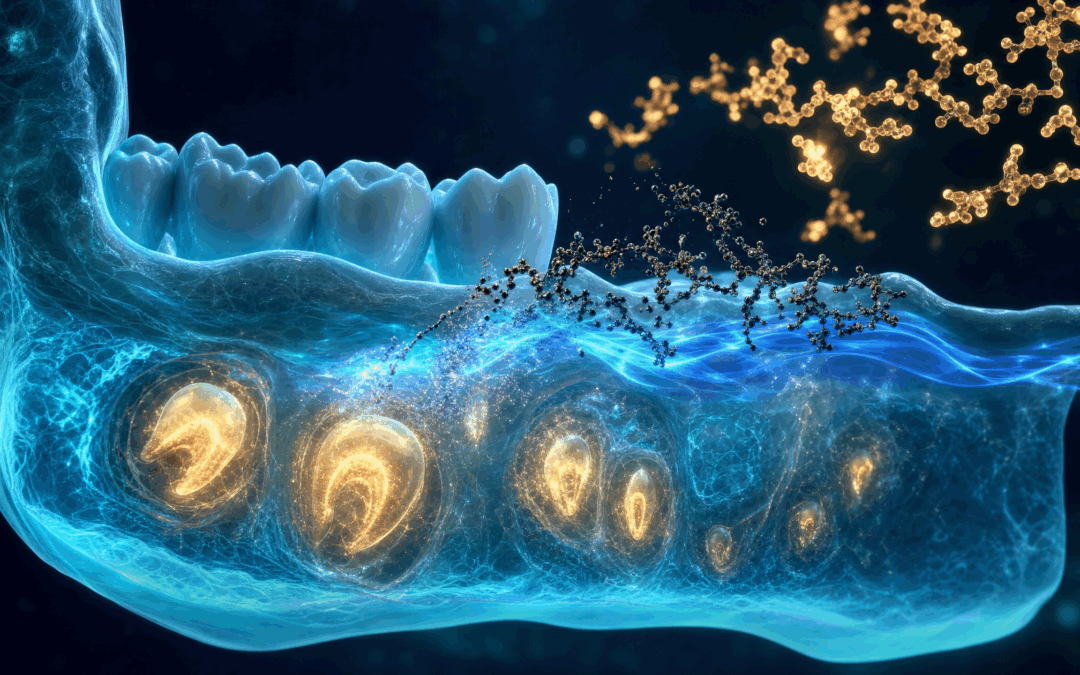
A third set of tooth buds exists in the human jaw. They are encoded in our DNA from early development, but they sit dormant beneath the adult dentition for our entire lives. The reason they do not grow is not because they are broken. It is because they are actively suppressed by a single protein called USAG-1 (Uterine Sensitization-Associated Gene 1) [1].
In 2021, a breakthrough study from Kyoto University proved that neutralizing this protein allows these dormant buds to awaken and grow into complete, functional teeth [2]. As of September 2024, human clinical trials for a USAG-1 blocking drug (TRG-035) have officially begun in Japan [3].
But while the pharmaceutical world races toward a 2030 release date, bioelectric science has developed a parallel pathway: The USAG-1 Tooth Regrowth 7-Phase Mandibular Biophi Vortex-Drive Phi-Harmonic Energetics protocol. This is not a chemical drug. It is a 63-minute bio-resonant architecture designed to mirror the exact biological cascade of USAG-1 suppression and BMP (Bone Morphogenetic Protein) activation.
The Science of USAG-1: Taking the Brakes Off
USAG-1 is a dual antagonist. Its primary job in the body is to bind to BMP and Wnt signaling proteins, stopping them from doing their jobs [4]. BMP (Bone Morphogenetic Protein) is the master builder of the skeletal system. It drives bone formation and tooth development. When USAG-1 binds to BMP, it acts as a chemical brake, preventing the formation of extra teeth.
In mice genetically engineered to lack the USAG-1 gene, the animals grow extra teeth, extra whiskers, and have higher bone density [5]. The Kyoto University team developed a monoclonal antibody that specifically blocks USAG-1 from binding to BMP. When injected into ferrets (which, like humans, grow two sets of teeth), the animals successfully grew a third set of fully integrated teeth.
Inside the Protocol: What the Spectral Analysis Reveals
The ePEMF protocol does not use physical antibodies. Instead, it utilizes the precise resonant frequencies of the biological substances involved in the tooth growth cascade (such as Proline, Silica, Calcium, and Vitamins K and D). The image below is a visual fingerprint of this frequency architecture.

What you are seeing: This view maps the protocol’s low-frequency carrier architecture. On the far left, Phase 1 establishes the parasympathetic field. The sudden drop in frequency marks Phase 2 (Lock Disengage), where methylation and sulfur clearance frequencies target the USAG-1 suppression mechanism. The thick, sustained blocks in the middle represent Phase 5 (Matrix Construction), where calcium and phosphorus resonance frequencies assemble the hydroxyapatite matrix. The final high-frequency bands on the right are the Vitamin D sealing chords.
The End of the Rife Era: Why Static Frequencies Fail
For decades, frequency therapy has relied on Rife machines—devices that play a single, static frequency continuously. While revolutionary in the 1930s, modern neuroscience reveals a fatal flaw in this approach: Cellular Adaptation.
The human nervous system is an adaptive survival machine. If you expose it to a static, unchanging stimulus, the cells quickly categorize it as “background noise” and tune it out. Within 3 to 5 minutes of exposure to a static Rife frequency, cellular receptors downregulate. The “door” closes. The therapy stops working.
Tooth regrowth requires complex, multi-stage signaling involving BMP, Wnt, fibroblasts, and calcium matrix assembly. A single static frequency cannot trigger a sequential biological cascade.
The Vortex-Drive Solution: The USAG-1 protocol uses an advanced Anti-Habituation architecture. It utilizes a slow 0.1 Hz stereo rotation between the left and right channels, creating a continuously shifting field vector. Frequencies drift slightly, amplitudes breathe with a 6-second respiratory rhythm, and Fibonacci-spaced counter-pulses prevent the cells from ever locking into adaptation. The cellular doors stay open for the entire 63-minute session.
The 7-Phase Mandibular Architecture

- Phase 1: Arrival (0-7 min). Parasympathetic engagement. Vitamin K7 and Sodium Phosphate frequencies prepare the tissue.
- Phase 2: Lock Disengage (7-12 min). The database correlate of USAG-1 inhibition. TMG, MSM, and Sulfur frequencies facilitate clearance.
- Phase 3: Signal Restoration (12-25 min). Correlates to BMP/Wnt signaling restoration. Asiaticoside and Proline frequencies stimulate fibroblast proliferation.
- Phase 4: Bud Activation (25-33 min). The Vitamin K carboxylation cluster (K1, K2, K4, K7) activates the dormant bud tissue.
- Phase 5: Matrix Construction (33-46 min). The architectural pivot. A sequence of Calcium Sulphate, Carbonate, and Phosphate frequencies mirror the biological assembly of the hydroxyapatite mineral matrix.
- Phase 6: Integration (46-54 min). Vitamin A and Quercetin frequencies support new tissue integration with surrounding gum and epithelium.
- Phase 7: Sealing (54-63 min). Long-term mineral maintenance. A precise Vitamin D cluster (D1, D3, Calcitriol) tuned to the musical note D seals the matrix.

The 30-Day Mandibular Recovery Protocol
To maximize the efficacy of this protocol, consistency and proper sequencing are required. Follow this day-by-day integration:
- Days 1-7 (The Activation Phase): Run the USAG-1 Tooth Regrowth protocol daily. Placement: Use two iTorus coils placed bilaterally on the jaw/cheeks.
- Days 8-14 (The Matrix Phase): Alternate daily between the USAG-1 protocol and the Dental Stem Cell Activation program to support deep pulp vitality.
- Days 15-21 (The Support Phase): Run the USAG-1 protocol 3 times a week. On off days, run the Bone Growth & Regeneration program to support the alveolar bone structure.
- Days 22-30 (The Integration Phase): Reduce USAG-1 to 2 times a week. Introduce the Gum Regrowth & Oral Health program to ensure the surrounding gingival tissue can support new growth.
What It Works On (And What It Doesn’t)
What it works on: This protocol is designed to provide the resonant energetic environment that mirrors the USAG-1 inhibition cascade. It supports the biological signaling pathways required for deep alveolar bone repair, periodontal ligament strengthening, and the theoretical awakening of dormant tertiary tooth buds.
What it does NOT work on: This is not a pharmaceutical drug. It will not magically sprout a tooth overnight. If you have an active, raging bacterial tooth infection or abscess, you need a dentist and antibiotics, not just frequencies. This protocol supports the body’s regenerative capacity; it does not replace emergency dental surgery.
Program Recommendations for Dental Regeneration
- USAG-1 Tooth Regrowth 7-Phase Mandibular Biophi Vortex-Drive Phi-Harmonic Energetics (The Primary Protocol)
- Dental Stem Cell Activation, 5 Phase Binaural Isochronic Energetics
- Gum Regrowth & Oral Health
- Tooth Regrowth (Electroherbalism 16X)
- Cavity and Tooth Decay 9X CAFL Advanced Energetics
- Tooth Abscess Recovery System 6 Phase Deep Resonance Energetics
- Bone Growth & Regeneration
- Collagen Building
- Cellular Communication – Rejuvenation
- Cushing’s Syndrome & Cortisol 5-Phase Detox (Crucial for clearing stress hormones that inhibit bone repair)
Best Practices for Dental Regeneration
- Imprinter Usage: Use the iMprinter Tesla Spiral to structure your drinking water with the Bone Growth & Regeneration program. Drink this structured water 30 minutes before your PEMF session to hydrate the cellular matrix with osteogenic frequencies.
- Coil Placement Precision: For maximum mandibular resonance, place two iTorus coils bilaterally directly on the jawline (cheeks). This ensures the rotating toroidal field passes directly through the dormant tooth buds.
- Binaural Integration: This protocol relies on precise stereo phase-offsets to drive field rotation. Using high-quality over-ear headphones simultaneously with the coils will significantly deepen the entrainment effect.
- Haptic Grounding: Place a haptic transducer (like the Woojer Vest) on the upper chest or neck to deliver the structural, mechanical layer of the frequency directly to the skeletal system.
References
[1] Kassai Y, et al. Regulation of mammalian tooth cusp patterning by ectodin. Science. 2005. Link
[2] Murashima-Suginami A, et al. Anti-USAG-1 therapy for tooth regeneration through enhanced BMP signaling. Science Advances. 2021;7(7):eabf1798. Link
[3] Toregem BioPharma. Orphan drug designation announcement. September 29, 2025. Link
[4] Ahn Y, et al. Inhibition of Wnt signaling by Wise (Sostdc1) and negative feedback from Shh controls tooth number and patterning. Development. 2010;137(19):3221-3231. Link
[5] Yanagita M, et al. USAG-1: a bone morphogenetic protein antagonist abundantly expressed in the kidney. Biochem Biophys Res Commun. 2004;316:490. Link
Related Articles
Dental Stem Cell Activation: The 5-Phase Binaural Protocol
Bone Growth & Regeneration: The Osteogenic Frequencies