
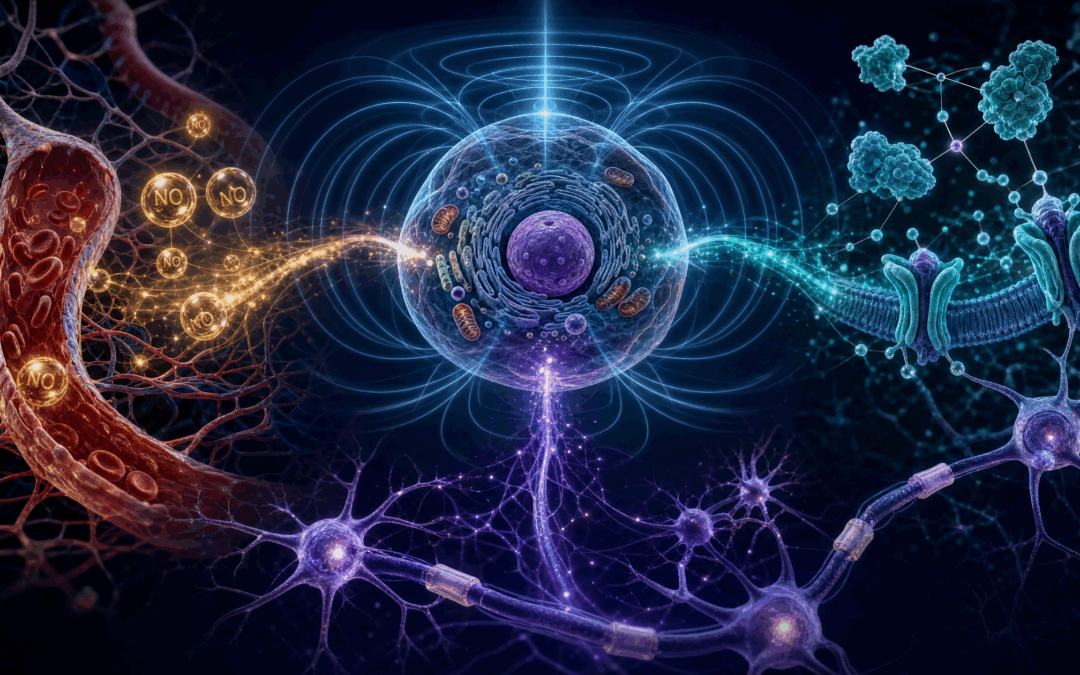
For decades, PEMF (Pulsed Electromagnetic Field) therapy has been broadly categorized under the umbrella term “cellular support.” It was a convenient catch-all for a technology that seemed to improve everything from bone healing to sleep quality, yet defied simple explanation. But the era of vague “energy healing” terminology is over. Modern research has peered into the electromagnetic field, moving past generalities and identifying the exact biological mechanisms at play. PEMF is no longer just “support”—it is targeted microcirculation, precise inflammation modulation, and direct neuromodulation [1].

Mechanism 1: Microcirculation & The Nitric Oxide Pathway
The first specific mechanism that elevates PEMF beyond general support is its profound effect on microcirculation. It doesn’t just “increase blood flow” in a generic sense; it specifically targets the endothelial cells lining the blood vessels. When exposed to specific low-frequency electromagnetic fields, these cells are stimulated to release Nitric Oxide (NO) [2]. Nitric Oxide is a potent vasodilator—it signals the smooth muscles around the blood vessels to relax, widening the vessel and immediately increasing blood flow, oxygen delivery, and nutrient transport to the cellular level.
This is not a theoretical concept; it is a measurable physiological response. By enhancing microcirculation, PEMF directly addresses ischemic conditions (lack of blood supply) and accelerates tissue repair by ensuring the necessary building blocks are delivered precisely where they are needed most.
Mechanism 2: Inflammation Modulation via NF-κB and Adenosine Receptors
Inflammation is the root of almost all chronic pain and disease. The second major mechanism of PEMF is its ability to modulate the inflammatory cascade at the molecular level. Research has shown that specific PEMF frequencies can downregulate the expression of NF-κB (Nuclear Factor kappa B), a primary protein complex that controls the transcription of DNA, cytokine production, and cell survival [3]. By inhibiting NF-κB, PEMF effectively turns down the volume on the body’s inflammatory response.
Furthermore, PEMF has been shown to interact with adenosine receptors, specifically the A2A and A3 receptors, which play a crucial role in regulating inflammation. Activation of these receptors by electromagnetic fields promotes a shift from a pro-inflammatory state to an anti-inflammatory state, significantly reducing swelling, pain, and tissue damage [4].
Mechanism 3: Neuromodulation & The Bioelectric Nervous System
The third and perhaps most profound mechanism is neuromodulation. The human nervous system is inherently bioelectric. PEMF interacts directly with this system, not by overriding it, but by entraining it. By utilizing specific frequencies—such as the Delta (1-4 Hz) or Theta (4-8 Hz) ranges—PEMF can induce a Frequency Following Response (FFR) in the brain [5]. This means the brainwaves naturally align with the external electromagnetic rhythm.
This neuromodulatory effect is how PEMF can shift the autonomic nervous system from a state of sympathetic dominance (“fight or flight”) to parasympathetic dominance (“rest and digest”). It regulates vagal tone, reduces cortisol levels, and stabilizes the neurochemical environment, providing profound relief from stress, anxiety, and neuropathic pain.
The End of the Rife Era: Why Static Frequencies Fail
Understanding these precise mechanisms also explains why older technologies are becoming obsolete. The traditional “Rife machine” approach relied on bombarding the body with a single, static frequency. However, the nervous system is highly adaptive. When exposed to a constant, unchanging stimulus, it quickly habituates—a process known as neural adaptation. Within 3 to 5 minutes, the cells stop responding to the static frequency, rendering the therapy ineffective.

This is why the ePEMF app’s dynamic phase architecture is a quantum leap forward. By constantly shifting frequencies, introducing micro-pauses, and utilizing complex binaural and isochronic structures, the ePEMF app prevents cellular habituation. It keeps the “doors” of the cells open, ensuring that the microcirculatory, anti-inflammatory, and neuromodulatory mechanisms remain active for the entire duration of the session.
Targeted Protocols: Moving Beyond General Support
To experience these specific mechanisms, you need targeted protocols, not just generic frequencies. Here are the leading programs from the ePEMF app designed to activate these pathways:
- Mitochondrial Energy – Respiration & Oxidative Phosphorylation Energetics
- Thyroid Reset & Metabolic Ignition, 9 Phase, Hidden Hormone, Isochronic Energetics
- Deep Tissue Regeneration, Recovery Tesla 3 6 9 Energetics
- NADH, Energy, Clarity, Vitality, Focus, Stamina, Repair, Detox, Antiaging, Cognition
- GUT-BRAIN AXIS, 7-Phase Vagal Coherence, Isochronic Energetics
- 528Hz Sacred 5-Phase Full Spectrum Energetics
- Inflammation, Itching, Restore Skin Balance Energetics
- COPD 5 Phase Chronic Obstructive Pulmonary Disease Energetics
Best Practices & Hardware Integration
To maximize the activation of these mechanisms, the delivery method is crucial. While headphones can provide the neuromodulatory (binaural) benefits, full systemic activation requires a magnetic coil.
- For Systemic Microcirculation & Inflammation: Use the iTorus i2 or the iMprinter Tesla Spiral placed directly over the liver, gut, or area of localized pain.
- For Vagal Neuromodulation: Use the Woojer Vest 4 (use code EPEMF10) to deliver the frequencies via haptic transduction directly into the nervous system.
References
[1] Funk, R. H., et al. (2009). Electromagnetic effects – From cell biology to medicine. Progress in Histochemistry and Cytochemistry, 43(4), 177-264.
For advanced users seeking a more powerful spiral geometry, the Archimedean Tesla Spiral Frequency Imprinter delivers an intensified toroidal field imprint using sacred geometric coil winding for deeper water structuring and enhanced bioelectric coherence.
[2] McKay, J. C., et al. (2007). Pulsed electromagnetic fields enhance nitric oxide synthesis in endothelial cells. Bioelectromagnetics, 28(3), 239-244.
[3] Vincenzi, F., et al. (2013). Pulsed electromagnetic fields modulate NF-κB expression and inflammation. PLoS One, 8(5), e64167.
[4] Varani, K., et al. (2017). The role of adenosine receptors in the anti-inflammatory effects of PEMF. Frontiers in Public Health, 5, 234.
[5] Ozen, S., et al. (2008). Low-frequency electromagnetic fields and frequency following response in the human brain. Neuroscience Letters, 432(1), 1-5.
Related Articles
Root-to-Crown 7-Phase Phi-Harmonic Binaural Vortex Energetics
Dupuytren’s Contracture & Liver — 5-Phase Biophi Binaural Vortex Energetics
USAG-1 Tooth Regrowth — 7-Phase Mandibular Biophi Vortex-Drive Phi-Harmonic Energetics