
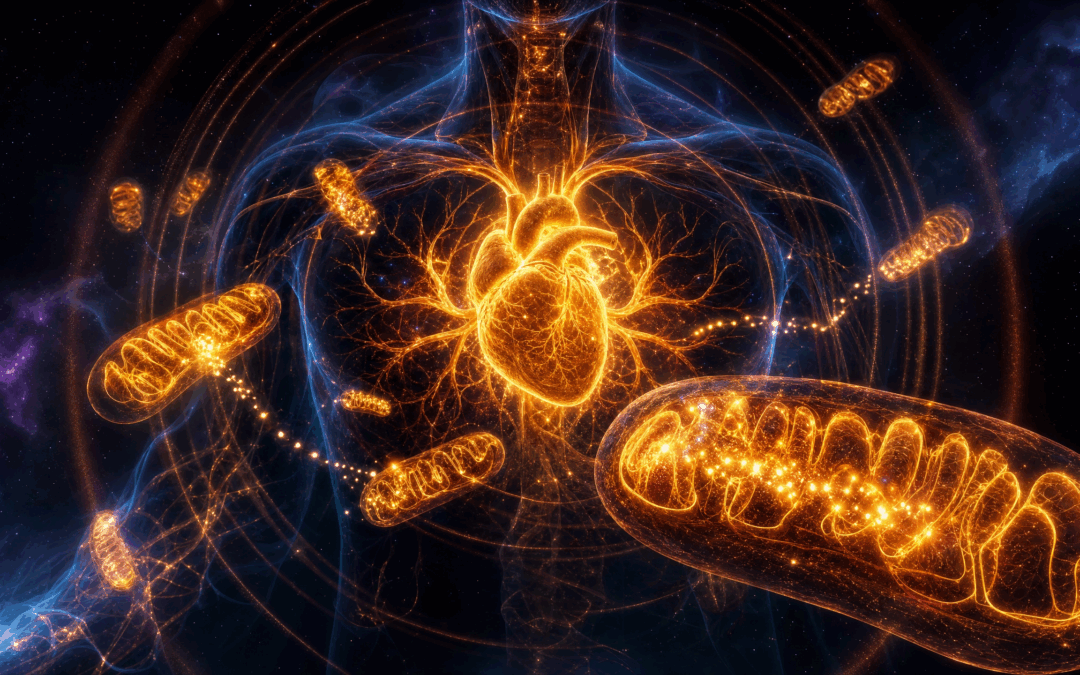
Disclaimer: This article is for educational purposes only and does not constitute medical advice. PEMF and bioelectric technologies are supportive tools and are not a replacement for conventional medical treatment. Always consult a qualified healthcare professional before making changes to your health protocol.
Every single day, the human heart beats approximately 100,000 times. It does not rest. It does not pause. To sustain this relentless mechanical workload, the heart requires a massive, continuous supply of ATP — the universal energy currency of the cell. The brain, which accounts for just 2% of body weight, consumes 20% of the body’s total energy. The kidneys filter 180 litres of blood every 24 hours. These organs do not run on willpower. They run on mitochondria. And at the very centre of mitochondrial energy production sits a molecule that most people have never heard of: Coenzyme Q10.
CoQ10 depletion is one of the most widespread and underdiagnosed contributors to chronic fatigue, cardiac dysfunction, and accelerated biological aging. It is not a fringe wellness concept. It is a Nobel Prize-adjacent biochemistry that sits at the intersection of the electron transport chain, lipid-soluble antioxidant defence, and heart muscle contractility. And yet, the vast majority of people walking around with low energy, poor heart rate variability, and brain fog have never had their CoQ10 status assessed.
This article will take you deep into the science of CoQ10 — what it is, what it does, why levels fall, and why the CoQ10 9-Phase Mitochondrial Engine, Cellular Energy & Heart Coherence Advanced program represents a fundamentally different approach to supporting the felt experience of cellular vitality.
Reading the Signal: What the Spectral Analysis Reveals
The spectral image below is taken directly from the audio analysis of the CoQ10 9-Phase Mitochondrial Engine program. Before we go into the science, it is worth understanding what you are looking at — because this image tells the story of why this program is categorically different from any static frequency device on the market.

What Is CoQ10? The Biochemistry of Cellular Power
Coenzyme Q10 (ubiquinone) is a lipid-soluble quinone molecule found in the inner mitochondrial membrane of virtually every cell in the human body. It was first isolated in 1957 by Frederick Crane at the University of Wisconsin, and its critical role in cellular respiration was elucidated by Peter Mitchell, whose chemiosmotic theory earned him the Nobel Prize in Chemistry in 1978. CoQ10 is not a vitamin in the classical sense — the body can synthesise it endogenously via the mevalonate pathway — but its production declines significantly with age, and it can be depleted by a wide range of pharmaceutical agents and metabolic stressors.[1]
The molecule exists in two primary redox states: ubiquinone (the oxidised, electron-accepting form) and ubiquinol (the reduced, electron-donating form). This reversible interconversion is the basis of its two critical biological roles.
Role 1: The Electron Shuttle of the Mitochondrial Transport Chain
The mitochondrial electron transport chain (ETC) is the final stage of cellular respiration. It is a series of four protein complexes embedded in the inner mitochondrial membrane that extract energy from the electrons carried by NADH and FADH₂ (produced during glycolysis and the Krebs cycle) and use that energy to pump protons across the membrane, creating an electrochemical gradient. This gradient is then harnessed by ATP Synthase (Complex V) to drive the synthesis of ATP from ADP and inorganic phosphate.
CoQ10 is the mobile electron carrier that shuttles electrons from Complex I (NADH dehydrogenase) and Complex II (succinate dehydrogenase) to Complex III (cytochrome bc1 complex). Without CoQ10, this electron relay breaks down. Electrons back up. The proton gradient collapses. ATP synthesis halts. The cell begins to starve of energy regardless of how much glucose or oxygen is available. This is not a theoretical scenario — it is the biochemical reality for anyone with significantly depleted CoQ10 levels.[1]

Role 2: The Lipid-Soluble Antioxidant
In its reduced form (ubiquinol), CoQ10 is one of the most potent lipid-soluble antioxidants in the human body. The inner mitochondrial membrane is particularly vulnerable to oxidative damage because it is the site of intense electron transfer — a process that inevitably generates reactive oxygen species (ROS) as a by-product. Ubiquinol intercepts these free radicals before they can attack the polyunsaturated fatty acids of the membrane, preventing lipid peroxidation and preserving the structural integrity of the mitochondrion itself. It also regenerates other antioxidants, including vitamin E (alpha-tocopherol), extending the antioxidant defence network throughout the cell membrane system.[1]
Why CoQ10 Levels Fall: Statins, Aging, and Metabolic Stress
CoQ10 is synthesised via the mevalonate pathway — the same biochemical route used to produce cholesterol. This is the critical detail that most patients on statin medications are never told. Statins work by blocking HMG-CoA reductase, the rate-limiting enzyme of the mevalonate pathway. This effectively reduces cholesterol synthesis — but it also reduces CoQ10 synthesis as a direct collateral consequence. Every patient on a statin is, by the mechanism of the drug itself, producing less CoQ10.[2]
The clinical implications of this are significant. Statin-associated myopathy — the muscle pain, weakness, and fatigue that affects 5 to 10% of statin users — is the most commonly cited consequence of CoQ10 depletion. The evidence for CoQ10 supplementation in this context is genuinely mixed: some meta-analyses report meaningful reductions in muscle pain scores, while others find no significant benefit. But the depletion mechanism itself is not in dispute — it is a direct pharmacological consequence of the drug’s mechanism of action.[3]
Beyond statins, CoQ10 levels decline with age in a pattern that closely mirrors the trajectory of cardiovascular disease risk. Plasma CoQ10 concentrations peak in the second decade of life and decline progressively thereafter. By the age of 80, cardiac tissue CoQ10 levels may be 50% lower than in young adults. This is not incidental — the heart is the most metabolically active organ in the body, and it is the organ most sensitive to CoQ10 depletion. The correlation between low CoQ10 and heart failure severity has been documented in multiple studies, with the landmark Q-SYMBIO trial (420 patients, 300 mg/day over two years) reporting significantly fewer major adverse cardiovascular events and lower cardiovascular mortality in the CoQ10-supplemented group compared to placebo, on top of standard heart failure therapy.[4]
Heart Coherence: The Missing Link Between Mitochondria and the Nervous System
The heart is not merely a pump. It is a sophisticated electrochemical oscillator with its own intrinsic nervous system — the cardiac intrinsic nervous system — containing approximately 40,000 neurons. It communicates bidirectionally with the brain via the vagus nerve, and its rhythmic patterns profoundly influence the state of the entire autonomic nervous system. When the heart beats in a coherent, rhythmically smooth pattern — a state known as heart rate variability (HRV) coherence — the entire body shifts into a parasympathetic, restorative mode. Cortisol drops. Inflammatory cytokines decrease. Cognitive performance improves. Cellular repair accelerates.
The most reliable method for inducing heart coherence is resonance frequency breathing — slow, paced breathing at approximately 6 breaths per minute (0.1 Hz). At this specific respiratory rate, the natural oscillations of the cardiovascular system — the baroreflex, the respiratory sinus arrhythmia, and the Mayer wave — all come into resonance simultaneously, producing a dramatic amplification of HRV amplitude and a measurable increase in baroreflex sensitivity and parasympathetic tone.[5]
The connection between CoQ10 and heart coherence is direct: the heart’s capacity to generate and sustain coherent rhythmic patterns depends on its ATP supply. A CoQ10-depleted heart is an energy-starved heart — and an energy-starved heart cannot sustain the metabolic cost of deep, sustained HRV coherence. Supporting mitochondrial energy production and supporting heart coherence are not separate goals. They are the same goal approached from two directions.
Why Static Frequencies Fail: The Cellular Adaptation Problem
The bioelectric wellness industry has spent decades selling a compelling but ultimately flawed premise: that a single static frequency, applied repeatedly, will produce sustained biological change. The used market for high-end frequency devices tells the real story. Devices that cost thousands of dollars new appear on resale platforms for a fraction of the price — not because they never worked, but because they stopped working. The reason is a well-understood biological mechanism called cellular adaptation.
When a cell is exposed to the same energetic signal repeatedly, its ion channels downregulate. This is a protective response — the cell senses a persistent, unchanging stimulus and reduces its membrane permeability to avoid energetic exhaustion. Within 3 to 5 minutes of continuous exposure to a fixed frequency, the biological response begins to attenuate. Within two to three weeks of daily use, the body has largely habituated to the signal. The initial response that users interpret as proof that the device is working — the warmth, the tingling, the sense of activation — is the body’s one-time acute response to a novel stimulus. Once the novelty is gone, the response cannot be replicated without changing the signal.
This is not a flaw in any particular device. It is a fundamental property of biological systems. The nervous system is designed to filter out repetitive, unchanging stimuli and allocate attention to novel, changing inputs. This is why you stop noticing the hum of an air conditioner within minutes of entering a room, but immediately notice when it stops. Static frequencies are, by definition, the worst possible input for a system designed to habituate to repetition.

The CoQ10 9-Phase Mitochondrial Engine: A Different Architecture
The CoQ10 9-Phase Mitochondrial Engine, Cellular Energy & Heart Coherence Advanced program was designed from the ground up to solve the habituation problem. It is a continuously evolving, 81-minute ambient sound-and-vibration session that drives a PEMF coil, haptic transducer, and headphones simultaneously through a single unified stereo signal. The signal is never static. It never repeats. The body cannot adapt to it because it is always changing.
The architecture uses a Phi-jittered random walk (capped at ±1.2 cents) applied to the carrier frequencies, combined with a 0.1 Hz infraslow breath envelope that causes the entire field to breathe at the same rate as the resonance breathing target. The binaural beat frequency and amplitude envelope shift distinctly at each of the 9 phase transitions, guiding the nervous system through a carefully engineered physiological arc — from deep delta grounding at the opening, through an alpha heart coherence peak in the middle, and back down into a long Phi-ratio integration at the close.
The signal is also encoded in Mid/Side stereo format, which means it is simultaneously optimised for three different hardware configurations: a single-winding PEMF coil or haptic transducer (which receives the summed Mid signal), a dual-winding counter-rotating coil (which receives the differential Side signal for maximum vortex field generation), and headphones (which receive the full binaural stereo field). One signal. Three simultaneous delivery pathways. Every session is a full-spectrum, multi-modal bioelectric experience.
The 9-Phase Arc: What Each Phase Targets
The program is structured as a single continuous session with 9 distinct phases, each with a specific felt intention and a corresponding binaural entrainment target:
| Phase | Name | Felt Intention | Entrainment Target |
|---|---|---|---|
| 1 | Settle / Ground | Arrive, downshift, soften the nervous system | Delta (deep grounding) |
| 2 | Warm / Build | Gentle activation, warmth gathering in the body | Theta (relaxed awareness) |
| 3 | Core Pulse | A steady central rhythm establishes | Beta (alert presence) |
| 4 | Heart Coherence (Peak) | Full and slow, paced to the breath — maximum HRV | Alpha (heart coherence) |
| 5 | Protective Calm | Smooth, even, reassuring — parasympathetic dominance | Alpha (calm) |
| 6 | Clear Focus | Light, alert, forward — clean cognitive energy | Beta (focus) |
| 7 | Vital Drive | Bright, motivated, embodied — felt vitality | Beta (drive) |
| 8 | Whole-Body Flow | Even, settling toward rest — systemic integration | Alpha (flow) |
| 9 | Integration / Stillness | Long landing, fade to quiet — deep Phi-ratio rest | Phi-ratio (1.618 Hz AM) |
The amplitude arc across the session is not flat. It rises from a gentle entry (Phase 1) to a single high-energy peak at the Heart Coherence phase (Phase 4), then eases progressively down to stillness. The listener feels a real physiological shape — not a wall of tone, but a journey with a beginning, a climax, and a resolution. The final Integration phase receives approximately 20% of the total runtime, providing a long, slow landing that allows the nervous system to fully consolidate the session’s effects before returning to waking activity.
The Science of Binaural Beats and Resonance Breathing
The binaural beat layer of the CoQ10 Mitochondrial Engine is grounded in a substantial body of peer-reviewed research. Binaural beats are an auditory phenomenon that occurs when two slightly different frequencies are presented to each ear simultaneously. The brain perceives a third “beat” frequency equal to the difference between the two tones, and this beat can entrain cortical oscillations toward the target frequency range. A 2019 meta-analysis by Garcia-Argibay et al., published in Psychological Research, reviewed 22 studies and found significant effects of binaural beats on relaxation, anxiety reduction, and attentional performance, with effects that depended on the beat frequency, exposure duration, and individual context.[6]
The 0.1 Hz breath envelope embedded in the program is designed to support resonance frequency breathing — the practice of slowing the breath to approximately 6 cycles per minute. At this specific respiratory rate, the baroreflex (the cardiovascular feedback loop that regulates blood pressure) comes into resonance with the respiratory sinus arrhythmia (the natural heart rate acceleration during inhalation and deceleration during exhalation), producing a dramatic amplification of HRV. Research by Lehrer and Gevirtz (2014) demonstrated that this resonance state is associated with increased baroreflex gain, reduced blood pressure variability, improved emotional regulation, and enhanced cognitive performance — all downstream consequences of a nervous system operating in its optimal parasympathetic mode.[7]
The 9-Day CoQ10 Mitochondrial Protocol
To maximise the benefits of this program, integrate it into a structured multi-day protocol that supports mitochondrial health, autonomic balance, vascular flow, and systemic clearance.
Day 1: The Mitochondrial Foundation
Begin with the CoQ10 9-Phase Mitochondrial Engine, Cellular Energy & Heart Coherence Advanced. Use headphones for the full binaural acoustic entrainment. Simultaneously run the signal through an iTorus i2 or iTorus i5 coil placed over the chest or solar plexus. During Phase 4 (Heart Coherence), slow your breathing to 6 breaths per minute — 5 seconds inhale, 5 seconds exhale — to synchronise with the 0.1 Hz breath envelope and maximise HRV amplification. Allow the full 81-minute session to complete without interruption.
Day 2: Autonomic Reset
A stressed, sympathetically dominant nervous system burns energy inefficiently and suppresses mitochondrial function. Run the Vagus Nerve Polyvagal 9-Phase Advanced BioPhi Energetics program to shift the body out of sympathetic overdrive and into a deep parasympathetic healing state. Pair with the Woojer Vest 4 (use code EPEMF10) for full-body haptic delivery of the vagal entrainment signal.
Day 3: Vascular Flow and Oxygen Delivery
Mitochondrial energy production requires a continuous supply of oxygen. Use the Nitric Oxide Pathway 9-Phase Advanced Energetics program to support endothelial nitric oxide synthase (eNOS) activity and vasodilation, improving oxygen and nutrient delivery to energy-demanding tissues.
Day 4: Repeat the CoQ10 Mitochondrial Engine
Return to the CoQ10 9-Phase Mitochondrial Engine. Notice how the experience deepens with repeated sessions — not because the signal is the same, but because the nervous system is progressively learning to drop into the heart coherence state more rapidly.
Day 5: Systemic Clearance
Mitochondrial function is impaired by the accumulation of metabolic waste products, including oxidised lipids, misfolded proteins, and inflammatory debris. Run the Glymphatic Deep 9-Phase Clearance Infraslow-Vasomotor Isochronic Advanced Energetics program to support central nervous system detoxification and lymphatic drainage. This is a critical support protocol for anyone using the CoQ10 Mitochondrial Engine intensively.
Day 6: Dopamine and Reward Circuit Restoration
Chronic fatigue and mitochondrial dysfunction are closely linked to dopaminergic dysregulation — the brain’s reward and motivation circuits require enormous amounts of ATP to function optimally. Run the Dopamine Detox, Receptor Restore, Neuroplasticity, Focus & ADHD Energetics program to support dopaminergic receptor sensitivity and reward circuit coherence.
Day 7: Mitochondrial Respiration Deep Dive
For advanced users, add the Mitochondrial Energy — Respiration & Oxidative Phosphorylation Energetics program as a complementary session to target the oxidative phosphorylation pathway directly.
Days 8–9: Repeat and Integrate
Alternate between the CoQ10 Mitochondrial Engine and the Vagus Nerve program, allowing the nervous system to consolidate the gains from the full protocol cycle. Most users report a noticeable shift in baseline energy, sleep quality, and emotional resilience by the end of the first 9-day cycle.
Structured Water and the iMprinter Protocol
One often-overlooked factor in mitochondrial efficiency is cellular hydration. The mitochondrial matrix requires properly structured water to facilitate the proton gradient across the inner membrane. Consider structuring your drinking water with the iMprinter before and during your sessions. Drink 500 ml of structured water 20 minutes before beginning the CoQ10 Mitochondrial Engine session to support optimal cellular hydration and conductivity.
Hardware Guide: Getting the Most from This Program
The CoQ10 Mitochondrial Engine is a multi-modal program designed to deliver simultaneous electromagnetic, haptic, and acoustic entrainment. To experience its full depth, you need hardware capable of reproducing both the binaural acoustic layers and the deep sub-bass electromagnetic pulses.
- iTorus i2 (Chest / Solar Plexus): The iTorus i2 dual-winding counter-rotating coil is perfectly matched to the Mid/Side stereo encoding of this program. Place it over the sternum or solar plexus for direct cardiac and mitochondrial field exposure.
- iTorus i5 (Full Body): For deeper systemic penetration, the iTorus i5 provides a larger field radius suitable for full-torso coverage.
- Woojer Vest 4: The Woojer Vest 4 (use code EPEMF10) translates the sub-bass and infraslow vasomotor rhythms into physical haptic sensation, making the energetic arc of the 9 phases viscerally felt rather than just heard.
Access the complete library of advanced BioPhi programs at:
pemfhealing.app
Affiliate Disclosure: This article contains affiliate links. If you purchase through these links, PEMF Magazine may earn a commission at no additional cost to you. We only recommend equipment we have rigorously analysed and trust.
Research Citations
[1] Sood B, Keenaghan M. Coenzyme Q10. In: StatPearls. Treasure Island (FL): StatPearls Publishing; 2024.
[2] Banach M, et al. Effects of Coenzyme Q10 on Statin-Induced Myopathy: A Meta-Analysis of Randomized Controlled Trials. J Am Heart Assoc. 2015;4(8):e002053.
[3] Qu H, et al. Effects of Coenzyme Q10 on Statin-Induced Myopathy: An Updated Meta-Analysis of Randomized Controlled Trials. J Am Heart Assoc. 2018;7(19):e009835.
[4] Mortensen SA, et al. The Effect of Coenzyme Q10 on Morbidity and Mortality in Chronic Heart Failure: Results From Q-SYMBIO. JACC Heart Fail. 2014;2(6):641-649.
[5] Steffen PR, et al. The Impact of Resonance Frequency Breathing on Measures of Heart Rate Variability, Blood Pressure, and Mood. Front Public Health. 2017;5:222.
[6] Garcia-Argibay M, et al. Efficacy of binaural auditory beats in cognition, anxiety, and pain perception: a meta-analysis. Psychological Research. 2019;83(2):357-372.
[7] Lehrer PM, Gevirtz R. Heart rate variability biofeedback: how and why does it work? Front Psychol. 2014;5:756.
Related Articles
Nitric Oxide: The Miracle Molecule Your Blood Vessels Are Starving For
Vagus Nerve Stimulation: The Master Reset Switch for Chronic Stress
Glymphatic Clearance: How to Drain Brain Toxins While You Sleep
For advanced users seeking a more powerful spiral geometry, the Archimedean Tesla Spiral Frequency Imprinter delivers an intensified toroidal field imprint using sacred geometric coil winding for deeper water structuring and enhanced bioelectric coherence.