
The Hamstring Crisis: Why Ice, Rest, and Static Frequencies Are Failing Your Tendons
If you have ever suffered a lateral hamstring strain, snapping knee, or posterolateral knee pain, you already know the frustrating cycle. You rest. You ice. You take NSAIDs. The pain fades. You return to activity—and the tendon flares up all over again. The medical literature calls this the high reinjury risk of hamstring strains [1]. But from a bioelectric perspective, the problem is not that your tendon is weak. The problem is that the modern approach to tendon recovery actively interrupts the body’s innate cellular healing cascade.
The distal biceps femoris tendon—the strong fibrous band connecting your lateral hamstring to the fibular head—does not heal by simply “resting.” Tendons are avascular, mechanosensitive tissues. They require specific biological signaling to activate fibroblasts, synthesize collagen, and align that collagen into a load-bearing matrix. When you suppress inflammation artificially, you silence the very signals that tell the tenocytes to begin repair.
Even in the alternative health space, the approach is often flawed. Static Rife machines and single-frequency PEMF devices blast the tissue with a repetitive, unchanging signal. The body, which operates on dynamic, non-linear biological rhythms, quickly habituates to the static input. The ion channels desensitize. The receptors downregulate. The healing stalls.
To truly support tendon recovery, we must stop trying to override the body and start speaking its language. We must provide a dynamic, multi-phase energetic environment that mirrors the exact sequence of biological tissue repair.
The Biological Repair Sequence: How Tendons Actually Heal
Tendon recovery is not a single event; it is a highly orchestrated cascade of overlapping biological phases. To support this process bioelectrically, a frequency program must move through these exact same phases in the correct order.

1. Irritation and Inflammatory Signaling: Acute pain, guarding, and immune-cell recruitment. This is the necessary first step of healing.
2. Fibroblast Activation: Tenocytes migrate to the injury site to begin building the extracellular matrix scaffold.
3. Collagen Synthesis: Rapid deposition of Type III collagen to quickly patch the micro-tears.
4. Matrix Remodeling: The disorganized Type III collagen is slowly replaced by strong, aligned Type I collagen under mechanical load.
5. Neuromuscular Reintegration: Muscle guarding resolves, allowing the posterior chain to recruit properly and safely.
Reading the Signal: The 8-Phase Phi-Harmonic Architecture
The Biceps Femoris Tendon 8-Phase Repair Relief Mobility Phi-Harmonic Energetics program was engineered specifically to guide the tissue through this cascade. It abandons the static Rife approach entirely, utilizing an 8-phase Phi-jittered architecture that is biologically impossible for the body to habituate to.

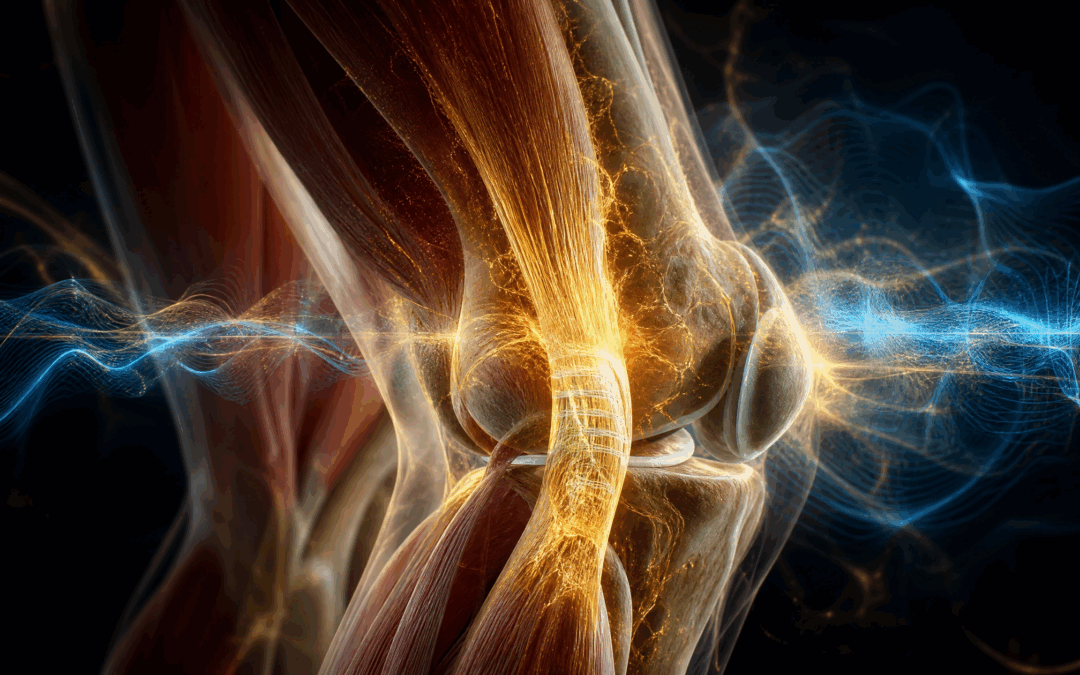
Look at the spectral image above. You are not looking at a flat, repetitive tone. You are looking at a living, breathing frequency landscape. The dense lower bands represent the foundational PEMF carriers interacting with the tissue, while the shifting upper bands represent the binaural entrainment layers guiding the nervous system.

Here is exactly what happens inside the tissue during this 38-minute session:
- Phase 1 (Neural Calm Entry): Opens with a 3 Hz Delta binaural beat and deep pain-gating PEMF frequencies (2 Hz, 3 Hz). This signals the nervous system to drop the chronic muscle guarding around the lateral knee.
- Phase 2 (Guarding Release): Shifts into Theta (5 Hz). The surrounding hamstring muscles (semitendinosus, semimembranosus) are signaled to relax, removing tension from the distal tendon insertion.
- Phase 3 (Tendon Signal Initiation): Anchors into the 7.83 Hz Schumann resonance. This is the baseline frequency of the human biofield, initiating the cellular environment for tenocyte activation.
- Phase 4 (Circulation & Matrix Build): Rises into Alpha (10 Hz). Frequencies targeting microcirculation (20 Hz, 25 Hz) are introduced to support the delivery of oxygen and nutrients required for collagen synthesis.
- Phase 5 (Inflammation Balance Peak): The energetic apex of the session. A 12 Hz binaural beat pairs with higher-frequency tissue signaling (40 Hz, 50 Hz) to modulate the inflammatory response—not suppress it, but organize it for optimal remodeling.
- Phase 6 (Connective Tissue Comfort): Descends back to 8 Hz. Deep connective tissue support frequencies (72 Hz, 95 Hz) provide localized comfort to the fibular head attachment zone.
- Phase 7 (Neuromuscular Integration): Drops to 6 Hz Theta. The nervous system is signaled to integrate the newly relaxed state into the posterior chain, resetting proprioception.
- Phase 8 (Stillness Reset): Closes with a profound 1.62 Hz (Phi) Delta beat. The body is left in a state of deep parasympathetic repair consolidation.
The Tendon Recovery & Mobility Collection
To fully support joint and tendon health, the Biceps Femoris program should be used as part of a comprehensive recovery strategy. The frequencyhealing.app platform offers a complete suite of targeted programs.
- Achilles Total Recovery: Repair, Relief, Circulation
- AC Joint Recovery & Ligament Deep Healing
- Cartilage & Joint Function Recovery
- Deep Tissue Regeneration, Recovery Tesla 3-6-9
- 1168 Hz Nogier Connectivity, Muscle, Bone
The 7-Day Biceps Femoris Recovery Protocol
To maximize the efficacy of the 8-phase architecture, you must deliver the signal through multiple vectors: magnetic (coil), acoustic (headphones), and haptic (vibration). Here is the day-by-day protocol.
Day 1: Acute Guarding Release
Focus on downregulating the nervous system and releasing the chronic muscle guarding around the lateral knee.
- Session: Biceps Femoris 8-Phase Repair.
- Delivery: Use headphones for the binaural entrainment. Place the iTorus i2 directly over the lateral posterior knee (fibular head region).
Day 2: Matrix Circulation Support
Support the delivery of blood flow and nutrients to the avascular tendon tissue.
- Session: Biceps Femoris 8-Phase Repair.
- Delivery: Place the iTorus i5 under the hamstring belly (mid-thigh) to stimulate the entire posterior chain while listening with headphones.
Day 3: Deep Tissue Regeneration
Broaden the energetic support to the surrounding fascia and musculature.
- Session: Deep Tissue Regeneration, Recovery Tesla 3-6-9.
- Delivery: Full body haptic immersion using the Woojer Vest 4.
Day 4: Lymphatic Detox & Clearance
As tissue repairs, metabolic waste and inflammatory byproducts must be cleared from the extracellular matrix.
- Protocol: Take a high-quality binder (zeolite or activated charcoal) in the morning.
- Session: Run a lymphatic drainage or detox program using the iTorus on the abdomen to support clearance.
Day 5: Neuromuscular Reintegration
Return to the targeted tendon program to support the alignment of new collagen fibers.
- Session: Biceps Femoris 8-Phase Repair.
- Delivery: iTorus over the lateral knee, headphones on. Practice gentle, pain-free knee flexion (heel slides) during Phase 4 and Phase 5 to encourage mechanotransduction.
Day 6: Cartilage & Joint Support
Address the overall health of the knee joint complex.
- Session: Cartilage & Joint Function Recovery.
- Delivery: iTorus i5 placed directly over the patella (kneecap).
Day 7: Full System Coherence
Consolidate the week of recovery with deep systemic rest.
- Session: Biceps Femoris 8-Phase Repair.
The Hardware: Delivering the BioPhi Signal
The 8-Phase architecture is built on a Mid/Side stereo matrix. To fully realize its potential, it must be delivered through hardware capable of reproducing this complexity.
iTorus i2 & i5: The program is specifically engineered for dual-winding vortex coils. The Mid channel drives the primary coil, while the Side-dominant channel drives the counter-winding, creating a localized, scalar-like torsion field directly into the tendon tissue. Explore iTorus Coils here.
Woojer Vest 4: Tendon repair requires physical mechanotransduction. The low-frequency PEMF carriers (2 Hz – 50 Hz) in this program translate beautifully into deep haptic vibration, stimulating the fascia and muscle bellies physically while the binaural beats guide the brain. Get the Woojer Vest 4 here (Use code EPEMF10 for a discount).
: For full-body integration and systemic inflammation modulation (especially during Phase 5), the full-body mat provides the necessary coverage. .
The iMprinter: Structuring Your Cellular Water
Tendons are highly dependent on hydration for glide and elasticity. However, bulk bulk tap water is biologically chaotic. To support the bioelectric signaling of the PEMF session, your cellular water must be structured to receive it.
Before every session, use the iMprinter to structure 500ml of water with the Biceps Femoris program. This pre-loads the water molecules with the exact harmonic signature of the session. When you drink it, you are delivering the frequency from the inside out, turning your body’s water network into a conductive medium for the external coil.
References
[1] Hamstring Strain Injuries: Recommendations for Diagnosis, Rehabilitation, and Injury Prevention
[2] Pulsed Electromagnetic Fields (PEMF) and Tendon Healing
[3] Snapping Biceps Femoris Tendon: A Case Report and Review of the Literature
Related Articles
- Your Body Is on Fire: The Curcumin 9-Phase Energetics
- Arnica Montana: The Bioelectric Muscle Recovery Method
- Hard-Tissue Enamel Remineralization: The Bioelectric Science
For advanced users seeking a more powerful spiral geometry, the Archimedean Tesla Spiral Frequency Imprinter delivers an intensified toroidal field imprint using sacred geometric coil winding for deeper water structuring and enhanced bioelectric coherence.