
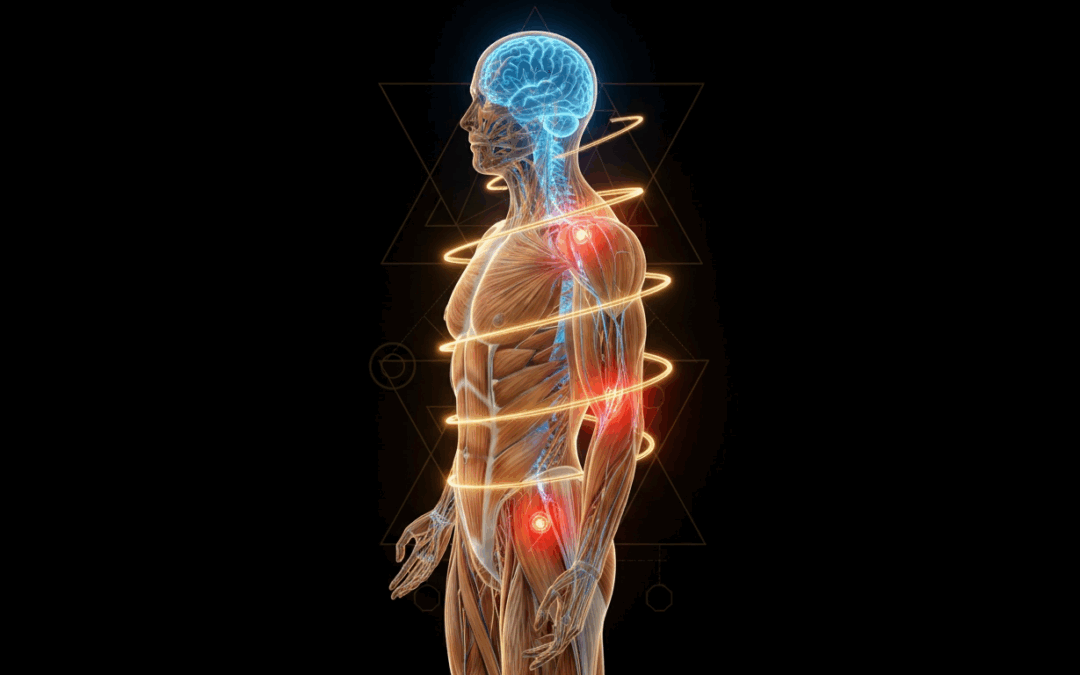
You have been told that your chronic pain is in your muscles. You have stretched, massaged, iced, heated, and medicated the localized tissue. Yet, the pain returns. Why? Because the tissue is just the speaker. The nervous system is the amplifier.
Chronic pain is not a localized muscle issue it is a systemic neurological loop. When peripheral nociceptors (pain receptors) fire continuously, they trigger a process called central sensitization. Your spinal cord dorsal horn and brain pain matrix become hyper-reactive, lowering the threshold for pain [1]. In this state, normal touch feels painful (allodynia), and mild pain feels excruciating (hyperalgesia) [2].
To break this cycle, you cannot just treat the muscle. You must rewrite the neurological signal. The Pain Relief Somatic Neuromuscular 12-Phase BioPhi-Harmonic Advanced Energetics program is engineered to do exactly that—interrupting the pain cascade at the peripheral, spinal, and central levels simultaneously.
The Bioelectric Cascade of Chronic Pain
When the body is locked in a chronic pain cycle, it follows a predictable, destructive cascade. Understanding this cascade is the first step to dismantling it.

As the diagram illustrates, pain triggers muscle guarding, which restricts blood flow, increases inflammation, and triggers more pain. Simultaneously, the autonomic nervous system shifts into sympathetic dominance (fight-or-flight), spiking cortisol and disrupting the sleep architecture required for tissue repair [3].
Decoding the Spectral Analysis: The Architecture of Relief
Why do we show you the spectral analysis? Because biology is electric, and health is coherence. A spectral image is not just a picture of sound; it is a visual map of the bio-informational data being delivered to your nervous system. It allows us to see exactly how and when the nervous system is being modulated.

In the spectral analysis above, you can observe three critical engineering layers:
- The 12-Phase Progression: Notice the distinct vertical blocks. Unlike static Rife frequencies that cause cellular fatigue (habituation) within minutes, this program shifts its carrier density every 2 minutes and 45 seconds. This dynamic progression prevents the nervous system from ignoring the signal, forcing continuous adaptation and release.
- Dense Carrier Bands (The Bright Horizontal Lines): These are not random tones. These dense bands represent the precise bioenergetic signatures of the active substances layered simultaneously. The thickness of the bands indicates the high informational density being delivered to the cellular receptors.
- The 0.1 Hz Breathing Envelope: Woven beneath the carrier bands is a sub-perceptual amplitude breathing pulse operating at approximately 0.1 Hz. This rhythm entrains the autonomic nervous system, pulling the body out of sympathetic fight-or-flight and into parasympathetic rest-and-digest—the only state where true tissue healing occurs [4] [5].
The 8 Bioenergetic Carriers of Somatic Relief
This program utilizes the bioenergetic frequency signatures of 8 critical substances. We do not disclose the proprietary Hz values, as true bio-resonance requires complex, multi-layered harmonics, not single static numbers. Instead, we use the frequency equivalents of these molecules to communicate directly with the body’s receptors.

These carriers are carefully selected from a private substance library to address specific somatic and neurological themes:
| Bioenergetic Signature | Targeted Action |
|---|---|
| Curcumin | Inflammation, arthritis, joint and muscle discomfort themes |
| MSM (Methylsulfonylmethane) | Inflammation, arthritis, joint and muscle discomfort themes |
| Proline | Collagen, tendon, fascia, connective-tissue, and joint themes |
| Glucosamine Sulfate | Collagen, tendon, fascia, connective-tissue, and joint themes |
| Boron | Bone, joint, and inflammatory-response symbolism |
| Naringin | Pain-comfort and modulation themes |
| DLPA (Phenylalanine) | Pain-comfort and modulation themes |
| N-acetyl Glucosamine | Joint and mobility symbolism |
The 12-Phase Somatic Journey
The program is a highly structured 33-minute and 33-second journey, broken into 12 distinct phases. The session intentionally avoids presenting pain as a single isolated signal. The architecture stages nervous-system settling first, then introduces sensory gating, nerve-comfort themes, muscle and fascia release, joint coherence, inflammatory-response symbolism, a controlled somatic peak, rebalancing, and zero-point integration.
| Phase | Time | Main Targets | Geometry | Binaural Target |
|---|---|---|---|---|
| 1. Nucleus Anchor | 0:00–2:18 | Sensory settling, field stabilization | Grounded spiral-torus | 2 Hz |
| 2. Autonomic Quieting | 2:18–4:48 | Breath pacing, reduced guarding | Inverse-phi torus | 4 Hz |
| 3. Pain-Signal Gate Preparation | 4:48–7:30 | Sensory gating and attentional focus | Orbital polarity field | 5 Hz |
| 4. Neuropathic Comfort Field | 7:30–10:18 | Nerve-discomfort contemplation | NeuroVortex orbital field | 8 Hz |
| 5. Muscle Tension Release | 10:18–13:12 | Muscle softening and somatic ease | Bilateral spiral | 10 Hz |
| 6. Fascia and Myofascial Spiral | 13:12–16:12 | Fascia, tendon, structural awareness | Crystalline BioPhi spiral | 12 Hz |
| 7. Joint and Mobility Coherence | 16:12–19:18 | Joint comfort and mobility readiness | Crystalline orbital-torus | 15 Hz |
| 8. Inflammatory-Response Repatterning | 19:18–22:18 | Calmer internal communication | 3-6-9 toroidal lattice | 20 Hz |
| 9. Deep Somatic Release Peak | 22:18–25:12 | Full-body release and sensory modulation | Expanding vortex-torus | 30 Hz |
| 10. Whole-System Pain Coherence | 25:12–28:00 | Nervous-system, muscle, fascia, and joint integration | Whole-body BioPhi torus | 40 Hz |
| 11. Rebalancing and Containment | 28:00–30:42 | Reduced intensity and containment | Vesica containment field | 8 Hz |
| 12. Zero-Point Integration | 30:42–33:33 | Grounding, stillness, and completion | Zero-point phi descent | 1.618 Hz |
The Mathematics of Zero-Point Integration
The final phase (Phase 12) utilizes a precise mathematical relationship to achieve profound grounding and stillness. It employs the Golden Ratio (Phi), where φ = (1 + √5) / 2 ≈ 1.618 Hz. By engineering a specific binaural difference (e.g., 261.618 Hz – 260.000 Hz = 1.618 Hz), the nervous system is guided into a deep state of integration.
Signal Architecture & Delivery Systems
To effectively rewrite a chronic pain loop, the signal must be delivered through multiple biological vectors simultaneously.

The signal is engineered as a unified stereo signal, meaning both channels contain the complete signal, with no channel assigned exclusively to haptic or coil output. It utilizes a Mid/Side design where the Mid floor supports mono playback and haptic transducers, while the Side energy supports differential Vortex-coil drive. A dual-winding Vortex coil responds strongly to the differential component, meaning substance carriers, rotating phase information, and modulation envelopes are weighted strongly into the Side field.
For maximum efficacy, the Pain Relief Somatic Neuromuscular program should be paired with specific hardware:
| Device | Placement / Use | Why It Works |
|---|---|---|
| iTorus i2 | Base of skull or directly over local pain point | Creates a localized toroidal scalar field that penetrates deep tissue without resistance, delivering the carrier signatures directly to the dorsal horn. |
| iTorus i5 | Thoracic spine or under the bed during sleep | Generates a massive 24-foot bio-magnetic field, enveloping the entire central nervous system for systemic autonomic reset. |
| Woojer Haptic Vest | Worn on the torso | Drives the sub-harmonic frequencies directly into the myofascia through acoustic vibro-tactile transduction, physically releasing muscle guarding. |
| iMPrinter (Metatronic) | Imprinting drinking water | Structures the hydrogen bonds in water with the 12-phase program signature, allowing for intracellular delivery of the bio-information throughout the day. |
The 3-Day Somatic Reset Protocol
To dismantle chronic central sensitization, consistency is required. Use this 3-day protocol to establish a new neurological baseline. The prime program must be the anchor of every single day.
Day 1: Acute Interruption & Clearing
- Morning: Pain Relief Somatic Neuromuscular. Use over-ear headphones and place the iTorus i2 directly on the primary site of pain.
- Afternoon: Vagus-Spinal Kundalini Root-to-Crown. To ensure the spinal pathway is clear for descending pain modulation.
- Evening: Pain Relief Somatic Neuromuscular. Imprint your evening water using the iMPrinter (Metatronic) to sustain the signal through the night.
Day 2: Deep Myofascial Release
- Morning: Pain Relief Somatic Neuromuscular. Wear the Woojer Haptic Vest to drive the sub-harmonics deep into the fascia.
- Afternoon: Rhus Toxicodendron Stiffness Ease. To address secondary joint stiffness resulting from prolonged muscle guarding.
- Evening: Pain Relief Somatic Neuromuscular. Place the iTorus i5 under your bed to bathe the nervous system in the field while you sleep.
Day 3: Central Nervous System Consolidation
- Morning: Pain Relief Somatic Neuromuscular. Focus on deep, coherent breathing (0.1 Hz) to match the program’s breathing envelope.
- Afternoon: Inflammation Response & Cellular Recovery. To clear out the residual oxidative stress from the released tissues.
- Evening: Pain Relief Somatic Neuromuscular. Combine audio, the iTorus i2 at the base of the skull, and imprinted water.
Safety and Usage Guidelines
This is a wellness, relaxation, meditation, and nervous-system support practice. It does not diagnose, treat, cure, prevent, or manage pain disorders, inflammatory disease, or any medical condition. Please adhere to the following safety guidelines:
- Use at a comfortable volume and low device intensity.
- Do not use while driving, operating machinery, bathing, or performing tasks requiring full attention.
- Stop if discomfort, dizziness, nausea, headache, agitation, palpitations, hearing discomfort, unusual sensations, or worsening symptoms occur.
- Do not place PEMF coils or haptic devices directly over implanted electronic medical devices.
- Consult a qualified healthcare professional before use with implanted devices, epilepsy, seizure history, pregnancy, serious cardiovascular concerns, acute injury, active infection, unexplained severe pain, neurological changes, or complex medical conditions.
- Severe, sudden, unexplained, or worsening pain requires appropriate medical evaluation.
- Do not use this session to start, stop, or change medication, supplements, rehabilitation, physical therapy, or medical care.
References
- Woolf, C. J. (2011). Central sensitization: Implications for the diagnosis and treatment of pain. Pain, 152(3 Suppl), S2-15. https://pubmed.ncbi.nlm.nih.gov/20961685/
- Latremoliere, A., & Woolf, C. J. (2009). Central sensitization: a generator of pain hypersensitivity by central neural plasticity. The Journal of Pain, 10(9), 895-926. https://pubmed.ncbi.nlm.nih.gov/19712899/
- Chapman, C. R., et al. (2008). Pain and stress in a systems perspective: reciprocal neural, endocrine, and immune interactions. The Journal of Pain, 9(2), 122-145. https://pubmed.ncbi.nlm.nih.gov/18088561/
- Zaccaro A, et al. (2018). How breath-control can change your life: a systematic review on psychophysiological correlates of slow breathing. Frontiers in Human Neuroscience. https://pmc.ncbi.nlm.nih.gov/articles/PMC6137615/
- Laborde S, et al. (2017). Heart Rate Variability and Cardiac Vagal Tone in Psychophysiological Research. Frontiers in Psychology. https://pmc.ncbi.nlm.nih.gov/articles/PMC5624990/
- Franco-Obregón A. (2023). Harmonizing Magnetic Mitohormetic Regenerative Strategies. https://pubmed.ncbi.nlm.nih.gov/37892906/
- Ingendoh RM, et al. (2023). Binaural beats to entrain the brain? A systematic review. https://pmc.ncbi.nlm.nih.gov/articles/PMC10198548/
- Fooks C, et al. (2024). Effects of Vibroacoustic Stimulation on Psychological, Physiological, and Cognitive Stress. https://pubmed.ncbi.nlm.nih.gov/39338668/