
Are Rife frequencies more real than digitally generated frequencies? It is one of the most persistent questions in modern frequency culture, usually posed as a contrast: a waveform from an app or computer on one side, a dedicated Rife-style generator on the other. The decisive question is more interesting than the label on the enclosure. What signal is actually produced, through what output chain, by what transducer, and with what evidence for the specific use being discussed?
A digitally specified waveform becomes a physical electrical output when digital samples are converted by a digital-to-analog converter (DAC) and passed through an analog output stage. A headphone driver can then convert that electrical variation into acoustic pressure; a haptic transducer can convert it into mechanical vibration; a coil-and-driver system can convert it into a time-varying electromagnetic field. These are different physical outputs, not interchangeable names for the same thing. The engineering question is therefore not whether “digital” is real. It is whether the complete signal path is specified, appropriate to its modality, and measured at its output.[1]
This distinction is the foundation of a more mature conversation about signal design. Frequency matters, but it is only one coordinate in a larger architecture that can include waveform shape, amplitude, harmonic content, phase relationship, modulation, pulse timing, output loading, session duration, transducer geometry, and the actual measurement plane. A well-designed program can organize those variables over time rather than treating one static number as the whole intervention. That is a meaningful design decision. It is not, by itself, proof of a clinical result.
The short answer: a Rife-style box does not make a waveform more physically real simply because it is a box. A dedicated device may have a different output stage, transducer, field geometry, or measurement profile than an audio pathway. Those differences should be described and tested—not assumed from a brand, a price point, or a frequency label.
Follow the Signal: Where “Digital” Becomes Physical
Digital signal generation begins with a numerical representation: a sequence of samples describing a changing value over time. A DAC reconstructs that representation as an analog electrical signal. In a practical output chain, filtering, amplification, impedance, cable behavior, and the connected load all shape what reaches the transducer. This is why a program file, a phone, a headphone amplifier, a haptic device, and a coil driver should never be collapsed into a single undifferentiated idea of “frequency.”[1]
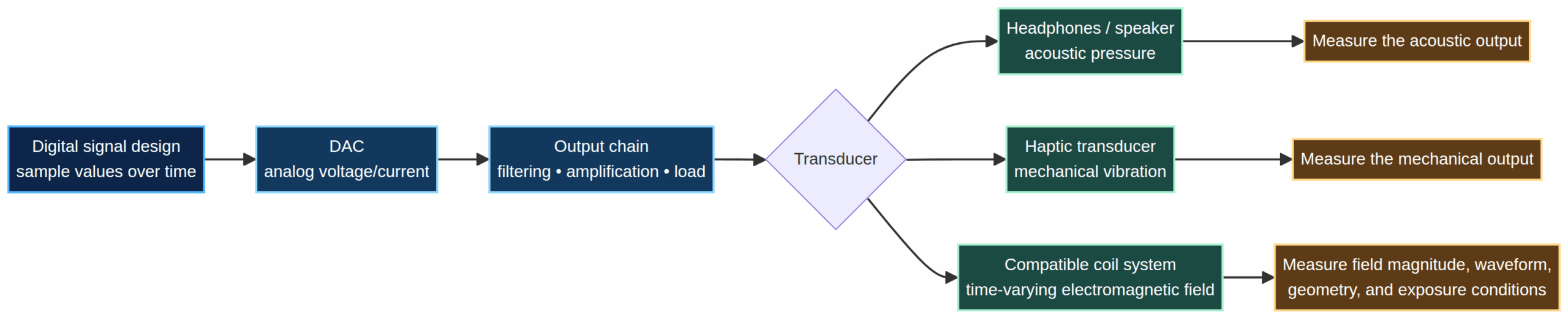
A speaker or headphone pathway is acoustic. The voice coil drives a diaphragm, and the diaphragm creates pressure variation in air that is heard as sound. A haptic pathway is mechanical: an electrical drive produces tactile vibration through a motor, resonator, or similar actuator. A coil pathway is electromagnetic: the current in the conductor produces a time-varying field whose magnitude, waveform, spatial distribution, and exposure geometry need to be characterized for the actual setup. One signal design can be translated across more than one pathway, but the output is not identical simply because a nominal frequency appears in each.
This is also why claims such as “audio is PEMF” are technically imprecise. Audio playback creates acoustic energy; a properly driven coil produces a time-varying electromagnetic field. A multilayer consumer experience may intentionally include both, plus haptic vibration, but the modalities remain distinct. The value of a layered design is its ability to organize a richer sensory experience not a license to confuse one physical channel with another.
Why Frequency Is Not the Whole Specification
In signal engineering, frequency is the rate at which a periodic component repeats. It can be important, but it does not describe the entire waveform. A sine wave, a pulsed waveform, a burst-modulated train, and an amplitude-modulated carrier can share a nominal rate while differing substantially in their time-domain structure and frequency-domain content. When a signal is dynamic, its spectrum may also evolve over time. That is why engineers use complementary descriptions: the time-domain waveform describes change over time, while the frequency-domain spectrum describes the distribution of components by frequency.
For electromagnetic-field research, this is more than a semantic refinement. A systematic review of in-vitro pulsed electromagnetic field studies evaluated results in relation to cell type, frequency, flux density, exposure time, and waveform. The literature was heterogeneous; cell responses varied with the experimental context. The scientifically responsible inference is not that a single frequency has universal meaning. It is that a full exposure description matters when interpreting a specific study or device.[2]

That is the constructive case for a phase-based or BioPhi-style composition. It can be designed as a sequence of transitions rather than a single, unchanging output: a direct frequency anchor may be placed within a broader temporal grammar of harmonics, phase relationships, modulation contours, bilateral routing, and staged changes. The purpose of that grammar is compositional organization. It gives the designer a way to create a session with entry, development, integration, and exit rather than simply looping an isolated numerical value.
What this language does not establish is a universal biological superiority. “Static frequency” and “phased architecture” are design descriptors, not clinical verdicts. A dynamic program should be evaluated as the actual program delivered through its actual modality, in its actual context.
Natural Sound, Harmonics, and Time-Varying Spectra
The difference between a single oscillator and a living acoustic event is easy to hear. Strike a singing bowl, a piano string, or a handpan and the sound is not just a fundamental rate. It contains partials, transients, decay, changing relative amplitudes, and room interaction. In signal-analysis language, those features produce a time-varying spectrum. A spectrogram is a time-frequency visualization of such audio content; it is not spectroscopy, a biological measurement, a field map, or evidence of physiological change.
This distinction matters because the word “harmonic” is often used loosely. In technical language, harmonics are frequency components related to a fundamental by integer multiples. In editorial and design language, “harmonic” may also refer to a broader compositional sense of ordered relationships. Both usages can be useful when stated clearly. Neither should be used as a shortcut for disease claims, nutrient delivery, or proof that a signal will create a particular biological outcome.
For a wellness listener, the practical insight is positive and accessible: a richly structured soundscape may feel less like a sterile loop because its components move through time. A phase-based session can use that same principle of temporal organization intentionally. That is a design rationale. It remains separate from a medical claim.
What Sensory Adaptation Does and Does Not Tell Us
Sensory systems do adapt to recent stimulus history. Neuroscience literature describes sensory adaptation across modalities and multiple stages of processing, with effects shaped by the dynamics and context of stimulation.[3] Habituation is also a recognized form of response change following repeated exposure to a specific stimulus, but it is parameter- and context-dependent rather than a simple universal law.[4]
That evidence gives a reasonable design motivation for varying the organization of a session: transitions, changing textures, and planned sections can make a sensory program more intentional than an endlessly repeated tone. It does not prove that a consumer program prevents “cellular adaptation,” overrides habituation, or outperforms every static protocol. Those claims would require direct testing of the exact signal, device, delivery geometry, population, and outcome.
In other words, phased composition is worth discussing because it is an explicit engineering and experiential choice. It does not need exaggerated physiology to be interesting.
Binaural Audio: A Psychoacoustic Layer, Not a Brain-Control Claim
When two tones with a small frequency difference are presented separately to the ears, listeners can perceive a binaural-beat phenomenon at the difference frequency. This is a real psychoacoustic construct and an understandable tool for audio composition. However, a 2023 systematic review found the evidence for consistent brainwave entrainment inconclusive: among fourteen included studies, five findings aligned with the hypothesis, eight were contradictory, and one was mixed; study methods and analyses were substantially heterogeneous.[5]
The correct conclusion is not that binaural audio is “fake,” nor that it reliably controls brain activity. It is that binaural design is an audio-layer choice whose experiential and physiological interpretations need calibration. The most defensible public language is to describe it as headphone-based psychoacoustic design and to avoid presenting it as a guaranteed cognitive, neurological, or medical intervention.
What the Rife Name Can and Cannot Establish
Rife machines occupy a prominent place in the history and mythology of frequency culture. They are commonly associated with claims that a condition can be identified or altered by a corresponding frequency. The history is relevant because it explains why many readers still ask whether a modern waveform must come from a particular type of box to “count.” It does not settle the engineering or evidence question.
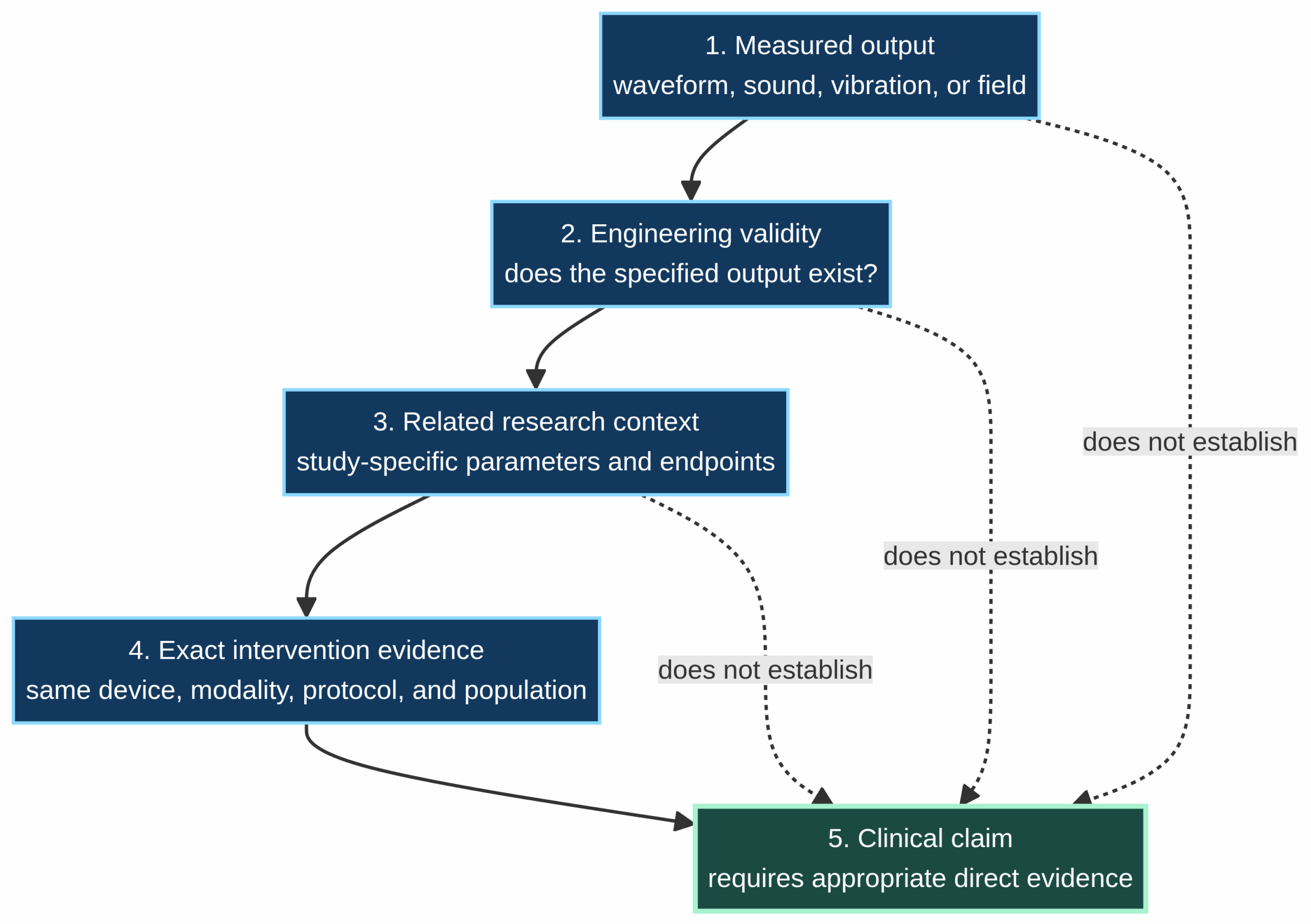
Reputable cancer-information sources state that there is no reliable evidence for using Rife machines as a cure for cancer, and regulators caution against products marketed with unproven disease-treatment claims.[6] [7] That boundary should be held firmly and without theatrical overreach. A device may generate a measurable electrical or electromagnetic output; that physical fact alone does not validate a diagnosis, a disease mechanism, or a treatment claim. Conversely, the historical Rife label alone does not tell an engineer what waveform, output level, geometry, or measurement method a current device uses.
The better question is therefore: Can the claimed output be specified and measured, and what direct evidence exists for the exact intended use? That question respects both physics and evidence.
BioPhi as a Design Grammar: What an Architecture Can Organize
BioPhi-style language is most useful when treated as an organizational grammar. It can describe a program built from a chosen set of direct frequency references, harmonic relationships, phase relationships, modulation shapes, transitions, and delivery layers. It gives a designer a vocabulary for moving from a single point on a frequency chart to a deliberately sequenced composition.
That distinction matters for users who have outgrown the “one number solves everything” narrative. A complete session can be designed as a temporal object: it has a beginning that establishes attention, a middle that develops texture and relationship, and an exit that reduces abruptness. Audio, haptic, and compatible-coil layers may be organized within the same session concept while remaining technically separate at the output. This is an approach to signal composition, not a claim that the program contains a hidden pharmacology or can substitute for medical evaluation, treatment, nutrition, or medication.
A Seven-Day Signal-Architecture Exploration
This is a wellness-oriented, screen-free exploration of program formats, not a medical protocol. Every day begins with the same primary program so that the sequence has a consistent opening, followed by two exact linked companions that vary the sound-design context. Use the visible in-app runtime for each selection, keep a 10-minute quiet interval between sessions, and stop if the experience is uncomfortable. Catalog titles are preserved as program names; they are not claims of diagnosis, treatment, cure, prevention, or a guaranteed effect.
Optional repeat: After Day 7, take one full week away from this sequence. If you choose to repeat it, treat the second week as a fresh observation period rather than escalating intensity, duration, or expectations.
Best Practices for Audio, Haptics, and Compatible Coil Systems
For audio: Keep listening volume comfortable and below 60% of your device maximum. Use well-fitted headphones when you want stereo separation, and take regular quiet breaks. The World Health Organization notes that risk rises with both sound level and duration; volume, time, and frequency of loud exposure all matter.[8] If you experience persistent ringing, pain, or hearing difficulty, stop and seek assessment from a qualified hearing professional.
For haptics: Use the device as its manufacturer instructs, begin conservatively, and allow the output to remain a tactile accompaniment rather than a reason to increase audio volume. Do not use discomfort as a signal to push harder.
For a compatible coil system: Follow the device manufacturer’s instructions, contraindications, connection requirements, and positioning guidance. Do not place a coil over the eyes, head, or any implanted electronic medical device. People with implanted electronic devices, pregnancy, seizure history, or a condition requiring medical supervision should consult an appropriately qualified clinician before using a pulsed-field device. For readers comparing hardware options, the current iTorus i2 collection and iTorus i5 collection provide manufacturer-facing specifications and usage information.
What to Ask Before You Believe a Frequency Claim
A useful consumer checklist is simple. Ask what waveform is being generated; what the final transducer produces; whether output has been measured at the relevant point; which parameters beyond frequency are disclosed; whether the cited research uses the same modality, configuration, duration, and population; and whether the claim has drifted from a wellness description into disease marketing.
This approach does not diminish the creative potential of digital composition. It makes that potential more intelligible. A well-built platform can use software to create repeatable, evolving, multichannel signal designs. A well-built hardware system can convert a defined electrical drive into an appropriately characterized output. The intellectual upgrade is to evaluate the whole architecture not to hand the argument to a single number or a single box.
Affiliate Disclosure
Some links in this article are affiliate links. If you choose to purchase through them, PEMF Magazine may receive a commission at no additional cost to you. This support does not change the article’s evidence standards or its wellness-only framing.
Safety and Scope
This educational article discusses signal concepts, consumer audio, haptics, and compatible field-device considerations. It is not medical advice and does not diagnose, treat, cure, mitigate, or prevent any condition. No waveform, spectrogram, app, haptic layer, or coil output should be interpreted as a substitute for professional medical assessment or evidence-based treatment. Do not delay medical care for a serious symptom or diagnosis.
Related Articles
- Why the PEMF Healing App Outperforms Traditional Tone Generators
- Frequency Based Wellness Programs
- Royal Raymond Rife Was Not a Doctor: The Man, the Microscope and the Controversial Frequency Healing Legacy
References
- Valvano, J. Digital to Analog Conversion and Sound. University of Texas at Austin.
- Mansourian M, Shanei A. Evaluation of Pulsed Electromagnetic Field Effects: A Systematic Review and Meta-Analysis on Highlights of Two Decades of Research In Vitro Studies. BioMed Research International. 2021.
- Adibi M, Zoccolan D, Clifford CWG. Editorial: Sensory Adaptation. Frontiers in Systems Neuroscience. 2021.
- Grissom N, Bhatnagar S. Habituation to repeated stress: get used to it. Neurobiology of Learning and Memory. 2008.
- Ingendoh RM, Posny ES, Heine A. Binaural beats to entrain the brain? A systematic review of effects on brain oscillatory activity. PLoS One. 2023.
- Cancer Research UK. Rife machines.
- U.S. Food and Drug Administration. Questions and Answers: FDA alerts companies to stop illegal sale of products claiming to treat cancer.
- World Health Organization. Deafness and hearing loss: Safe listening. 2026.