
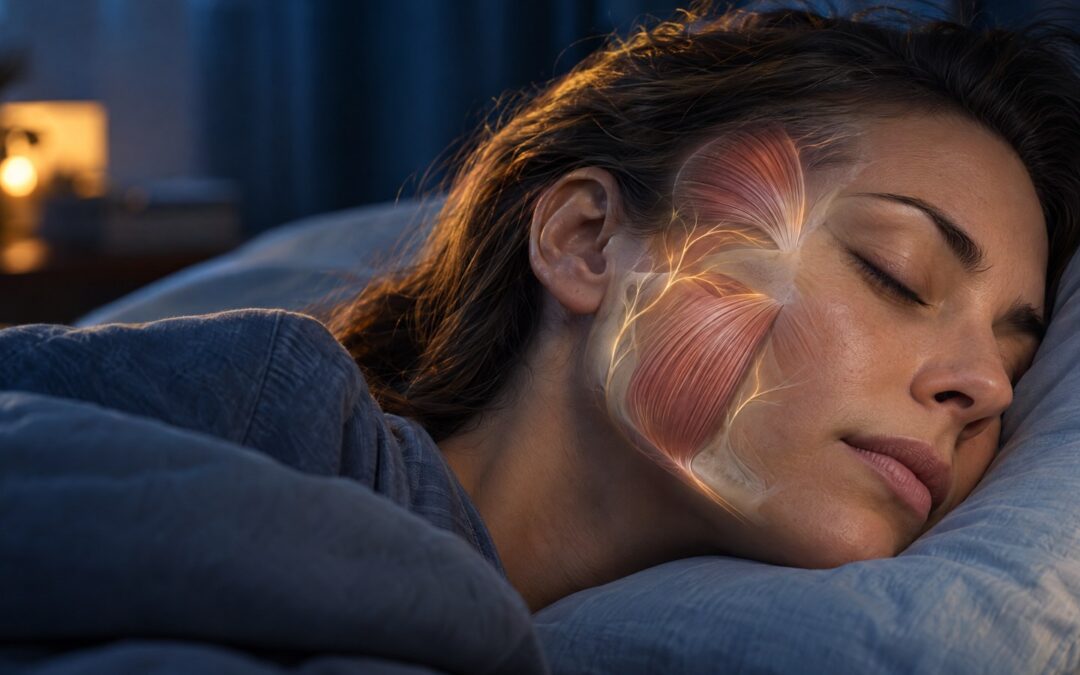
You can be asleep while your jaw briefly becomes active. That is the overlooked starting point in sleep bruxism. Nighttime grinding is not simply daytime tension continuing after the lights go out. Research has recorded rhythmic jaw-muscle activity in many healthy sleepers, while people classified as sleep bruxers can show more pronounced patterns. Understanding that difference opens a better conversation about jaw comfort, dental protection, sleep physiology, and the role of a thoughtful evening routine.[1] [2]
Quick answer: Sleep Bruxism & Jaw Relaxation BioPhi Matrix 4-Phase BioPhi Harmonic Neuromuscular & Sleep Energetics is a four-phase pre-sleep listening design. Its practical proposition is a defined interval for comfortable listening and gentle awake jaw awareness. The research helps explain why that experience belongs alongside, rather than in place of, dental protection and appropriate sleep assessment. No reviewed clinical trial tests this exact recording for nighttime grinding.
Sleep bruxism: the sleeping jaw is not always still
Bruxism refers to activity of the masticatory muscles, the muscles used in chewing. The masseter contributes to jaw closure along the cheek; the temporalis fans across the side of the head. Sleep bruxism can involve rhythmic bursts or sustained activity during sleep. Awake bruxism can include repeated or sustained tooth contact, jaw bracing, or thrusting while a person is awake. These are related behaviours, but they are not the same situation.[1] [4]
The 2025 international consensus update treats bruxism as a motor behaviour, not automatically as a disorder. That is an important shift. A movement becomes clinically meaningful through its context: damaged teeth or restorations, discomfort, functional difficulty, and other relevant findings. A grinding report alone does not tell the whole story.[1]
One landmark study compared 82 normal sleepers with 33 sleep bruxers. Rhythmic masticatory muscle activity, abbreviated RMMA, occurred in nearly 60% of the normal sleepers. The sleep-bruxism group showed more bursts per episode and greater episode amplitude. The striking fact is not that jaw activity is always harmless. It is that the presence of activity and the significance of that activity are different questions.[2]
What brief arousals reveal
A micro-arousal is a brief activation within sleep, not necessarily a remembered awakening. Small physiological studies have linked sleep-bruxism events to transient cortical and autonomic activation. In a matched study of 10 sleep-bruxism patients and 10 controls, researchers observed changes in brain activity and heart rate around jaw-muscle events. The sequence was study-specific, not a universal script for every grinding episode.[3]
This helps explain why someone can feel calm before bed and still have sleep-related jaw activity. It also removes an unhelpful assumption: grinding is not evidence that a person failed to relax hard enough. A pre-sleep routine addresses the awake transition into rest. Activity after sleep begins may require a different kind of assessment.
Three goals make the evidence easier to understand
A better approach starts by deciding what needs attention. A comfortable jaw, protected teeth, and fewer measured sleep-muscle events are distinct outcomes. Studies frequently examine only one of them. Keeping the endpoints separate makes both clinical decisions and personal observations more useful.[1] [4] [6]
| Goal | What is assessed | Useful next step |
|---|---|---|
| Jaw comfort | Tightness, tenderness, pain, and comfortable movement. | Discuss persistent symptoms with a dentist or clinician; use gentle, symptom-limited awake self-care. |
| Tooth protection | Wear, cracks, sensitivity, damaged restorations, and the condition of the bite. | A dental examination and an individually appropriate protection plan. |
| Sleep motor activity | Jaw-muscle events measured with suitable electromyography or sleep assessment when indicated. | Ask which measurement answers the clinical question, rather than interpreting relaxation as an event-count result. |

Why a night guard and a relaxation routine have different jobs
A dentist may recommend a mouth guard or splint to help protect teeth and restorations. Its mechanical protection role should not be confused with guaranteed suppression of the underlying sleep behaviour. A randomized study of 21 participants found no group-level change in measured sleep-bruxism variables after four weeks of stabilization versus palatal splints, although individuals varied. A Cochrane review likewise found insufficient evidence to establish splints as a treatment for sleep bruxism, while noting their possible tooth-wear benefit.[4] [6] [7]
That does not make protection unimportant. It clarifies its purpose. Audio can provide a listening experience; a professionally selected appliance can address mechanical protection; a clinical examination can investigate pain or damage. Combining appropriate roles is more sensible than asking one tool to do everything.
What the electrical and PEMF studies actually measured
There is genuine clinical research on physical stimulation in the jaw region. The strongest way to read it is to ask four questions: who was studied, what was physically delivered, what changed, and what was not measured. For this topic, pain research and nighttime grinding research often occupy different evidence lanes.
Electrical stimulation: pain and short-term function
Rajpurohit and colleagues studied 60 people with bruxism-associated masticatory muscle pain, comparing transcutaneous electrical nerve stimulation, or TENS, with microcurrent electrical nerve stimulation over seven days. They reported improvements in pain and tenderness. These are meaningful symptom endpoints, but the study did not establish fewer instrumentally measured sleep-bruxism episodes.[8]
Another study included 36 people with TMD muscle pain and 39 controls. A single TENS session was followed by immediate pain and pain-free mouth-opening changes. It had no sham TENS comparison and no sleep-bruxism monitoring. Its findings describe an electrical intervention and immediate clinical responses, not what a similarly numbered acoustic tone would do.[9]
PEMF: promising findings and a placebo-controlled counterpoint
In a randomized study of 45 people with temporomandibular dysfunction, a PEMF-plus-ultrasound group and a dextrose-phonophoresis group showed favourable pain, movement, and function findings compared with ultrasound alone after four weeks. Because the PEMF arm also received ultrasound, the study cannot isolate a universal PEMF effect.[10]
A larger multicentre placebo-controlled TMD study assigned 36 patients to active PEMF and 42 to placebo, with 76 completing treatment. It found no specific PEMF effect over placebo. Together, these studies show why the device, comparator, co-intervention, and endpoint matter. Neither establishes that the featured recording or a consumer coil reduces nighttime grinding.[11]
The practical distinction: electrical current through electrodes, a characterized magnetic field from an applicator, and sound from headphones are different exposures. A shared frequency number cannot transfer evidence between them. The output chain, tissue coupling, intensity, waveform, and duration are part of the intervention, not incidental details.
The remarkable difference made by a sensor
Some of the most interesting bruxism research does not continuously play a signal. It first detects jaw activity, then responds. This is closed-loop feedback: a sensor, an event criterion, and a contingent response.
A small randomized pilot involving 11 patients used online jaw-muscle EMG to trigger electrical stimulation. During active sessions, EMG episodes per hour fell by a reported 52% compared with baseline. Pain did not significantly improve. The result is useful precisely because it separates a measured motor-event change from a symptom change; the small trial does not establish a lasting clinical outcome.[12]
A 14-week oral-appliance study analysed 20 people with diagnosed sleep bruxism. Bite-force sensing triggered vibration during the active period. Event duration decreased at selected active-period measurements, then activity increased after stimulation was withdrawn. It was an open-label, single-arm study, so the time-sequence results are not equivalent to a blinded comparison against a parallel control group.[13]
The insight is architectural: a timed recording follows elapsed time; a feedback device responds to a detected event. A haptic vest responding to the soundtrack is not a bite-sensing appliance. A four-phase file can contain an evolving experience, but it does not know whether the sleeper has started grinding. That distinction keeps the programme’s value clear without borrowing a different technology’s results.
Where pre-sleep audio research offers useful context
Listening research asks different questions: subjective sleep quality, stress, sleep-onset latency, or brain electrical activity. These studies can inform the idea of a pre-sleep listening interval. They do not establish a jaw-muscle or tooth-protection effect.
In a randomized double-blind study with 43 completers who had subclinical insomnia, participants listened to music with binaural beats or comparison music for two weeks. Insomnia scores improved, but the between-group difference was not statistically significant. A related EEG study reported selected waking spectral-power changes. Waking EEG findings are not the same thing as demonstrating overnight sleep-stage change.[14] [15]
A three-week pilot compared binaural-beat audio with autonomous sensory meridian response, or ASMR, in 76 completers. Both groups improved on several stress and sleep measures, without a significant group-by-time interaction for the sleep parameters. This is a useful reason to respect the whole listening experience, including preference and context, rather than attribute every change to one beat characteristic.[16]
A smaller polysomnography crossover study in 10 healthy volunteers found shorter sleep-onset latency with a particular dynamic binaural stimulus compared with no-sound sham. It offers a proof-of-concept finding worth following, but its small sample, imperfect masking, and different stimulus prevent it from validating this programme. None of these studies measured sleep bruxism.[17]
Binaural perception, mono audio, and bone conduction
A binaural beat is an auditory percept created when different tones are delivered separately to the two ears. Stereo headphones preserve that separation. Summing both channels to mono changes the presentation and does not preserve the same binaural percept. A bone-conduction headset may provide an acoustic listening route, but it should not be assumed to maintain independent ear separation or to electrically stimulate the jaw.[18]
A systematic review of 14 EEG studies found five consistent with the binaural-entrainment hypothesis, eight contradictory, and one mixed. The evidence supports careful terminology: an auditory response, a local spectral-power change, and a generalized shift of brain rhythms are not interchangeable claims. “Theta” in a listening design is not a diagnosis of the listener’s brain state.[18]
Why the four-phase BioPhi design is more than one repeated tone
The featured matrix is designed as a planned 30-minute pre-sleep listening composition. Its four-phase arc organizes attention and sensory intensity rather than mapping four clinical stages of bruxism. The useful differentiation is a deliberate progression: a gentle entrance, developed listening, a softer wind-down, and a quiet ending.
| Design movement | Experiential purpose | What the reader can notice |
|---|---|---|
| 1. Gentle entry | Introduce sound gradually and allow a comfort check. | Whether the level feels easy to listen to without bracing the jaw. |
| 2. Pre-sleep listening | Develop the sound through changing texture and stereo presentation. | Whether the listening experience is engaging, neutral, or distracting. |
| 3. Wind-down | Soften the sensory presentation toward the close. | Whether the transition suits an unhurried evening routine. |
| 4. Quiet close | Taper the experience and provide a defined stopping point. | Whether ending playback, rather than extending it, makes the routine easier to keep. |

A fixed recording can contain changing sound
“Fixed recording” means that the file follows a predetermined sequence. It does not mean every moment contains a static tone. Harmonic balance, texture, stereo presentation, and intensity can evolve within that sequence. Here, “BioPhi Harmonic” is the programme’s design name, not a claim that a particular mathematical ratio has been shown to stop bruxism.
Compared with a single-tone or a list marketed as a “Rife frequency” for grinding, this architecture provides a more articulated listening experience. That is a defensible design distinction. It is not evidence of clinical superiority, and a changing soundtrack has not been shown to prevent cellular adaptation. Auditory habituation and physiological treatment response should not be conflated.[18]
Release and use boundary: the supplied design material does not establish completed listening approval, compatibility with a particular coil or haptic system, or a clinical bruxism outcome. Use the platform’s current release instructions. The description here is a design guide, not permission to improvise a hardware connection or dose.
Programme menu: primary first, then optional listening pathways
Start with the Sleep Bruxism & Jaw Relaxation BioPhi Matrix 4-Phase BioPhi Harmonic Neuromuscular & Sleep Energetics. The following exact catalogue titles provide related navigation. Their names describe how the platform organizes content; they are not verified medical indications or instructions to treat a condition.
- Sleep Bruxism Teeth Grinding, Jaw clenching Ultra Advanced Energetics
- Temporomandibular Joint dysfunction, TMJ Electroherbalism CAFL energetics
- Sleep Energetics
- Quality of Sleep, Deprivation, Insomnia Energetics
- Insomnia, Falling Sleep Advanced
- Insomnia, Lack of Falling Sleep
- Melatonin, Sleep, Restoration, Pineal, Circadian, Dreamwork Energetics
- 528Hz Eros Handpan + Tibetan Bowl, Stress-Relief, Anxiety-, Sleep, Focus, Healing, Tranquility
The melatonin-named companion is a separate listening title, not an ingredient in the featured matrix, a hormone delivery method, or a supplement recommendation. Choose by listening preference and current platform guidance, not by assuming a catalogue label establishes a chemical effect.
A simple three-evening listening orientation
This is a comfort-focused orientation for an adult who can use the released audio safely, not a bruxism treatment plan. Use one complete primary session according to the current platform listing. Its planned listening arc is 30 minutes; individual phase allocations are not a medical prescription. If you choose a companion, use its own listed length separately, allow a ten-minute quiet gap, and move the whole routine earlier rather than delaying bedtime. There is no need to run every option.
| Evening | Linked programme order | One useful observation |
|---|---|---|
| Evening 1 | Sleep Bruxism & Jaw Relaxation BioPhi Matrix 4-Phase BioPhi Harmonic Neuromuscular & Sleep Energetics alone. | Did the sound level and timing feel comfortable? Record only the listening experience. |
| Evening 2 | Sleep Bruxism & Jaw Relaxation BioPhi Matrix 4-Phase BioPhi Harmonic Neuromuscular & Sleep Energetics, then optionally and separately Sleep Energetics. | Did one session fit better than a longer routine? More playback is not automatically better. |
| Evening 3 | Sleep Bruxism & Jaw Relaxation BioPhi Matrix 4-Phase BioPhi Harmonic Neuromuscular & Sleep Energetics, then optionally and separately Quality of Sleep, Deprivation, Insomnia Energetics. | Is the routine simple enough to keep without postponing sleep or encouraging symptom checking? |
Keep prescribed care unchanged. After the three evenings, take a playback-free evening to notice whether the ritual itself is useful. Continue only if it remains comfortable and compatible with your sleep routine. There is no evidence-based requirement here to repeat cycles or escalate duration.
Audio, PEMF, and haptics: choose the pathway deliberately
The lowest-complexity starting point is comfortable listening while awake. Use a supported stereo headphone setup if binaural separation is part of the desired experience. Keep the volume low enough to remain comfortable, end playback before sleeping with unsecured equipment, and avoid anything that interferes with prescribed sleep equipment.
Physical devices add a different output pathway. A coil requires a manufacturer-supported drive system; a haptic device converts supported audio into mechanical vibration. Neither inherits the electrical or magnetic exposures of a clinical study simply because it receives the same recording. For this programme, specific hardware compatibility must be confirmed rather than assumed.

Affiliate disclosure: some links below are affiliate links. PEMF Magazine may receive a commission from qualifying purchases. Product pages identify optional resources; they do not establish bruxism efficacy.
| Layer | Linked resource | Role and practical boundary |
|---|---|---|
| Platform | Frequency Healing App | Access the current programme listing, playback information, and supported workflow. |
| Consumer PEMF | iTorus i2 or iTorus i5 | Optional consumer-wellness resources only. Confirm this programme’s compatibility with both platform and manufacturer before use. Follow supported connection, placement, and output guidance; no direct jaw or neck placement is prescribed here. |
| Haptic | Woojer Vest 4. Use code EPEMF10 at checkout. | An audio-driven vibroacoustic wearable, described by its manufacturer as a wellness product. It is not a bite-sensing appliance. Confirm compatibility and use only while awake according to manufacturer guidance. |
| Optional ritual | Metatronic Flower of Life Dual Frequency Imprinter | A separate optional ritual resource, not a bruxism intervention. Keep liquids separate from electronics and do not equate a ritual object or water with a clinical stimulation dose. |
Best practices: let the routine support real care
Make daytime jaw awareness gentle
While awake, notice whether the teeth are touching when they do not need to be. NIDCR recommends awareness and reminders to keep the teeth apart during the day. Let them separate comfortably without forcing the jaw open or holding a rigid pose. This is an awake-awareness practice, not a promise of control over sleep events.[4]
For jaw pain or suspected TMD, start with professional assessment and conservative care. Avoid painful stretching, forceful jaw manipulation, or self-adjusting the bite. NIDCR advises caution with treatments that permanently change the teeth, bite, or jaw joints when proposed for TMD.[5]
Use a consistent evening, not a stronger signal
Regular sleep and wake times, a cool quiet bedroom, and a short wind-down period are useful sleep-support habits. Review caffeine, nicotine, and alcohol timing, and discuss possible medication contributions with the prescriber rather than stopping medicines yourself. Chronic insomnia deserves evidence-based care; cognitive behavioural therapy for insomnia, or CBT-I, carries a strong recommendation from the American Academy of Sleep Medicine. A listening ritual is not equivalent to CBT-I.[4] [21] [22]
If you include the imprinter, keep it a separate ritual
A brief ritual can mark the transition from work to rest without acquiring a medical claim. If using an imprinter, follow its handling and electrical-safety instructions, keep cables and liquids out of the sleeping area, and keep the process separate from the body. Ordinary hydration remains ordinary hydration. There is no established bruxism-treatment effect from imprinted water, and no reason to ingest a substance or alter a medicine because its name appears in a programme menu.
Keep the observation log small and honest
One line per evening is enough: listening comfort, perceived awake jaw tension, and whether the routine fitted the day. Morning symptoms can be useful to discuss with a dentist, but a better-feeling morning is not proof that grinding stopped. Bed-partner observations are also context, not a substitute for an appropriate examination.
When a clinician needs to assess sleep activity, electromyography, or EMG, records muscle electrical activity, while polysomnography records several aspects of sleep. A 2024 review found promising portable-EMG performance but very-low-certainty evidence because of bias and heterogeneity. That is why an arbitrary event cutoff or a general wellness app should not become a personal diagnostic rule.[24]
When to bring dental or sleep care into the picture
Arrange dental assessment for worn or cracked teeth, new sensitivity, damaged restorations, recurrent jaw pain, painful joint noises, restricted opening, or a changed bite. A jaw that locks, especially when eating or drinking becomes difficult, needs prompt assessment rather than forceful attempts to unlock it.[4] [5]
Discuss sleep breathing if there is habitual loud snoring, witnessed breathing pauses, gasping, or significant daytime sleepiness. Sleep bruxism and obstructive sleep apnea can coexist, but a 2024 meta-analysis did not establish a clear overall association, and the evidence was heterogeneous. Bruxism alone neither diagnoses apnea nor rules it out. Feeling relaxed before bed also does not establish that the airway remains open after sleep begins.[19] [20]
Keep devices and safety separate from experimentation. Do not improvise electrical jaw stimulation, electrode placement, amplifiers, or overnight hardware arrangements. FDA consumer guidance on electrical muscle stimulators reports risks including pain, burns, irritation, and interference with implanted pacemakers or defibrillators. Those warnings concern electrical stimulators; safety for another modality still requires its own manufacturer and clinician guidance. Pregnancy, implanted electronic devices, significant medical conditions, and uncertainty about compatibility warrant professional advice before adding physical stimulation.[25]
If you are sleepy while driving, stop driving and move to a safe place; a soundtrack is not a way to make drowsy driving safe.[23] Severe breathing difficulty requires emergency medical help, not a relaxation session.
The most useful outcome is a clearer plan. Protect teeth when protection is needed. Investigate pain or sleep symptoms when assessment is needed. Use the four-phase listening design, if released and appropriate for your setup, for the job it can honestly offer: a deliberate, comfortable pre-sleep experience with a beginning, progression, and quiet close.
Educational and wellness disclaimer: This article is for educational purposes only. It does not provide medical advice, diagnosis, or treatment, and it does not establish that any programme or device will produce a particular result. Do not delay or replace licensed dental, medical, or sleep care. Consult a qualified healthcare professional for symptoms, pregnancy, implanted electronic devices, medication questions, or concerns about whether a physical stimulation device is appropriate. Follow the current platform and manufacturer instructions.
Related Articles
References
- Verhoeff MC et al. (2025). Updating the Bruxism Definitions: Report of an International Consensus Meeting. Direct source.
- Lavigne GJ et al. (2001). Rhythmic masticatory muscle activity during sleep in humans. Journal of Dental Research. Direct source.
- Kato T et al. (2001). Sleep bruxism: an oromotor activity secondary to micro-arousal. Journal of Dental Research. Direct source.
- National Institute of Dental and Craniofacial Research. Bruxism. Direct source.
- National Institute of Dental and Craniofacial Research. TMD (Temporomandibular Disorders). Direct source.
- van der Zaag J et al. (2005). Controlled assessment of the efficacy of occlusal stabilization splints on sleep bruxism. Journal of Orofacial Pain. Direct source.
- Macedo CR et al. (2007). Occlusal splints for treating sleep bruxism (tooth grinding). Cochrane Database of Systematic Reviews. Direct source.
- Rajpurohit B et al. (2010). Effectiveness of transcutaneous electrical nerve stimulation and microcurrent electrical nerve stimulation in bruxism associated with masticatory muscle pain. Indian Journal of Dental Research. Direct source.
- Abe S et al. (2020). Immediate Effect of Masticatory Muscle Activity with Transcutaneous Electrical Nerve Stimulation in Muscle Pain of Temporomandibular Disorders Patients. BioMed Research International. Direct source.
- Elerian AE et al. (2021). Effect of dextrose phonophoresis versus pulsed electromagnetic field on temporomandibular dysfunction. Journal of Bodywork and Movement Therapies. Direct source.
- Peroz I et al. (2004). A multicenter clinical trial on the use of pulsed electromagnetic fields in the treatment of temporomandibular disorders. Journal of Prosthetic Dentistry. Direct source.
- Jadidi F et al. (2013). Effect of contingent electrical stimulation on jaw muscle activity during sleep: a pilot study with a randomized controlled trial design. Acta Odontologica Scandinavica. Direct source.
- Maejima H et al. (2024). Effects of vibratory feedback stimuli through an oral appliance on sleep bruxism: A 14-week intervention trial. Journal of Dental Sciences. Direct source.
- Bang YR et al. (2019). Minimal Effects of Binaural Auditory Beats for Subclinical Insomnia: A Randomized Double-Blind Controlled Study. Journal of Clinical Psychopharmacology. Direct source.
- Lee M et al. (2022). Entrapment of Binaural Auditory Beats in Subjects with Symptoms of Insomnia. Brain Sciences. Direct source.
- Lee M et al. (2022). Comparison of autonomous sensory meridian response and binaural auditory beats effects on stress reduction: a pilot study. Scientific Reports. Direct source.
- Lee et al. (2024). Effect of dynamic binaural beats on sleep quality: a proof-of-concept study with questionnaire and biosignals. Sleep. Direct source.
- Ingendoh RM et al. (2023). Binaural beats to entrain the brain? A systematic review of the effects of binaural beat stimulation on brain oscillatory activity, and the implications for psychological research and intervention. PLOS ONE. Direct source.
- Systematic review. (2024). Sleep bruxism may be not associated with obstructive sleep apnea: A comprehensive assessment employing a systematic review and meta-analysis. Direct source.
- National Heart, Lung, and Blood Institute. Sleep Apnea Symptoms. Direct source.
- American Academy of Sleep Medicine. New guideline supports behavioral, psychological treatments for insomnia. Guideline announcement. Direct source.
- National Heart, Lung, and Blood Institute. Insomnia Treatment. Direct source.
- American Academy of Sleep Medicine. Drowsy Driving Health Advisory. Direct source.
- Systematic review. (2024). Instrumental assessment of sleep bruxism: A systematic review and meta-analysis. Direct source.
- U.S. Food and Drug Administration. Electronic Muscle Stimulators. Direct source.