
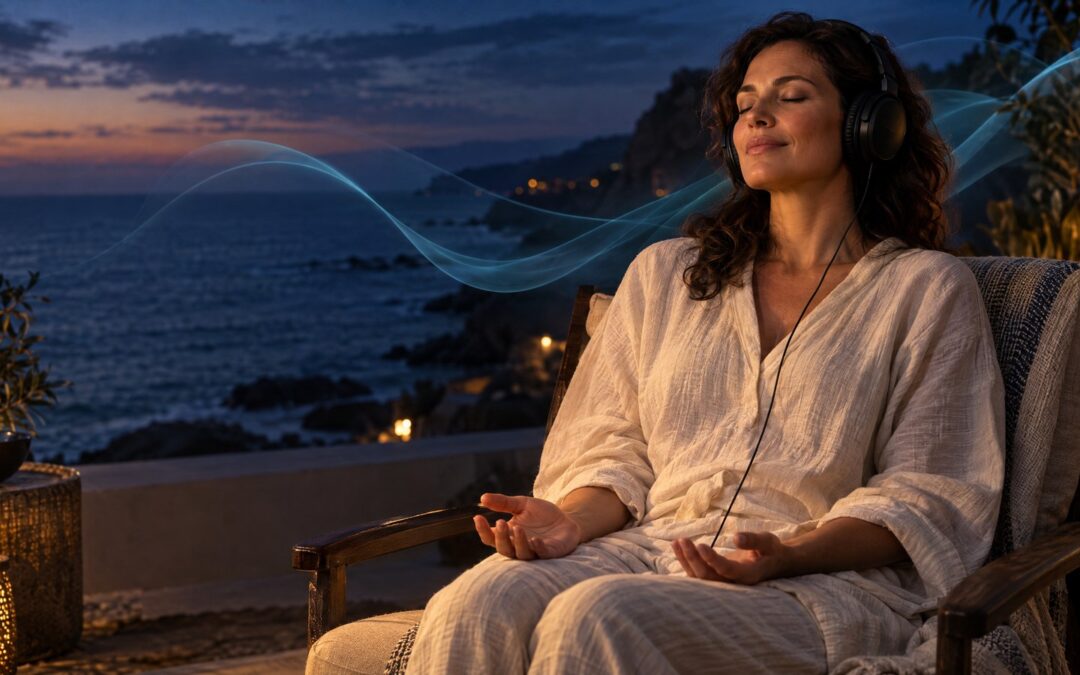
You know how to show up for people. But what happens when someone shows up for you? A compliment is deflected. An offer of help becomes an apology. Rest is postponed until everyone else is comfortable. For a reader who recognizes that pattern, receiving can feel more unfamiliar than giving.
That is the human question at the center of Open to Receive Living BioPhi Meditation, 432Hz Binaural Theta Journey. Its invitation is unusually direct: for a little while, you are not responsible for producing something, fixing someone or earning the right to rest.
The short answer: Open to Receive is documented by its creator as a 33-minute, 33-second guided meditation with six listening phases. Luma’s voice moves through a receiving-centered narrative over an evolving C-minor musical foundation, ocean textures and a stereo binaural design. Compatible haptic, bone-conduction and PEMF equipment offer optional additional delivery routes. Its strongest distinction is this integrated experience, not a claim that one frequency guarantees receptivity or that equipment makes meditation clinically superior.
Begin with the meditation: open the exact Open to Receive Living BioPhi Meditation, 432Hz Binaural Theta Journey programme on the PEMF Healing Platform. The current public page confirms the title; the detailed runtime and composition description below come from the creator’s supplied production brief. They are design documentation, not an independent measurement of the finished master or its effects.
Why learning to receive deserves serious attention
Giving often comes with a clear role. You know what to do and who needs you. Receiving asks something different: can you name a need, let another person contribute and tolerate not controlling every part of the exchange?
This is more than a pleasant meditation theme. Research on help-seeking gives part of the picture. A systematic review in young people identified preference for self-reliance, embarrassment and stigma among prominent barriers to seeking mental-health support. That population is not every adult, and accepting a meal is not the same as seeking clinical care. Still, the findings make a useful point: support being available and support being accepted are different questions.[1]
Caregiving research adds another perspective. In a small cross-sectional study of informal dementia caregivers, greater self-compassion was associated with lower caregiver burden and less dysfunctional coping. It does not show that this meditation changes those outcomes. It does underline why care for the person giving care belongs in the conversation.[2]
Make receiving concrete. Let someone prepare a meal. Accept a sincere compliment without immediately returning one. Ask for a clearly defined task to be shared. Give yourself an evening in which rest is a need, not a reward for exhaustion. These are suggested experiments in daily life, not a psychological diagnosis.
Receiving includes boundaries. You can welcome kindness and decline an obligation. You can accept practical help without accepting unwanted advice. You do not have to turn a clear no into a yes. The practice is choosing what is supportive, not making yourself available to everything.

The meditation’s most important innovation is the sequence
The composition does not lead with an instruction to believe harder. According to the production brief, it begins with arrival: a supported posture, comfortable breathing and attention to the jaw, shoulders and places where the body rests. Luma’s guidance then moves toward being held, opening the hands and noticing hesitation before introducing receiving statements.
This is a strong compositional decision. It gives the listener something specific to notice before offering an abstract idea to consider. A chair supporting your weight is an immediate experience. The possibility of accepting care can be explored from there.
The six listening phases are Arrival, Opening, Inner Awareness, Deep Receiving, Stillness, and Emergence. The voice has eight narrative movements within those six phases. There is no contradiction: spoken sections and musical phases are different organizational layers.
The arc moves from settling and noticing support to observing the quiet “not for me,” then to welcoming care, gratitude and a gentle return. Quieter passages leave space between instructions. They are deliberately reduced-intensity listening moments, not necessarily silence and not evidence that the listener has reached a special brain state.

Receiving statements that leave room for honesty
Short phrases such as “I receive with gratitude” can function as invitations. They do not need to become tests of whether you have achieved the right feeling. If a line feels too far from your present experience, try a more believable version: “I am willing to notice one form of support,” or “I can receive what helps and decline what does not.”
The distinction matters scientifically. Values-based self-affirmation research examines reflection on important values and sources of worth; it is not interchangeable with repeating flattering statements. Separately, experiments with a particular positive self-statement found that some participants with low self-esteem felt worse after repeating it. Neither finding evaluates this meditation, but both favor an honest, voluntary approach over forced agreement.[3] [4]
“Subconscious reprogramming” is sometimes used as marketing language for repeated practice. A clearer description here is rehearsing attention and a different response to support. You listen, notice your reaction and choose a small action afterward. That is a usable practice without pretending the recording has been shown to rewrite unconscious beliefs.
Why the sound feels like a journey rather than a backdrop
The documented musical foundation is C natural minor, tuned with an A4 = 432 Hz reference. A tuning reference organizes the pitch relationships of the music. It does not mean the listener hears only a continuous 432 Hz tone, and it is not the binaural difference or a measured brainwave.
Over that foundation, the brief describes gradually changing harmonic textures, soft spatial movement, ocean ambience and periods of retreat. Voice directs meaning; the musical bed supplies continuity; the ocean suggests arrival and release. “Living” describes this authored movement. It does not mean the track reads your body or changes itself using live EEG or heart-rate feedback.
The binaural element depends on slightly different audible tones reaching the two ears separately. The perceived fluctuation relates to their difference. Spatial audio, by contrast, concerns where sound seems to be located. A composition can use both without making them the same technique.[5]
There is real research here, but the most useful reading is precise. A 2019 meta-analysis found promising pooled outcomes across heterogeneous binaural-beat studies of cognition, anxiety and pain perception. A 2023 systematic review of EEG studies found inconsistent support for reliable brainwave entrainment. These results give context for the design, not proof that this recording places everyone into theta or makes affirmations bypass critical judgment.[6] [5]
Likewise, a small 432-versus-440 Hz music pilot provides preliminary listening research, not a universal verdict on which tuning is better. Here, 432 Hz is best understood as a deliberate musical choice within a complete composition. The quality of the experience also depends on pacing, timbre, narrative, volume and whether you actually like the sound.[7]
What the supplied spectrogram and vectorscope show

The two stacked channel spectrograms show horizontal bands, a brighter lower region and changes in spectral prominence across the displayed excerpt. The L/R vectorscope at the right shows a predominantly vertical trace with visible width. These are views of audio content and relationships between channels.
The image does not include enough readable timing and calibration information to reconstruct the complete session. It is also not EEG, spectroscopy of tissue or a physical PEMF field map. Its editorial value is showing an audio arrangement with visible structure and variation, while leaving the proprietary implementation private.
Why multimodal meditation is a forward-looking design direction
“Relax” is an instruction. Having a gentle sound, a clear voice cue and an optional physical point of contact gives attention something to work with. That is the compelling idea behind a layered format: different ways of engaging can serve the same contemplative intention.
General multisensory research describes interactions between attention and signals from different senses. It supports a design rationale for coordinating auditory and tactile cues. It does not establish that adding a PEMF coil to headphones and a haptic vest multiplies the effect of this meditation.[8]
Think of the layers by their actual jobs. The voice offers language and direction. The music and ocean textures shape an auditory environment. The binaural component adds ear-specific listening cues. Haptics can make parts of the audio physically perceptible. Bone conduction is another route for hearing through a transducer coupled to the skull. A suitable PEMF device adds a distinct physical field generated by its hardware.
These are not six independent clinical treatments hiding in a stereo file. Several are components of one audio stream; each physical device filters and transforms what it receives. With a compatible setup, sound and tactile sensation can be experienced together. A coil adds a different exposure whose output depends on its controller, geometry and operating conditions, not the meditation title.
ASMR research has documented changes in affect and physiology among people who experience ASMR, but triggers and responses vary. Vibroacoustic studies also explore relaxation-related responses, with designs that do not isolate every contribution or validate this specific soundtrack. They help explain why some listeners find a bodily anchor engaging without turning immersion into an assured outcome.[9] [10]
Integration is the opportunity. Choice is the safeguard. A listener who benefits from a felt vibration has another way into the practice. A listener who finds it distracting can remove it. Layering is useful when it reduces the effort of following the session, not when it becomes an equipment checklist.

Open to Receive compared with a common guided recording
The fair comparison is with a voice-led recording over a repeating musical bed, not with every form of meditation. Traditional practices can already include chanting, movement, music, silence and rich bodily awareness. Simplicity can be deeply effective as a preferred practice format; complexity does not establish depth.[11]
| Dimension | Voice-led recording with a repeating bed | Open to Receive’s documented design | Practical distinction |
|---|---|---|---|
| Central intention | Often general settling, focus or rest, depending on the recording. | A specific exploration of receiving love, support and care. | A defined emotional question can make reflection more concrete. |
| Sound movement | Repetition offers familiarity and predictability. | Evolving harmony, texture and stereo movement over an authored journey. | Different compositional experience, not proven superiority. |
| Narrative pacing | Instruction density varies by teacher and recording. | Spacious narration with intentional quieter passages. | Room to notice a response rather than continuously follow words. |
| Binaural listening | May or may not include separate-ear tones. | An intended alpha/theta-range binaural progression. | Reliable stereo separation preserves the intended cue; EEG state is not guaranteed. |
| Body experience | Breath and posture may already anchor attention. | Optional compatible haptic, bone-conduction or coil equipment. | Additional delivery options, with extra setup and individual tolerance. |
| Adaptation | A loop repeats its audio; a guided narrative may still evolve. | A pre-authored, changing composition. | Variation is a musical feature, not proof of avoiding cellular adaptation. |
| Access | Can be simple and equipment-light. | Headphones first, optional equipment later. | You do not need to buy a full stack to practice receiving. |
What makes this forward-looking is the move from one instruction channel to a coordinated, optional listening environment. It is a substantial design proposition: theme, voice, pacing and physical delivery considered together. Calling it the future of meditation is an editorial vision for that direction, not a demonstrated ranking above every meditation or an assertion that no one else uses multiple senses.
An evolving composition can maintain musical interest differently from a fixed loop. That does not justify the claim that familiar sound becomes useless or that variation prevents neural or cellular habituation. Predictability may be welcome. The useful question is which format lets this listener attend with less strain.
Choose the programme before choosing equipment
The featured session remains Open to Receive Living BioPhi Meditation, 432Hz Binaural Theta Journey. The following real platform programmes offer alternative moods or optional companion listening. Their exact titles describe catalogue entries, not independently established medical effects or reasons to substitute them for care.
| Linked programme | Role in a receiving-centered practice |
|---|---|
| Heart-Brain Love Matrix: 5-Phase Neurocardiac, Autonomic & Compassion BioPhi Energetics | A separate compassion-themed reflection after the main session, if you want more listening. |
| Muscle Relaxation Energetics | An optional settling-themed excerpt. Notice comfort rather than treating tension. |
| 432Hz Indian Flute Awakening Morning Meditation | A morning musical alternative on a day when you prefer a different texture. |
| Bb/A#: 15MIN Meditation Handpan 435Hz Ancient Love | An instrument-led alternative for listeners who prefer handpan music. |
| Heart Chakra, Anahata | A symbolic heart-centered intention, not a cardiac intervention. |
| 639Hz Love Relationships Solfeggio | A relationship-themed listening choice, without a promise about another person’s behavior. |
| C: Earth Grounding Lock, Wind Magic Harmonics ASMR | A contrasting ASMR texture for listeners who prefer a wind-themed atmosphere. |
| Sleep Energetics | A rest-themed evening alternative, not a diagnosis or treatment for sleep problems. |
Choose one or two companions, not all of them. Do not run tracks simultaneously. The main guided meditation should remain audible and intact, not compete with another affirmation or frequency recording.
How to set up headphones, haptics and a compatible coil
- Make the space supportive. Sit with back support or recline safely. Keep water nearby, silence notifications and allow time to return afterward. Open palms are an optional gesture, not a required mechanism.
- Use reliable stereo playback. Wired over-ear headphones are the creator’s preferred starting setup. Keep both channels active and check that mono accessibility/downmix is off. Suitable stereo earbuds or wireless headphones can preserve separate-ear delivery; they are not universally incapable of binaural listening. Start low enough to hear Luma comfortably without strain.[5] [12]
- Prepare with comfortable breathing. If the platform’s Breath Lab is available to you, use up to four minutes of gentle preparation. Timed box breathing is optional, not a gate you must pass. Breathe normally or count comfortably without holds if holding your breath causes air hunger, dizziness or anxiety.[13]
- Begin with the main recording alone. Play the linked Open to Receive session. The documented full runtime is 33:33. A shorter first exposure is acceptable for comfort; it is not a therapeutic dose or a failure to complete the practice.
- Add a haptic device only if it is welcome. For Woojer Vest 4, follow its manual for the selected audio input and headphone connection. Its separate audio-volume and sensation controls let you keep tactile output low while maintaining clear narration. Confirm the actual model’s supported route rather than inventing a splitter chain.[14]
- Check coil compatibility separately. Use only a coil/controller explicitly documented by its manufacturer as compatible with the intended input. Audio-input models require their approved signal path. Standalone models run through their own controls. Do not assume every iTorus accepts this recording or that headphones, vest and coil share a certified common route. Never connect a bare coil directly to a phone’s headphone output.
- Keep placement conservative. Follow the exact coil model’s distance, placement and operating limits. Start in its approved external arrangement, away from the head, neck and implanted electronics; do not invent chest or cranial placement because the script mentions the heart. Where suitable placement is not documented, leave the coil out and ask the manufacturer. Pregnancy, implanted devices and relevant medical conditions require device-specific guidance.
- Return before doing more. Let the final guidance finish, orient to the room and move gently. Spend several quiet minutes noticing how you feel. Do not drive or operate machinery while listening or while drowsy.
Bone-conduction headphones are an optional hearing route, not an established additional brain therapy. Sound transmitted through the skull can reach both cochleae, so separate-ear presentation depends on placement and hardware. They should not replace ordinary stereo headphones on the assumption that they preserve the same binaural isolation, nor should you increase pressure or vibration to chase a stronger experience.[15]
Equipment and platform resources
Affiliate disclosure: Some equipment links below are affiliate links. PEMF Magazine may earn a commission from qualifying purchases at no additional cost to you. Equipment is optional.
| Layer | Resource | Practical role |
|---|---|---|
| Programme access | Frequency Healing App | Find the exact linked session and check available playback options. |
| Optional PEMF | iTorus i2 or iTorus i5 | Choose by documented model capabilities, not by assuming audio-input compatibility or a universal field dose. |
| Optional haptic | Woojer Vest 4. Use code EPEMF10. | Audio-driven tactile sensation, with separate comfort controls and manufacturer precautions. |
| Optional ritual | iMPrinter | An optional intention-setting ritual. No demonstrated transfer of substances, nutritional properties or clinical effects into water is claimed. |
A practical seven-day receiving practice
The core is simple: prepare comfortably, listen to the primary recording and make one small receiving choice in daily life. All timings below are editorial wellness-listening suggestions, not medical doses. The main session’s 33:33 is its documented runtime; companion excerpts do not imply those programmes have five-minute native runtimes.
For an optional extended three-programme routine, run the primary first, take a 10-minute quiet gap, play up to 5 minutes of Heart-Brain Love Matrix: 5-Phase Neurocardiac, Autonomic & Compassion BioPhi Energetics, take another 10-minute quiet gap, then play up to 5 minutes of Muscle Relaxation Energetics. Keep companions audio-only unless their specific hardware use is separately documented. That extended option totals 43:33 of playback and 20 minutes of gaps, or 63:33 before preparation and journaling. The core does not require it.
| Day | Main session and setup | Receiving action to try |
|---|---|---|
| Day 1: Notice | Open to Receive Living BioPhi Meditation, 432Hz Binaural Theta Journey, up to the full 33:33. Headphones only; omit companions to learn the main experience. | Write down one offer of support you tend to dismiss. You do not have to accept it yet. |
| Day 2: Let it stand | Open to Receive Living BioPhi Meditation, 432Hz Binaural Theta Journey, 33:33 if comfortable. Repeat the same headphone setup; companions remain optional. | Accept one welcome compliment with a simple thank you, without explaining it away. |
| Day 3: Ask clearly | Open to Receive Living BioPhi Meditation, 432Hz Binaural Theta Journey, 33:33 if comfortable. If desired, add only a low haptic setting through its approved route. Use the extended companion sequence only if you want more listening. | Ask a trusted person for one specific, manageable form of help. |
| Day 4: Keep the boundary | Open to Receive Living BioPhi Meditation, 432Hz Binaural Theta Journey, 33:33 if comfortable. Keep the previous setup rather than adding more equipment. | Name what would make that help welcome. Decline an unwanted condition without apology. |
| Day 5: Compare comfort | Open to Receive Living BioPhi Meditation, 432Hz Binaural Theta Journey, 33:33 if comfortable. A manufacturer-approved coil setup may be the single optional change after compatibility and safety checks; otherwise keep headphones. | Notice whether added sensation makes following the session easier or more distracting. Neither response is a verdict about biology. |
| Day 6: Receive without repaying immediately | Open to Receive Living BioPhi Meditation, 432Hz Binaural Theta Journey, 33:33 if comfortable. Choose your most comfortable setup; optional companions follow the stated gaps. | Accept a welcome small kindness without turning it into an immediate exchange. Reciprocity can have its own time. |
| Day 7: Integrate | Open to Receive Living BioPhi Meditation, 432Hz Binaural Theta Journey, 33:33 if comfortable. Keep the setup simple enough to repeat without strain. | Choose one receiving habit worth keeping, and one boundary that makes it sustainable. |
After Day 7: take a seven-day pause from the structured programme schedule before deciding whether to repeat it. The pause is an editorial way to reflect and avoid turning rest into an obligation, not a biological washout period or a requirement to prevent adaptation. Daily-life receiving choices can continue.
A useful log takes less than a minute: “Before: comfort 0–10; willingness to accept one welcome form of support 0–10. Setup used. After: the same ratings. One real-world action. Any discomfort.” These are personal observations, not clinical measures, a diagnosis or a controlled test of which layer caused a change.
Best practices: carry receiving into the day
Choose a time when you can be unhurried. You may prefer an evening after caring for others or a quiet period before a difficult conversation. Do not turn listening into another task you must complete perfectly. If an open-palm posture, closed eyes or a phrase does not fit, adapt it.
Keep companions separate, leave quiet gaps and avoid competing recordings. Familiarity is not failure; you can notice something new in a repeated session without needing to increase intensity. A brief, genuine receiving action afterward is more useful than chasing an extraordinary sensation.
If you include an iMPrinter, follow its manufacturer’s instructions and keep the ritual separate from the listening evaluation. Use a clean container and ordinary safe drinking water if water is involved. Treat the activity as intention-setting, not water purification, a supplement or delivery of a substance’s biological effects.
For caregivers, practical help matters alongside reflection: protected time off, shared responsibilities and professional support when needed. Meditation should not become a way to tolerate an unsustainable arrangement indefinitely.
Comfort and safety are part of the design
Keep headphone volume comfortable and take breaks; a volume percentage is not a universal acoustic measurement. Stop for hearing discomfort, persistent ringing, headache, dizziness, nausea or agitation. Never make the sound louder because you expect a stronger frequency effect.[12]
Woojer Vest 4’s manual states that it is not suitable for people with pacemakers and includes pregnancy precautions. Other implants and magnetically sensitive devices require manufacturer and clinician advice before any PEMF or relevant haptic equipment is used. The FDA’s consumer-magnet guidance is a general interference warning, not clearance for an untested combined setup.[14] [16]
Meditation can also be uncomfortable for some people. Keep your eyes open, attend to the room, move or stop if inward attention becomes distressing. Distress is not proof that a hidden block is being released. Seek qualified support for severe or persistent anxiety, dissociation, agitation or symptoms affecting daily life.[11]
Educational and wellness disclaimer: This feature describes a meditation design and optional consumer-wellness experience. It is not medical advice, diagnosis or treatment. The specific recording and hardware combination have not been shown here to produce a particular psychological, neurological or clinical outcome. Consult appropriate professionals for health concerns, pregnancy, implanted devices and suitability questions, and follow every manufacturer’s instructions.
The real measure of receiving happens after the music
The ambition of Open to Receive is not small. It asks a person accustomed to giving to practice another role, through a thoughtfully paced narrative and an evolving listening environment. Its forward-looking quality is the care given to how those elements fit together and how optional sensory routes can make the practice more personally usable.
But the meaningful moment may be ordinary: letting a meal arrive, saying what help would be welcome, taking a rest without defending it, or believing a sincere thank you long enough not to push it away.
You can remain generous without being unavailable to care. Start with Open to Receive Living BioPhi Meditation, 432Hz Binaural Theta Journey, choose the simplest comfortable format and let one welcome form of support count.
References
- Gulliver A, Griffiths KM, Christensen H. (2010). Perceived barriers and facilitators to mental health help-seeking in young people: a systematic review. BMC Psychiatry. Full text.
- Joanna Lloyd; Jane Muers; Tom G Patterson; Magdalena Marczak. (2018 online publication). Self-Compassion, Coping Strategies, and Caregiver Burden in Caregivers of People with Dementia. Clinical Gerontologist. Journal record.
- Cascio CN and colleagues. (2016). Self-affirmation activates brain systems associated with self-related processing and reward and is reinforced by future orientation. Social Cognitive and Affective Neuroscience. Full text.
- Wood JV, Perunovic WQE, Lee JW. (2009). Positive self-statements: power for some, peril for others. Psychological Science. PubMed record.
- Ingendoh RM, Posny ES, Heine A. (2023). Binaural beats to entrain the brain? A systematic review of the effects of binaural beat stimulation on brain oscillatory activity, and the implications for psychological research and intervention. PLOS ONE. Full text.
- Garcia-Argibay M, Santed MA, Reales JM. (2019). Efficacy of binaural auditory beats in cognition, anxiety, and pain perception: a meta-analysis. Psychological Research. PubMed record.
- Calamassi D, Pomponi GP. (2019). Music Tuned to 440 Hz Versus 432 Hz and the Health Effects: A Double-blind Cross-over Pilot Study. EXPLORE. PubMed record.
- Xiaoyu Tang, Jinglong Wu, Yong Shen. (2016 journal issue; 2015 online publication). The interactions of multisensory integration with endogenous and exogenous attention. Neuroscience & Biobehavioral Reviews. Full text.
- Poerio GL, Blakey E, Hostler TJ, Veltri T. (2018). More than a feeling: Autonomous sensory meridian response (ASMR) is characterized by reliable changes in affect and physiology. PLOS ONE. Full text.
- Charlotte Fooks, Oliver Niebuhr. (2024). Effects of Vibroacoustic Stimulation on Psychological, Physiological, and Cognitive Stress. Sensors. Full text.
- National Center for Complementary and Integrative Health. Meditation and Mindfulness: Effectiveness and Safety. Evidence and safety guidance.
- World Health Organization. Deafness and hearing loss: Safe listening. Safe listening guidance.
- NHS. Breathing exercises for stress. Comfortable breathing guidance.
- Woojer. Vest 4 User Manual. Manufacturer connections and precautions.
- Surendran A, Prodanovic S, Stenfelt S. (2023). Hearing Through Bone Conduction Headsets. Trends in Hearing. Full text.
- U.S. Food and Drug Administration. Magnets in Cell Phones and Smart Watches May Affect Pacemakers and Other Implanted Medical Devices. Implant-interference guidance.