
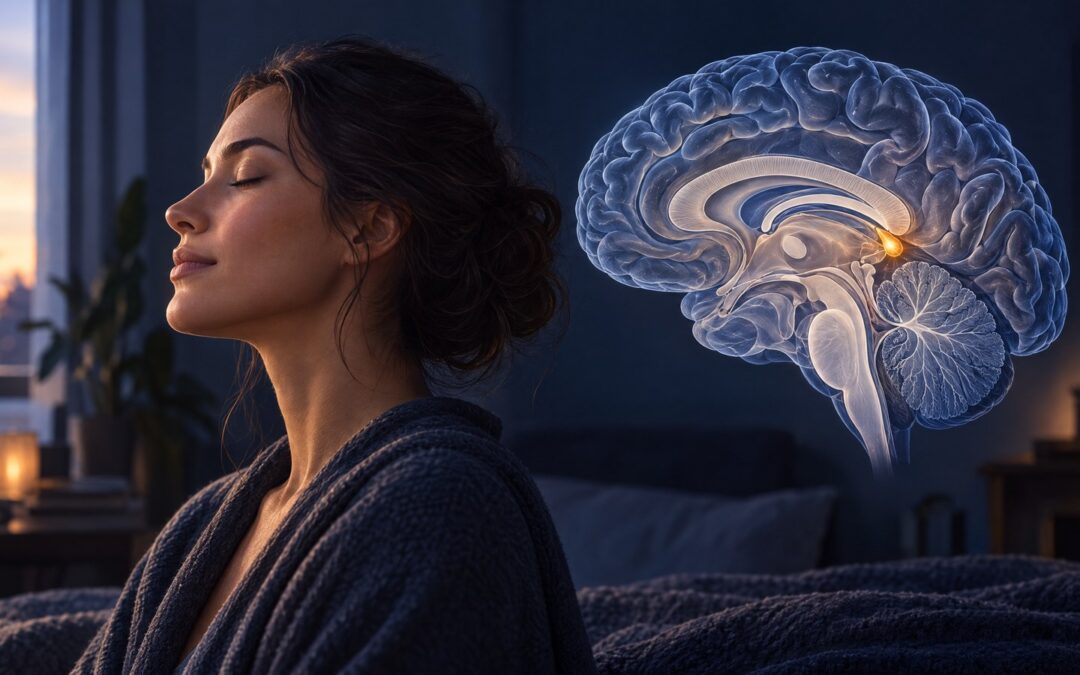
Can you “activate your pineal gland” in less than three minutes? You can begin a meaningful breath, sound and attention practice in that time. The compelling part is what you can do immediately: step away from bright stimulation, breathe without rushing, use a gentle hum and give your attention somewhere simple to rest. That is an accessible contemplative practice, not a demonstrated switch for melatonin, intuition or pineal calcification.
The pineal gland deserves the fascination. It is a small endocrine organ deep in the brain that helps communicate biological night through melatonin. Third-eye traditions give people a language for inner attention. The strongest guide respects both without making one pretend to prove the other.[1] [2]
Your optional listening centerpiece: 2675Hz Powerful Crystal Resonator Pineal Gland 3rd Eye Energetics in the Frequency Healing App. Its pineal and third-eye theme makes it relevant to this contemplative routine. The public page currently labels it subscriber-only; the equipment-free practice below does not require the app, a subscription or a device.

Start here: the three-minute pineal-themed practice
Choose a safe, supported seated position. Put away the screen and soften the light if convenient. Your eyes can remain open with a relaxed gaze or close gently. There is no need to press on your forehead, hold your breath or chase a sensation. Set up before starting the timer.
Minute 1: soften the setting and breathe comfortably
Let the inhale arrive easily through your nose if comfortable, then let the exhale be a little longer. You can try four comfortable counts in and six out, but the counts are optional cues, not mandatory seconds. Keep the breaths ordinary rather than unusually deep. If counting creates strain or air hunger, return to your natural rhythm.
Slow-breathing research reports autonomic and psychological changes across varied protocols. It offers a rationale for a gentle breathing pause, not proof that this exact minute changes the pineal gland.[3]
Minute 2: add a soft hum
On a comfortable exhale, close your lips gently and hum at an easy pitch. “Om” is an optional traditional choice; a simple “mmm” is equally sufficient for the exercise. Let the hum end before you run short of air. Notice whatever ordinary vibration you feel around the lips, nose or face without trying to drive it into a gland.
Om has a long history as a sacred syllable in Indian religious and contemplative practice.[4] In a small physiological study of ten healthy people, humming increased measured nasal nitric oxide compared with quiet exhalation. The endpoint was gas in the nasal airway, not pineal stimulation or a clinical benefit.[5]
Minute 3: give attention one gentle resting place
Rest attention on breathing or on the area between the eyebrows, whichever feels easier. If imagery helps, imagine a soft indigo color as a symbolic focus. You do not need to see a light, develop tingling or make the image brighter. When attention wanders, notice that and return without effort. Finish with an ordinary breath and gently open your eyes.
Want a version that is literally under three minutes? Use 45 seconds of breathing, 45 seconds of humming and 60 seconds of quiet attention. That totals two and a half minutes of practice, excluding setup. The three one-minute stages above total exactly three minutes. Neither timing is a validated endocrine dose.
Comfort rule: if breathing brings dizziness, tingling, air hunger, chest discomfort or increasing anxiety, stop the counting and humming and return to ordinary breathing. Stop the practice if discomfort persists. Do not interpret discomfort as an awakening, detoxification or something to push through.

What the pineal gland actually does
The adult pineal gland is approximately eight millimetres long, though size varies. It sits deep in the midline brain near the third ventricle, not behind the skin between the eyebrows. Its hormone-producing cells, called pinealocytes, synthesize melatonin through a biochemical pathway involving tryptophan, serotonin and N-acetylserotonin.[1]
Melatonin is best understood as a signal of biological night. Its rhythm helps coordinate sleep timing with the circadian system. Production is generally low during biological day and rises during biological night, but the timing and amount vary with age, schedule and light exposure. It is not an on-demand hormone that a meditation timer can be assumed to switch on.[1]
Darkness matters through the eyes and the body clock
In humans, the pineal gland does not directly watch the room grow dark. Light information enters through the retina and reaches the suprachiasmatic nucleus, or SCN, the brain’s circadian clock. Hypothalamic and spinal relays then connect that timing system to sympathetic nerves reaching the pineal through the superior cervical ganglion.[1]
At biological night, sympathetic signaling helps regulate the melatonin synthesis machinery. Light can suppress or shift that signal depending on its timing, intensity, spectrum and duration. Dimming the room can make a quiet evening practice comfortable, but three minutes with closed eyes is not a demonstrated melatonin activation protocol.[1] [6]

Why a short practice can still be worth doing
The value does not depend on proving an exotic mechanism. A small time commitment gives you a repeatable opportunity to notice your breathing, pause screen use and practice returning attention. For some people, gentle breathing or sound may feel settling. Others may simply notice that their mind is busy. Both are valid observations, not a pass or fail.
A systematic review of slow breathing found autonomic, brain-activity and psychological correlates, but the studies differed substantially.[3] A later review of breathing interventions found that implementation and duration matter; many sessions shorter than five minutes were less often effective, with confounding between protocol features. That is a reason to avoid a universal three-minute promise, not a reason to dismiss a brief personal pause.[7]
Start with a routine you can comfortably repeat. If you enjoy it, you can gradually give quiet attention more time. There is no need to claim that three daily minutes has been experimentally shown to outperform thirty occasional minutes. Consistency is a practical goal, not a guaranteed biological result.
The third eye: meaningful symbolism, different anatomy
Ajna is a chakra associated with the forehead or area between the eyebrows in particular Hindu and Tantric Buddhist systems. It provides a symbolic focus for inner attention; it is not an anatomical name for a hormone gland. An indigo image can be a personal contemplative choice rather than a claim about a measurable light inside your head.[2]
In the seventeenth century, René Descartes proposed that the pineal gland was the principal seat of the soul. That is a documented philosophical theory, not a modern finding that consciousness or intuition is localized in the gland.[8]
The Egyptian Eye of Horus, or wedjat, is documented in museum scholarship as a symbol of protection and regeneration. Modern comparisons between its shape and brain anatomy are interpretations, not secure evidence that ancient Egyptians encoded pineal anatomy.[9] You can appreciate a tradition’s meaning without turning resemblance into a medical mechanism.
Pineal calcification: what “brain sand” really means
Calcification is mineral deposition, often described as corpora arenacea or “brain sand.” These deposits include calcium-phosphate minerals. They are frequently visible on brain imaging and often become more apparent with age. Calcification is not the same thing as a cyst, tumor or a gland that has been switched off.[10] [11]
A 2023 systematic review pooled eight CT-based studies and estimated prevalence at about 62%. Results varied widely between the studies, so this is not a universal figure for every age or population. Most of the prevalence studies did not measure pineal function or melatonin.[10]
Some research has associated calcification or the amount of uncalcified tissue with melatonin and sleep measures. Those observations are interesting, but they do not show that a scan finding explains an individual’s insomnia or that removing deposits would restore normal sleep. A common imaging feature is not a diagnosis you can make from forehead sensations.[11]
Fluoride in water and the pineal gland: the finding worth understanding
The pineal-fluoride story begins with a real result, not an invented internet rumor. In 2001, Jennifer Luke reported fluoride measurements from the pineal glands of eleven aged human cadavers. Fluoride was present in the tissue, and pineal fluoride was associated with pineal calcium content.[12]
That deserves careful attention. Fluoride has an affinity for mineral-rich tissues, and pineal deposits provide a plausible place for it to accumulate. But finding fluoride in a calcified tissue does not show which came first. The study did not reconstruct lifetime exposure, identify drinking water as the source, measure living-human melatonin or demonstrate loss of intuition. It therefore cannot establish that community-water fluoride caused pineal calcification or functional harm.[12]
Why animal findings and sleep studies need separate labels
Luke’s earlier doctoral thesis included a gerbil experiment that reported differences in a urinary melatonin metabolite between fluoride-exposure groups. That is animal evidence in a thesis, not the same study as the peer-reviewed human cadaver paper and not proof of the effect in people drinking ordinary community water.[13]
Later observational studies examined fluoride exposure and sleep patterns in human populations. They measured exposure indicators and sleep outcomes, not pineal tissue or direct melatonin production. Such work can motivate better studies without resolving a pineal mechanism.[14] A water-quality decision should begin with your actual exposure, not an assumption that your third eye is blocked.

What current drinking-water research adds
United States context, reviewed November 11, 2026: CDC describes 0.7 mg/L as the recommended community-water concentration for cavity prevention. Fluoride may occur naturally in groundwater; utilities may adjust it upward or remove it when natural concentrations are high. That target is separate from EPA’s listed public-system maximum contaminant level of 4.0 mg/L and secondary standard of 2.0 mg/L.[15] [16]
The National Toxicology Program’s 2024 review found moderate-confidence evidence of an association between higher estimated fluoride exposure, illustrated by water concentrations above 1.5 mg/L, and lower IQ in children. NTP states that data are insufficient to determine an effect at 0.7 mg/L. Its review was not designed to isolate fluoridated water alone, and it does not establish a pineal mechanism.[17]
A 2025 meta-analysis also reported inverse exposure-IQ associations, while acknowledging limited data and uncertainty at lower drinking-water concentrations. Many included studies had high risk of bias. Urinary fluoride reflects an estimate of total exposure and cannot be converted directly into the effect of a particular tap-water concentration.[18]
This is an active research and assessment area. EPA published a toxicity-assessment protocol in August 2026; a protocol is not a completed assessment or a new final drinking-water rule.[19] The useful response is informed exposure management and proportionate questions, not a claim that every fluoride exposure damages the pineal gland.
Four useful steps if you are concerned about your water
- Find the actual result. Ask your public utility for its current fluoride concentration or annual water-quality report. For a private well, use a certified laboratory and ask local water or health authorities which contaminants should be included; groundwater fluoride can be naturally elevated.[20]
- Choose treatment by a tested claim. If you elect to reduce fluoride, look for a specific product listing and performance documentation naming fluoride reduction. NSF/ANSI 58 includes fluoride reduction as an optional claim for reverse-osmosis systems, not a guarantee attached to every RO unit or every NSF mark.[21]
- Do not rely on boiling or a generic charcoal claim. Boiling is not fluoride removal. Home-treatment performance varies by system, so check the actual contaminant-reduction claims and replacement schedule.[22] [23]
- Keep dental protection in the conversation. Fluoride’s cavity-prevention role involves repeated contact with tooth surfaces. A water concern is not evidence that fluoride toothpaste blocks the pineal gland; discuss individual oral-care choices with your dentist rather than abandoning protection based on that claim.[15]
Can you decalcify the pineal gland?
No clinically demonstrated home method for reversing pineal calcification was established in the evidence reviewed here. Food lists, sound, supplements, “detox” products and consumer devices should not be presented as proven ways to dissolve those deposits. A narrative review discussing possible future rejuvenation approaches is a source of hypotheses, not a consumer treatment protocol.[11]
The better-supported path is less dramatic and more actionable: give your circadian system dependable light and dark cues, protect regular sleep and get appropriate help for persistent symptoms. Do not start high-dose iodine, chelation or other “pineal detox” treatments on the basis of a wellness article.
DMT and the pineal gland: keep the wonder, get the experiment right
A 2019 study measured DMT in the brains of rats and detected an enzyme-related transcript, INMT mRNA, in sampled human brain tissue. Rat cortical DMT remained detectable after pineal removal. The human-tissue finding did not measure living-human pineal DMT release or demonstrate psychoactive levels.[24]
That research does not show that meditation, humming, dreaming or a three-minute routine releases a psychedelic dose from the human pineal. A pharmacology review addresses the gap between the popular story and the evidence.[25] You do not need to pursue altered chemistry to make a quiet practice personally valuable.
Choose your pineal-themed listening programmes
The featured selection is 2675Hz Powerful Crystal Resonator Pineal Gland 3rd Eye Energetics. Its exact title states a pineal and third-eye theme. It does not establish that its named frequency selectively stimulates the gland. The subscriber-gated page does not expose a complete runtime, phase count or signal specification, so those details are not invented here.
The relevant choices below let you organize a contemplative routine around brow-focused symbolism, gentle music, grounding or evening listening. Titles are retained exactly; words such as “activation,” “healing” and “detox” are catalogue names rather than verified endocrine or medical outcomes. The melatonin-named selection is not a hormone product, prescription or supplement.
| Exact programme | Role in this guide |
|---|---|
| 2675Hz Powerful Crystal Resonator Pineal Gland 3rd Eye Energetics | Primary pineal and third-eye thematic selection; complete runtime and signal details are not public. |
| Third Eye Chakra, Ajna, Pineal Gland | Ajna and third-eye symbolism for an optional attention focus. |
| Bb/A#: ASMR 963Hz Handpan, Freq of Gods, Awaken, Activate Pineal Gland Meditation | Pineal-themed handpan meditation for readers who prefer a musical setting. |
| 221.23Hz Chakra Ajna Third Eye Meditation Energetics | Ajna-focused contemplative theme, not a demonstrated gland response. |
| 13Hz Beta Third Eye Chakra, Power of Visualization/Conceptualize | Visualization theme; use without chasing sensory effects or performance. |
| Melatonin, Sleep, Restoration, Pineal, Circadian, Dreamwork Energetics | Evening and dreamwork theme. It is not melatonin supplied to the body. |
| Digital Blue Light Detox & Circadian Recovery 7-Phase BioPhi-Harmonic Energetics | Evening-listening theme to pair with actual dim-light habits, not a screen-light antidote. |
| 432Hz Indian Flute Awakening Morning Meditation | Morning musical companion, distinct from the physiological effect of ordinary daylight. |
| C: 8min Soulful Soundscape, 528Hz Handpan Meditation | Publicly described eight-minute musical soundscape; the short excerpt in the guide is optional. |
| ASMR Binaural Full Chakra and Grounding Guided Meditation, 432Hz+7.83Hz advanced healing | Guided grounding and chakra-themed listening. Binaural naming does not prove reliable entrainment. |
| 432Hz + 12th Sub, Calmness, Balance, Healing, Grounding Energetics | Calmness and grounding thematic companion, not a clinically validated physiological setting. |
What makes the integrated routine useful
You can choose a clear beginning and end, use musical or thematic companions that you enjoy and connect the listening time with an ordinary habit such as evening dimness or a brief reflection note. That is the practical distinction from merely repeating a tone and waiting for a sensation. The value is in the structure of your practice, not a demonstrated biological advantage of this programme over another meditation.
A frequency number alone does not specify binaural perception, modulation, a magnetic exposure or clinical effectiveness. Binaural listening depends on different tones reaching the two ears separately, and an EEG systematic review found mixed results for entrainment. Do not infer a binaural or phase-based architecture for the featured recording from its title.[26]
A seven-day guide you can actually follow
The core routine takes three minutes and requires no equipment. The optional programme routine is separate: choose a two-minute opener, a three-minute excerpt of the primary and a two-minute close, with thirty seconds of quiet between selections. That optional listening sequence takes eight minutes; with the separate core practice, the total is eleven minutes, excluding setup.
These are editorial time boxes for a manageable wellness routine, not full programme runtimes, treatment doses or an activation threshold. Use the platform’s playback controls and currently available length, stop sooner when needed and do not loop a selection automatically. The publicly described Soulful Soundscape lasts eight minutes; the two-minute excerpt below is a scheduling choice, not a claim that the complete recording lasts two minutes.
Do the equipment-free practice first, then listen if you want to extend it. If you use an optional manufacturer-approved coil setup, keep it separate from the core practice and follow the limits in the equipment section below. You do not need to apply a device to your forehead or head to follow this guide.
Day 1: Find a comfortable baseline
Start: do the equipment-free three-minute practice, or the two-and-a-half-minute variation if preferred.
- Optional opener, up to two minutes: 432Hz + 12th Sub, Calmness, Balance, Healing, Grounding Energetics.
- Quiet gap: thirty seconds.
- Primary, up to three minutes: 2675Hz Powerful Crystal Resonator Pineal Gland 3rd Eye Energetics. This is an editorial listening excerpt, not the full runtime or a hormone-activation dose.
- Quiet gap: thirty seconds.
- Optional close, up to two minutes: Third Eye Chakra, Ajna, Pineal Gland.
Today’s practical step: Use natural breathing first; add the optional counts only if easy. Write one sentence about comfort, not a hormone result.
If using optional equipment, follow the manufacturer-supported setup and placement described below. No device is required for the core practice.
Day 2: Try a softer sound
Start: do the equipment-free three-minute practice, or the two-and-a-half-minute variation if preferred.
- Optional opener, up to two minutes: C: 8min Soulful Soundscape, 528Hz Handpan Meditation.
- Quiet gap: thirty seconds.
- Primary, up to three minutes: 2675Hz Powerful Crystal Resonator Pineal Gland 3rd Eye Energetics. This is an editorial listening excerpt, not the full runtime or a hormone-activation dose.
- Quiet gap: thirty seconds.
- Optional close, up to two minutes: Bb/A#: ASMR 963Hz Handpan, Freq of Gods, Awaken, Activate Pineal Gland Meditation.
Today’s practical step: Keep the hum low and unforced. Notice whether quiet breathing or humming feels more comfortable; neither is a test of activation.
If using optional equipment, follow the manufacturer-supported setup and placement described below. No device is required for the core practice.
Day 3: Make the symbolic focus gentle
Start: do the equipment-free three-minute practice, or the two-and-a-half-minute variation if preferred.
- Optional opener, up to two minutes: ASMR Binaural Full Chakra and Grounding Guided Meditation, 432Hz+7.83Hz advanced healing.
- Quiet gap: thirty seconds.
- Primary, up to three minutes: 2675Hz Powerful Crystal Resonator Pineal Gland 3rd Eye Energetics. This is an editorial listening excerpt, not the full runtime or a hormone-activation dose.
- Quiet gap: thirty seconds.
- Optional close, up to two minutes: 221.23Hz Chakra Ajna Third Eye Meditation Energetics.
Today’s practical step: If brow imagery feels distracting, use the breath as your attention target. The goal is a manageable practice, not a vivid vision.
If using optional equipment, follow the manufacturer-supported setup and placement described below. No device is required for the core practice.
Day 4: Separate morning music from daylight
Start: do the equipment-free three-minute practice, or the two-and-a-half-minute variation if preferred.
- Optional opener, up to two minutes: 432Hz Indian Flute Awakening Morning Meditation.
- Quiet gap: thirty seconds.
- Primary, up to three minutes: 2675Hz Powerful Crystal Resonator Pineal Gland 3rd Eye Energetics. This is an editorial listening excerpt, not the full runtime or a hormone-activation dose.
- Quiet gap: thirty seconds.
- Optional close, up to two minutes: 13Hz Beta Third Eye Chakra, Power of Visualization/Conceptualize.
Today’s practical step: At a safe time after waking, spend ordinary time in outdoor daylight if practical. Do not look at the sun and do not close your eyes while walking.
If using optional equipment, follow the manufacturer-supported setup and placement described below. No device is required for the core practice.
Day 5: Make the evening setting quieter
Start: do the equipment-free three-minute practice, or the two-and-a-half-minute variation if preferred.
- Optional opener, up to two minutes: C: 8min Soulful Soundscape, 528Hz Handpan Meditation.
- Quiet gap: thirty seconds.
- Primary, up to three minutes: 2675Hz Powerful Crystal Resonator Pineal Gland 3rd Eye Energetics. This is an editorial listening excerpt, not the full runtime or a hormone-activation dose.
- Quiet gap: thirty seconds.
- Optional close, up to two minutes: Digital Blue Light Detox & Circadian Recovery 7-Phase BioPhi-Harmonic Energetics.
Today’s practical step: Lower room lighting and put the screen aside before the routine. Treat audio as an accompaniment, not protection from bright light.
If using optional equipment, follow the manufacturer-supported setup and placement described below. No device is required for the core practice.
Day 6: Ask an informed water question
Start: do the equipment-free three-minute practice, or the two-and-a-half-minute variation if preferred.
- Optional opener, up to two minutes: 432Hz + 12th Sub, Calmness, Balance, Healing, Grounding Energetics.
- Quiet gap: thirty seconds.
- Primary, up to three minutes: 2675Hz Powerful Crystal Resonator Pineal Gland 3rd Eye Energetics. This is an editorial listening excerpt, not the full runtime or a hormone-activation dose.
- Quiet gap: thirty seconds.
- Optional close, up to two minutes: Melatonin, Sleep, Restoration, Pineal, Circadian, Dreamwork Energetics.
Today’s practical step: Look up your utility’s fluoride result, or ask a certified laboratory about a private-well panel. Do not infer exposure from sleep or forehead sensations.
If using optional equipment, follow the manufacturer-supported setup and placement described below. No device is required for the core practice.
Day 7: Review what is worth keeping
Start: do the equipment-free three-minute practice, or the two-and-a-half-minute variation if preferred.
- Optional opener, up to two minutes: ASMR Binaural Full Chakra and Grounding Guided Meditation, 432Hz+7.83Hz advanced healing.
- Quiet gap: thirty seconds.
- Primary, up to three minutes: 2675Hz Powerful Crystal Resonator Pineal Gland 3rd Eye Energetics. This is an editorial listening excerpt, not the full runtime or a hormone-activation dose.
- Quiet gap: thirty seconds.
- Optional close, up to two minutes: Bb/A#: ASMR 963Hz Handpan, Freq of Gods, Awaken, Activate Pineal Gland Meditation.
Today’s practical step: Review the week for comfort and feasibility. Keep what you enjoy, shorten what feels cumbersome and seek appropriate help for persistent symptoms.
If using optional equipment, follow the manufacturer-supported setup and placement described below. No device is required for the core practice.
At the end of the week, decide whether the routine was comfortable and worth keeping. Continue, shorten it or take a week off to reflect. A pause is a personal scheduling choice, not a necessary biological washout or “reset.”
Optional equipment: audio, haptics and PEMF are different paths
Ordinary listening is the simplest starting point. Audio reaches you through acoustic transducers; haptics use mechanical vibration; PEMF equipment produces a device-specific magnetic field. These are not interchangeable exposures, and combined use does not establish a pineal effect.
| Choice | Useful role | What you should not infer |
|---|---|---|
| Quiet breath, optional hum and attention | A short, accessible contemplative pause with no equipment. | A measured melatonin increase or decalcification. |
| Low-volume audio through ordinary headphones | An optional musical or thematic setting for personal attention. | Selective pineal stimulation from a named frequency. |
| Compatible haptic equipment | Optional tactile content within the transducer’s supported range. | That every audible tone is reproduced mechanically or that vibration has a hormone effect. |
| Manufacturer-supported coil system | An optional consumer-wellness device used within its own electrical and placement limits. | That an audio file specifies coil current, field strength or a clinical dose. |
If you already own an iTorus
- Check the official model-specific setup resources. Use only a manufacturer-supported source, connection and placement. Do not connect a bare coil directly to a phone headphone output.
- Choose a safe seated session and verify the setup before playback. This article does not prescribe head, neck or brow placement, current, field intensity or output level.
- Open the exact programme linked for that day. If the equipment does not explicitly support the intended source and interface, use ordinary audio instead. Do not improvise cables, adapters or amplifiers.
- Stay within the manufacturer’s limits. Do not turn up the output to make a faint tone stronger or pursue a more intense “third-eye” sensation. Stop if equipment becomes hot, distorted or uncomfortable.
A specific haptic compatibility point
Woojer lists a haptic response range of 1 to 250 Hz for Vest 4. The primary programme’s named 2675 Hz is outside that advertised tactile range. Its title therefore does not justify promising that Vest 4 will reproduce the named tone as vibration. The gated description does not confirm a lower-frequency haptic layer. Use suitable content and the current manual, not a stronger intensity setting, to address compatibility.[27]
Affiliate disclosure: some links below are affiliate resources. PEMF Magazine may earn a commission from qualifying purchases at no additional cost to you. Equipment is optional; none is required for the three-minute practice.
| Resource | Linked option | Practical role and boundary |
|---|---|---|
| Platform | Frequency Healing App | Explore the linked catalogue and available playback controls. The featured primary is currently subscriber-only. |
| Consumer PEMF | iTorus i2 or iTorus i5 | Optional manufacturer-limited equipment. No pineal targeting, treatment setting or validated dose is provided. |
| Haptics | Woojer Vest 4. Use code EPEMF10. | Optional compatible tactile content. Read the manual; checkout eligibility for the code is subject to current merchant terms. |
| Intention ritual | Metatronic Flower of Life iMPrinter | An optional personal ritual accessory, not a fluoride filter, melatonin treatment or decalcification method. |
Best practices: work with the gland’s real rhythm
Make daytime and nighttime different. For healthy adults with a regular daytime schedule, expert light guidance favors brighter daytime exposure, dimmer evenings and a dark sleep environment. Get ordinary outdoor daylight when practical, without looking directly at the sun, and preserve enough light for safe movement at night. If you work shifts or have a circadian disorder, seek individualized guidance rather than applying a generic morning rule.[6]
Reduce bright evening stimulation. Lower room lighting and screen brightness rather than assuming only a blue-light filter controls the entire exposure. Timing, intensity and spectrum all matter. A phone-free breathing pause can be part of this routine, but it does not replace the light and sleep schedule around it.[6]
Protect a consistent sleep opportunity. Use a routine you can sustain and discuss persistent sleep difficulty with a qualified clinician. Melatonin supplements are a separate medication or supplement question, not proof that an energetic programme changes the gland. Ask about suitability, interactions and timing rather than using a “pineal activation” label as a dosing guide.
Listen gently. WHO emphasizes sound level, duration and repeated exposure in hearing risk. Keep audio low and comfortable, take breaks and never raise the volume to make an alleged energetic effect stronger. Do not use eyes-closed listening, headphones or haptics while driving or doing attention-critical tasks.[28]
Daily iMPrinter practice, if you use one
Keep this separate from biological or water-treatment claims. On a dry, stable surface, use the accessory only as the manufacturer permits. Choose a nonmedical intention such as “I make space for quiet attention,” play your chosen content only within the equipment’s supported limits and finish with a brief reflection note. This article supplies no imprinting dose or treatment duration.
Keep fluids sealed and away from electrical connections. An iMPrinter is not a fluoride-removal system and does not establish a change in the chemistry or safety of water. Do not treat imprinted water, supplements or medicines as substitutes for testing, filtration or prescribed care.
What to notice, and when to get medical help
You can note comfort, how easy it was to return attention, whether a screen-free pause felt useful and whether the routine fits your evening. Tingling, warmth, vivid imagery or a quiet moment are subjective experiences, not tests of pineal activation, calcification, DMT or hormone output. An uneventful practice is not a failure.
Pineal cysts are often incidental and benign. Persistent or worsening headaches, repeated vomiting, new double vision or difficulty looking upward, or new balance problems need medical assessment rather than an “awakening” explanation. Seizures, severe confusion or reduced consciousness require urgent care.[29]
Before optional magnetic, electrical or haptic equipment, consult the manufacturer and an appropriate clinician about implanted electronic devices, pregnancy or relevant medical conditions. Woojer specifically states that Vest 4 is unsuitable for people with pacemakers and advises physician approval during pregnancy.[27]
The practical conclusion: start with the short routine because it is accessible, not because you must force a hidden gland to open. Support your circadian rhythm with real light and sleep habits, investigate water concerns with measurements and let spiritual imagery remain a source of meaning. You can take the practice seriously without turning it into a hormone claim.
Educational and wellness disclaimer: this article provides informational wellness guidance, not medical advice, diagnosis or treatment. The practice and programme selections do not establish pineal activation, decalcification, fluoride removal or a clinical outcome. Spiritual interpretations are offered as symbolism. Consult a qualified professional about health concerns, symptoms, pregnancy, implanted devices, medications or equipment suitability, and do not delay or replace licensed medical care.
References
- Endotext. Physiology of the Pineal Gland and Melatonin. Direct source.
- Encyclopaedia Britannica. Chakra, including Ajna and symbolic third-eye placement. Direct source.
- Zaccaro et al. (2018). How Breath-Control Can Change Your Life: A Systematic Review on Psycho-Physiological Correlates of Slow Breathing. Direct source.
- Encyclopaedia Britannica. Om: sacred syllable and Indian religious practice. Direct source.
- Weitzberg and Lundberg. (2002). Humming greatly increases nasal nitric oxide. Ten healthy subjects; nasal-gas outcome. Direct source.
- Brown et al. (2022). Recommendations for daytime, evening and night-time indoor light exposure to best support physiology, sleep and wakefulness in healthy adults. Direct source.
- Bentley et al. (2023). Breathing Practices for Stress and Anxiety Reduction: Conceptual Framework Based on a Systematic Review. Direct source.
- Stanford Encyclopedia of Philosophy. Descartes and the Pineal Gland. Historical philosophical attribution. Direct source.
- The Metropolitan Museum of Art. Ancient Egyptian Amulets, including wedjat protection and regeneration symbolism. Direct source.
- Belay and Worku. (2023). Prevalence of pineal gland calcification: systematic review and meta-analysis. Eight quantitative studies with high heterogeneity. Direct source.
- Tan et al. (2018). Pineal Calcification, Melatonin Production, Aging, Associated Health Consequences and Rejuvenation of the Pineal Gland. Narrative review and hypotheses. Direct source.
- Luke. (2001). Fluoride deposition in the aged human pineal gland. Caries Research. Chemistry measurements in eleven aged cadavers. Direct source.
- Luke. (1997). The Effect of Fluoride on the Physiology of the Pineal Gland. University of Surrey doctoral thesis; animal work is distinct from the human cadaver paper. Direct source.
- Fluoride exposure and duration and quality of sleep in a Canadian population-based sample. (2021). Observational exposure and sleep outcomes. Direct source.
- Centers for Disease Control and Prevention. About Community Water Fluoridation. Direct source.
- US Environmental Protection Agency. Drinking Water Regulations and Contaminants. Direct source.
- National Toxicology Program. Fluoride Exposure: Neurodevelopment and Cognition. Monograph summary, exposure context and lower-concentration uncertainty. Direct source.
- Fluoride Exposure and Children's IQ Scores: A Systematic Review and Meta-Analysis. (2025). JAMA Pediatrics. Observational associations and exposure-range limitations. Direct source.
- US Environmental Protection Agency. (August 2026). Protocol for Developing the Fluoride Human Health Toxicity Assessment. Protocol, not a completed assessment or final rule. Direct source.
- US Environmental Protection Agency. Potential Well Water Contaminants and Their Impacts. Direct source.
- NSF. NSF/ANSI 58: Reverse Osmosis Drinking Water Treatment Systems. Fluoride reduction is an optional product-specific claim. Direct source.
- Centers for Disease Control and Prevention. How to Make Water Safe in an Emergency. Boiling is a germ-control measure, not fluoride removal. Direct source.
- Centers for Disease Control and Prevention. About Home Water Treatment Systems. Contaminant removal is system-specific. Direct source.
- Dean et al. (2019). Biosynthesis and Extracellular Concentrations of N,N-dimethyltryptamine (DMT) in Mammalian Brain. Rat measurements and human-tissue transcript localization. Direct source.
- Nichols. (2018). N,N-dimethyltryptamine and the pineal gland: Separating fact from myth. Review. Direct source.
- Ingendoh et al. (2023). Binaural beats to entrain the brain? A systematic review. Mixed EEG findings and methodological heterogeneity. Direct source.
- Woojer. Vest 4 User Manual. Technical response ranges, supported interfaces and safety warnings; not clinical pineal evidence. Direct source.
- World Health Organization. Deafness and hearing loss: Safe listening. Direct source.
- University Hospitals Plymouth NHS Trust. Pineal Cysts. Incidental findings and clinical warning signs. Direct source.