
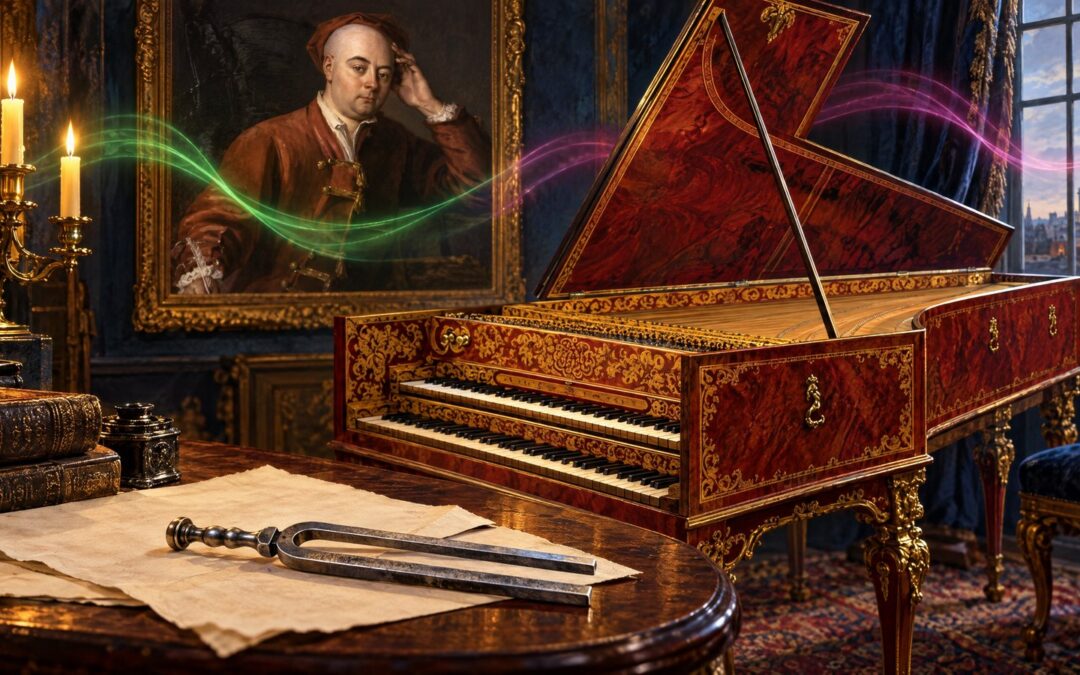
THE FORGOTTEN PITCH OF BAROQUE MUSIC
Have you been hearing Handel at the wrong pitch? A historical reference of A = 422.5 Hz places his sound world almost three-quarters of a semitone below modern A = 440. That is enough to make the question audible, not merely academic. The fascinating part is that the evidence leads somewhere more interesting than a claim that one number is universally right.[1][2]
The short answer: Alexander J. Ellis published 422.5 Hz as Handel’s pitch. It is a valuable historical clue, not a universal specification for everything Handel wrote. Modern 440 is a later coordination standard. It can be inappropriate as an automatic assumption about an eighteenth-century performance without being wrong for every modern performance.[1][11]

What the Handel tuning-fork story actually reveals
A tuning fork preserves something a score usually does not: a physical pitch reference. The written note A tells a player which note to play. It does not, by itself, settle how many vibrations per second that note should have sounded in a particular room in a particular year. That distinction makes an old fork an unusually compelling witness to musical history.[5][13]
Ellis’s The History of Musical Pitch gives A422.5 as Handel’s pitch and describes the distance to A440 as about 70 cents. The association is often retold through a fork and a box inscription connecting Handel with a Messiah performance at the Foundling Hospital in 1751. Handel’s broader relationship with the institution is well documented, including benefit performances and his role as a governor.[1][3][4]
There is a consequential detail that popular versions often omit. Music historian Fanny Gribenski reports a curator’s identification of the Handel-associated fork held by the Foundling Museum as a C fork. The fork discussed by Ellis and his associates was an A fork, whose whereabouts are unknown. We should therefore not point to today’s museum-associated object and claim that it is securely the surviving A422.5 fork.[2]
This distinction does not erase Ellis’s published figure. It tells us exactly how to use it: as a reported historical pitch reference with an incomplete object history. The printed decimal is also not a modern calibration certificate. The measurement temperature and uncertainty for that particular reading were not established in the sources reviewed here.[1][2]

Why would Handel’s music have used a lower reference?
The strongest answer begins with the practical world in which he worked. Eighteenth-century performers did not all tune to a single global reference. A venue’s instruments, local practice and available performers shaped the sound. The modern expectation that every ensemble can begin with one universally shared electronic A is the wrong starting assumption for that world.[9][14]
Consider the organ. It is an extensive system of pipes, wind supply and stops, not a violin string that can simply be tightened a little before a concert. A historical organ’s construction and pitch could become a practical anchor for other players. Wooden winds and natural brass also brought construction-dependent limitations. A player could not always transfer a part to a different pitch level with the freedom of a modern pitch-shifting plug-in.[6][7]
The human side mattered too. Voices, available instrumental forces and local continuo practice were part of a performance’s actual conditions. Historical performance involved accommodation and interpretation, not just reproduction of a numerical setting. Instrument design and musical technique worked together to establish what a particular ensemble could do well.[6][8]
Those are evidence-based reasons that a lower local pitch could make sense. They are not evidence that Handel selected exactly 422.5 for a secret physiological effect, a universal natural law or a documented campaign against 440. No personal statement establishing such a motive emerged from this research. His music belongs to a historically variable performance culture, and that is already a substantial answer.[1][2][9]
Why 440 Hz can be the wrong historical assumption
The real correction is not “440 is false.” It is “440 is not timeless.” A modern reference can be useful for coordination and still be a poor default for reconstructing a specific earlier sound world. French A435 became an important national standard in 1859. The twentieth-century international history later converged on 440 through musical, scientific, manufacturing and broadcasting negotiations.[9][12]
The primary standardization record describes an international London conference endorsing A440 in May 1939, further consideration in 1953 and an ISO recommendation in 1955. ISO 16:1975 specifies 440 Hz as standard musical pitch. It supplies a reference for agreement, not a proof that every earlier composer conceived music at that pitch or that another reference is acoustically illegitimate.[10][11]
That gives historically informed performance a clear purpose. It asks which instruments, pitches, interval systems and techniques best illuminate the work and its circumstances. A modern Handel performance at 440 can be artistically persuasive. It should not be mistaken for a self-evident recovery of the pitch heard at every Handel premiere.[14]
422.5, 423 and 415 are not interchangeable
Three numbers are easily collapsed into one story. Ellis’s reported figure is 422.5. The often-quoted 423 is a rounded presentation. 415 is a common working reference in modern Baroque performance, including institutional historical-performance practice. It is not the universal original tuning of the Baroque era.[1][3][15]
A second distinction is even more important. Reference pitch establishes an anchor such as A = 422.5. Temperament describes how the intervals are distributed within the octave. Move an entire recording down by one ratio and its interval ratios stay the same. You have moved the pitch framework, not selected a historical temperament.[13][14]
This is why a retuned modern track is an excellent listening demonstration but not a time machine. It does not replace modern strings with historical strings, remake a flute, alter a harpsichord’s temperament or supply eighteenth-century articulation and ornamentation. Historical sound is a performance system, not one number pasted onto an audio file.[6][14]
The exact shift from A440 to A422.5
Musical intervals depend on frequency ratios. A cent is one hundredth of an equal-tempered semitone. The calculation below describes a ratio between reference frequencies; it does not require the music itself to use equal temperament.[13]
Semitones = 12 × log2(422.5 / 440) = −0.702626Cents = 1200 × log2(422.5 / 440) = −70.262619
| Target A reference | Difference from 440 Hz | Semitone adjustment | Cent adjustment |
|---|---|---|---|
| 422.5 Hz | −17.5 Hz | −0.702626 | −70.2626 cents |
| 423 Hz | −17 Hz | −0.682150 | −68.2150 cents |
For a tuner: set its adjustable A reference directly to 422.5 Hz if supported. If it stays calibrated at 440 and displays cents relative to that reference, the corresponding A is approximately 70.26 cents flat. A whole-cent control gives −70 cents; a tenth-cent control gives −70.3. A pitch-shift effect applied to a verified A440 source would use the same ratio. Check the tool’s controls rather than treating an A-reference setting and a transpose setting as the same function.
The −17.5 Hz difference applies to the A reference. It is not an instruction to subtract 17.5 Hz from every note. A uniform transposition multiplies all frequencies by about 0.960227. That preserves their ratios. Also, a modern recording should not be assumed to begin at A440 merely because it is modern.[13]

Press play: 440 Hz and 422.5 Hz side by side
This is the giveaway you can hear before you download. The two full versions of Golden Ratio Invocation below are contemporary creator-supplied instrumental demonstrations. Music by Art Tawanghar. They are not compositions by Handel and are not recordings of his orchestra. Their role is to make a pitch-level change directly comparable.[20]
Version A: A = 440 Hz
Green reference · Golden Ratio Invocation
Music by Art Tawanghar.
Full comparison track: approximately 3 minutes 29 seconds.
Version B: A = 422.5 Hz
Pink/purple reference · Golden Ratio Invocation
Music by Art Tawanghar.
Full comparison track: approximately 3 minutes 29 seconds.
Compare sequentially, not simultaneously. Choose the same passage in each player, for example 0:30 to 1:00. Listen to A, pause it, then start B at the same time position. Repeat in the opposite order. These are independent native browser players, so you control the switching; they do not automatically synchronize or stop one another.
Both supplied files have the same encoded duration, approximately 208.9 seconds, and very similar measured integrated loudness, approximately −16.3 and −16.4 LUFS. LUFS is an audio-file loudness measure, not the sound level at your ears. A relative matched-peak analysis across several passages found a shift of about 70.3 cents lower, consistent with the intended ratio. That checks the relative comparison; it does not independently calibrate the absolute A reference or identify the producer’s exact processing method.[20]
Keep the playback device unchanged and match the perceived loudness comfortably. Louder can be mistaken for better. You might hear a different register, bass weight or sense of brightness, or prefer different versions on different days. Those are worthwhile listening observations, not a test of health, intuition or historical authenticity.[17]
Green and pink: what the supplied spectrograms show
These displays combine waveform overviews with stereo spectrograms. Time runs horizontally and frequency vertically. Colour intensity represents spectral magnitude according to the display’s chosen settings. The green and pink/purple palettes are visual choices, not different kinds of acoustic energy.[25]


The screenshots are helpful views of the recordings’ changing spectral content. By themselves they do not establish the pitch of a particular notated A, confirm an eighteenth-century tuning system or show a biological effect. The audio-file comparison provides a separate relative-pitch check. Keeping those jobs separate makes the visual evidence more useful.
440 Hz vs 422.5 Hz: see the contributor’s sand test
You can hear the comparison above. Here is a visual counterpart from a different kind of experiment. The article contributor supplied this image from a sand test, labelled 440 Hz on the left and 422.5 Hz on the right. Both panels show organized, curved traces of sand on circular surfaces. The full comparison is reproduced below, with the original labels retained.[28]

The physics is genuinely interesting. In a classic Chladni plate experiment, vibration moves sand away from strongly moving regions and toward relatively stationary nodal lines. Those lines reveal a standing-wave pattern in the plate. The grains make a mechanical response visible, rather than drawing the airborne sound wave itself.[26]
The pattern belongs to the frequency-and-apparatus combination. Plate material, dimensions, mounting and the position of the drive influence which modes appear. A different plate can produce a different figure at the same frequency. A visually appealing pattern is therefore not a universal signature of a number, or a ranking of which tuning is better for listeners.[26][27]
There is also an important musical distinction: a tone at 422.5 Hz is not the same thing as a whole composition tuned to A = 422.5 Hz. The latter contains many changing notes and harmonics. The supplied test does not specify whether its stimulus was a single tone or music, so these figures should not be described as measurements of the two complete recordings above.[13]
The image adds a tangible invitation to explore vibration. A repeatable comparison would document the plate, supports, drive level, measured frequency, sand loading and observation time. Those methods were not supplied here, so we present it as a contributor-reported demonstration, not evidence that 422.5 is medically superior or that it reconstructs Handel’s original performance.
Sand, water and ferrofluid: three materials, three responses
The contributor also supplied this broader side-by-side comparison, with 440 Hz on the left and 422.5 Hz on the right. It brings the sand figures together with water-surface patterns and ferrofluid spikes. What makes the comparison interesting is that each material responds through a different physical mechanism.[32]

Sand: a plate’s vibration becomes visible
The sand row illustrates the Chladni-type comparison described above. Grains trace a vibrating plate’s relatively stationary nodal lines. The response belongs to the plate and its supports as well as the driving signal, so the same frequency need not make the same figure on another apparatus.[26][27]
Water: surface motion, depth and boundaries
A mechanically driven liquid surface can form standing-wave patterns under suitable conditions. Faraday waves are a well-studied example generated by vertical vibration of a container. Their response depends on forcing frequency and acceleration, liquid properties, depth and vessel boundaries. A surface pattern is not evidence that a musical tuning changes water’s chemical identity or gives it a health benefit.[29][30]
Ferrofluid: magnetic forcing is essential to the explanation
Ferrofluid’s characteristic spikes can arise when an applied magnetic field exceeds the threshold for Rosensweig instability. Their formation and arrangement depend on magnetic-field conditions and the fluid system. If vibration or an audio-controlled electromagnet is added, that setup must be described to interpret its effect. The graphic’s phrase “magnetic field shaped by vibration frequency” should not be read as evidence that a 440 or 422.5 Hz sound alone creates a particular magnetic field or spike pattern.[31]
The useful connection is material response, not a universal verdict. These comparisons invite readers to explore how signals interact with physical systems. They do not rank the two tunings as healthier, establish their effects in the human body or identify Handel’s original sound. The audio players remain the direct way to compare the supplied music; these graphics add a separate, contributor-reported visual exploration.
What did Handel’s music really sound like?
The answer is richer than “the same recording, slightly lower.” A historically informed performance explores the relationship between reference pitch, temperament, instrumental construction, vocal production and musical gesture. A harpsichord’s plucked attack, a period wind player’s phrasing and a continuo group’s choices belong to the sound as much as the frequency of the tuning note.[6][8][14]
Digital comparison offers a narrower but powerful opportunity: hold the musical material relatively steady and listen to a changed pitch level. If a producer instead lowers playback rate, pitch and speed move together. A tempo-preserving pitch shift aims to separate those changes, but its processing can introduce artifacts. Ordinary sample-rate conversion that preserves duration should not be confused with playing the same samples at a slower rate.[16]
| Question | What a shifted comparison can reveal | What requires more evidence or a different performance |
|---|---|---|
| Does the reference move? | A consistent frequency-ratio shift can be measured. | Absolute tuning requires a known original reference. |
| Does the music feel different? | You can report your own perception and preference. | A general audience preference needs controlled listening research. |
| Is the temperament historical? | A uniform shift preserves existing interval ratios. | A historical temperament must be established separately. |
| Is this Handel’s original sound? | The comparison makes a lower pitch framework audible. | Instrumentation, technique, venue and performance-specific pitch need their own evidence. |
The conclusion is clear: 440 should not be imposed on the past as though it had always been there. But replacing that assumption with one allegedly universal 422.5 would repeat the same mistake. The more revealing practice is to compare, contextualize and listen.
Explore music as an active listening practice on PEMF Healing
The PEMF Healing platform offers a practical place to continue with instrument-based meditations and soundscapes. The selections below are linked for their musical content, not because a catalogue number proves a healing effect or duplicates Handel’s reported pitch. Some entries are subscriber-only. The free two-track download in this article is separate from platform membership.[21]
A particularly relevant musical companion is E: 432Hz Persian Santoor, Handpan, Didgeridoo Meditation. Its public page describes a 60-minute collaboration with Persian Santoor by Cale Alit, handpan by Art Tawanghar and didgeridoo by Dragon Fire. Plucked-string resonance makes it an engaging next listen after a harpsichord-focused history, without pretending the instruments or traditions are interchangeable.
- E: 432Hz Persian Santoor, Handpan, Didgeridoo Meditation. 60-minute instrumental collaboration. Use a short excerpt for the exercise.
- B: Handpan B Amara in 432Hz Meditation. Handpan composition; use the available playback controls.
- A: 444Hz Sacred Handpan Hijaz Live Meditation. Public description: 23 minutes.
- C: 8min Soulful Soundscape, 528Hz Handpan Meditation. Public description: 8 minutes.
- Bb/A#: 15MIN Meditation Handpan 435Hz Ancient Love. Premium entry with a 15MIN title; full runtime not independently exposed.
- E: ASMR Binaural 432Hz Handpan Rain Meditation. Public description: 33:33.
- E: Jungle Jam 432Hz Handpan Night Meditation. Subscriber-only musical entry; runtime not publicly exposed.
- F#/Gb: 444Hz Handpan + Shamanic Drum Moon Meditation. Subscriber-only handpan and drum entry; runtime not publicly exposed.
- 432Hz Indian Flute Awakening Morning Meditation. Subscriber-only flute entry; runtime not publicly exposed.
- 444Hz Harmony of Soul Morning Movement Meditation. Subscriber-only musical entry; runtime not publicly exposed.
Frequency labels above are reproduced as published programme titles. They do not all necessarily mean a verified A4 reference, and they should not be read as different clinical doses. In particular, the 435-labelled handpan entry is a distinct modern composition, not evidence of the nineteenth-century French standard or Handel’s practice.
A three-day listening experiment, not a treatment schedule
Begin with the free comparison and only then add optional musical companions. For the app selections, the short excerpts below are editorial listening windows chosen to keep the exercise manageable, not full-session requirements or therapeutic doses. Use playback controls to pause. Stop whenever you have heard enough. A minute of silence between different pieces helps you record one impression before introducing another.
Day 1: Learn the audible change
- Listen to 0:30 to 1:00 of the A440 file, pause, then the same passage of A422.5. Repeat once in reverse order at the same comfortable level. Note the register and one concrete detail rather than choosing a winner immediately.
- After a quiet minute, optionally play E: 432Hz Persian Santoor, Handpan, Didgeridoo Meditation for a 3-minute excerpt.
- Pause, then optionally play C: 8min Soulful Soundscape, 528Hz Handpan Meditation for a 2-minute excerpt. These are two optional companion excerpts after the comparison, not additional tuning-test conditions.
Day 2: Check the order effect
- Use a different 30-second passage and begin with the lower-labelled file. Ask a helper to operate the players without revealing which is first if possible. Record your preference before checking the labels.
- After a quiet minute, optionally play E: 432Hz Persian Santoor, Handpan, Didgeridoo Meditation for a 3-minute excerpt.
- Pause, then optionally play A: 444Hz Sacred Handpan Hijaz Live Meditation for a 2-minute excerpt. Leave one minute of silence between selections. A different composition cannot isolate the effect of tuning, so treat the companions as music appreciation.
Day 3: Listen to the whole piece
- Play both complete supplied versions sequentially, approximately 3:29 each, with a short quiet break. Reverse the order from your first day. Write whether your preference is stable, changed or unclear.
- After a quiet minute, optionally play E: 432Hz Persian Santoor, Handpan, Didgeridoo Meditation for a 3-minute excerpt.
- Pause, then optionally play E: ASMR Binaural 432Hz Handpan Rain Meditation for a 2-minute excerpt. Stop after the exercise if you prefer. Full app-session lengths are not required and longer listening is not a stronger dose.
Track which version you prefer, how clearly you follow a melodic line and whether your preference survives reversing the order. “No clear preference” is a useful result. Revisit the exercise when curious, rather than escalating duration to force an experience.

Audio first: optional haptics and coils have different jobs
To compare tuning, ordinary speakers or headphones are enough. Leave additional devices off during the A/B exercise so that the listening condition stays consistent. Music is already a changing combination of pitches, harmonics, rhythms and dynamics; the use of one fixed tuning reference does not turn it into a static single-tone stimulus. This historical question gives no basis for claiming that one tuning defeats cellular adaptation.[13][14]
For a separate optional immersion session, a haptic vest converts part of the audio into tactile motion. A driven coil produces a magnetic field through its own hardware. Headphones produce acoustic pressure. A stereo recording is not automatically a binaural-beat programme, and none of these delivery paths becomes physically identical because a label contains the same number. The Woojer Vest 4 manual lists a 1 to 250 Hz haptic response, so the vest should not be described as reproducing an A422.5 or A440 reference directly as full-body tactile pitch.[23]
If you already own an iTorus, follow the manufacturer’s model-specific connection, output and placement instructions. Do not connect a bare coil to a phone, improvise a splitter network or choose head and neck placement to “deliver Handel’s tuning.” This article supplies no measured magnetic-output calibration or evidence of a tuning-specific clinical benefit. Manufacturer and clinician guidance is essential where implants, pregnancy or medical conditions are relevant.[22]
Affiliate disclosure: some resource links below are affiliate links. PEMF Magazine may earn a commission from qualifying purchases. No purchase is needed for the comparison or free audio.
| Resource | Practical role | Important boundary |
|---|---|---|
| Frequency Healing App | Browse the exact musical companions linked above. | Access varies by programme; the article giveaway remains free. |
| iTorus i2 or iTorus i5 | Optional consumer-wellness hardware in a separate manufacturer-supported session. | Not required for hearing the pitch difference; do not infer acoustic-to-magnetic equivalence. |
| Woojer Vest 4 Use code EPEMF10 at checkout. |
Optional tactile accompaniment after the controlled audio comparison. | Use independent sensation and audio controls. Check code eligibility at checkout. |
| iMPrinter | Optional personal ritual accessory, not part of the pitch test. | No claim here that it records music into water, changes a substance or provides a medical benefit. |
If an iMPrinter belongs in your personal ritual, keep it separate from the evidence comparison. Follow product handling instructions, keep electrical parts dry and do not infer that a symbolic practice changes the safety or chemistry of drinking water. No object needs to be “imprinted” to enjoy these recordings.[24]
Listen comfortably and let preference remain personal
The daily practice that matters most here is simple: a quiet setting, a comfortable level and enough attention to notice what the music is doing. Do not turn up a lower-pitched version to make it seem equally exciting. Take breaks, and do not use immersive listening while driving or doing anything that requires environmental awareness. WHO and NIDCD emphasize level, duration and repeated exposure, not a special safe tuning number.[18][19]
Stop if listening causes ear pain, dizziness, ringing or a noticeable hearing change. Seek qualified care for persistent or sudden hearing symptoms. Woojer’s manual says its vest is unsuitable for people with pacemakers and requires physician approval during pregnancy; other devices require their own precautions. More layers are not automatically a better comparison or a safer experience.[18][23]
FREE DOWNLOAD: keep the 440 and 422.5 comparison pair
The best reason to revisit 422.5 is not that a number can settle every question about Handel. It is that a historical clue can change what you listen for. Hear the two versions. Notice the shift. Then return to the music with a sharper question: which choices make this performance come alive?
Educational and wellness disclaimer: This feature discusses musical history, audio comparison and optional wellness listening. It is not medical advice, diagnosis or treatment and does not establish a health benefit from A422.5, A440 or any listed programme. Do not delay licensed care for symptoms. Follow manufacturer instructions for all optional devices, especially where pregnancy, implanted electronics or medical conditions are involved.
References
- Alexander J. Ellis. The History of Musical Pitch. Original historical text, including the A422.5 reference. Direct source.
- Fanny Gribenski. (2020). Tuning forks as time travel machines: pitch standardisation and historicism. Includes the C-fork/A-fork distinction. Direct source.
- The Rise and Fall of English Pitch. Secondary compilation of historical pitch records and reported fork inscription. Direct source.
- Coram Story. George Frideric Handel. Institutional history of the Foundling Hospital connection. Direct source.
- Whipple Museum. Historical Notes: a Brief Chronicle of the Tuning Fork. Direct source.
- Carnegie Hall. (2022). Period Instruments: A Short Guide. Direct source.
- Eastman School of Music. The Italian Baroque Organ. Institutional instrument account. Direct source.
- Metropolitan Museum of Art. Musical Terms for the Seventeenth and Eighteenth Centuries. Direct source.
- Lynn Cavanagh. A brief history of the establishment of international standard pitch a=440 hertz. Direct source.
- ISO/R 16:1955. Recommendation: Standard Tuning Frequency. Original standardization record. Direct source.
- International Organization for Standardization. ISO 16:1975: Acoustics, Standard tuning frequency, Standard musical pitch. Direct source.
- Max Planck Institute for the History of Science. Tuning the World: The Rise of 440 Hertz in Music, Science and Politics, 1859 to 1955. Scholarly book account. Direct source.
- Indiana University Jacobs School of Music. Acoustics Chapter One: Pitch and Tuning. Direct source.
- Ross W. Duffin, Case Western Reserve University. Performance Practice: Que me veux-tu? Part 2. Direct source.
- Juilliard School. Bringing Historical Performance to China. Documents present-day A415 practice. Direct source.
- Audacity Manual. Change Pitch. Pitch change without changing tempo and processing considerations. Direct source.
- Preferred music-listening level in musicians and non-musicians. Peer-reviewed study. Direct source.
- World Health Organization. Deafness and hearing loss: Safe listening. Direct source.
- National Institute on Deafness and Other Communication Disorders. How Loud is Too Loud? Direct source.
- Creator-supplied Golden Ratio Invocation comparison files. Music by Art Tawanghar. Contemporary listening demonstration, not Handel repertoire. Direct source.
- PEMF Healing platform. Official access page and download links. Product information, not tuning-health evidence. Direct source.
- iPyramids Academy. Official model-specific setup tutorials. Direct source.
- Woojer. Vest 4 User Manual. Connections, independent controls and safety warnings. Direct source.
- Sacred Ritual Oils. Metatronic Flower of Life Dual Frequency Imprinter. Manufacturer information only. Direct source.
- Audacity Manual. Spectrogram View. Time-frequency display, magnitude, colour and analysis settings. Direct source.
- University of California, Santa Barbara. Chladni plates. Institutional physics demonstration of sand, standing waves and nodal lines. Direct source.
- Peer-reviewed study of resonant modes in circular and polygonal Chladni plates. (2024). Entropy. Material, geometry and boundary-condition dependence. Direct source.
- Contributor-supplied sand-test image labelled 440 Hz and 422.5 Hz. Reported demonstration; methods and independent calibration not supplied. Direct source.
- University of Toronto Advanced Physics Laboratory. Faraday Waves. Teaching manual on forcing, liquid properties and surface-wave patterns. General mechanism context, not validation of the contributor's frequency settings. Direct source.
- Wilson, P., Shao, X., Saylor, J. R. and Bostwick, J. B. (2022). Role of edge effects and fluid depth in azimuthal Faraday waves. Physical Review Fluids 7, 014803. Abstract reviewed. Direct source.
- Spyropoulos, A. N., Papathanasiou, A. G. and Boudouvis, A. G. (2019). The 2-3-4 spike competition in the Rosensweig instability. Journal of Fluid Mechanics 870, 389-404. Abstract reviewed: magnetic-field-dependent ferrofluid spikes. Direct source.
- Contributor-supplied sand, water and ferrofluid comparison graphic labelled 440 Hz and 422.5 Hz. Apparatus, stimulus and magnetic-field records not supplied. Direct source.