

Brainwave frequency selection for focus is defined as the deliberate use of auditory or bioelectric stimulation to entrain your brain’s neural oscillations toward states that support sustained attention and cognitive performance. The practice draws on decades of neuroscience research connecting specific frequency bands, including Alpha (8–12 Hz), Beta (12–30 Hz), and Gamma (30–100 Hz), to measurable shifts in concentration, working memory, and creative processing. Tools like binaural beats, isochronic tones, and PEMF programs have made this accessible outside a clinical lab. A 2026 study confirmed that 40 Hz binaural beats significantly improved reading accuracy and attentional scope in 72 participants, which signals that frequency entrainment is no longer fringe science.
Which brainwave frequencies work best for focus?
The brain does not operate at a single frequency. It runs multiple oscillations simultaneously, and the dominant band at any moment reflects your current cognitive state. Choosing the right frequency means matching the band to the mental demand in front of you.
Beta and gamma: the analytical powerhouses
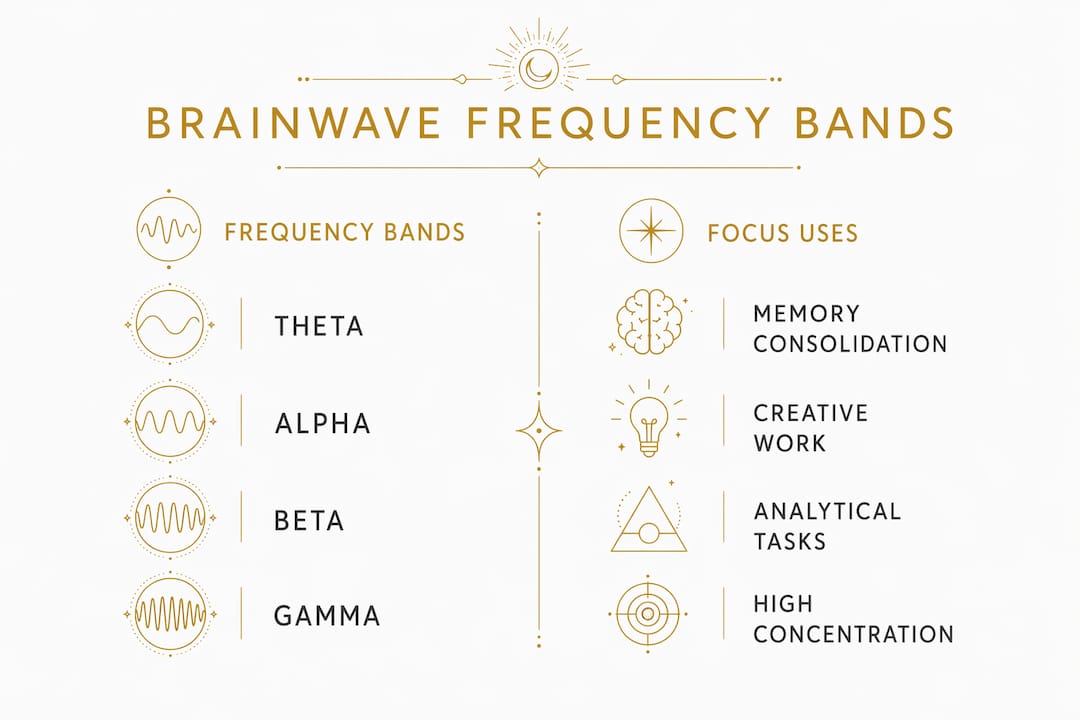
Beta waves (13–30 Hz) correlate directly with alertness, analytical problem-solving, and active working memory. When you are crunching numbers, writing a report, or debugging code, Beta is the dominant pattern your prefrontal cortex runs. Low Beta (13–15 Hz) supports steady, methodical task execution. High Beta (20–30 Hz) drives intense, rapid-fire cognitive processing, though it can tip into anxiety if sustained too long.

Gamma oscillations (30–80 Hz) synchronize widespread neuron firing during high-concentration tasks. Gamma is the frequency of binding: it stitches together information from different brain regions into a single coherent thought. The 40 Hz Gamma band has attracted the most research attention in 2026, with studies showing measurable gains in reading comprehension and narrow attentional focus. Think of Gamma as the brain’s broadband connection during peak cognitive load.
Alpha: relaxed readiness for creative work
Alpha waves (8–12 Hz) promote relaxed concentration and reduce internal mind chatter. Alpha is the frequency of creative ideation, brainstorming, and pre-task mental preparation. It is less suited for intense analytical work but highly effective when you need to generate ideas, review material without pressure, or transition into a focused state from a distracted one. Many experienced practitioners use Alpha as an on-ramp before shifting to Beta or Gamma for deep work.
Theta: memory consolidation and deep learning
Theta (4–8 Hz) sits below typical waking focus but plays a critical role in memory encoding and deep learning. The Theta-to-Beta ratio is a standard biomarker in cognitive diagnostics, used to assess attention function and monitor intervention outcomes over months. A high Theta-to-Beta ratio is associated with reduced concentration capacity. This makes Theta entrainment useful during review sessions or meditation-based learning, not during active task execution.
| Frequency Band | Range | Best For |
|---|---|---|
| Theta | 4–8 Hz | Memory consolidation, deep review |
| Alpha | 8–12 Hz | Creative ideation, relaxed prep |
| Low Beta | 13–15 Hz | Steady task execution, reading |
| High Beta | 20–30 Hz | Rapid analytical processing |
| Gamma | 30–100 Hz | Peak concentration, complex problem-solving |
Pro Tip: Start a focused work session with 5 minutes of Alpha audio to quiet mental noise, then switch to Low Beta or 40 Hz Gamma for the main task block. This two-phase approach mirrors how the brain naturally transitions into deep focus.
How to select brainwave frequencies for your specific needs
Choosing the right frequency is not guesswork. It follows a logic called state-matching, which means selecting a frequency that nudges your brain toward the state the task requires rather than forcing a single frequency onto every situation.
The distinction between state-matching and state-forcing matters. State-forcing means playing 40 Hz Gamma audio regardless of what you are doing or how you feel. State-matching means assessing your current mental state and choosing the frequency that bridges the gap to your target state. If you are scattered and anxious, jumping straight to High Beta will likely amplify the noise. Starting with Alpha to settle the nervous system, then stepping up to Beta, produces better results.
Here is a practical framework for getting started:
- Identify your task type. Analytical tasks (writing, coding, analysis) call for Beta or Gamma. Creative tasks (brainstorming, design) call for Alpha. Review and memorization benefit from Theta or Low Alpha.
- Assess your current state. Tired and foggy? Start with Alpha to re-engage. Anxious and scattered? Use Alpha to ground before moving to Beta. Already alert? Go straight to Low Beta or 40 Hz Gamma.
- Run a 15–25 minute test block. Experts recommend 15–25 minute blocks with a single frequency rather than switching mid-session. This gives your brain enough time to entrain and for you to notice a genuine effect.
- Log your results. Note your perceived focus quality, output volume, and any discomfort. After five sessions, patterns become clear.
- Adjust the audio environment. Pair your chosen frequency with pink noise at a low volume. Pink noise combined with binaural beats creates a non-distracting soundscape that sustains cognitive engagement without pulling your attention to the audio itself.
The most common mistake is expecting instant results after one session. Brainwave entrainment is a practice, not a switch. Consistency across multiple sessions produces the neurological adaptation that makes the effects reliable.
Pro Tip: Keep a simple focus log in Notion or Apple Notes. Rate your session from 1 to 5 on output quality and mental clarity. After two weeks, you will have objective data on which frequencies actually work for your brain.
What tools and technologies support frequency entrainment?
Three primary audio formats deliver brainwave entrainment: binaural beats, isochronic tones, and monaural beats. Each works differently and suits different listening conditions.
- Binaural beats require stereo headphones. Two slightly different tones play in each ear, and the brain perceives a third frequency equal to the difference. A 200 Hz tone in the left ear and a 240 Hz tone in the right ear produce a 40 Hz Gamma beat. This format is the most researched and the most widely available.
- Isochronic tones are single tones that pulse on and off at a target frequency. They do not require headphones, making them usable through speakers. Many users find them easier to tolerate for long sessions.
- Monaural beats combine two frequencies before they reach the ears, producing a beat that is audible without headphones. They sit between binaural and isochronic in terms of research backing.
Hardware requirements are straightforward. Binaural beats demand wired or high-quality wireless stereo headphones. Over-ear headphones with flat frequency response, such as those from Audio-Technica or Sennheiser, deliver the most accurate entrainment signal. Earbuds work but reduce the spatial separation that makes binaural processing effective.
| Tool Type | Headphones Required | Best Use Case | Research Backing |
|---|---|---|---|
| Binaural beats | Yes (stereo) | Deep focus, analytical work | Strong (multiple 2026 studies) |
| Isochronic tones | No | Long sessions, open environments | Moderate |
| Monaural beats | No | General focus, flexibility | Moderate |
| PEMF programs | No | Nervous system entrainment, recovery | Growing |
| Pink noise + frequency | No | Background focus support | Strong |
Platforms like Frequencyhealing offer preset frequency programs designed for specific cognitive states, including focus, recovery, and sleep. These programs combine binaural audio with scalar brainwave and haptic vibration protocols, which removes the guesswork of building a session from scratch. You select the cognitive goal, and the program sequences the frequencies accordingly.
Common challenges when selecting frequencies for focus
Common obstacles include distraction from the audio itself, frequency mismatches, and habituation that reduces effectiveness over time. Recognizing these early prevents wasted sessions.
- Audio distraction. If you find yourself listening to the beats rather than working, the volume is too high. Frequency audio should sit at the edge of awareness, not in the foreground. Drop the volume until it blends into the background.
- Frequency mismatch. Using High Beta when you are already overstimulated will worsen focus, not improve it. Always assess your starting state before selecting a frequency.
- Habituation. The brain adapts to repeated stimuli. Using the same frequency at the same time every day for weeks can reduce its effect. Rotate between frequency bands across the week, or vary session length to maintain neurological responsiveness.
- Inconsistent timing. Frequency entrainment works best when sessions are anchored to consistent times in your day, such as the start of a morning work block. Irregular use produces irregular results.
- Expecting standalone results. Brainwave entrainment functions best as a rhythmic anchor that supports focus, not as a replacement for task structure, sleep, or nutrition. Pairing it with a clear task list and a distraction-free environment multiplies the effect.
If attention problems persist despite consistent frequency practice, consult a neurofeedback specialist or cognitive health professional. Neurofeedback for enhanced concentration uses real-time EEG feedback to train the brain directly, and it is the clinical-grade version of what consumer entrainment tools approximate.
Key takeaways
Brainwave frequency selection for focus works best when you match the frequency band to the specific cognitive demand, use consistent session blocks, and pair audio with a structured work environment.
| Point | Details |
|---|---|
| Match frequency to task | Use Beta or Gamma for analytical work; use Alpha for creative tasks and mental preparation. |
| Use 15–25 minute blocks | Short, consistent session blocks allow entrainment to take effect and make results measurable. |
| Pair with pink noise | Combining frequency audio with pink noise sustains engagement without pulling attention to the sound. |
| Avoid habituation | Rotate frequency bands across the week to prevent the brain from adapting and reducing effectiveness. |
| Track results objectively | Log session quality scores over two weeks to identify which frequencies genuinely improve your output. |
What i have learned after years of frequency work
By Art
The biggest misconception I see is that people treat brainwave frequency selection like a productivity hack. They download a binaural beats track, play it once, feel nothing dramatic, and conclude it does not work. That is not how the nervous system operates.
What I have found through consistent practice is that the real value is not in any single session. It is in the cumulative calibration of your attentional baseline. After several weeks of state-matched frequency sessions, the transition into deep focus becomes faster and more reliable, even without the audio. The entrainment trains the pattern, and eventually the pattern runs on its own.
I have also learned that individual variation is real and significant. Some people respond strongly to 40 Hz Gamma. Others find it agitating and do better with Low Beta around 14–16 Hz. The research supports population-level averages, but your nervous system is not an average. The only way to know your optimal frequency is to test systematically and track honestly.
The combination I return to most consistently is 5 minutes of Alpha at the start of a session, followed by Low Beta for sustained writing or analysis, with pink noise running underneath at low volume. It is not glamorous. It is not a bioelectric revelation. It works because it respects how the brain actually transitions into focus rather than demanding it perform on command.
Pair frequency work with a clear task structure. Frequencyhealing’s guided frequency programs are worth exploring if you want a sequenced approach rather than piecing together individual tracks. The platform’s scalar brainwave and BioPhi protocols go beyond standard binaural audio, which makes them worth testing once you have established your baseline response to conventional entrainment.
— Art
How Frequencyhealing supports your focus practice
Frequencyhealing is built for exactly this kind of personalized frequency work. The platform offers binaural audio, scalar brainwave, PEMF, and haptic vibration programs designed around specific cognitive and wellness goals, including focus, nervous system balance, and recovery.
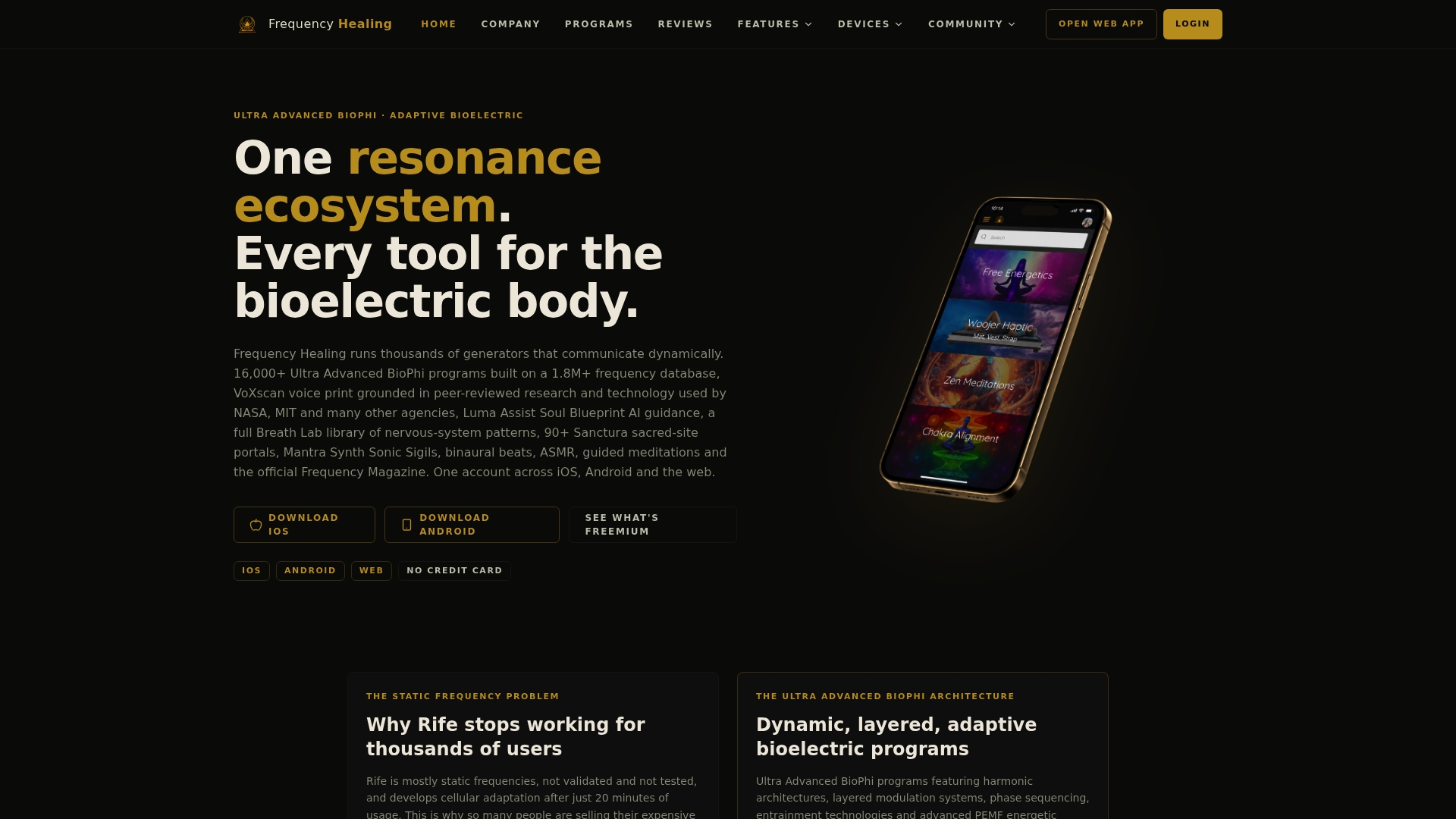
For focus specifically, Frequencyhealing sequences frequencies across a session rather than holding a single tone, which addresses the habituation problem directly. Programs are compatible with wired headphones, PEMF coils, and haptic devices, so you can match the delivery method to your environment. Whether you are at a desk, in a studio, or working remotely, the platform adapts to your setup. Visit Frequencyhealing to explore focus-specific programs and build a frequency practice grounded in both sound science and energetic precision.
FAQ
What is the best frequency for deep focus and analytical work?
Beta waves (13–30 Hz) and Gamma oscillations at 40 Hz are the most effective for analytical focus and complex problem-solving. A 2026 study confirmed that 40 Hz binaural beats improved reading accuracy and attentional processing in 72 participants.
Do binaural beats require headphones to work?
Yes, binaural beats require stereo headphones because each ear receives a different tone and the brain generates the target frequency from the difference. Isochronic tones and monaural beats work through speakers.
How long should a brainwave entrainment session last?
Experts recommend 15–25 minute focused session blocks with a single frequency to allow entrainment to take effect. Switching frequencies mid-session reduces effectiveness and makes it harder to assess results.
Can brainwave audio replace other focus strategies?
Brainwave entrainment functions as a rhythmic anchor that supports focus, not a standalone solution. It works best when combined with a clear task structure, consistent sleep, and a low-distraction environment.
What is the theta-to-beta ratio and why does it matter?
The Theta-to-Beta ratio is a standard biomarker used in cognitive diagnostics to assess attention capacity. A high ratio indicates reduced concentration function and is monitored in clinical interventions for attention-related conditions.