

Energy medicine integrates frequencies by applying rhythmic physical stimuli, including sound, light, and electromagnetic pulses, to modulate physiological systems through brainwave entrainment, cellular adaptation, and nervous system regulation. This is the recognized scientific framing for what practitioners call “frequency therapy integration,” and understanding the distinction between measurable mechanisms and symbolic interpretations is the first step toward using these methods effectively. Research published in peer-reviewed literature identifies three primary pathways: neural oscillation synchronization, pulsed electromagnetic field effects on cellular repair, and mechanoreceptor activation through vibrational input. Frequencyhealing is built on exactly these principles, combining PEMF, binaural audio, haptic vibration, and scalar brainwave programs into a single frequency wellness platform.
How energy medicine integrates frequencies: the primary methods
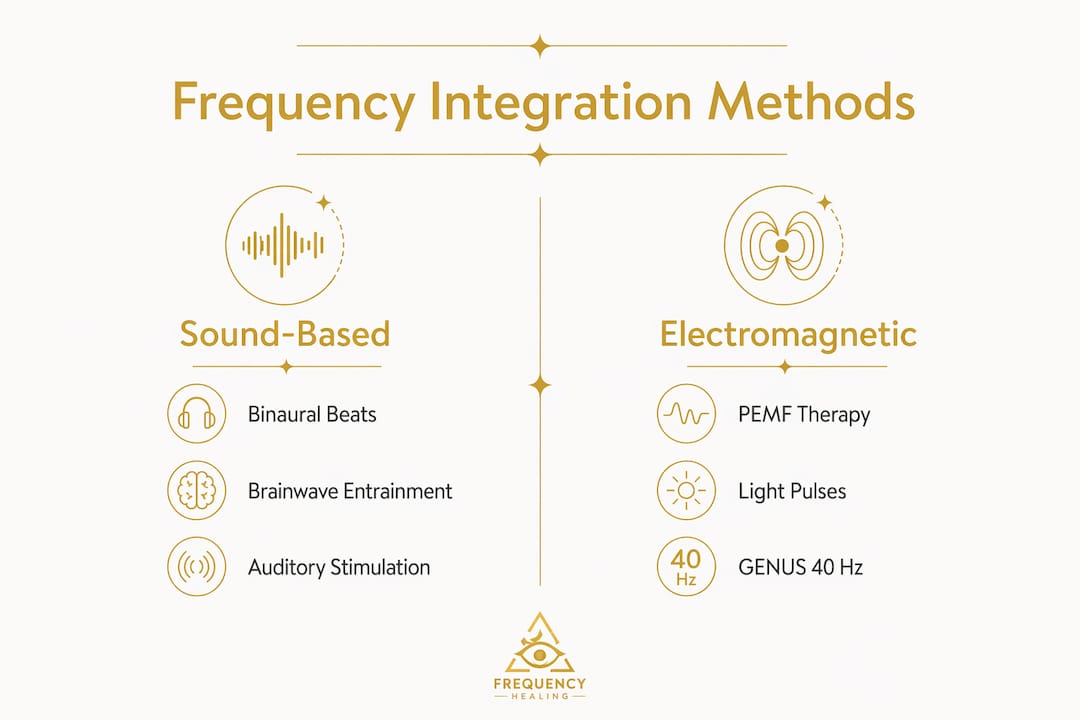
Energy medicine frequency methods fall into three well-defined categories, each targeting a distinct physiological pathway. Understanding each one separately makes it easier to see why practitioners often combine them.
Brainwave entrainment via sensory stimulation is the process of synchronizing cortical oscillations to an external rhythmic input. The most studied example is 40 Hz gamma entrainment, also called GENUS (Gamma Entrainment Using Sensory Stimuli). It delivers visual flicker, auditory beats, or combined multisensory inputs at exactly 40 cycles per second. Early clinical and preclinical research links this approach to modulation of gamma rhythms that are deficient in neurodegenerative conditions.

Pulsed electromagnetic field therapy (PEMF) delivers low-level electromagnetic pulses through mats, coils, or portable applicators. PEMF may reduce pain and inflammation, promote tissue repair, and modulate neuronal excitability. The pulses act directly on membrane potentials and cellular repair processes, making PEMF one of the most physically grounded modalities in energy medicine.
Sound-based frequency therapies include binaural beats and vibroacoustic therapy (VAT). Binaural beats create an auditory illusion when two slightly different tones are delivered separately to each ear, and the brain perceives a third frequency equal to the difference. VAT uses low-frequency sine waves in the 30–120 Hz range to stimulate mechanoreceptors throughout the body, producing downstream physiological responses including changes in neural activity.
- GENUS 40 Hz: targets gamma oscillation deficits via visual and auditory rhythmic inputs
- PEMF: acts on ion channels, membrane potentials, and microcirculation via electromagnetic pulses
- Binaural beats: create perceived frequency differences to guide brainwave states toward relaxation or focus
- Vibroacoustic therapy: delivers physical vibration to mechanoreceptors at specific sine wave frequencies
- Multi-modal stacking: combines two or more modalities in a single session to engage multiple pathways simultaneously
Pro Tip: When starting with sound-based methods, use wired headphones rather than wireless. Binaural beat processing requires each ear to receive a distinct frequency signal, and wireless compression can degrade that separation.
What happens inside the body during frequency therapy integration
The body is a living bioelectric conversation. Every cell maintains an electrical charge across its membrane, and external rhythmic inputs can shift that charge in measurable ways.
Neural entrainment works because the brain’s cortical oscillations are not fixed. They respond to sustained, controlled rhythmic inputs by gradually synchronizing their firing patterns to match the external frequency. Multisensory visual and auditory stimuli combined achieve broader cortical synchronization, measurable by EEG and MEG. This is why GENUS protocols use both flicker and tone together rather than relying on a single sensory channel.
PEMF operates at the cellular level through several parallel mechanisms. 2026 reviews hypothesize PEMF modulates neurotransmitter release, inflammatory signaling, microcirculation, and neuronal excitability simultaneously. The electromagnetic pulses influence ion channel gating and mitochondrial ATP production, which is the cell’s primary energy currency for repair. This multi-target profile is what makes PEMF mechanistically distinct from purely acoustic approaches.
Vibroacoustic therapy adds a third pathway: mechanoreceptor activation. When low-frequency sine waves travel through a mat or haptic device, they stimulate pressure-sensitive receptors in muscle, fascia, and skin. Those receptors feed signals into the central nervous system, producing relaxation responses and, at specific frequencies like 40 Hz, contributing to gamma-range neural activity.
| Modality | Primary target | Measurable mechanism |
|---|---|---|
| GENUS 40 Hz | Cortical gamma oscillations | EEG-confirmed neural synchronization |
| PEMF | Ion channels, mitochondria | Membrane potential shift, ATP modulation |
| Binaural beats | Brainwave state | Perceived frequency difference, cortical following |
| Vibroacoustic therapy | Mechanoreceptors | Peripheral nerve activation, CNS downstream response |
Pro Tip: Stacking modalities is not the same as doubling the dose. Start with one modality per session for the first two weeks, then layer a second only after your nervous system has adapted to the baseline input.
What does the evidence say about frequency integration benefits and limits?
The evidence base for frequency integration in energy medicine is real, but it is uneven across modalities. Knowing where the science is strong and where it is still developing protects you from both dismissing useful tools and overclaiming their effects.
PEMF has the most consistent clinical support. PEMF therapy may reduce pain and inflammation and promote tissue repair, with ongoing expert study recommending healthcare consultation before use. The Cleveland Clinic notes that benefits remain under active investigation, which means the field is advancing rather than settled.
GENUS 40 Hz stimulation carries compelling early evidence. Preclinical and early clinical research supports its role in modulating gamma rhythms linked to cognitive health. The mechanism is well-defined; the therapeutic dosing for specific conditions is still being refined.
Sound-based methods require the most careful framing. A 2023 review found contradictory evidence on reliable brainwave entrainment from binaural beats, and mainstream medical sources highlight relaxation benefits over guaranteed healing outcomes. Using binaural beats as a relaxation tool aligns with medical consensus. Expecting them to resolve clinical conditions does not.
Key evidence summary:
- PEMF: strong mechanistic basis, growing clinical evidence, professional consultation advised
- GENUS 40 Hz: promising non-invasive neuromodulation, early but compelling research
- Binaural beats: reliable for relaxation and stress reduction, limited evidence for broader healing claims
- Vibroacoustic therapy: mechanoreceptor activation is well-established; outcome research is still emerging
- All modalities: outcome variability depends on dosage, individual physiology, and safety context
How to apply frequency integration safely for well-being
Practical frequency integration follows a simple principle: match the modality to the goal, pace the sessions, and monitor your response. Rushing the process produces nervous system fatigue rather than regulation.
-
Define your primary goal first. Sleep and relaxation call for delta and theta range audio programs. Focus and cognitive support align with gamma-range entrainment like GENUS 40 Hz. Recovery and tissue support point toward PEMF coils or mats.
-
Consult a healthcare provider before using PEMF devices. PEMF devices affect membrane potentials and cellular processes. People with implanted electronic devices, pregnancy, or active bleeding conditions require professional clearance.
-
Start with single-modality sessions of 20–30 minutes. Shorter, consistent sessions build cellular adaptation more effectively than long irregular ones. Track how you feel for 24 hours after each session before increasing duration or intensity.
-
Layer modalities gradually. Combining sound and vibration with PEMF for cellular repair is increasingly common in clinical practice. Add a second modality only after two weeks of stable single-modality use.
-
Set realistic expectations. Sound therapy is a supportive tool for stress reduction, not a replacement for medical treatment. Medical guidance from Cedars-Sinai frames sound-based methods as complementary, not curative.
-
Pair frequency sessions with complementary practices. Breathwork, adequate sleep, and reduced stimulant intake all amplify the nervous system regulation that frequency integration initiates. Frequencyhealing’s guided frequency programs are designed to fit within exactly this kind of daily wellness ritual.
Key Takeaways
Energy medicine integrates frequencies most effectively when scientifically grounded modalities like PEMF, GENUS 40 Hz, and vibroacoustic therapy are applied with clear goals, appropriate pacing, and realistic expectations.
| Point | Details |
|---|---|
| Frequency integration is physical | Sound, light, and electromagnetic pulses produce measurable changes in neural oscillations and cellular processes. |
| PEMF has the strongest evidence base | PEMF modulates ion channels, inflammation, and tissue repair; consult a healthcare provider before use. |
| Binaural beats support relaxation | Evidence supports stress reduction and relaxation; broad healing claims exceed current research findings. |
| Modality stacking requires pacing | Combining PEMF, sound, and vibration in one session is effective only when introduced gradually to avoid overstimulation. |
| Outcome variability is real | Dosage, individual physiology, and session consistency all determine how frequencies affect health for each person. |
Why I think most people misread frequency medicine entirely
People tend to land in one of two camps with frequency medicine. The first group dismisses it as pseudoscience because the language around it often sounds mystical. The second group overclaims it, expecting a single session to resolve years of accumulated stress or pain. Both positions miss what the science actually shows.
What I have observed, working closely with frequency integration practices, is that the most consistent results come from people who treat it the way they treat physical training: progressive, consistent, and goal-specific. A person who uses a PEMF mat for 20 minutes every morning for six weeks will report something meaningfully different from someone who tries it twice and gives up. The biology requires repetition. Neural entrainment is not a switch you flip. It is a pattern you reinforce.
The other thing worth saying plainly: not every frequency claim is equal. Controlled multisensory rhythmic stimulation produces measurable EEG changes. A randomly selected “healing frequency” audio file on a streaming platform does not carry the same mechanistic weight. The difference is protocol design, delivery precision, and dosage consistency. Frequencyhealing is built around that distinction, sequencing programs with the same logic a clinician would apply to a treatment plan.
The most empowering thing you can do is learn to read the evidence yourself. Ask whether a claimed effect has a named mechanism. Ask whether the frequency input is calibrated and controlled. That habit alone will separate genuinely useful tools from noise.
— Art
Frequencyhealing: frequency integration programs and PEMF devices
Frequencyhealing brings together the modalities covered in this article into a single, structured wellness platform.
The platform offers PEMF coils, haptic vibration devices, binaural audio programs, and scalar brainwave sessions, all sequenced with the same phase-specific logic that clinical research supports. Whether your goal is nervous system regulation, sleep support, focus, or recovery, the PEMF coils and devices and the full program library give you calibrated, protocol-driven tools rather than generic audio files. For readers who want to go deeper into the science before choosing a device, the PEMF therapy science guide covers mechanisms, safety considerations, and clinical context in detail.
FAQ
What is frequency integration in energy medicine?
Frequency integration in energy medicine is the application of rhythmic physical stimuli, including sound, light, and electromagnetic pulses, to modulate brainwave activity, cellular processes, and nervous system function through measurable physiological mechanisms.
How does PEMF therapy work at the cellular level?
PEMF delivers low-level pulsed electromagnetic waves that influence ion channels, membrane potentials, and mitochondrial ATP production, which supports cellular repair, reduces inflammation, and modulates neuronal excitability.
Are binaural beats scientifically proven to heal?
Binaural beats have reliable evidence for relaxation and stress reduction, but a 2023 review found contradictory evidence for broader healing claims. Medical sources recommend treating them as a supportive tool rather than a therapeutic intervention.
What is GENUS 40 Hz stimulation?
GENUS (Gamma Entrainment Using Sensory Stimuli) uses visual flicker and auditory beats at 40 Hz to synchronize cortical gamma oscillations. Early clinical and preclinical research links it to modulation of brain rhythms relevant to cognitive health.
How do I start using frequency therapy safely at home?
Begin with a single modality at 20–30 minutes per session, consult a healthcare provider before using PEMF devices, and set realistic expectations based on current evidence. Gradual, consistent use produces more reliable results than intensive irregular sessions.