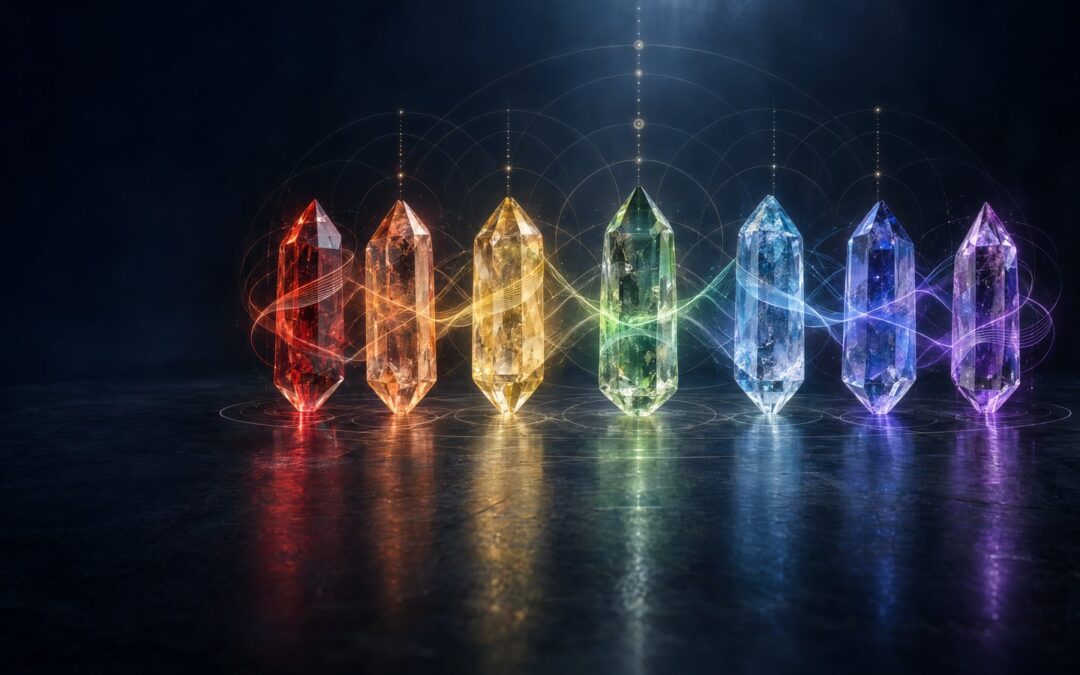
Vogel Crystal Light Harmonic Energetics is a seven-part BioPhi listening collection for people who want to organize a meditation, creative, focus, or reflection practice around a clear color intention. It is not an attempt to turn a phone into a gemstone, replicate visible-light exposure through sound, or assign a medical meaning to a color. The collection’s value is more practical: it gives a listener seven distinct, deliberately structured routes into the same question: What quality of attention do I want to practice today?
Red begins with grounding and body awareness. Orange opens a creative and relational-warmth lane. Yellow supports a bright, engaged session frame. Green provides a slower sensory-calm route. Blue is designed for daytime attention. Indigo turns inward toward contemplative focus. Violet closes the arc with meditation and reflective awareness. Each route is a linked, 15-minute, five- or six-phase listening session, not a static tone and not a medical protocol.
The central idea: color, sound, attention, and ritual can be organized together without pretending they are the same physical thing. This is a modern listening collection with historical color-music inspiration, a contemporary phase-based signal design, and an evidence-bounded invitation to build a more intentional session.
Explore the Red Crystal Light route or browse the full PEMF Healing program library.
What is Vogel Crystal Light Harmonic Energetics?
At its core, the collection is a color-indexed listening architecture. Each of its seven titles pairs a familiar color theme with a defined session arc. The public program name tells the listener the intended practice context. The internal phase architecture changes across the session, creating a beginning, development, and landing rather than one unchanging playback state.
The word Vogel locates the collection in the broader historical conversation around crystals, color, sound, and perceptual symbolism. Marcel Vogel’s legacy archive records early explorations of color, light, sound, crystals, and brainwave observations, but it is a historical self-report, not controlled product validation.[1] The more rigorous color-music history is equally interesting: researchers have documented many proposed color-to-sound tables, not one universally established map. E. G. Lind’s 1900 scheme is one historically reproduced example among many.[2]
That is why the collection should be understood as designed symbolic correspondence, not literal physical substitution. A green-themed audio session does not become green light. A crystal-themed title does not establish transfer of a gemstone’s physical properties into a digital waveform. The design proposition is simpler and more useful: color can give a session an intelligible emotional and attentional frame, while time-varying audio can give that frame a beginning, middle, and close.

Why organize a listening practice by color?
Color is a powerful cue in human design, art, and self-expression. A 2025 systematic review synthesized 132 peer-reviewed studies across 42,266 participants from 64 countries and found consistent associations between color categories and affective dimensions. Yellow and orange were commonly associated with positive high-arousal terms; blue, green, and green-blue with positive lower-arousal terms; red with high-arousal and empowering terms; and purple with empowering associations.[3]
Those findings do not prove that a color-themed audio session changes mood or cognition. They do explain why a color palette can be a compelling entry point for intention. A listener may use green as a reminder to slow down, blue as a prompt for a daytime attention block, or violet as a cue to close the day with reflection. The collection uses those recognizable design meanings to reduce decision fatigue: instead of scrolling through an abstract library, you can select the route that fits the moment you want to create.
The Seven Crystal Light Routes, Explained
| Route | Program | Designed practice context | Who may choose it |
|---|---|---|---|
| Red | Red Crystal Light Grounding & Body Awareness Matrix | Arriving, scanning posture, noticing breath and contact points. | Someone beginning a journal, breath, or movement practice who wants a clearer landing ritual. |
| Orange | Orange Crystal Light Creative Expression & Emotional Warmth Matrix | Opening a sketchbook, writing session, voice note, or relational check-in. | Someone creating, making, or looking for a softer transition into expressive work. |
| Yellow | Yellow Crystal Light Positive Mood & Mental Engagement Matrix | Setting an engaged daytime tone before reading, planning, or a meaningful task. | Someone wanting a brighter start to a focused, non-clinical work block. |
| Green | Green Crystal Light Relaxation & Sensory Calm Matrix | Reducing sensory load before a quiet evening, reading session, or pause. | Someone who prefers a softer, lower-demand listening environment. |
| Blue | Blue Crystal Light Attention & Daytime Awareness Matrix | Creating an intentional morning or early afternoon attention routine. | Someone entering a study, organization, or deliberate single-task period. |
| Indigo | Indigo Crystal Light Introspection & Contemplative Focus Matrix | Journal reflection, personal inquiry, reading, or quiet idea development. | Someone who wants a contained inner-work session without a clinical promise. |
| Violet | Violet Crystal Light Meditation & Reflective Awareness Matrix | Closing a day, sitting quietly, or practicing a simple reflective meditation. | Someone who wants a deliberate transition into stillness and observation. |
Why the programs move through phases
A memorable session needs more than a label. The seven Crystal Light programs are organized as five- or six-phase experiences. That matters because a session can unfold: an entry establishes attention, later phases develop the listening environment, and the final phase offers a place to finish rather than an abrupt stop. This is the collection’s primary design distinction.
Phase-based composition also provides a richer creative canvas than a single, unchanging tone. The audible work can be arranged through timing, transitions, stereo relationships, layered components, envelopes, and a deterministic session timeline. These are real audio-design variables. They make the listener’s experience more legible and variegated across time. They should not be mistaken for proof of a biological effect, a clinical dose, or an ability to prevent physiological adaptation.
For users interested in binaural listening, separate left and right audio paths are required for the classic auditory binaural-beat phenomenon. The research literature is not settled on broad brain-entrainment claims: a 2023 systematic review found five studies consistent with the hypothesis, eight contradictory findings, and one mixed result across 14 heterogeneous studies.[4] That is a reason to value stereo as a listening-design option, not to oversell it as a treatment mechanism.

Actual light, audio, haptics, and PEMF are different delivery modes
This distinction protects the quality of the experience. Visible light acts through the eye. For example, short-wavelength light affects retinal photoreception and circadian signaling through melanopsin-related pathways.[5] An audio session acts through the auditory system. A haptic vest translates portions of audio into physical vibration. A compatible coil has its own output characteristics, placement instructions, and safety conditions. A color name is not a substitute for measuring any of those pathways.
The collection therefore works best as a layered ritual, not as a claim that every route is the same thing. Start with the app and its stereo listening design. If desired, add one optional compatible route. The experience remains coherent because your attention, breath, environment, and session timing are working together, not because a digital file is being presented as optical light or a measured medical device.
- Wired stereo headphones: the clearest route when you want the app’s left-right audio design to remain separated.
- Haptic option: a device such as the Woojer Vest 4 can turn compatible audio into body-worn vibroacoustic sensation. That is a sensory-format choice, not proof of a medical outcome.
- Compatible coil: optional and governed by the coil maker’s placement, output, and safety instructions. The collection itself does not prescribe a body site or field dose.
- Jawbone or bone-conduction audio: useful as a different listening route, but cross-head transmission limits independent left-right separation, so it should not be described as preserving conventional binaural delivery.[6]
A seven-day Crystal Light practice
Every day begins with the linked Crystal Light program. Each primary program is a 15-minute session. Add the two listed companions only when the day has enough time and you feel comfortable. Leave ten minutes of quiet between programs. This is a collection guide, not a medical prescription. After seven days, take one full week away from the cycle before deciding whether to repeat it.
| Day | Primary first | Then, after ten quiet minutes | Then, after ten quiet minutes |
|---|---|---|---|
| 1 | Red Crystal Light for 15 minutes | ASMR Binaural Full Chakra and Grounding Guided Meditation | Luma Haptic Full Body |
| 2 | Orange Crystal Light for 15 minutes | Creative Sync: Artistic Expression, Inspiration | 15MIN Meditation Handpan Ancient Love |
| 3 | Yellow Crystal Light for 15 minutes | Harmony of Soul Morning Movement Meditation | Focus Clarity Pulsation, Soundscape Harmonics |
| 4 | Green Crystal Light for 15 minutes | ASMR Ocean Relaxation | Deep Stillness Haptic Energetics |
| 5 | Blue Crystal Light for 15 minutes | 20Hz Earth Beta Binaural Beat, Intense Alertness and Focus | Focus Clarity Pulsation, Soundscape Harmonics |
| 6 | Indigo Crystal Light for 15 minutes | Ometeotl Handpan Relaxation | 15MIN Meditation Handpan Ancient Love |
| 7 | Violet Crystal Light for 15 minutes | Luma Haptic Full Body | ASMR Ocean Relaxation |

Equipment: create a sensible setup, not a maximal one
The most complete setup is not automatically the best setup. Begin with a comfortable seat or reclined position, moderate volume, and wired stereo headphones if you want the clearest left-right audio separation. World Health Organization safe-listening guidance emphasizes that risk is shaped by level, duration, and repeated exposure. A practical default is to keep volume under 60% of device maximum, use breaks, and stop if the session is uncomfortable.[7]
If you already own a haptic or compatible coil device, treat it as an optional format layer rather than a requirement. Follow its maker’s manual exactly. For any coil or magnet-adjacent equipment, people with implanted electronic medical devices should seek clinician and manufacturer guidance before use. The FDA advises keeping consumer electronics that may create magnetic interference at least six inches from implants, including cardiac devices.[8]
Resources for a color-centered home practice
Some links below are affiliate links. They do not change the price you pay and help support PEMF Magazine.
| Resource | How it fits the collection |
|---|---|
| Frequency Healing App | Access the Crystal Light collection and linked companion programs on iOS, Android, or web. |
| iTorus i2 collection | Optional compatible coil route. Follow the product instructions and individual safety guidance. |
| iTorus i5 collection | Optional larger-space compatible device route. Use only according to maker instructions. |
| Woojer Vest 4 with code EPEMF10 | Optional body-worn vibroacoustic layer for compatible audio. It changes sensory format rather than proving a health outcome. |
| Metatronic Flower of Life Dual Frequency Imprinter | An optional ritual object for users who choose to explore the platform’s compatible imprinting workflow. Follow its maker instructions. |
The editorial conclusion
The strongest way to approach the Vogel Crystal Light collection is neither with blind belief nor with a reductive dismissal. It is with design literacy. The historical color-music tradition offers a rich vocabulary. Modern audio tools make it possible to build a session with sequence, contrast, stereo organization, and intentional closure. The seven colors make that vocabulary easy to use.
Choose a color as a practice cue. Let the linked phase-based session mark out fifteen minutes. Listen at a comfortable level. Reflect on the quality of attention you brought to the experience. This is where the collection is most compelling: as a coherent, usable framework for grounded presence, creative opening, focused work, sensory calm, and reflective meditation.
Related Articles
- 432 Hz vs 440 vs 444: The Math Verdict Across 13 Tunings
- Static Frequency vs Phase-Based BioPhi Programs: A Design Comparison
- Heart-Brain Love Matrix: Why Phase-Based Signal Design Matters
References
- Marcel Vogel Legacy. Color and Sound: Their Influence on the Human Body. Historical source; self-reported exploratory material, not controlled validation.
- Spence C, Di Stefano N. Coloured hearing, colour music, colour organs, and the search for perceptually meaningful correspondences between colour and sound. i-Perception. 2022. Historical review of many proposed color-sound correspondences.
- Jonauskaite D, Mohr C. Do we feel colours? A systematic review of 128 years of psychological research linking colours and emotions. Psychonomic Bulletin & Review. 2025. Associations do not establish audio-program effects.
- Ingendoh RM, Posny ES, Heine A. Binaural beats to entrain the brain? A systematic review. PLOS One. 2023. Findings were heterogeneous and inconclusive.
- Tosini G, Ferguson I, Tsubota K. Effects of blue light on the circadian system and eye physiology. Molecular Vision. 2016. Actual light effects involve retinal photoreception.
- Surendran S, Stenfelt S. Inter-aural separation during hearing by bilateral bone conduction stimulation. Hearing Research. 2023. Documents cross-head transmission constraints.
- World Health Organization. Deafness and hearing loss: Safe listening. 2026.
- U.S. Food and Drug Administration. Magnets in Cell Phones and Smart Watches May Affect Pacemakers and Other Implanted Medical Devices. 2021.
- Frequency Healing. Medical Disclaimer. Wellness and educational use only; not a medical device.
- National Institute of Standards and Technology. Speed of light in vacuum. Exact SI constant. Relevant to understanding why optical and audio domains are not interchangeable.
Wellness and safety note: This collection is for wellness, educational, and reflective use. It is not a medical device and is not intended to diagnose, treat, cure, mitigate, or prevent any disease. Do not use optional coil or magnetic hardware without appropriate clinician and manufacturer guidance if you are pregnant, have a pacemaker, implanted electronic device, epilepsy, a seizure history, or a serious medical condition. Stop any session that causes discomfort. For medical concerns, seek qualified professional care.