

A frequency pyramid device is a wellness instrument that combines pyramid geometry with electromagnetic coils, audio transducers, or resonators to generate specific frequencies for relaxation, meditation, or energetic balancing. The term itself is a marketing category, not a standardized scientific classification. Devices in this space include the Quantyx Pyramid, the Pyramid Schumann Generator, and PEMF-cymatic hybrids, each using distinct technologies to produce vibrational or electromagnetic effects. Understanding what separates these tools at the hardware level is the first step toward using them with real discernment.
What is a frequency pyramid device and how is it defined?
A frequency pyramid device is defined as any pyramid-shaped tool that generates electromagnetic fields, scalar fields, or acoustic vibrations at targeted frequencies for wellness or experimental purposes. The device category spans scalar field generators, Schumann resonance emulators, and hybrid PEMF-cymatic systems. What unites them is the pyramid form factor, which manufacturers claim focuses or amplifies the generated fields. What separates them is the underlying technology, which varies dramatically from one product to the next.
The pyramid shape carries symbolic weight in sacred geometry traditions, and many manufacturers incorporate that symbolism into their marketing. Devices like the Pyramid Schumann Generator reference Fibonacci sequences and Tesla coil arrangements to reinforce the geometry’s role in field enhancement. Whether the shape produces measurable physical effects remains an open question in mainstream science. The more grounded starting point is examining the specific coil configuration, frequency range, and output type each device actually produces.

How does a frequency pyramid work? Mechanisms and technologies explained
Three distinct operating principles define most frequency pyramid devices on the market today.
-
Scalar field generation: The Quantyx Pyramid uses opposing inductors that cancel each other’s electromagnetic fields within a confined space, producing what engineers describe as a scalar field. The device operates across a frequency range of 0.1 Hz to 40 MHz and connects to an external frequency generator for signal input. This design makes it useful for physics and biology experiments where samples are placed inside the pyramid for exposure.
-
Schumann resonance emulation: The Pyramid Schumann Generator uses Tesla coils arranged in Fibonacci-sequence geometry to produce Earth-resonance frequencies, most notably 7.83 Hz. Additional harmonics at 14.3 Hz and higher are also generated. These devices are marketed primarily for meditation and nervous system relaxation, with some models including sound frequency settings linked to chakra states.
-
PEMF-cymatic hybrids: Some devices combine pulsed electromagnetic field coils with sound transducers to deliver both electromagnetic and acoustic vibration simultaneously. Patent filings describe wireless pyramid systems using inductive coils at sacred frequencies such as Solfeggio tones (396–963 Hz), with optimal wireless power transfer occurring at 20–80 kHz.
The key distinction between these types is the output medium. Scalar and PEMF devices produce electromagnetic fields that interact with the body’s bioelectric environment. Cymatic and audio-based devices produce mechanical vibration through sound waves. Some hybrid models deliver both, which is why reading the product specification carefully matters before purchase.
Pro Tip: Check whether a device lists an external frequency generator as a required input. If it does, the pyramid is a passive transducer, not a self-contained frequency source. That distinction changes how you use it and what results you can expect.
What are the benefits and uses claimed for frequency pyramid devices?
Frequency pyramid devices are promoted across a wide range of wellness and experimental applications. The claims vary by device type, but the most commonly reported uses fall into these categories:
- Meditation support: Devices emitting Schumann resonance at 7.83 Hz are marketed to synchronize brainwave activity with Earth’s natural electromagnetic rhythm, supporting deeper meditative states.
- Brainwave entrainment: Frequencies in the alpha and theta ranges (7–14 Hz) are used to guide the brain toward relaxed or creative states, a practice supported by alpha/theta brainwave research in biofeedback contexts.
- Relaxation and nervous system balance: PEMF-cymatic hybrids are used in sessions targeting parasympathetic activation, with users reporting reduced tension and improved sleep onset.
- Subtle energy balancing: Solfeggio-based devices target specific chakra frequencies, with 396 Hz associated with grounding and 963 Hz linked to higher states of awareness.
- Scientific experimentation: The Quantyx Pyramid is explicitly designed for physics, biology, and chemistry experiments, where samples are placed inside the pyramid field for controlled exposure studies.
The range of applications reflects the diversity of the device category itself. A Schumann generator and a PEMF-cymatic hybrid serve different purposes and should not be evaluated by the same criteria. Matching the device type to your specific wellness goal produces far better outcomes than selecting based on aesthetics or general frequency claims alone.
Pro Tip: When evaluating any frequency pyramid device, separate the claimed benefit from the delivery mechanism. Ask: does this device produce electromagnetic fields, acoustic vibration, or both? The answer tells you which body systems it is most likely to influence.
How do frequency pyramid devices compare in design and technology?
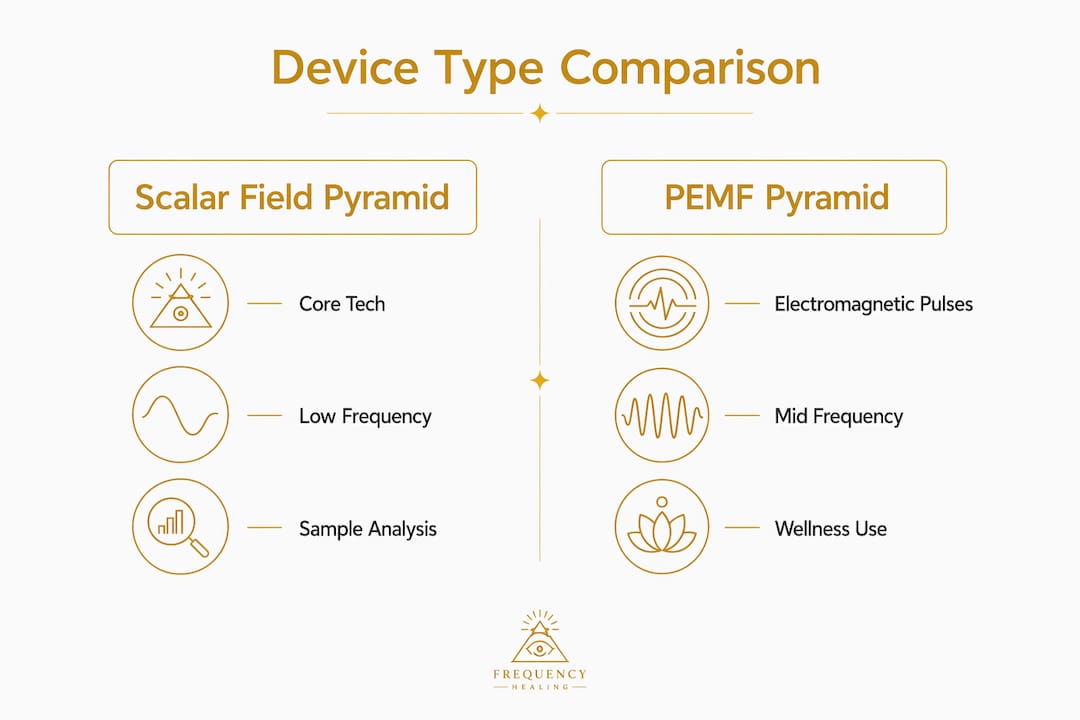
The table below maps the three main device types against their core technology, frequency range, and primary use case.
| Device type | Core technology | Frequency range | Primary use |
|---|---|---|---|
| Scalar field pyramid (e.g., Quantyx) | Opposing inductors, scalar field generation | 0.1 Hz to 40 MHz | Physics/biology experiments, energetic field research |
| Schumann resonance pyramid | Tesla coils, Fibonacci geometry | 7.83 Hz and harmonics | Meditation, relaxation, nervous system support |
| PEMF-cymatic hybrid | PEMF coils plus sound transducers | 396–963 Hz (audio); 20–80 kHz (power transfer) | Chakra balancing, sleep, emotional wellness |
Each device type requires different inputs and produces different outputs. The Quantyx Pyramid needs an external frequency generator to function. The Pyramid Schumann Generator is typically self-contained, with onboard circuitry producing its target frequencies. PEMF-cymatic hybrids often connect to audio sources or dedicated apps for frequency sequencing.
Size and placement also differ across types. Scalar field pyramids are generally compact, designed to hold small samples inside the structure. Schumann generators range from desktop units to larger room-scale installations. PEMF-cymatic hybrids are often mat or pad-based, with the pyramid form serving as a housing for the transducer array rather than a functional geometric element.
Controls vary as well. Some devices offer fixed frequency output with no user adjustment. Others include multi-mode switches, frequency selector dials, or app connectivity for custom programs. If you plan to use a device with a platform like Frequencyhealing, confirming generator compatibility and input frequency range before purchase prevents mismatched hardware.
What scientific perspectives and cautions should users consider?
The phrase “frequency pyramid device” is a marketing term, not a scientific category). No standardized engineering or medical classification exists for this device type. That matters because it means no shared testing protocol, no regulatory standard, and no uniform definition of what the device must produce to earn the label.
Several specific scientific considerations apply when evaluating these devices:
- Schumann resonance complexity: The Schumann resonance is a natural electromagnetic standing wave formed between Earth’s surface and the ionosphere, triggered by global lightning activity. Reproducing it indoors with a desktop coil is a strong claim that requires careful technical scrutiny.
- Missing measurement data: Product listings for Schumann generators often omit field strength values and measurement methodology. Without knowing the amplitude at the user’s location, it is impossible to assess whether the device produces a biologically relevant signal.
- Scalar energy terminology: The term “scalar energy” is used loosely across wellness marketing. In physics, scalar fields exist, but the wellness application of this term often exceeds what the underlying device actually produces.
- Independent validation: Few frequency pyramid devices have been evaluated in peer-reviewed studies. User testimonials and manufacturer claims are not substitutes for controlled outcome data.
- Sacred geometry claims: Fibonacci sequences and pyramid geometry carry cultural and mathematical significance. Their direct influence on electromagnetic field behavior inside a device has not been independently verified at the level of rigor required for medical claims.
Approaching these devices with curiosity and critical thinking is not contradictory. You can explore the experiential dimension of frequency work while also asking hard questions about what a device actually measures and produces.
Key Takeaways
A frequency pyramid device is a marketing-defined wellness tool, not a scientific standard, so understanding its specific mechanism, whether scalar, Schumann, or PEMF-cymatic, determines its actual application and value.
| Point | Details |
|---|---|
| Marketing term, not science | “Frequency pyramid device” has no standardized scientific definition; evaluate each device by its specific technology. |
| Three core technologies | Scalar field, Schumann resonance, and PEMF-cymatic hybrids each operate differently and suit different wellness goals. |
| Frequency range matters | Devices span 0.1 Hz to 40 MHz; matching the output range to your intended use is the most important selection criterion. |
| Missing data is a red flag | Devices that omit field strength measurements and amplitude data at the user location cannot be fully assessed for effect. |
| Platform compatibility | Devices requiring external generators must be checked for input compatibility with apps like Frequencyhealing before purchase. |
What I’ve learned from years of working with frequency devices
The most common mistake people make with frequency pyramid devices is buying the concept instead of the hardware. The pyramid shape is compelling. The language around sacred geometry and Earth resonance is genuinely fascinating. But the device sitting on your desk either produces a measurable field at a relevant frequency or it does not. That is the only question that matters at the point of purchase.
What I have found consistently useful is starting with the mechanism. A device built around opposing inductors and a 0.1 Hz to 40 MHz input range is a fundamentally different tool than a Tesla coil Schumann generator running at 7.83 Hz. Both can have a place in a frequency wellness practice. They are not interchangeable, and treating them as if they are leads to frustration and wasted investment.
The experiential side of this work is real. People report genuine shifts in relaxation, focus, and sleep quality when using these devices consistently. Those reports deserve respect. They also deserve the context of knowing whether the device is producing electromagnetic fields, acoustic vibration, or primarily a placebo-adjacent ritual effect. All three can have value. Only one of them requires specific hardware to achieve.
My practical recommendation is to pair any physical frequency device with a structured program from a platform like Frequencyhealing, where the frequency sequencing is documented and the delivery mechanism is clearly defined. That combination gives you both the energetic experience and the technical grounding to evaluate what is actually happening in your sessions.
— Art
Explore frequency wellness programs at Frequencyhealing
Frequencyhealing offers PEMF, binaural audio, scalar brainwave, and BioPhi energetic programs designed to complement physical frequency devices, including pyramid-compatible tools. If you are exploring Schumann resonance sessions, Solfeggio-based chakra programs, or PEMF recovery sequences, the platform provides guided frequency programs with clearly defined delivery mechanisms and hardware compatibility. Every program is built around documented frequency sequencing, so you always know what your nervous system is receiving and why. Start your personalized frequency ritual at Frequencyhealing and bring structure to your energetic wellness practice.
FAQ
What is a frequency pyramid device used for?
A frequency pyramid device is used for meditation, brainwave entrainment, relaxation, subtle energy balancing, and in some cases scientific experimentation. The specific application depends on whether the device generates scalar fields, Schumann resonance frequencies, or PEMF-cymatic vibrations.
How does a frequency pyramid work at the hardware level?
Most frequency pyramids work through one of three mechanisms: opposing inductors that generate scalar fields, Tesla coils that emulate Schumann resonance at 7.83 Hz, or PEMF coils combined with sound transducers for dual electromagnetic and acoustic output.
Are frequency pyramid devices scientifically validated?
The term “frequency pyramid device” is a marketing classification with no standardized scientific definition. Individual device technologies like PEMF have research support, but most pyramid-specific wellness claims lack independent peer-reviewed validation.
What frequency range do these devices typically cover?
Frequency ranges vary widely by device type. The Quantyx Pyramid covers 0.1 Hz to 40 MHz via external generator input. Schumann generators focus on 7.83 Hz and its harmonics. PEMF-cymatic hybrids typically operate in the 396–963 Hz audio range for Solfeggio tones.
What should I check before buying a frequency pyramid device?
Check the output type (electromagnetic, acoustic, or both), the frequency range, whether an external generator is required, and whether the manufacturer provides field strength measurements at the user location. Devices that omit amplitude data cannot be fully evaluated for practical effect.