
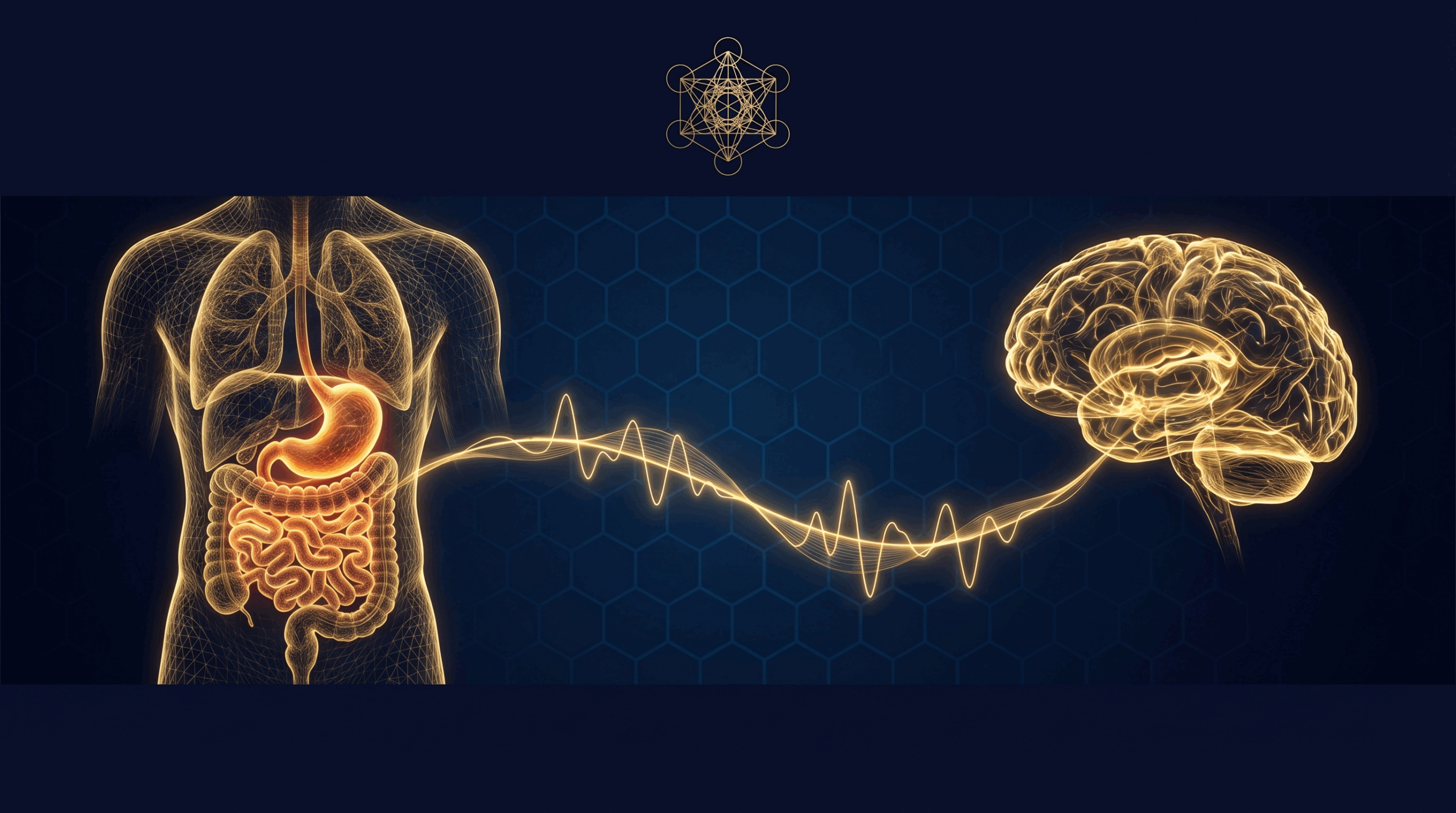
There is a quiet failure mode built into modern digestion, and almost no one discusses it openly. You eat clean. You take the probiotics. You eliminate gluten, dairy, and seed oils. Yet your stomach remains distended, your motility is sluggish, and your anxiety spikes after meals. You are not experiencing a food problem. You are experiencing a nervous system problem. Your vagus nerve has withdrawn its parasympathetic signaling, and your gut is operating in a state of chronic, low-grade fear.
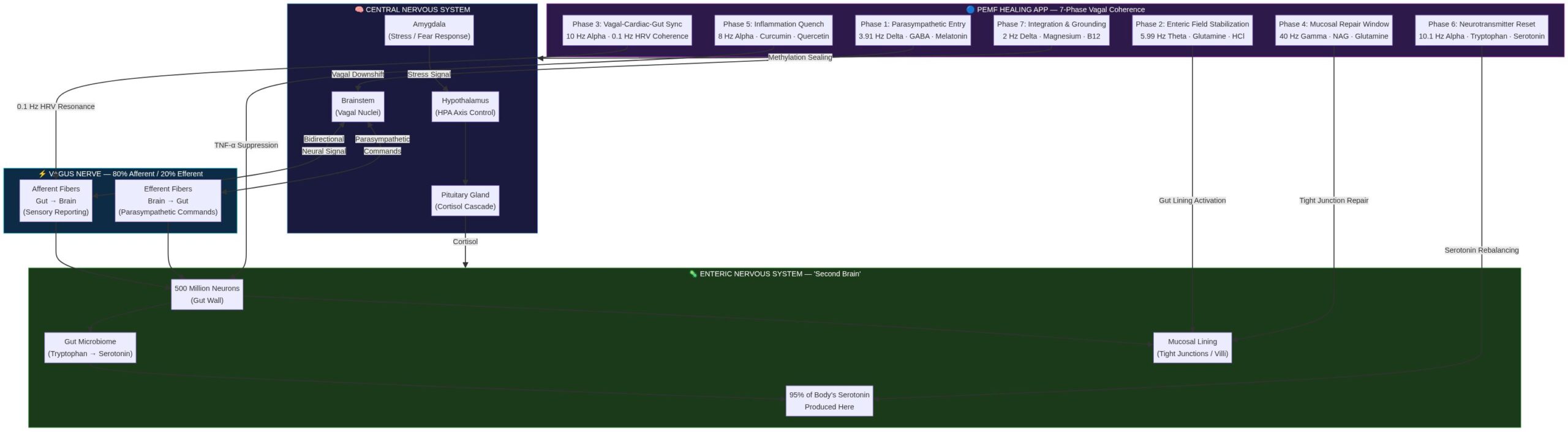
The gut is not simply a tube for processing nutrients; it is a sensory organ. It contains 500 million neurons—the enteric nervous system, often called the “second brain.” When the central nervous system perceives chronic stress, it downregulates the vagus nerve. This halts peristalsis, degrades the mucosal lining, and alters the microbiome. To fix the gut, you cannot just treat the gut. You must restore the communication line between the gut and the brain. The Gut-Brain Axis, 7-Phase Vagal Coherence, Isochronic Energetics program is designed specifically to rebuild this bioelectric bridge.
This article details the exact 21-day, 7-phase protocol that uses isochronic amplitude modulation to entrain the nervous system, lower inflammation, and restore the mucosal lining from the cellular level up. You will learn why traditional frequency therapy plateaus, and how a phased, multi-layered architecture prevents cellular adaptation.
The Core Science: The Vagus Nerve at the Interface of the Microbiota-Gut-Brain Axis
The gut-brain axis operates through four simultaneous pathways: the vagus nerve (neural), the hypothalamic-pituitary-adrenal axis (endocrine), cytokine signaling (immune), and microbial metabolites (metabolic). The vagus nerve is the primary conduit, consisting of roughly 80 percent afferent fibers (sending signals from the gut to the brain) and 20 percent efferent fibers (sending commands from the brain to the gut).[1] This anatomical reality reframes the gut as a sensory organ reporting to the brain.
Vagus nerve stimulation (VNS) has long been studied for its profound systemic effects. The mechanism operates through the cholinergic anti-inflammatory pathway: vagal efferents release acetylcholine, which binds to alpha-7 nicotinic receptors on macrophages, effectively suppressing TNF-alpha and other pro-inflammatory cytokines.[2] While invasive VNS is FDA-approved for specific conditions, non-invasive neuromodulation—using precise frequency architecture—can engage the same physiological substrate. By targeting the upper abdomen (the vagal-enteric reflex zone) with pulsed electromagnetic fields (PEMF) and specific brainwave entrainment frequencies, we can support parasympathetic dominance and initiate tissue repair.[3]
Molecular Detail: Why 0.1 Hz Matters for Coherence
A critical component of vagal restoration is achieving heart rate variability (HRV) coherence. The natural baroreflex oscillation of the cardiovascular system occurs at approximately 0.1 Hz. Breathing at a rate of roughly 6 breaths per minute (0.1 Hz) produces temporal coherence between respiratory, blood pressure, and cardiac rhythms.[4] This resonance measurably increases vagally-mediated HRV.
When the body enters this 0.1 Hz coherence state, vagal afferents stimulate interoceptive brain areas more intensely and for longer durations than during spontaneous breathing.[5] This is the biological window where the nervous system feels safe enough to divert resources from “fight or flight” survival modes back to “rest and digest” functions—specifically, mucosal repair, tight junction regeneration, and balanced neurotransmitter production.
The Problem: Why Static Rife-Era Frequencies Fail
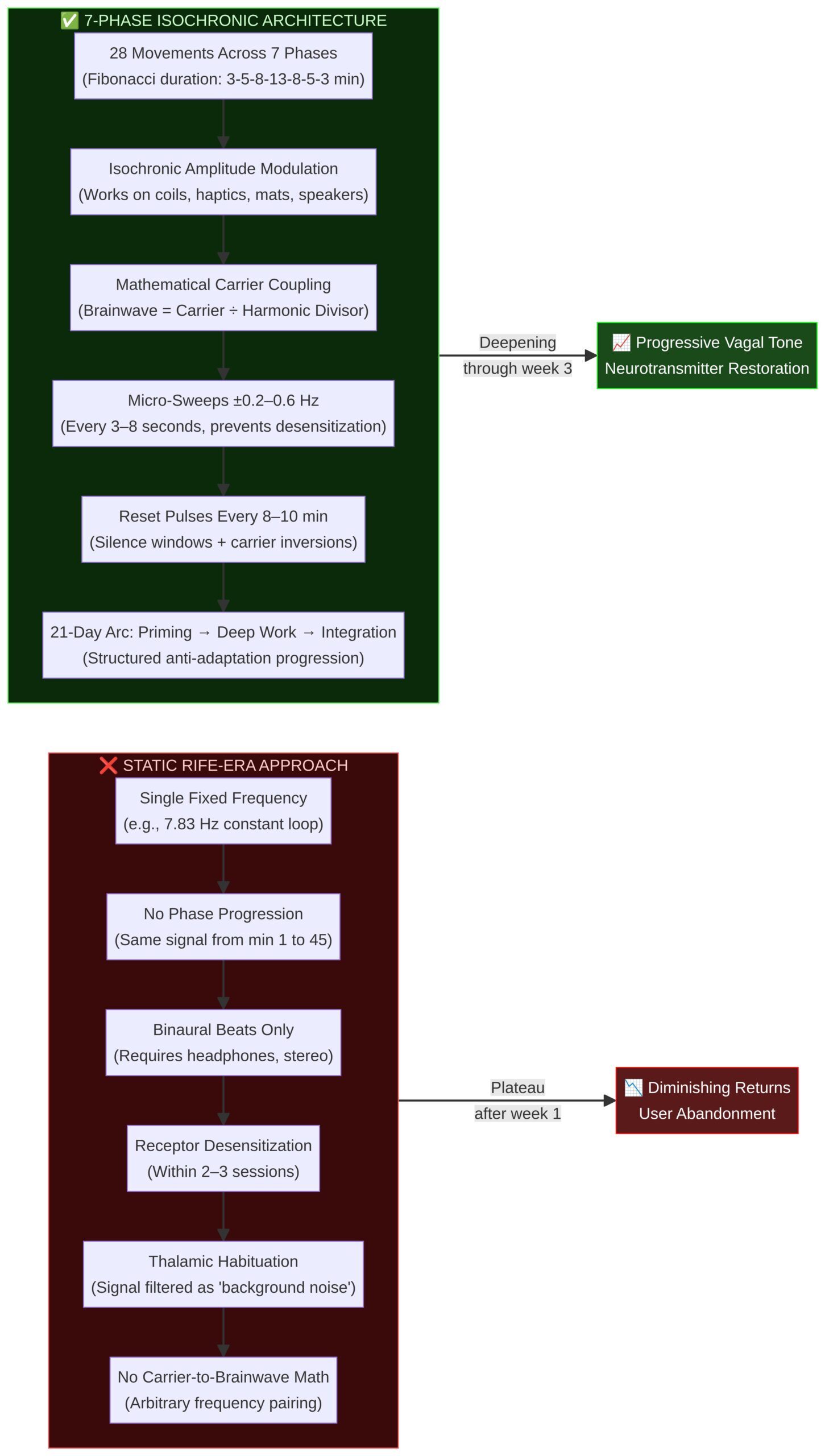
The human body is an incredibly adaptive bioelectric system. If you expose it to a single, unchanging frequency—such as a static 7.83 Hz Schumann resonance loop—it will initially respond. However, within two to three sessions, the nervous system recognizes the signal as background noise and begins to filter it out. This is a survival mechanism known as thalamic habituation.
Furthermore, continuous exposure to a static signal leads to receptor desensitization. Ion channels reduce their amplitude response to steady input. This is why traditional Rife-era frequency devices often produce a sharp initial improvement followed by a frustrating plateau. The body has simply learned to ignore the signal. To create lasting change, the frequency architecture must be as dynamic and complex as the biology it is trying to influence.
The Natural Template: Complexity as the Design Model
Endogenous biological signaling is never static. A healthy heart rate is highly variable. Brainwaves shift dynamically through delta, theta, alpha, and gamma states depending on the task. To bypass cellular adaptation, a bioelectric protocol must mimic this natural complexity. It must speak the language of the nervous system, which relies on variation, phase shifts, and mathematical coherence.
The Solution Architecture: 7-Phase Isochronic Modulation
The Gut-Brain Axis, 7-Phase Vagal Coherence protocol abandons static loops entirely. It is a 45-minute, 7-phase, 28-movement bioelectric program designed specifically for enteric nervous system repair.
Instead of arbitrary frequency pairing, this protocol derives each phase’s brainwave pulse rate as a harmonic division of its primary substance carrier. For example, in Phase 1, the Melatonin carrier (117.33 Hz) is divided by 30 to produce a 3.91 Hz Delta brainwave entrainment envelope. The nervous system recognizes this mathematical relationship as naturally coherent. Furthermore, the protocol utilizes isochronic amplitude modulation—which produces stronger evoked potentials than binaural beats—allowing the mono-unified signal to be delivered effectively through PEMF coils, haptic transducers, mats, or speakers.[6]
Comparison: Static vs. Advanced PEMF Architecture
| Dimension | Traditional Static Systems | Advanced PEMF Architecture (PEMF Healing App) | Why It Matters |
|---|---|---|---|
| Signal Structure | Single fixed frequency (e.g., constant 7.83 Hz) | 28 movements across 7 distinct physiological phases | Prevents thalamic habituation; keeps the nervous system actively engaged rather than filtering the signal as background noise. |
| Entrainment Method | Binaural beats | Isochronic amplitude modulation | Isochronic tones produce significantly stronger evoked potentials and can be delivered through coils and mats, whereas binaural beats require stereo headphones. |
| Carrier Coupling | Arbitrary pairing of brainwave and carrier frequencies | Mathematical harmonic division (Brainwave = Carrier ÷ Divisor) | The nervous system recognizes the mathematical overtone relationship, increasing bio-resonance and cellular uptake of the frequency signature. |
| Adaptation Prevention | None; identical loop every session | Micro-sweeps (±0.2-0.6 Hz) and reset pulses every 8-10 min | Prevents receptor desensitization and ion channel fatigue, ensuring the protocol remains effective on Day 21 as it was on Day 1. |
| Session Progression | Flat amplitude and unchanging focus | Fibonacci duration progression (3-5-8-13-8-5-3 min) | Mirrors natural biological rhythms (expansion to center, then contraction), guiding the body from parasympathetic entry to deep mucosal repair, and finally integration. |
| Delivery System | Often limited to single modality (e.g., mat only) | Mono-unified signal compatible with coils, haptics, mats, and audio | Allows for dual-pathway activation (e.g., combining haptic mechanoreceptor stimulation with PEMF induction) for compounded results. |
The Quantum Dimension: Bio-Resonance and Coherence
Beyond simple electrical induction, advanced PEMF operates in the realm of bio-resonance. When the applied electromagnetic field perfectly matches the harmonic signature of a biological process—such as the 0.1 Hz coherence frequency—it creates constructive interference. This amplifies the body’s endogenous healing signals. The 7-phase architecture doesn’t force the body into a state; it provides the precise energetic template that the vagus nerve and enteric nervous system need to remember how to regulate themselves.
The Future of Bioelectric Medicine
The era of single-frequency “magic bullet” therapy is over. The future of bioenergetics lies in complex, multi-layered architectures that address the body as an integrated, dynamic system. PEMF Magazine continues to highlight these advanced protocols because they represent the bleeding edge of non-invasive neuromodulation, moving beyond symptom management into structural, systemic restoration.
How to Use the 4 Device Systems for the Gut-Brain Axis
The Gut-Brain Axis protocol is a mono-unified signal, meaning it is perfectly formatted for delivery across all major hardware systems. Here is how to deploy each modality for maximum vagal and enteric impact.
With the iMprinter
The Archimedean Tesla Spiral Frequency iMprinter or Metatronic Flower of Life Frequency iMprinter allows you to encode the entire 7-phase frequency architecture into water. Drinking this imprinted water provides a continuous, micro-dose exposure to the vagal and mucosal repair signatures between active sessions, keeping the enteric nervous system bathed in the coherent field.
With the iTorus i2 Coil
The iTorus i2 Active PEMF Therapy Shield provides focused, high-intensity field delivery. For this protocol, place the coil directly over the upper abdomen (the vagal-enteric reflex zone) or at the base of the skull (brainstem) to directly induce the isochronic modulation into the vagal nuclei.
With Woojer Haptic Systems
Vibrotactile delivery engages the body’s mechanoreceptors, providing a secondary physical pathway for the frequency data. Wearing the Woojer vest during the session physically vibrates the vagus nerve and abdominal cavity, profoundly deepening the parasympathetic shift.
PEMF Magazine readers receive an exclusive discount at woojer.com. Use code EPEMF10 at checkout.
Related Programs for Anti-Adaptation Rotation
Rotating programs is itself a primary anti-adaptation strategy. The following programs address overlapping physiological systems and can be used in alternation with the primary Gut-Brain protocol to maintain signal novelty across extended use.
- Gut-Brain Axis, 7-Phase Vagal Coherence, Isochronic Energetics
- Gastrointestinal – Gut Health with 432Hz and 7.83Hz Electroherbalism Energetics
- H. Pylori Detox & Gut Healing – Ultra Advanced Energetics
- Leaky Gut Basic Energetic
- Inflammatory Bowel Disease Basic+ Energetic
- Irritable Bowel Syndrome Basic+ Energetic
- Ringworm Detox, Digestive, Gut Balance & Pathogen Clearing Energetics
- 10Hz Alpha Vagus Nerve Energetics
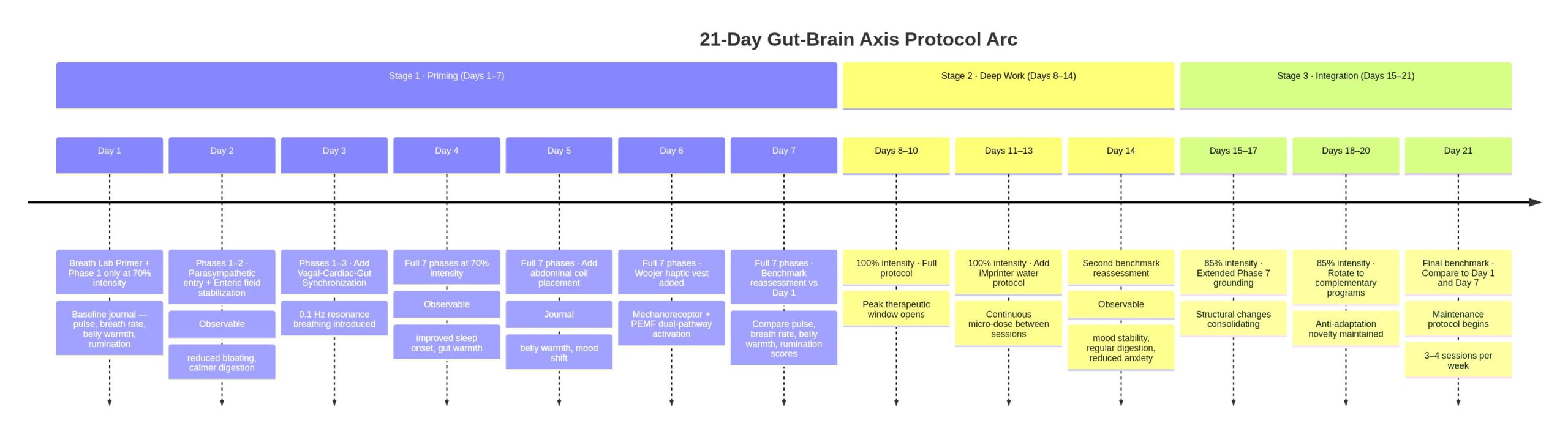
The 21-Day Gut-Brain Axis Protocol
This is a structured 21-day arc divided into Priming, Deep Work, and Integration. Do not skip the Day 1 baseline; it is crucial for tracking your physiological shift.
Day 1: The Baseline and Priming
Device: Audio headphones or small PEMF coil on abdomen.
Duration: 45 minutes (Phase 1 only at 70% intensity).
Timing: 7:00 PM to 9:00 PM (Natural vagal peak).
Action: Complete the 3-minute Breath Lab primer (60s extended exhale, 60s belly breath, 60s humming).
Journal Baseline: Rate 1-10: Belly warmth, rumination/anxiety level, sleep quality (previous night), and tongue coating.
Day 2: Enteric Field Stabilization
Device: PEMF coil on abdomen.
Duration: 45 minutes (Phases 1-2 at 70%).
Timing: Evening.
Action: Focus on the 5-second inhale / 5-second exhale breath pattern during Phase 2.
Observable: Notice any reduction in bloating or a feeling of calmer digestion before bed.
Day 3: Vagal-Cardiac-Gut Synchronization
Device: or Woojer Vest.
Duration: 45 minutes (Phases 1-3 at 70%).
Timing: Evening.
Action: Engage the 0.1 Hz resonance breathing (5.5s inhale / 5.5s exhale) during Phase 3.
Observable: Watch for the moment when breath and heart rate align in coherence.
Day 4: Full Phase Introduction
Device: Mat + Coil on brainstem.
Duration: 45 minutes (Full 7 Phases at 70%).
Timing: Evening.
Action: Practice box breathing (4/4/6/2) during the Phase 4 Mucosal Repair Window.
Observable: Track sleep onset speed and deep sleep metrics if using a wearable.
Day 5: Dual-Pathway Activation
Device: Woojer Vest + iTorus coil.
Duration: 45 minutes (Full 7 Phases at 70%).
Timing: Evening.
Action: Allow the physical haptic vibration to deepen the parasympathetic drop.
Observable: Note any internal cooling sensation during the Phase 5 Inflammation Quench.
Day 6: Neurotransmitter Focus
Device: Mat or Coil.
Duration: 45 minutes (Full 7 Phases at 70%).
Timing: Evening.
Action: Focus intention on neurochemical balance during Phase 6.
Observable: Note any subtle mood lift or chest warmth.
Day 7: First Benchmark Reassessment
Device: Your preferred combination.
Duration: 45 minutes (Full 7 Phases at 70%).
Timing: Evening.
Action: Complete the session and the 10-minute integration period.
Journal: Re-rate your Day 1 metrics (Belly warmth, rumination, sleep, tongue coating). Compare the shift.
Week 2 (Days 8-14): Deep Work
Increase intensity to 100%. This is the peak therapeutic window. Introduce the iMprinter water protocol, drinking imprinted water between sessions to maintain the field. By Day 14, you should observe more stable moods, regular digestion, and a significant reduction in post-meal anxiety. Complete your second benchmark reassessment on Day 14.
Weeks 3 & 4 (Days 15-30): Integration and Consolidation
Reduce intensity to 85%. Focus on Phase 7 (Integration and Grounding). The changes initiated in Week 2 are now becoming structural. Begin rotating in complementary programs (like the Gastrointestinal 432Hz program) every third day to maintain anti-adaptation novelty. Complete your final 30-day benchmark.
Month 2 and Beyond: Maintenance
Transition to 3-4 sessions per week. Rotate through the related programs list to ensure the nervous system continues to receive novel, complex signaling.
Who This Is For
This protocol is designed for individuals experiencing functional gastrointestinal disorders, IBS, leaky gut, chronic bloating, and the accompanying neurological symptoms (brain fog, anxiety, rumination). It is for those who have hit a plateau with diet and supplements alone.
Contraindications: Do not use PEMF coils if you have a pacemaker. If pregnant, consult a practitioner and skip the Phase 4 gamma window. If epileptic, skip Phase 4 and reduce Phase 6 intensity. If on SSRI medication, reduce the intensity of the Serotonin and 5-HTP carriers in Phase 6.
Best Practices for Amplification
- Hydration is Non-Negotiable: Drink 4-8 oz of water before the session. Bioelectric conductivity requires hydration.[7]
- The 10-Minute Integration: Do not immediately stand up or look at a screen after the 45 minutes. Remain supine for 2 minutes, then slowly sit up. This seals the parasympathetic state.
- Temperature Control: Cover yourself with a light blanket. Parasympathetic activation naturally drops body temperature slightly.
- Post-Session Environment: For 60 minutes post-session, avoid intense conversation, driving, or strenuous exercise. Allow the vagal reset to hold.
Conclusion: Reclaiming the Second Brain
Your gut is not broken; it is locked in a defensive posture. It is waiting for a clear, coherent signal from the central nervous system that the environment is safe enough to begin repair. Static frequencies cannot convey this complex message. The phased, isochronic architecture of the Gut-Brain Axis Protocol provides the precise bioelectric vocabulary needed to restore vagal tone, quench enteric inflammation, and rebuild the mucosal lining. By speaking the language of the nervous system, you can finally move out of survival mode and back into deep, systemic coherence.
Medical Disclaimer: The information provided in this article is for educational purposes only and is not intended as a substitute for professional medical advice, diagnosis, or treatment. Always seek the advice of your physician or other qualified health provider with any questions you may have regarding a medical condition. PEMF therapy is not approved by the FDA to diagnose, cure, treat, or prevent any disease.
- Bonaz B, Bazin T, Pellissier S (2018). The Vagus Nerve at the Interface of the Microbiota-Gut-Brain Axis. Frontiers in Neuroscience. https://doi.org/10.3389/fnins.2018.00049
- Bonaz B, Sinniger V, Pellissier S (2017). Vagus nerve stimulation: a new promising therapeutic tool in inflammatory bowel disease. Journal of Internal Medicine. https://doi.org/10.1111/joim.12611
- Sigrist C et al (2024). Brain-Gut Axis: Invasive and Noninvasive Vagus Nerve Stimulation. Inflammatory Bowel Diseases. https://doi.org/10.1093/ibd/izad143
- Sevoz-Couche C, Laborde S (2022). Heart rate variability and slow-paced breathing: when coherence meets resonance. Neuroscience & Biobehavioral Reviews. https://doi.org/10.1016/j.neubiorev.2022.104576
- McCraty R et al (2025). Heart rate variability biofeedback in a global study of the most common coherence frequencies. Scientific Reports. https://doi.org/10.1038/s41598-025-87729-7
- Siever D (2009). Entraining Tones and Binaural Beats. Mind Alive Inc. https://mindalive.com/pages/entraining-tones-and-binaural-beats
- Oschman JL (2015). Energy Medicine: The Scientific Basis, Second Edition. Churchill Livingstone. Elsevier Link