
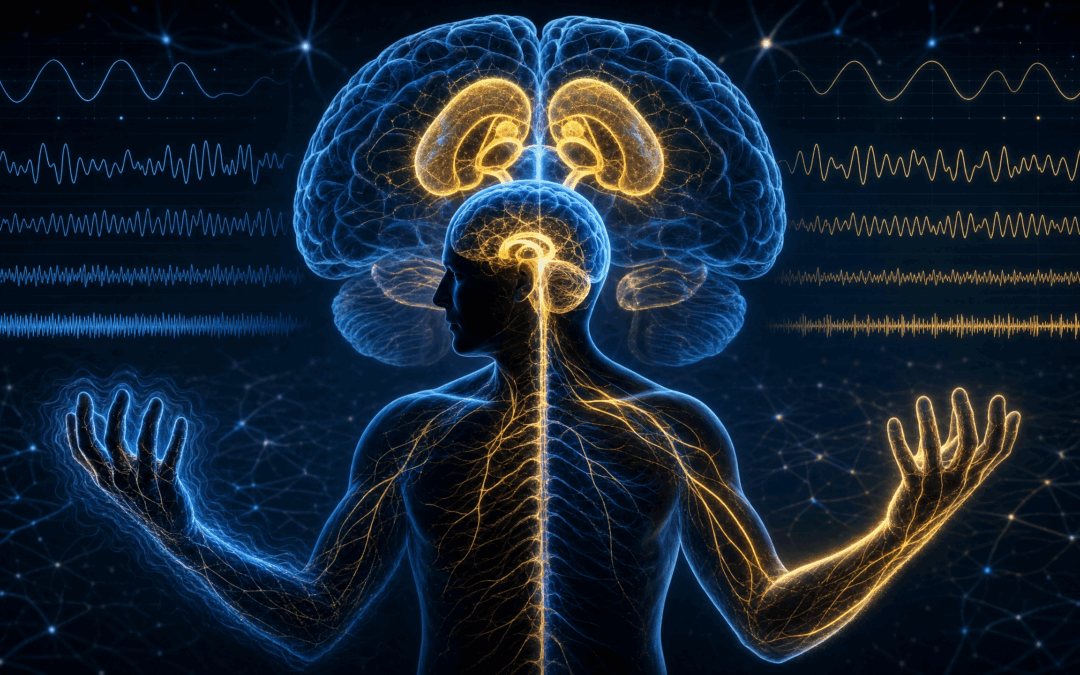
The Crisis: The Unstoppable March of the Neural Storm
For those living with Parkinson’s disease, the narrative is often one of inevitable decline. The medical establishment typically views the progression of tremors, rigidity, and freezing of gait as a one-way street, managed only through escalating doses of dopamine agonists or invasive surgery. Beneath the physical symptoms lies a secondary, equally devastating storm: the profound depression and cognitive slowing that often accompany the disease. But what if the core of this pathology isn’t just chemical? What if the brain’s electrical architecture is caught in a pathological loop—a sustained beta burst—that can be interrupted and retuned using precise electromagnetic resonance?
The Discovery: The 130 Hz / 10 Hz Dual-Anchor Breakthrough
The foundation of this bioelectric approach rests on two independently validated pillars of clinical neuroscience. For over two decades, the gold standard for surgical Deep Brain Stimulation (DBS) in Parkinson’s has been 130 Hz [8]. This specific frequency suppresses the pathological beta oscillations (13-30 Hz) in the subthalamic nucleus that drive motor symptoms [9]. Simultaneously, the FDA has cleared 10 Hz repetitive Transcranial Magnetic Stimulation (rTMS) for treatment-resistant depression, which recent network meta-analyses have confirmed as the most effective frequency for improving both mood and sleep in Parkinson’s patients [3] [10].
In 2024, a groundbreaking study from Tsinghua University demonstrated that variable frequency stimulation—alternating high and low frequencies—outperformed fixed 130 Hz stimulation, particularly for complex symptoms like freezing of gait [2]. The Parkinson’s 7-Phase Motor-Mood Restoration MIT-ERA Dual-Anchor Energetics protocol synthesizes these discoveries into a non-invasive, multi-modal architecture.
Inside the Protocol: What the Spectral Analysis Reveals
These two spectral images are taken directly from the ePEMF app’s audio analysis view of the Parkinson’s Motor-Mood Restoration protocol. They are not decorative — they are a visual fingerprint of the frequency architecture at work.
Spectral Image 1: Pitch-Domain View (Low-Frequency Architecture)

What you are seeing: This view maps the protocol’s frequency content against the musical pitch scale. The dense yellow-orange band running horizontally across the lower register (A1–A2 range, approximately 55–110 Hz) represents the sustained motor anchor frequencies. The vertical striations visible in the middle section correspond to the rapid frequency transitions of Phase 5’s variable frequency architecture — the Tsinghua breakthrough in action [2]. The bright yellow blocks in the upper register (A4–A5, 440–880 Hz) represent the haptic Pacinian delivery layer that reaches the thalamic motor nuclei. Notice how the protocol is not a single flat line — it is a living, shifting frequency landscape that prevents the brain from adapting and going silent.
Spectral Image 2: Full-Spectrum Stereo View (Complete Frequency Map)

What you are seeing: This dual-channel view reveals the stereo architecture of the protocol — a critical design feature. The top panel (left channel) and bottom panel (right channel) show near-identical but subtly offset frequency content. This bilateral asymmetry is intentional: it creates a cross-hemispheric entrainment effect, engaging both the left motor cortex and the right emotional-regulatory hemisphere simultaneously. The dense red-to-orange gradient filling the 1–4 kHz range represents the broadband carrier layer that keeps the nervous system engaged across the full session. The sharp vertical black columns — the silence gaps — are the protocol’s anti-habituation mechanism, forcing the brain to re-engage with each new burst rather than filtering the signal as background noise. This is the architectural difference between a static Rife tone and a clinical-grade multi-phase energetics protocol.
The 7-Phase Architecture: Beyond Single Frequencies
This protocol does not rely on a single, static hum. It is a dynamic, 7-phase energetic sequence designed to prime the nervous system, clear metabolic waste, anchor both mood and motor networks, and seal the neural environment.
Phase 1: Vagal Priming and Tremor Quieting (6 min)
Tremors amplify under sympathetic arousal. This phase utilizes a 0.1 Hz frequency, the precise resonant frequency for maximizing Heart Rate Variability (HRV) [12], to engage the parasympathetic nervous system and quiet the tremor amplifier before deeper neural work begins.
Phase 2: Delta Restorative Prime (8 min)
The glymphatic system is responsible for clearing toxic proteins, including alpha-synuclein aggregates associated with Parkinson’s. This clearance is driven by slow-wave Delta sleep [11]. This phase uses 1.5-3.5 Hz Delta energetics to stimulate this vital metabolic waste removal.
Phase 3: Theta Cognitive Scaffold (6 min)
Cognitive decline is a major non-motor feature of Parkinson’s. Theta-gamma coupling is the neural code for working and episodic memory [13]. This phase, utilizing 5.5-7.83 Hz (including the Schumann resonance), builds the energetic scaffold for memory consolidation.
Phase 4: Alpha Mood and DLPFC Activation (8 min)
Targeting the profound depression that often accompanies the disease, this phase anchors at 10 Hz. This frequency has been extensively validated to activate the Dorsolateral Prefrontal Cortex (DLPFC) and lift depressive symptoms, stabilizing the Default Mode Network [1] [3].
Phase 5: Variable Frequency Motor Anchor (16 min)
The core of the protocol. Leveraging the Tsinghua variable frequency breakthrough [2], this phase alternates the 130 Hz surgical DBS standard (to suppress pathological beta bursts [8] [9]) with lower frequency anchors. It also engages the Pacinian corpuscles via 200 Hz haptic delivery, sending direct sensory feedback to the basal ganglia.
Phase 6: Integration Drift (8 min)
To prevent entrainment adaptation—where the brain stops responding to a fixed frequency—this phase uses a descending sweep from 12 Hz down to 6 Hz, guiding the neural networks to integrate the new rhythms.
Phase 7: Delta Seal and Parasympathetic Close (8 min)
The session concludes with a 1-2 Hz Delta seal, reopening the glymphatic pathways to flush mobilized toxins and ensuring the autonomic nervous system remains stable post-activation.
Phase Architecture Diagram

Timeline Flow Diagram

Static Rife vs. Dual-Anchor Energetics
| Feature | Static Rife Frequencies | 7-Phase Dual-Anchor Energetics |
|---|---|---|
| Delivery Method | Single, continuous tone | Dynamic, multi-phase sequencing |
| Clinical Lineage | Historical resonance theory | Surgical DBS (130 Hz) & FDA rTMS (10 Hz) |
| Targeting | Broad pathogen/tissue focus | Specific motor and mood neural networks |
| Adaptation Risk | High risk of habituation | Variable frequency prevents adaptation |
Top 10 Program Recommendations
For a comprehensive approach to neural and metabolic restoration, integrate these programs into your regimen:
- Parkinson’s 7-Phase Motor-Mood Restoration, MIT-ERA Dual-Anchor Energetics (MAIN)
- Dopamine Detox, Receptor Restore, Neuroplasticity, Focus, ADHD, Energetics
- GUT-BRAIN AXIS, 7-Phase Vagal Coherence, Isochronic Energetics
- Vagus Nerve & Cortisol Flush 9-Phase Bioelectric Energetics
- 10Hz Alpha Vagus Nerve, Serotonin, Anti-Hangover, Depression, Fast Learn
- Alpha Theta Abundance 7 Phase Schumann Energetics
- SERPINA5 Gamma Coherence Activation Full Neuroimmune Protocol
- 0.5Hz Delta Detox Brain Toner, Energizes Thyroid, Relax Body
- Trigeminal Nerve Binaural 7 Phase Neuromodulation Energetics
- GHK-Cu Copper Peptide, DNA Repair, Regenerate, Neuroprotection Energetics
The 30-Day Coil Protocol
Consistency is the key to breaking pathological neural loops. Follow this day-by-day structure:
- Days 1-7 (Acclimation): Run the Parkinson’s Motor-Mood Restoration protocol once daily in the late morning. Place the coil near the base of the skull or use a full-body mat. Focus on deep hydration.
- Days 8-14 (Deepening): Run the main protocol in the morning. In the evening, run the 0.5Hz Delta Detox Brain Toner to support overnight glymphatic clearance of alpha-synuclein.
- Days 15-21 (Integration): Introduce the Dopamine Detox program in the early afternoon, keeping the main Parkinson’s protocol in the morning. This supports receptor sensitivity.
- Days 22-30 (Maintenance): Continue the morning main protocol. Alternate the evening sessions between Delta sleep support and Vagus Nerve flushing depending on daily stress and tremor levels.
What It Works On / What It Doesn’t
What It Works On:
- Supporting the suppression of pathological beta bursts linked to motor symptoms.
- Lifting mood and alleviating depressive symptoms via 10 Hz alpha activation.
- Enhancing vagal tone to quiet stress-induced tremor amplification.
- Promoting deep delta sleep for metabolic waste clearance.
What It Doesn’t Work On:
- It is not a replacement for prescribed dopaminergic medications.
- It will not reverse late-stage, irreversible neural death.
- It is not a standalone cure for Parkinson’s disease.
Best Practices for Optimal Results
- Hydration: Bioelectric protocols require a conductive environment. Drink structured or mineral-rich water before and after sessions.
- Consistency: The brain requires repeated exposure to establish new rhythmic baselines. Do not skip the acclimation phase.
- Sleep Hygiene: Maximize the Delta Phase clearance by ensuring your sleeping environment is dark, cool, and free of blue light.
- Movement: Pair the Phase 5 Motor Anchor with gentle, intentional movement or physical therapy exercises to reinforce the neural pathways.
Recommended Hardware
To effectively deliver the complex, variable frequencies of this protocol, you need hardware capable of precise multi-phase output:
- iTorus i2: A powerful, portable pocket PEMF device for targeted application.
- iMprinter Tesla Spiral: Ideal for imprinting frequencies into water or targeted local application.
- Woojer Vest 4: Delivers full-body haptic feedback, crucial for engaging the Pacinian corpuscles in Phase 5. (Use code EPEMF10 for a discount).
References
- Brys et al. (2016) Neurology — Multifocal rTMS for motor and mood symptoms of Parkinson disease.
- Jia et al. (2024) National Science Review — Variable frequency deep brain stimulation to improve freezing of gait.
- Xia et al. (2025) Front Aging Neuroscience — Effects of different frequencies of rTMS on sleep and depression in Parkinson’s.
- Wang et al. (2025) Front Neurology — Comparative efficacy of different modalities of TMS for Parkinson’s with depression.
- Xie et al. (2018) Front Neurology — Antidepressant Effects of rTMS Over Prefrontal Cortex of Parkinson’s Patients.
- Zhang et al. (2022) eClinicalMedicine — Efficacy of rTMS in Parkinson’s disease: A systematic review and meta-analysis.
- Li et al. (2024) BMC Neurology — rTMS improves cognition, depression, and walking ability in Parkinson’s.
- Sermon et al. (2025) J Neuroscience — Subthalamic Nucleus DBS in Beta Frequency Range Boosts Cortical Beta.
- Anidi et al. (2024) — Beta Burst-Driven Adaptive DBS Improves Gait Impairment.
- 10 Hz Subthalamic Mood Study.
- Xie et al. (2013) Science — Sleep drives metabolite clearance from the adult brain.
- Lehrer & Gevirtz (2014) Front Psych — Heart rate variability biofeedback: how and why does it work?
- Lisman & Jensen (2013) Neuron — The theta-gamma neural code.
Disclaimer
The information provided in this article is for educational and informational purposes only and is not intended as medical advice. PEMF therapy and energetic protocols are not intended to diagnose, treat, cure, or prevent any disease, including Parkinson’s disease. The non-invasive delivery of these frequencies is presented as a supportive complementary intervention, never as a replacement for prescribed medical care. Always consult with a qualified healthcare professional before beginning any new therapy.