
Your Cells Are Sending Light Signals And Science Just Proved It
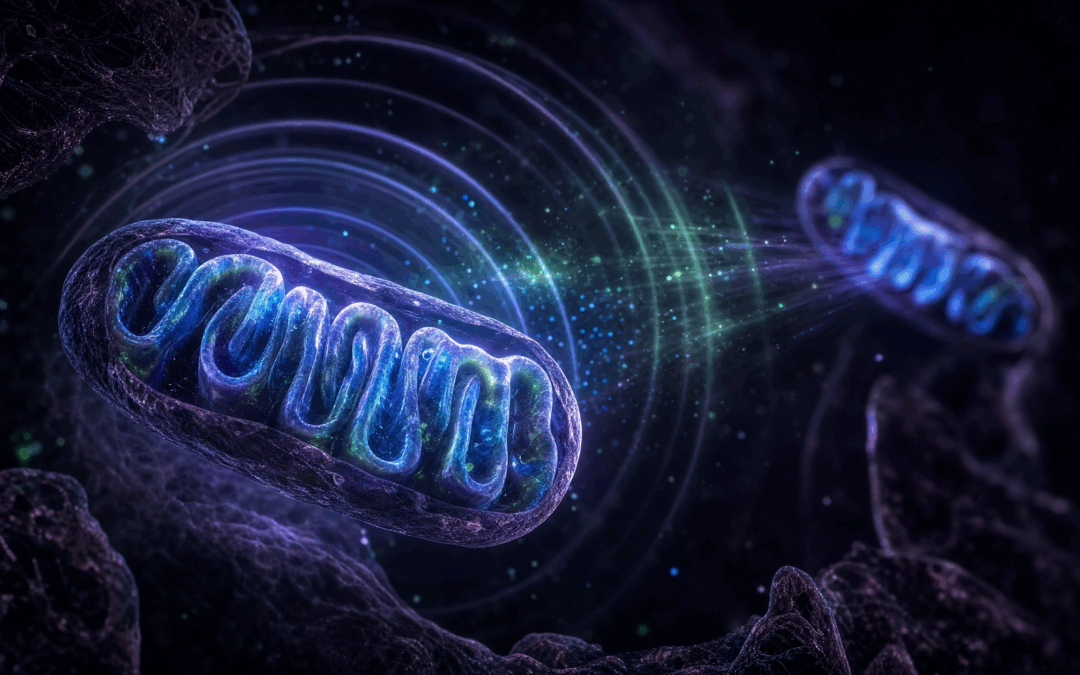
Scientists are beginning to uncover something extraordinary at the cellular level. A 2023 study published in Frontiers in Physiology [1] found evidence of non-chemical communication between isolated mitochondria. The researchers observed that mitochondria in one chamber could influence the respiration of mitochondria in a separate chamber, even when they were physically and chemically isolated.
The most fascinating part? The experimental design suggests this communication may be light-based, connected to ultraweak photon emission, also known as biophotons.
This does not mean humans are “made of light” in a poetic way. It means biology may be far more electromagnetic, photonic, and frequency-based than conventional models have fully explained. Your mitochondria are not only power generators. They may also be part of a subtle light-signaling network inside the body.

The Experiment: How Mitochondria “Talk” Without Chemicals
In the study, researchers separated populations of isolated mitochondria into different cuvettes. They induced oxidative stress in one group by inhibiting the electron transport chain (ETC) using antimycin. Remarkably, the chemically isolated mitochondria in an adjacent, unshielded cuvette showed a significant decrease in their oxygen consumption rate (OCR). However, when an opaque barrier was placed between them, this effect disappeared [1].
Because the only difference was the opaque barrier, the researchers concluded that the signaling mechanism was light-based. The stressed mitochondria were emitting ultraweak photon emission (UPE) — biophotons — which the neighboring mitochondria received and reacted to.

What Are Biophotons?
Biophotons, or Ultraweak Photon Emission (UPE), are extremely low-intensity emissions of light produced by living cells. They typically range from 200 to 800 nanometers. They are generated primarily when reactive oxygen species (ROS) interact with biomolecules like lipids and proteins, creating excited states that release photons as they return to their ground state.
Inside the cell, these photons don’t just disappear. They can be absorbed by aromatic structures, such as the tryptophan and tyrosine residues in microtubule networks, effectively turning the cell’s cytoskeleton into a fiber-optic waveguide for signal transmission.

The End of the Rife Era: Why We Need a New Model
For decades, the alternative health community has relied on the “Rife Era” model — the idea that specific, fixed frequencies (like a single Hz value) can target and destroy pathogens or heal specific organs. This mechanistic view is outdated.
As this 2023 study demonstrates, cellular communication is dynamic, non-linear, and highly adaptive. Mitochondria don’t just respond to a single fixed frequency; they communicate through a complex, shifting spectrum of ultraweak photon emissions and electromagnetic resonance. When we blast the body with static Rife frequencies, the cells quickly adapt and tune out the signal, much like ignoring a car alarm that won’t turn off. This phenomenon, known as cellular adaptation or habituation, renders static frequency therapy ineffective over time.
To truly support the body’s biophotonic network, we must use Phi-Harmonic Advanced Energetics — multi-phasic, sweeping frequency programs that mimic the dynamic, chaotic nature of biological signaling. By constantly shifting and evolving, these programs prevent cellular adaptation and resonate with the body’s natural electromagnetic and photonic pathways.

How to Support Your Biophotonic Network
If your cells are communicating via light and frequency, you can support this network using advanced ePEMF (Pulsed Electromagnetic Field) therapy. Here are the specific, multi-phasic programs designed to support mitochondrial energy, cellular coherence, and systemic communication.
Day 1: Establish Coherence and Energy
- Mitochondrial Energy – Respiration & Oxidative Phosphorylation Energetics — Supports the foundational energy production (ATP) of the mitochondria.
- Spine Body as Sound Energy Aspects Biophotonics Energetics — Helps align the central nervous system with biophotonic signaling.
Day 2: Cellular Rejuvenation and Detox
- Cellular communication – Rejuvenation — Enhances the non-chemical signaling pathways between cells.
- Fenbendazole Enbendazole – Cellular Detox & Immune Energetics — A crucial detox step to clear metabolic waste that can interfere with photon transmission.
Day 3: Advanced Light Body Integration
- 12 Chakra Dynamic Light Body Biophotonic Advanced Energetics — Integrates the biophotonic network across the entire energetic body.
- Brain Stem Spine Body Biophotonics Energetics — Targets the brain stem to support systemic light-based communication.
Hardware Recommendations for Biophotonic Support
To effectively deliver these advanced frequency programs to your cellular network, we recommend the following devices:
- iTorus i2 — Portable, powerful scalar vortex coil for targeted application.
- iTorus i5 — Larger field generation for whole-body immersion in coherent frequencies.
- Metatronic iMprinter — Ideal for imprinting water with biophotonic frequencies to support internal hydration networks.
- Archimedean iMprinter — A powerful tool for structuring water and supplements with specific energetic signatures.
- Woojer Vest 4 — Delivers frequencies through vibroacoustic haptics directly into the body. Use code EPEMF10 for a discount.