

Natural harmonic frequency tuning is defined as the practice of adjusting musical intervals so their frequencies match simple whole-number ratios found in the harmonic series, producing acoustically pure tones without audible beats. Known formally as just intonation in music theory, this system governs everything from ancient instrument building to modern vibrational therapy. If you have ever felt a perfectly tuned chord resonate through your chest, you have experienced what natural harmonic frequency tuning does at its most direct. Frequencyhealing applies these same principles across PEMF, binaural audio, and haptic vibration programs designed to work with your body’s own bioelectric rhythms.
What is natural harmonic frequency tuning?
Natural harmonic frequency tuning means tuning tones so musical intervals match the harmonic series and have simple integer frequency ratios, producing pure sound without audible beating. The formal music theory term for this is just intonation. Both phrases describe the same acoustic reality: when two tones share a ratio like 2:1 or 3:2, their waveforms align cleanly and the sound feels stable, full, and alive.
The harmonic series is not a human invention. It is a physical law. Every vibrating object, from a plucked guitar string to the human larynx, produces a fundamental frequency and a cascade of overtones at integer multiples above it. Natural harmonic frequency tuning selects intervals that sit at those natural meeting points, rather than forcing tones into mathematically convenient but acoustically impure positions.

This distinction matters for wellness practitioners and sound therapists. When a frequency program is built on harmonic ratios rather than arbitrary spacing, the tones interact with each other in ways that feel coherent rather than tense. That coherence is not subjective poetry. It is measurable physics.
How do harmonic frequencies work?
Harmonics are sinusoidal components/01%3A_Vibrations/1.05%3A_More_about_overtones) with frequencies at positive integer multiples of the fundamental frequency, arising naturally from the physical properties of vibrating systems. If a string vibrates at a fundamental of 100 Hz, its harmonics appear at 200 Hz, 300 Hz, 400 Hz, and so on. Each harmonic is a standing wave that fits exactly within the geometry of the vibrating object.
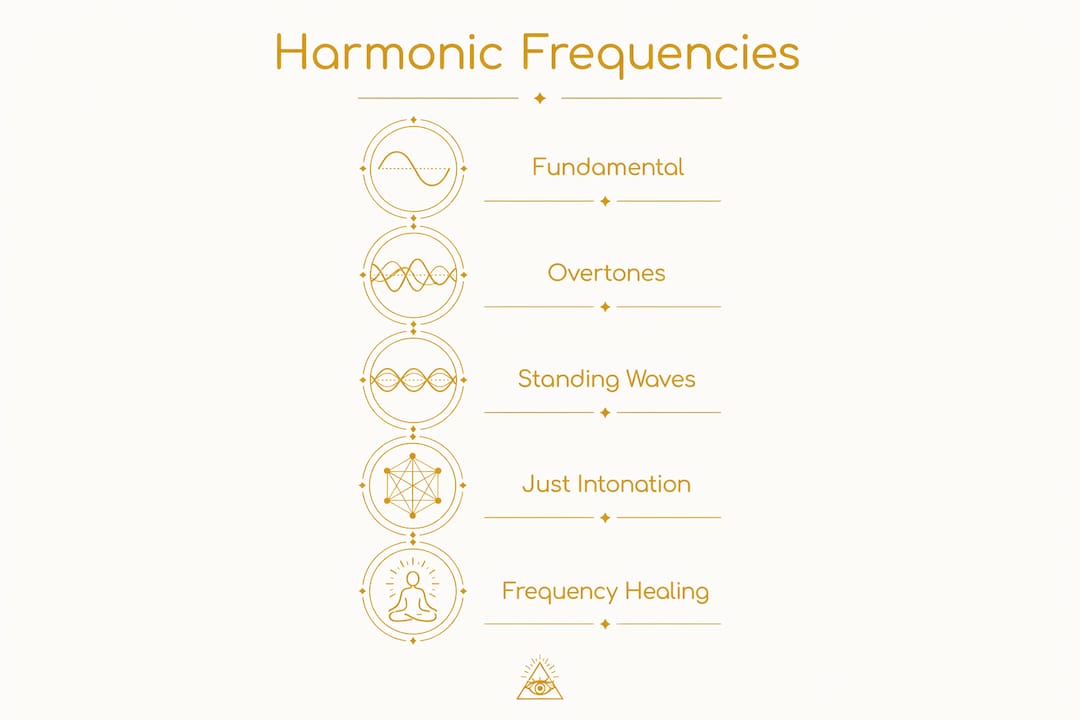
Understanding harmonic frequencies requires understanding standing waves. A standing wave forms when a vibrating medium, such as a string fixed at both ends, supports only wavelengths that fit its length as whole-number fractions. This is why a violin string and a flute both produce harmonic series, even though one vibrates a solid medium and the other vibrates air. The boundary conditions force the same mathematical outcome.
The distinction between harmonics and overtones is worth clarifying. The first harmonic is the fundamental itself. Overtones are all frequencies above the fundamental, so the first overtone is the second harmonic. In practical sound healing and music contexts, the terms are often used interchangeably, but the physics are precise.
Instrument timbre is shaped by which harmonics are strong and which are weak. A bowed string produces a rich, dense harmonic envelope. A plucked string emphasizes lower harmonics and decays faster. A monochord, commonly used in sound therapy, produces a clean, sustained harmonic profile that makes it well suited for therapeutic delivery.
Key characteristics of harmonic frequencies:
- Fundamental frequency: The lowest, loudest tone produced by a vibrating system.
- Integer multiples: Harmonics appear at 2x, 3x, 4x the fundamental, never at fractional positions.
- Standing waves: Physical geometry determines which harmonics a system supports.
- Timbre: The relative strength of each harmonic gives each instrument its unique sound color.
- Overtone envelope: Playing technique, material, and shape all shift which harmonics dominate.
Pro Tip: When listening to a sound therapy session, pay attention to the sense of “fullness” in the tone. That fullness is the harmonic envelope at work, not just the fundamental frequency.
How does just intonation implement natural tuning?
Just intonation is the music theory system that implements natural harmonic frequency tuning by aligning intervals with simple whole-number ratios to produce beatless, pure musical intervals. The octave sits at 2:1, the perfect fifth at 3:2, and the perfect fourth at 4:3. These ratios are not arbitrary choices. They correspond directly to adjacent positions in the harmonic series.
The contrast with equal temperament, the tuning system used in most modern pianos and digital instruments, is significant. Equal temperament divides the octave into 12 mathematically equal semitones. This makes every key sound equally in tune, which is practical for instruments that cannot retune mid-performance. The cost is that almost every interval except the octave is slightly impure. The perfect fifth in equal temperament is about 2 cents flat of the pure 3:2 ratio. That small deviation introduces a slow, audible beating between the tones.
| Interval | Just intonation ratio | Equal temperament deviation |
|---|---|---|
| Octave | 2:1 | 0 cents (exact) |
| Perfect fifth | 3:2 | ~2 cents flat |
| Perfect fourth | 4:3 | ~2 cents sharp |
| Major third | 5:4 | ~14 cents sharp |
| Minor third | 6:5 | ~16 cents flat |
The major third deviation is the most audible. In equal temperament, a major third beats noticeably. In just intonation, it locks into stillness. Choral singers, string quartets, and barbershop ensembles naturally drift toward just intonation when they listen carefully to each other, because the beatless sound is acoustically rewarding.
Beatlessness is the practical test for pure intervals. When two tones produce no audible beats, they are likely sitting at a simple integer ratio. Practitioners in sound therapy use this same principle to verify that their instruments are producing genuinely harmonic relationships rather than approximations.
Pro Tip: Tune two singing bowls or tuning forks together and listen for the slow “wah-wah” pulse between them. That pulse is beating. When it disappears, you have found a pure harmonic interval.
Historical contexts for just intonation include Renaissance choral music, Indian classical music with its raga system, and many traditional folk tuning practices worldwide. Modern applications extend into sound healing, where practitioners deliberately select instruments and tunings that produce pure harmonic relationships.
How is harmonic tuning applied in wellness and vibrational therapy?
Sound healing practices apply natural frequency tuning by selecting instruments and delivery frequencies that align with harmonic ratios, then exposing the body to sustained vibration at those frequencies. The theoretical basis is resonance: resonance occurs when a forced vibration matches an object’s natural frequency, resulting in amplified vibrations. Applied to the body, the claim is that tissues, organs, and neural systems each have characteristic frequencies that respond to external harmonic input.
A 2025 randomized crossover trial studied monochord sound healing with tuning from 432 Hz to 443 Hz. The protocol used 15-minute intervention sessions with at least one week of washout between conditions. That structured design reflects how seriously researchers now treat delivery timing and exposure control in frequency wellness research.
Common delivery methods in harmonic frequency therapy include:
- Monochord instruments: Multi-string instruments tuned to harmonic ratios, placed on or near the body.
- Singing bowls: Tibetan and crystal bowls produce rich harmonic envelopes when struck or rimmed.
- Tuning forks: Applied directly to acupuncture points or held near the ears for air conduction.
- PEMF coils: Deliver electromagnetic pulses at specific frequencies, bypassing the auditory system entirely.
- Binaural audio programs: Two slightly different frequencies delivered to each ear, producing a perceived beat frequency in the brain.
- Haptic vibration devices: Translate frequency programs into physical vibration felt through the skin and fascia.
The 432 Hz tuning claim deserves specific attention. Proponents argue that 432 Hz is more harmonically aligned with natural systems than the standard 440 Hz concert pitch. The physics argument is that 432 Hz produces a slightly different harmonic series. Whether that difference produces measurable physiological outcomes remains an open research question. What the 2025 monochord trial does confirm is that structured, timed exposure to harmonically tuned instruments produces measurable effects worth studying rigorously.
Entrainment is the second key mechanism cited in vibrational therapy. Neural oscillations, heart rate variability, and brainwave patterns all show the capacity to synchronize with external rhythmic stimuli. Binaural beats and PEMF programs exploit this principle directly, using frequency sequencing to guide the nervous system toward target states like deep relaxation or focused attention.
What are the common misconceptions about harmonic tuning?
The most persistent misconception is that natural harmonic frequency tuning refers to a single healing frequency rather than a system of ratios. Practitioners sometimes speak of “432 Hz healing” or “528 Hz DNA repair” as if one frequency carries universal therapeutic power. The physics do not support that framing.
Here are the most important nuances to understand:
-
Harmonic tuning is a ratio system, not a single number. Just intonation defines relationships between tones. A 432 Hz fundamental produces a different harmonic series than a 440 Hz fundamental, but both generate the same ratio relationships internally. The system is what matters, not the anchor pitch alone.
-
Timbre shapes perception as much as frequency ratios. Different playing methods produce distinct harmonic envelopes that influence how a sound feels. A monochord bowed slowly sounds very different from the same frequency played on a synthesizer, even at identical pitch. Delivery method is not a secondary concern.
-
Environmental factors reintroduce beating. Instruments and rooms can reintroduce beating despite ideal ratios due to drift and environmental factors. Temperature changes detune strings. Room acoustics create standing waves at specific positions. A session that starts in pure just intonation may drift within minutes.
-
Wellness results may reflect relaxation, not precise tuning. Clinical wellness interventions controlling for timing and exposure reduce carryover effects, but perceived benefits may still be due to general sound exposure or relaxation rather than specific frequency ratios. Honest practitioners acknowledge this distinction.
-
Calibration requires ongoing attention. Frequency drift is real. PEMF devices, digital audio programs, and acoustic instruments all require regular calibration checks to maintain the harmonic relationships their programs promise.
Key Takeaways
Natural harmonic frequency tuning is a ratio-based system rooted in physics, not a single healing frequency, and its wellness applications are most credible when delivered through structured, calibrated protocols.
| Point | Details |
|---|---|
| Core definition | Natural harmonic tuning uses simple integer ratios like 2:1 and 3:2 to produce beatless, pure intervals. |
| Just intonation vs. equal temperament | Just intonation produces acoustically pure intervals; equal temperament trades purity for consistent cross-key playability. |
| Wellness delivery methods | PEMF coils, binaural audio, monochords, and haptic devices all apply harmonic tuning principles to the body. |
| Research context | A 2025 monochord trial used 15-minute structured sessions, showing that timing and exposure control matter as much as tuning. |
| Key limitation | Timbre, environment, and calibration drift all affect whether a session actually delivers pure harmonic ratios. |
Why I think most people are missing the point on harmonic tuning
Most conversations about natural harmonic frequency tuning get stuck arguing about whether 432 Hz or 440 Hz is the “correct” pitch. That debate misses the deeper point entirely. The acoustical beauty of just intonation is not about any single anchor frequency. It is about the living relationships between tones, the way a pure fifth opens up and breathes compared to its equal-tempered cousin.
I have spent time with both acoustic instruments tuned to just intonation and digital frequency programs built on harmonic architectures. The difference is not subtle. A chord tuned to pure ratios has a quality of stillness at its center that equal temperament simply cannot replicate. That stillness is not mystical. It is the physical absence of beating, and it has a real effect on how the nervous system responds.
Where I urge caution is in attributing specific healing outcomes to specific frequencies without controlled evidence. The 2025 monochord trial is a good model: structured timing, washout periods, and careful design. That rigor is what separates credible frequency wellness research from marketing. When you explore frequency healing programs or PEMF protocols, look for that same commitment to structured delivery. The science and the tradition are most powerful when they work together, not when one is used to dress up the other.
— Art
Frequencyhealing programs built on harmonic principles
Frequencyhealing brings harmonic frequency tuning into daily wellness practice through a platform that combines PEMF coils, binaural audio, haptic vibration, and scalar brainwave programs. Every program is built around frequency sequencing that respects harmonic relationships, not arbitrary pitch selections.
The platform’s guided frequency programs cover relaxation, sleep, nervous system balance, recovery support, and emotional wellness. Hardware options include PEMF coils for electromagnetic delivery and haptic devices for physical vibration. For those new to frequency wellness, the Luma Assist AI guide helps you identify which programs align with your current state and goals. Frequencyhealing makes it straightforward to apply the physics of harmonic tuning to your daily wellness ritual, with or without prior knowledge of acoustics.
FAQ
What is the difference between natural frequency and harmonic frequency?
Natural frequency is the characteristic vibration rate of a physical system when undisturbed. Harmonic frequencies are integer multiples of that fundamental, produced when the system vibrates and generates overtones above its base pitch.
Is 432 Hz tuning scientifically proven to heal?
Current research, including the 2025 monochord crossover trial, shows measurable effects from structured harmonic sound exposure, but has not isolated 432 Hz as uniquely therapeutic compared to other harmonic tunings. Results may reflect relaxation responses rather than a specific frequency effect.
How does just intonation differ from equal temperament?
Just intonation tunes intervals to simple whole-number ratios like 3:2 for a perfect fifth, producing beatless sound. Equal temperament divides the octave into 12 equal semitones, which introduces slight impurities in most intervals but allows consistent tuning across all musical keys.
Can PEMF devices deliver harmonic frequency tuning?
Yes. PEMF coils deliver electromagnetic pulses at programmable frequencies, allowing practitioners to apply harmonic frequency protocols directly to the body without relying on the auditory system. Frequencyhealing’s PEMF coil devices are designed for this purpose.
Why do some sound therapy sessions feel more effective than others?
Timbre, delivery method, room acoustics, and calibration all affect whether a session actually produces pure harmonic ratios. A session using a well-tuned monochord in a controlled acoustic space will deliver a more coherent harmonic experience than one using a poorly calibrated digital track played through low-quality speakers.