

Burnout and mental exhaustion are rarely experienced as one flat, unchanging state. A meaningful recovery composition should not be flat either. Burnout & Mental Exhaustion Reset: 9-Phase Cognitive Recovery BioPhi-Harmonic Energetics is built as a 33-minute sensory composition with a clear engineering premise: move from a lower-demand off-ramp through staged recovery, cognitive organization, and reintegration, instead of leaving the listener inside one unchanging tone bed.
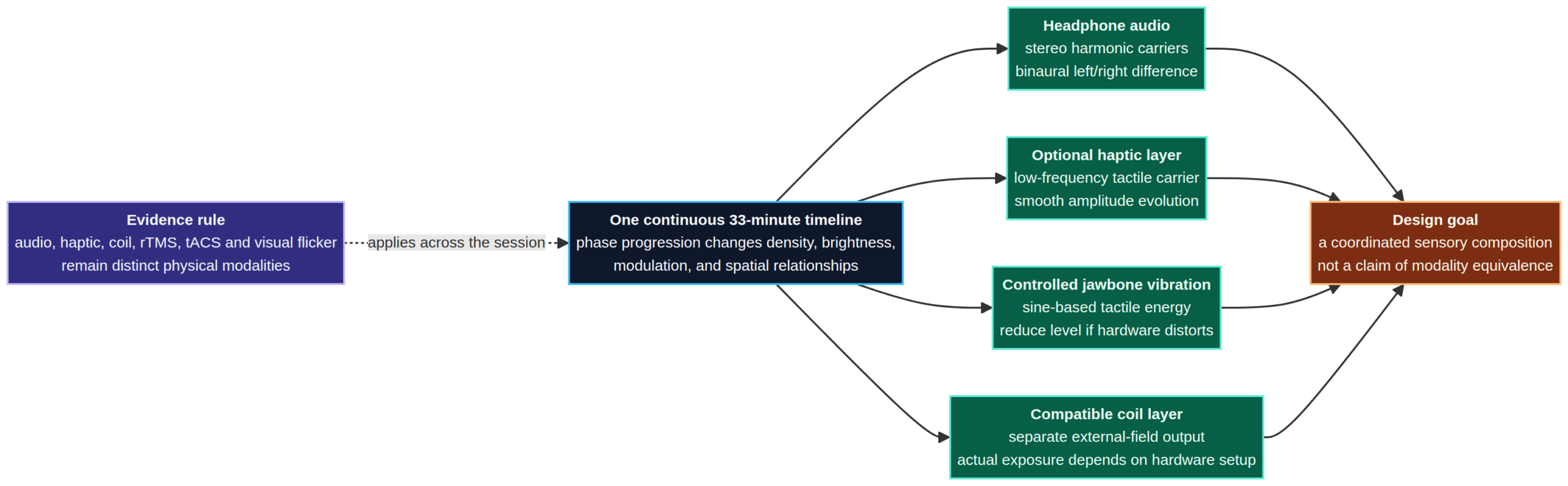
That is the architectural difference readers can actually inspect. The program carries a coordinated headphone, compatible-coil, haptic, and controlled jawbone-vibrotactile design through nine public phases. Its layers evolve in timing, harmonic brightness, left/right relationship, modulation, and density. The result is not a claim that an audio file can diagnose or treat burnout. It is a deliberate attempt to make a wellness session more coherent, more navigable, and more responsive to the fact that cognitive demand, sensory load, and subjective fatigue change over time.

The design proposition: from sensory off-ramp to cognitive reintegration
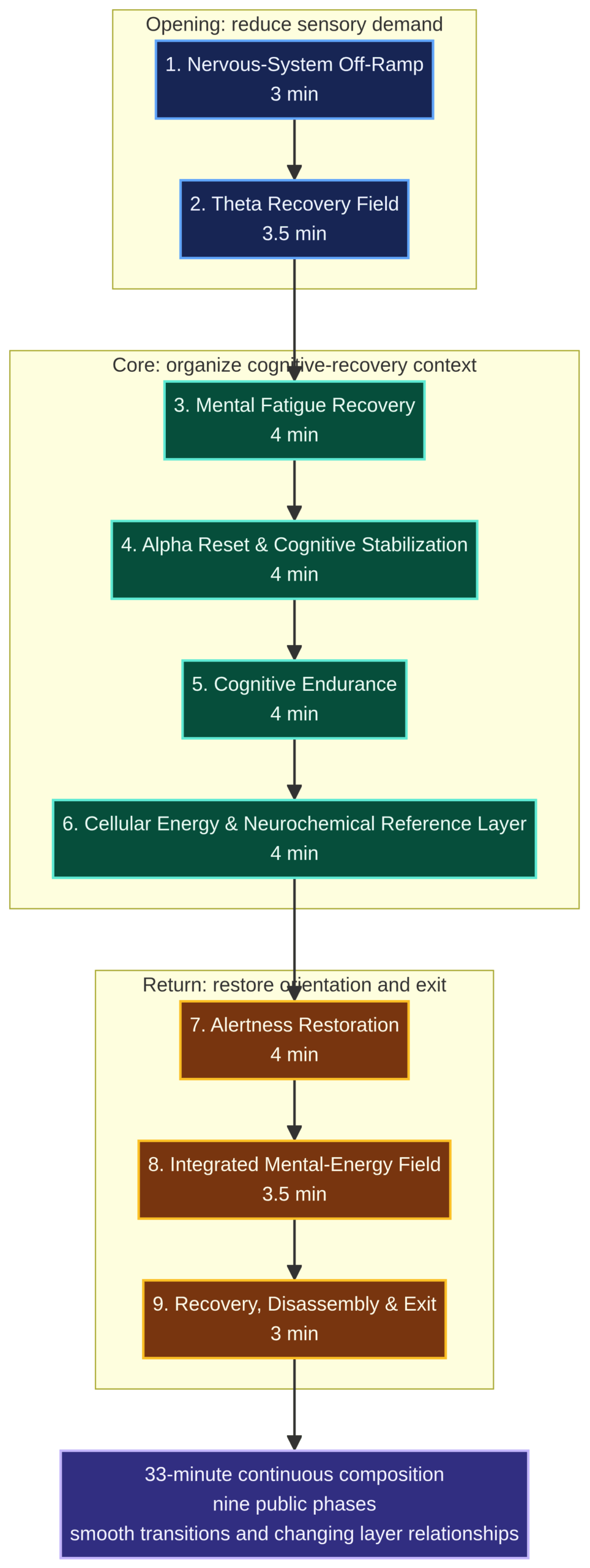
The opening two phases, Nervous-System Off-Ramp and Theta Recovery Field, lower the compositional demand before the session reaches its more organized cognitive chapters. This is not an accidental playlist order. It is a signal-design decision. The architecture begins with smoother entry, controlled density, and a progression that gives the listener a clear temporal frame rather than immediately presenting the most activating material.
The central sequence then moves through Mental Fatigue Recovery, Alpha Reset & Cognitive Stabilization, Cognitive Endurance, and the Cellular Energy & Neurochemical Reference Layer. In the final third, Alertness Restoration and the Integrated Mental-Energy Field bring the compositional threads together before Recovery, Disassembly & Exit progressively reduces layer density. This creates a full-session arc with deliberate entry, central organization, and controlled exit behavior.
The distinction is especially relevant for readers who are tired of static wellness tracks. A fixed tone can be a valid acoustic object. It has a stable identity, a stable spectrum, and a stable listening task. This program is designed around a different question: how can a signal remain coherent while its relational properties evolve? Its answer is phase continuity, controlled amplitude evolution, changing harmonic brightness, stereo Mid/Side movement, bounded microvariation, and sequential crossfades. The same stack is not simply looped for 33 minutes.
Why the cognitive-recovery chapter is built around a sequence, not a slogan
The program uses public research anchors with different levels of modality proximity. The most direct audio context is a human mental-fatigue study comparing 15 Hz and 40 Hz binaural beats, relaxing music, and pure tone conditions during a fatigue-induction paradigm. The study reported specific EEG-network and within-task findings, while scale and psychomotor-vigilance outcomes did not show between-group differences. That makes 15 Hz a serious audio-design reference, not a promise of reliable cognitive control. [4] Read the original study.
Other public anchors sit in distinct physical modalities. A 5 Hz left-DLPFC rTMS study in healthy adults reported preserved reaction time and lower worry versus sham after sustained-attention work, while another rTMS study in sleep-deprived nurses found that subjective fatigue and task performance did not move uniformly together. That first study[1] and the second study[2] both reinforce an important intellectual point: cognitive fatigue is not one variable, and better design means avoiding a one-variable story.
Alpha-oriented electrical stimulation, audiovisual alpha/theta work, and visual 20 to 30 Hz research offer additional context for how scientists investigate state, task, timing, and perception. They do not collapse into one intervention. Alpha tACS research[3], exploratory audiovisual work[5], and visual-flicker research[6] retain their own exposure conditions, hardware, endpoints, and limitations. The useful editorial conclusion is positive and exact: this nine-phase program translates selected timing concepts into an evolving wellness composition while preserving the physical distinction between audio, haptics, external-field hardware, visual stimulation, rTMS, and tACS.
The internal-reference chapter: why the substance vocabulary is unusually rich
Phase 6 is the conceptual center of the program. Its disclosed reference vocabulary is not a random collection of wellness words. It is organized around three interlocking biochemical languages that matter when people think about sustained mental work: energy transfer and redox metabolism; neurotransmitter and membrane biology; and essential nutrient/cofactor context.
Energy-transfer and redox vocabulary. ATP and ADP name the cellular energy-transfer cycle. NAD and NADH name a major redox pair. Pyruvate, citric acid, Coenzyme A, and acetyl-L-carnitine belong to the broader vocabulary of substrate handling, acetyl-group transfer, and mitochondrial energy metabolism. These terms make the reference layer intellectually coherent because cognitive work is metabolically demanding. They establish a biological map for the composition, not an unsupported claim that a signal can supply molecules, raise ATP, change NAD status, or repair mitochondria.
Neurotransmitter and membrane vocabulary. GABA is the primary inhibitory neurotransmitter in the brain and a major inhibitory neurotransmitter in the spinal cord. Its biology is an appropriate reference point when discussing the balance between neural signaling, sensory demand, and calm attention. NCBI’s physiology review[10] explains that GABA signaling is receptor- and circuit-dependent, which is exactly why the program does not claim to increase GABA or mimic a drug. Choline is equally relevant as biological context because it is an essential nutrient needed for phosphatidylcholine and sphingomyelin synthesis and for acetylcholine production. The NIH Office of Dietary Supplements[11] describes those roles in detail.
Nutrient and cofactor vocabulary. Pantothenic acid, also called vitamin B5, is essential for synthesis of coenzyme A and acyl carrier protein. NIH’s B5 fact sheet[8] places it in that biochemical role. Vitamin B12 is required for central-nervous-system development, myelination and function, red blood cell formation, and DNA synthesis. NIH’s B12 fact sheet[9] also makes clear why nutritional status is a clinical matter, not an audio parameter.
Here is the key distinction. The program uses these names as sequential compositional references. It does not reveal or infer their proprietary associated values, does not deliver nutrients or metabolites, does not increase neurotransmitters, and does not replace sleep, food, medical assessment, medication, or treatment. The value of this chapter is the quality of its organization: it gives a complex cognitive-recovery session a biochemical systems language without pretending that a signal is a supplement bottle or a prescription.
BioPhi-Harmonic design: organized change without artificial noise
BioPhi in this program is an engineering and organizational language. Its public expression is not a medical claim. The generator uses phi-derived harmonic attenuation, smooth evolving envelopes, deterministic microvariation, slow phase relationships, nested gain evolution, and coherent return behavior. Base 12 functions as a carrier-lattice and spatial-phase organizing framework. No Base-12 or phi value is presented as a biological frequency.
This matters because complexity can be designed rather than faked. The composition does not rely on broadband noise, abrupt jumps, clipping, or random crackle to create a feeling of movement. It uses continuous oscillator and modulation phase, raised-cosine boundary interpolation, controlled entry and exit, low DC offset, mono-compatibility checks, and no hard clipping. These are the kinds of details that make a dynamic session feel considered: transitions retain continuity, layer changes are intentional, and the final exit is part of the composition rather than an afterthought.
Reading the supplied audio spectrogram correctly
The supplied visual is an audio spectrogram, a time-frequency representation of produced sound. It is not spectroscopy in the analytical-chemistry sense, an EEG, a brain scan, an EMF scan, a dose display, or a physiological measurement. Across the 33-minute display, visible upper-band steps, recurring narrow vertical events, a dense lower textured region, later block-like changes, and final density reduction are consistent with a composition whose spectral organization changes through time.

The 7-Day Cognitive-Recovery Context Routine
This is a wellness routine designed to make the featured nine-phase composition the anchor of each day. Start at a comfortable audio and haptic level. Use a 10-minute quiet gap between every session. Program titles below are linked exactly as published; they are not endorsements of every outcome claim appearing in their titles.
After Day 7, take one full week away before considering an optional repeat. During the pause, track non-diagnostic observations such as comfort, sound tolerance, whether the sequence helps you reserve a quiet work break, and whether a session feels overly stimulating. Persistent or worsening exhaustion, major mood changes, significant sleep disruption, chest symptoms, fainting, new neurological symptoms, or self-harm thoughts warrant prompt licensed medical or urgent-care support rather than a repeated wellness sequence.
Best practices for an intentional session
Use the program as a transition ritual. The strongest behavioral companion to a recovery-oriented composition is a real boundary around it. Start away from a high-stakes task if possible, let the first phase run without additional media, and give the final exit phase time to finish before returning to email, messages, or demanding work.
Use headphones responsibly. The program’s binaural relationship requires discrete stereo playback. The World Health Organization recommends keeping device volume at or below 60 percent of maximum, using well-fitted noise-cancelling headphones where appropriate, monitoring exposure, and taking quiet breaks. WHO safe-listening guidance[12] emphasizes that loudness, duration, and frequency of exposure all matter.
Keep modalities distinct and optional. Headphone audio can stand alone. Haptic support is optional. Controlled jawbone vibration should remain comfortable and free from mechanical chatter or distortion. If using a compatible coil, follow the device manufacturer’s supported setup, contraindications, and placement guidance. Never treat a consumer-wellness setup as equivalent to clinical rTMS, tACS, or medical neuromodulation.
Optional tools and affiliate resources
Disclosure: some links below may be affiliate links. They help support PEMF Magazine at no added cost to you. Resource links are optional and are not medical recommendations.
| Resource | Role in a session | Link |
|---|---|---|
| Frequency Healing App | Program library and session access. | Explore the platform |
| iTorus i2 | Optional compatible external-field hardware. Follow manufacturer instructions and contraindications. | View iTorus i2 |
| iTorus i5 | Optional compatible external-field hardware for users who already understand its supported setup. | View iTorus i5 |
| Woojer Vest 4 | Optional tactile layer for users who prefer a body-based audio experience. Use code EPEMF10. | View Woojer Vest 4 |
| Metatronic Flower of Life Dual Frequency Imprinter | Optional ritual and personal-wellness accessory. It is not a medical device or treatment. | View the imprinter |
Related Articles
- Digital Eye Strain & Sensory Recovery: An 8-Phase BioPhi-Harmonic Program Guide
- Frequency Based Wellness Programs
- Breathwork for Stress and Anxiety Relief
References
- Xu et al. 5 Hz rTMS and mental fatigue in healthy adults. 2026. PMID 41860904.
- Wang et al. rTMS and cognitive fatigue after sleep deprivation. 2026. PMID 41672352.
- Chen et al. Alpha tACS and tDCS study. 2024. PMID 38957184.
- Wang et al. Binaural beats, EEG networks, and mental fatigue. 2022. PMID 36138896.
- Cone et al. Exploratory audiovisual alpha/theta study. 2026. PMID 41904342.
- Liu et al. Visual 20 to 30 Hz stimulation and mental fatigue. 2026. PMID 41815100.
- Systematic review of binaural beats. 2023. PMID 37205669.
- NIH Office of Dietary Supplements. Pantothenic Acid Fact Sheet for Health Professionals.
- NIH Office of Dietary Supplements. Vitamin B12 Fact Sheet for Health Professionals.
- NCBI Bookshelf. Physiology, GABA.
- NIH Office of Dietary Supplements. Choline Fact Sheet for Health Professionals.
- World Health Organization. Deafness and hearing loss: Safe listening.
Editorial and safety note: This article is frequency education and consumer-wellness information. The featured program does not diagnose, treat, cure, prevent, reverse, or manage burnout, depression, chronic fatigue, sleep disorders, neurological disease, or any other medical condition. Clinical research cited here remains tied to its original intervention and conditions.