
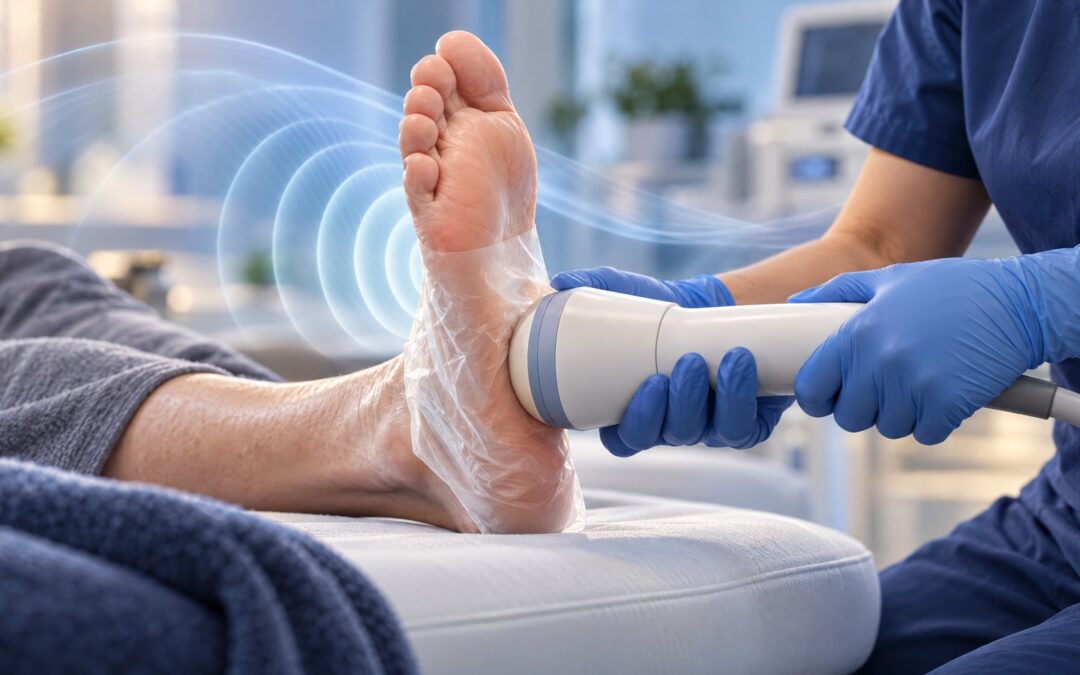
A wound-healing device can use pressure pulses instead of a blade or an injection. That is the compelling fact behind the diabetic-foot-ulcer story. In 2017, the U.S. Food and Drug Administration permitted marketing of SANUWAVE’s dermaPACE System for a defined group of chronic diabetic foot ulcers. Two randomized, sham-controlled studies later reported a higher pooled rate of complete closure at 24 weeks with the active device added to standard wound care.[1] [5]
The quick answer: this is clinical acoustic shockwave therapy, not listening to a healing tone. The documented 4 Hz describes four discrete pressure pulses per second. The FDA authorization belongs to the particular device and eligible ulcers. The headline result is promising, but the earlier primary endpoint was not statistically significant, and current international guidance does not recommend physical therapies such as shockwave or electromagnetic stimulation for diabetic foot-ulcer healing. Expert wound care remains the foundation.[4] [5] [11]
For readers who also want to explore the PEMF Healing App, this guide includes direct wound and skin catalogue links, beginning with Wounds Energetic. These are a separate wellness-listening resource, not the FDA-authorized shockwave treatment. A practical seven-day listening and care-plan organisation guide appears below.

What the FDA authorized for diabetic foot ulcers
The dermaPACE System received a De Novo authorization on December 28, 2017. De Novo is an FDA pathway for classifying a new device type and permitting marketing subject to controls. Here, the prescription device was classified as Class II. “FDA-authorized shockwave therapy” is accurate shorthand for this device-specific record; it does not mean the agency approved every form of sound, vibration or electromagnetic wellness.[2] [3]
The labeled indication is unusually specific: chronic, full-thickness diabetic foot ulcers no larger than 16 cm², extending through the epidermis, dermis, tendon or capsule, but without bone exposure. It applies to adults with diabetes aged 22 and older whose ulcers have lasted more than 30 days, used alongside standard diabetic-ulcer care. Wound size, depth, circulation and infection assessment are clinical questions, not a self-screening shortcut.[1] [3]
The studied population was narrower still: selected chronic neuropathic ulcers, with trial screening and a standard-care run-in. The result should therefore be read as evidence for a carefully evaluated ulcer population, not a claim about every cut, scar, pressure injury, infected wound or poorly perfused foot.[4] [6]
Why 4 Hz is a pulse rate, not a wound-healing tone
A shockwave is a brief acoustic pressure transient with a rapid pressure rise. It is not a smooth, continuous sine wave. An applicator delivers mechanical energy through a controlled interface to tissue. Its effect depends on the pressure waveform, energy, geometry, coupling and number of pulses, as well as how often those pulses occur.[7]
In the dermaPACE FDA review, the study applications used 500 pulses at 4.0 Hz, with a stated minimum active application time of two minutes. Nominal uninterrupted delivery of 500 pulses at four per second takes 125 seconds, or about two minutes and five seconds. That arithmetic explains the “about two minutes” headline. It describes active pulse delivery, not the entire appointment, wound preparation, assessment or dressing care.[4]
Nor does it mean a wound heals in two minutes. The clinical studies involved repeated applications and follow-up measured in weeks. One study used four treatments over two weeks; the second allowed additional applications for unhealed wounds. Those are study facts, not a do-it-yourself dosing schedule. Individual treatment decisions belong to the prescribing team and the device’s applicable instructions.[4]
The sham design offers a particularly useful insight. FDA describes an unenergized applicator at the wound while pulses from a separate, non-contact applicator simulated the sound. The trial was designed to distinguish the physical treatment from its audible accompaniment. Hearing a similar rhythm was not the active wound exposure.[4]
The biological idea: cells can sense mechanical conditions
Mechanotransduction is the conversion of mechanical cues into cellular responses. Cells interact with their surrounding matrix through structures such as integrins, focal adhesions and the cytoskeleton. Changes in stiffness, stretch or force can influence signalling, movement and tissue organisation. Skin repair is therefore not only a chemical process; it also takes place in a physical environment.[8]
This helps explain why shockwaves interest wound researchers. In cultured human endothelial cells, which line blood vessels, one low-energy shockwave experiment reported changes in VEGF and eNOS, ERK/Akt signalling and cell migration. Suppressing certain mechanosensing components reduced those responses. These are useful laboratory observations about possible angiogenic signalling, not proof that the same molecular pathway caused closure in the human diabetic-foot trials.[9]
Fibroblast research adds another part of the picture. Fibroblasts help organise the extracellular matrix, including collagen. Reviews describe shockwave-related findings involving growth signalling, collagen and nitric-oxide pathways in cell and tissue models. The important scientific question is how a defined mechanical exposure interacts with a particular repair environment, rather than whether one universal “healing frequency” exists.[10]

What the 336-patient trials actually found
The primary publication combined two randomized, double-blind, sham-controlled phase III studies involving 336 participants: 172 in the active group and 164 in the sham group. Both groups received standard wound care. The question was whether adding the active shockwave device improved outcomes beyond the sham procedure and the same care foundation.[4] [5]
| Measurement | Active device plus standard care | Sham plus standard care | Interpretation |
|---|---|---|---|
| Complete closure at 12 weeks | 22.7% | 18.3% | Primary endpoint; pooled difference was not statistically significant. |
| Complete closure at 24 weeks | 37.8% | 26.2% | Later pooled result; reported p = 0.023. |
| 24-week absolute difference | 11.6 percentage points | An observed difference between group closure rates, not a guarantee for an individual. | |
The encouraging finding is complete closure at the later timepoint, not merely a smaller wound. But the timing matters: the prespecified primary assessment was at 12 weeks. Each individual study’s 24-week comparison also did not independently meet the conventional statistical-significance threshold. The pooled result gives a reason to investigate further without turning the study into a stronger success claim than it supports.[4] [5] [6]
Complete closure, wound-area reduction and durable prevention of recurrence are different outcomes. The 37.8% figure is not an amputation-prevention rate or proof that all closed ulcers remain closed indefinitely. Keeping the endpoint precise makes the genuine finding easier to understand.[4] [5]

FDA authorization and clinical guidance answer different questions
FDA authorization establishes a particular device’s lawful marketing pathway and indication. A clinical guideline asks whether an intervention should be used in care, considering the wider evidence, its certainty and practical context. Those questions can produce different answers without one record erasing the other.[3] [11]
The 2023 International Working Group on the Diabetic Foot, or IWGDF, Recommendation 15 recommends against interventions in the physical-therapy field for diabetic foot-ulcer healing. It explicitly includes extracorporeal shockwave therapy and electrical or electromagnetic stimulation. The recommendation is strong, with low-certainty evidence. As of this feature’s November 2026 review, that was the latest IWGDF wound-healing update located.[11]
This is important context for a specialist conversation, not a reason to dismiss mechanobiology or ignore a promising result. It means the authorised dermaPACE indication should not be described as a guideline endorsement of routine shockwave treatment, and certainly not as an endorsement of consumer frequency products. A useful consultation asks about the particular wound, the quality of standard care, expected benefit, burdens, risks and alternatives.[3] [11]
The care that gives a wound a chance to heal
The most practical value in this story is understanding what sits around any device. Diabetic foot care depends on pressure relief, adequate circulation, infection assessment, professional wound care and an appropriate dressing plan. A physical signal cannot substitute for removing repeated loading from an ulcer or addressing a threatened blood supply.[12] [14] [15]
For a neuropathic ulcer on the plantar forefoot or midfoot, IWGDF’s first-choice offloading recommendation is a non-removable knee-high device when appropriate. Selection, fitting and contraindications require a clinician. It is not a recommendation for every wound, and readers should not replace prescribed offloading with ordinary shoes or start extra walking to “improve circulation.”[13]
Ask the care team: Has blood supply been assessed? Is there infection or possible deeper involvement? What should protect the foot during standing and walking? Who is responsible for dressing changes and debridement? When is the next review? These questions turn an intriguing technology story into a more informed care conversation.[12] [14] [15]
Where PEMF wound and skin research fits
PEMF is a separate physical approach. A powered coil generates a time-varying magnetic field. That is different from an acoustic shockwave applicator and from electrodes delivering current through the skin. Wound research has investigated several of these modalities, but evidence for one cannot be assigned to another simply because both use a frequency number.[19]
A small 2015 randomized, sham-controlled diabetic-foot pilot involved just 13 people. It reported wound-size reductions of 18% with active PEMF and 10% with sham, alongside microcirculation observations. The study used its own specified apparatus and exposure schedule. This is a preliminary signal about wound size and capillary measures, not definitive complete-closure evidence or validation of a consumer app and coil.[16]
For venous leg ulcers, a 2015 Cochrane review found the healing effect unclear across three small, heterogeneous trials involving 94 participants. A later 2023 venous-ulcer trial reported favourable area and volume outcomes with PEMF-containing regimens, but its population, co-interventions and design differ from the diabetic-foot study. Venous ulcers and diabetic foot ulcers should not be treated as the same condition.[17] [18]
The design opportunity is to study complete interventions with clear exposure reporting and meaningful endpoints. A programme can offer changing sections, layering and a planned listening sequence as design features. The wound studies reviewed here do not establish that phase changes prevent cellular adaptation, that a fixed tone universally fails, or that a phased consumer programme is clinically superior. The primary linked below has no publicly exposed phase map, so none is invented.[16] [18]
| Approach | Physical delivery | What this article can support |
|---|---|---|
| dermaPACE shockwave therapy | Discrete acoustic pressure pulses coupled to tissue | Specific FDA indication and device-specific human study results, alongside guideline context. |
| Research PEMF apparatus | Defined electromagnetic exposure | Separate pilot and trial findings, with uncertainty and device-dependent parameters. |
| App listening through headphones | Acoustic pressure at the ears | Programme access and optional personal listening, not the shockwave trial exposure. |
| Consumer haptic or coil accessory | Mechanical vibration or magnetic-field exposure | Manufacturer-supported wellness use only; no transfer of clinical wound-closure rates. |
Wound and skin programmes in the PEMF Healing App
Start at the PEMF Healing App platform, which links to iOS, Android and web access, or use the direct programme links. The Skin Health collection includes the primary Wounds Energetic and related tissue, scar, cut, bruise and blister themes. Public pages for the selected items currently show Premium Content / Subscriber Only; check access and the displayed playback information.[23]
Here is a focused library, with exact catalogue names retained. Words such as “healing,” “building” and “recovery” are programme titles and themes, not clinical outcome claims. These links are for exploration and optional listening. They do not replace wound assessment, infection treatment, offloading or a surgical care plan.
| Exact programme title | Role and context |
|---|---|
| Wounds Energetic | Wound-themed primary for optional listening. No clinical closure effect is established for this programme. |
| Tissue Healing, Regeneration Skin Energetics | Tissue and regeneration topic companion. The title is not proof of tissue regeneration. |
| Tissue Healing Skin Scar Energetics | Scar-themed catalogue navigation. Not scar treatment or a guide to wound-stage dosing. |
| Cuts Skin Energetics | Cut-themed skin entry. Do not use it instead of appropriate wound assessment. |
| Bruise Skin Energetics | Bruise-themed skin entry. The title does not establish reduced bruising. |
| Blisters Skin Energetics | Blister-themed skin entry. Keep foot protection and wound-care instructions unchanged. |
| Diabetic Foot Infection Energetics | Diabetic-foot topic navigation only. Suspected infection needs prompt clinical care. |
| Collagen Building | Collagen-themed entry. It does not deliver collagen or establish increased collagen synthesis. |
| Post-Surgical Recovery 12-Phase BioPhi Tissue, Collagen, Circulation, Nerve & Cellular Renewal Energetics | Post-surgical topic companion with a public 12-phase title. No hidden stage order or runtime is inferred. |
| 432Hz + 12th Sub, Calmness, Balance, Healing, Grounding Energetics | Grounding-themed optional opener for a quiet listening break. |
| Bb: Sleep Decent, Deep Rain Rest and Relaxation ASMR | Rain soundscape for a closing listening excerpt while awake. |
| Muscle Relaxation Energetics | Muscle-relaxation-themed listening companion, not a treatment for a wound or neuropathy. |
About the diabetic-foot link: Diabetic Foot Infection Energetics is a topic-labelled catalogue entry. A suspected diabetic foot infection needs prompt clinical evaluation. Do not use the name as permission to try a listening session before seeking care.[15]
About collagen: collagen is part of the extracellular repair matrix, which gives the theme a biological context. Collagen Building does not deliver collagen, establish collagen synthesis or disclose a proprietary substance signal. The same distinction applies to the post-surgical programme’s tissue and circulation themes.[8] [10]
Seven days of listening and care-plan organisation
This is an optional adult wellness routine, not a wound-healing protocol. Its practical goal is to make a quiet break easy to organise while keeping the actual care plan visible. If you have an ulcer, arrange the clinical care first. No device or special equipment is required for the listening routine.
Each day offers two companions around Wounds Energetic. Use up to two minutes of the opener, up to four minutes of the primary and up to two minutes of the closer, with a thirty-second silent interval between selections. The maximum suggested listening block is nine minutes including the two gaps. These are editorial time boxes, not full programme runtimes, therapeutic doses or the dermaPACE two-minute application. Use the available playback controls, choose shorter excerpts or silence, and stop if uncomfortable.
Keep the injured foot supported according to the care team’s positioning and offloading instructions. Leave dressings in place unless a prescribed change is due. Never connect a phone output to improvised electrodes or place a consumer transducer, coil or pressure device against a wound or dressing. The journal records listening comfort and organisation, not whether a programme healed tissue.
Day 1: Make the care plan easy to find
- Opener, up to two minutes: Tissue Healing, Regeneration Skin Energetics. Then take thirty seconds of silence.
- Primary, up to four minutes: Wounds Energetic. Use a short excerpt through available playback controls, not an assumed complete programme. Then take thirty seconds of silence.
- Closer, up to two minutes: Bb: Sleep Decent, Deep Rain Rest and Relaxation ASMR. Stop playback at the end of your chosen excerpt.
- Practical step: Put the next clinical review, dressing instructions and contact number in one place. If a wound has not been assessed, arrange care rather than waiting to finish this routine.
Day 2: Choose a comfortable supported position
- Opener, up to two minutes: 432Hz + 12th Sub, Calmness, Balance, Healing, Grounding Energetics. Then take thirty seconds of silence.
- Primary, up to four minutes: Wounds Energetic. Use a short excerpt through available playback controls, not an assumed complete programme. Then take thirty seconds of silence.
- Closer, up to two minutes: Muscle Relaxation Energetics. Stop playback at the end of your chosen excerpt.
- Practical step: Use the positioning and offloading instructions you were given. Record only listening comfort and whether your setup avoids pressure on the injured area.
Day 3: Prepare two questions for the care team
- Opener, up to two minutes: Tissue Healing, Regeneration Skin Energetics. Then take thirty seconds of silence.
- Primary, up to four minutes: Wounds Energetic. Use a short excerpt through available playback controls, not an assumed complete programme. Then take thirty seconds of silence.
- Closer, up to two minutes: Bb: Sleep Decent, Deep Rain Rest and Relaxation ASMR. Stop playback at the end of your chosen excerpt.
- Practical step: Write down any unanswered questions about circulation, infection, dressing care or pressure relief. Bring them to your appointment; a programme title cannot answer them.
Day 4: Keep the routine modest
- Opener, up to two minutes: 432Hz + 12th Sub, Calmness, Balance, Healing, Grounding Energetics. Then take thirty seconds of silence.
- Primary, up to four minutes: Wounds Energetic. Use a short excerpt through available playback controls, not an assumed complete programme. Then take thirty seconds of silence.
- Closer, up to two minutes: Tissue Healing Skin Scar Energetics. Stop playback at the end of your chosen excerpt.
- Practical step: Choose shorter excerpts if preferred. Keep dressings and offloading equipment undisturbed. The scar-themed closer is a catalogue choice, not a signal that the wound has reached a repair stage.
Day 5: Separate personal impressions from clinical records
- Opener, up to two minutes: Tissue Healing, Regeneration Skin Energetics. Then take thirty seconds of silence.
- Primary, up to four minutes: Wounds Energetic. Use a short excerpt through available playback controls, not an assumed complete programme. Then take thirty seconds of silence.
- Closer, up to two minutes: Bb: Sleep Decent, Deep Rain Rest and Relaxation ASMR. Stop playback at the end of your chosen excerpt.
- Practical step: Note which sound you preferred and whether you felt comfortable. Leave wound measurements and clinical interpretation to the agreed care process; enjoyable listening is not a closure test.
Day 6: Plan the next day without adding foot loading
- Opener, up to two minutes: 432Hz + 12th Sub, Calmness, Balance, Healing, Grounding Energetics. Then take thirty seconds of silence.
- Primary, up to four minutes: Wounds Energetic. Use a short excerpt through available playback controls, not an assumed complete programme. Then take thirty seconds of silence.
- Closer, up to two minutes: Muscle Relaxation Energetics. Stop playback at the end of your chosen excerpt.
- Practical step: Check that supplies and the next appointment are organised. Do not add walking, resisted foot exercise or device exposure to an ulcer because of this guide.
Day 7: Review the habit and keep clinical follow-up
- Opener, up to two minutes: Tissue Healing, Regeneration Skin Energetics. Then take thirty seconds of silence.
- Primary, up to four minutes: Wounds Energetic. Use a short excerpt through available playback controls, not an assumed complete programme. Then take thirty seconds of silence.
- Closer, up to two minutes: Bb: Sleep Decent, Deep Rain Rest and Relaxation ASMR. Stop playback at the end of your chosen excerpt.
- Practical step: Review your listening preferences and care reminders. Keep only the optional elements you enjoyed. Do not change a treatment plan, dressing schedule or appointment because of your journal.
After the week, review which listening choices you enjoyed and whether your care reminders were useful. An optional week without this listening sequence can provide time to reflect before repeating. It is not a biological washout period, and clinical appointments, medication and wound care continue without a pause.
Optional equipment, with wound-safe separation
Headphones, haptic accessories and compatible coils offer different physical experiences. Audio reaches the ears; haptics create mechanical vibration; a powered coil creates magnetic-field exposure. Combining them does not reproduce a shockwave applicator or make the clinical closure statistic transferable. With a wound, recent operation, reduced sensation or an implanted device, the simplest choice is audio alone unless your clinician and the product’s instructions support another option.[19] [21]
iTorus: use only the manufacturer-supported model-specific setup, connection and output guidance. This article prescribes no wound placement. Keep hardware off the wound, dressing and insensate skin; do not remove protection to fit a coil. Personal-space and room-use products need not have the same workflow. No healing benefit is inferred from an accessory’s proximity.[22]
Woojer: follow the Vest 4 manual and use independent audio and sensation controls conservatively. Do not position haptic hardware against a wound or sensitive surgical area. The manual states that the product is not suitable for pacemaker users and that pregnancy requires physician approval. Feeling stronger vibration is not evidence of stronger repair.[21]

Affiliate disclosure: some resource links may support PEMF Magazine through a referral commission. Equipment is optional and purchase does not confer FDA authorization or a wound-healing result.
| Resource | Optional role | Practical guidance |
|---|---|---|
| Frequency Healing App | Browse wound and skin themes and supported listening. | Check programme access and playback. Keep medical care separate. |
| iTorus i2 | Consumer magnetic-field wellness hardware. | Follow model-specific instructions and clinical advice. No contact with wounds or dressings. |
| iTorus i5 | Consumer room-oriented hardware. | Room use is not a prescribed local wound exposure or clinical dose. |
| Woojer Vest 4 | Optional tactile listening. | Use code EPEMF10 at checkout; confirm eligibility. Follow all manual restrictions. |
| Metatronic Flower of Life iMPrinter | Optional symbolic intention ritual. | Not a wound-care tool, sterilizer, water purifier or medicine-altering device. |
Best practices: protect the care plan and the skin
Follow the prescribed dressing and offloading plan, attend reviews and ask for clarification whenever an instruction is unclear. Professional debridement is not a home task. Do not cut callus, probe an ulcer or substitute oils, caustic products or unprescribed treatments. Practical IWGDF guidance advises washing but not soaking feet; care of an existing wound should follow its specific clinical plan.[12]
Keep listening comfortably quiet, use available sound-exposure controls and take breaks. WHO’s safe-listening advice stresses both loudness and duration. A phone’s volume percentage is not, by itself, a calibrated measure of the exposure at your ears. Stop for discomfort and seek a hearing assessment for persistent tinnitus or hearing difficulty.[20]
Daily practice with an iMPrinter
If you enjoy a symbolic ritual, let the iMPrinter be a reminder to organise care: write one intention, such as “keep my next review,” and return to the note after a quiet session. Follow supported connections and keep liquids away from electronics. Do not place medicines, dressings or wound products into an “imprinting” workflow, and do not apply an allegedly imprinted substance to an ulcer. The practice described here is reflection, not a demonstrated material change or treatment.
When a wound needs prompt or urgent care
A new diabetic foot wound deserves prompt professional assessment, even when it is not painful. Neuropathy can reduce warning sensations. Spreading redness, warmth or swelling, drainage, worsening tissue colour or a wound that is deteriorating should be assessed rather than watched through a seven-day routine. Fever or systemic illness, rapidly spreading infection, blackened tissue, or a cold or discoloured foot warrants urgent evaluation. Severe infection or poor circulation can require coordinated surgical and vascular care.[12] [14] [15]
Clinical shockwave treatment can cause discomfort and other adverse effects; the FDA review includes application pain, bruising and numbness. A brief active exposure is not a promise of a painless or risk-free procedure, and more applications are not automatically better. Discuss eligibility and risks with the prescribing team.[1] [4]
The useful takeaway: pressure-based medical technology is a real research field, and the dermaPACE record gives this story a specific clinical anchor. Understanding pulse rate, tissue delivery, trial endpoints and standard care makes the finding more meaningful than the slogan “sound heals.” It also lets readers explore the app’s wound and skin themes without confusing a personal listening choice with medical wound treatment.
Educational and wellness disclaimer: This article is for information only and does not provide medical advice, diagnosis or treatment. FDA authorization applies to the named device and indication, not to frequencies independently or to the PEMF Healing App and consumer accessories. No programme is established here to heal a wound, treat infection or replace care. Consult a qualified clinician about wounds, diabetes, recent surgery, pregnancy, implanted devices or device suitability. Continue prescribed care, follow manufacturer instructions and do not delay urgent assessment.
References
- FDA (2017). FDA permits marketing of device to treat diabetic foot ulcers. Direct source.
- FDA. dermaPACE System De Novo database record DEN160037: decision December 28, 2017. Direct source.
- FDA. dermaPACE Classification Order DEN160037: prescription status and indication. Direct source.
- FDA. dermaPACE De Novo decision summary DEN160037: device, pivotal studies, protocol and safety. Direct source.
- Snyder et al. (2018). Diabetic foot ulcer treatment with focused shockwave therapy: two multicentre, prospective, controlled, double-blinded, randomised phase III clinical trials. Journal of Wound Care. Direct source.
- ClinicalTrials.gov. NCT00536744: dermaPACE Study 1 and its prespecified 12-week closure endpoint. Direct source.
- Use of the Shock Wave Therapy in Basic Research and Clinical Applications: A Review (2022). Direct source.
- Mechanotransduction in skin wound healing and scar formation (2022). Mechanistic review. Direct source.
- Molecular mechanisms of the angiogenic effects of low-energy shock wave therapy: roles of mechanotransduction (2016). Cultured endothelial-cell experiment. Direct source.
- Biological Effects of Extracorporeal Shock Waves on Fibroblasts: A Review (2013). Direct source.
- IWGDF (2023). Guidelines on interventions to enhance healing of foot ulcers in people with diabetes, Recommendation 15. Direct source.
- IWGDF (2023). Practical Guidelines on prevention and management of diabetes-related foot disease. Direct source.
- IWGDF (2023). Guidelines on offloading foot ulcers in persons with diabetes. Direct source.
- IWGDF, ESVS and SVS (2023). Intersocietal guideline on peripheral artery disease in people with diabetes and a foot ulcer. Direct source.
- IWGDF/IDSA (2023). Guidelines on diagnosis and treatment of diabetes-related foot infections. Direct source.
- Kwan et al. (2015). Pulsed electromagnetic field therapy promotes healing and microcirculation of chronic diabetic foot ulcers: a pilot study. Direct source.
- Electromagnetic therapy for treating venous leg ulcers. Cochrane review (2015). Direct source.
- Mohamady et al. (2023). Effect of Combined Electromagnetic Field and Plantar Flexion Resistance Exercise on Wound Healing in Patients with Venous Leg Ulcers: A Randomized Controlled Trial. Direct source.
- Electric Factors in Wound Healing (2021). Review of distinct electrical and electromagnetic approaches. Direct source.
- WHO (2026). Deafness and hearing loss: Safe listening. Direct source.
- Woojer. Vest 4 user manual: supported connections, separate audio and sensation controls and safety warnings. Direct source.
- iPyramids Academy. Official iTorus model-specific setup and tutorial resources. Direct source.
- Frequency Healing. Official platform access and wellness disclaimer. Manufacturer information, not wound-healing validation. Direct source.