
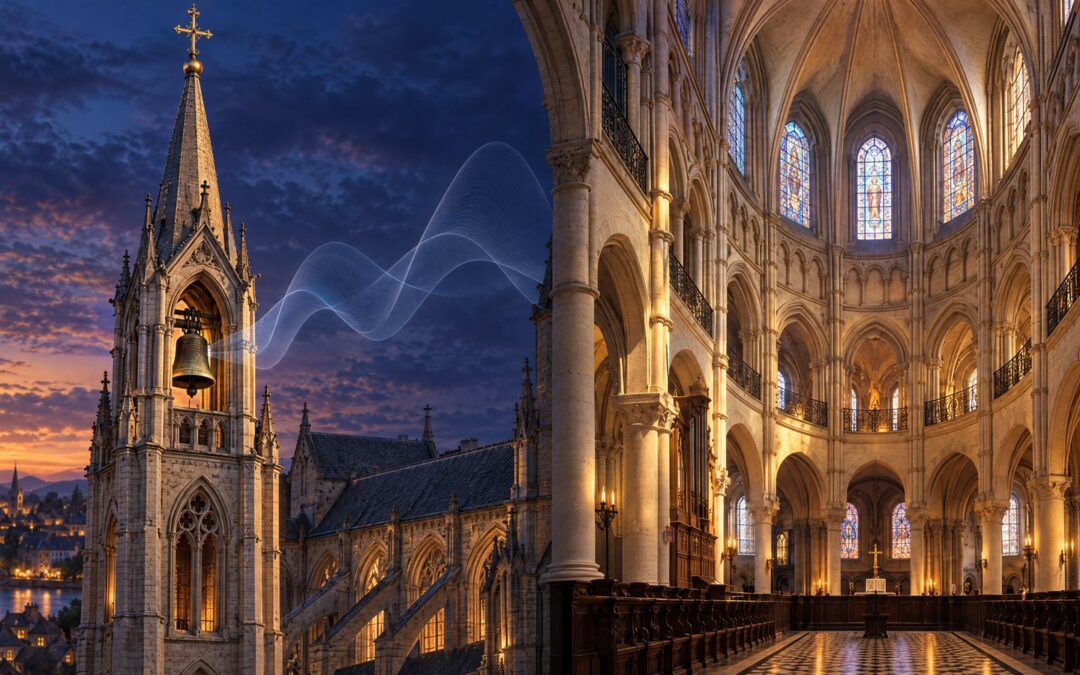
The tower looks like a machine. The labels sound like engineering. But where is the evidence?
The image proposes something extraordinary: a historic church tower containing antennas, coupled resonators and a vessel of “red mercury.” Around the architecture, glowing waves suggest an operating frequency system. It is an arresting idea. A technical label, however, is not a measurement, and a cutaway illustration is not an archaeological discovery.
The direct answer: Historical acoustic technology is real. Ancient texts describe tuned vessels, surviving church pots have measured resonances, and experiments have found acoustic changes in specific spaces. A church spire also supported a documented wireless-telegraphy experiment in 1899. Those findings do not authenticate the unidentified tower’s illustrated coils or flask, demonstrate an ancient wireless-power network, or establish a healing effect.[1] [5] [6] [14]

What follows separates the discoveries worth taking seriously from the connections that have not been demonstrated. The strongest story is not that every ornate tower was secretly a power station. It is that people developed acoustic ideas long before electronic audio, and that modern measurements can sometimes reveal how those ideas interact with surviving buildings.
What the tower graphic actually establishes
The graphic labels an upper feature “Antenne,” a sphere “Resonator – Primär,” and an internal assembly “Resonator – Sekundär.” It asks whether red mercury in a container might act as a capacitor or frequency amplifier. These are proposed functions in the supplied image, not independently authenticated components.

Ancient acoustic vessels: the documented starting point
What Vitruvius wrote, and what that proves
In Book V, chapter 5 of De architectura, Vitruvius describes bronze vessels for theatres. He specifies musical relationships, their arrangement in cavities and their intended interaction with the voice. This is unusually concrete historical evidence: not a modern label attached to an old ornament, but a written prescription for an acoustic installation.[1]
That text establishes an intended use. It does not provide a modern controlled trial or prove that a particular surviving theatre followed every instruction. It also does not make the bronze vessels mechanically identical to ceramic jars embedded in church walls. A freely responsive metal vessel, an enclosed ceramic cavity and an open-air theatre present different physical conditions.[1] [2]
How a cavity becomes an acoustic resonator
A vessel with a neck can behave as a Helmholtz resonator. The air in its opening moves back and forth like an effective mass. Compression and expansion of the air inside provide the restoring force. The vessel’s response is therefore frequency-selective, with its resonance influenced by cavity volume, opening area and effective neck length.[26]
The standard idealized relation is fH = c/(2π) × √[A/(V × Leff)]. Here c is sound speed, A the neck opening area, V the cavity volume and Leff the effective neck length, including end corrections. This equation explains why geometry matters. It cannot establish a frequency from an unidentified illustration with no verified dimensions.[26]
A real jar is not the ideal model. Cracks, partial obstruction, embedding, losses and the nearby wall or room affect the response. Strong pressure inside a cavity also does not necessarily mean a useful increase in sound across an entire nave. The important question is how the vessel exchanges energy with the surrounding sound field at the positions that matter to listeners and performers.[2] [4] [26]

The French survey, the Serbian result and the 2026 review
A 2013 paper by Jean-Christophe Valière and colleagues examined acoustic pots in French churches. Its survey involved 25 churches, but its principal frequency analysis used 197 usable pots from 11 churches. Those numbers should not be presented as 25 controlled demonstrations of improved room acoustics. The authors considered the distributions compatible with empirical acoustic selection and possible low-frequency reverberation control, while acknowledging inconclusive earlier in-situ experiments.[2]
The evidence is not uniformly positive. The accessible abstract of Mijić and Šumarac-Pavlović’s 2004 Serbian Orthodox church study concludes that the resonators did not contribute to acoustic quality in the churches studied. Its explanation includes unsuitable resonance frequencies for the activity, church size and too few resonators. That result is specific to its sample, just as a positive result elsewhere would be specific to its setting.[3]
A review published in Acoustics on 3 August 2026 brings these issues together. Magrini, Cattani and Cerniglia describe heterogeneous methods and possible effects that can be weak, frequency-dependent or spatially confined. Their review does not establish a universal room-scale benefit from acoustic vases. It makes the case for better-controlled measurements rather than treating every surviving pot as a successful amplifier.[4]
This is a valuable distinction. The vessels are genuine historical objects with measurable physical behavior. Whether they helped a particular liturgy, voice or room is a further question, not something that their mere presence answers.
Noyon Cathedral: 64 pots and two measured resonance groups
One of the most compelling cases is the caveau phonocamptique, an underground chamber at Noyon Cathedral. Valière and Bénédicte Palazzo-Bertholon’s 2014 conference paper records 64 embedded ceramic vessels: 24 on the north wall, 24 on the south and 16 on the west. Only their necks reach the wall surface.[5]
The measurements separate into two populations of 32, centered near 108 Hz and 141 Hz. These are group means, not exact settings shared by every vessel. Their ratio is approximately 1.306, close to but not equal to the just musical fourth, 4:3 or about 1.333. The investigators interpret the grouping as suggestive of selection. It is a reasoned inference from the vessels, not a recovered instruction from their maker.[5]
The open-versus-blocked experiment
In a 2016 study, investigators compared the existing chamber with all pot mouths blocked and with them open. An eight-microphone array scanned roughly one-third of the accessible volume. This was a small, strongly modal room, where distinct standing-wave patterns matter, rather than a conventional diffuse sound field.[6]
The reported mean 60 dB decay time was 0.71 seconds with the pots open and 0.58 seconds blocked. The paper reports a larger change in the 125 Hz octave band and less contrast between modal nodes and antinodes. In this configuration the result was not simply “pots absorb sound and shorten reverberation.” The open vessels changed the distribution and persistence of low-frequency sound.[6]
Four male singers from the Ensemble Gilles Binchois also performed in the chamber, directed by Dominique Vellard. Questionnaire ratings were generally higher with the pots open, especially for some low voices and more complex polyphony. Not every average increased: the rating for hearing the other singers did not improve overall. This was a small present-day performance experiment, not proof that historical singers occupied the chamber or that its builders intended exactly that use.[6]
The date is still an open question
The 2014 paper discusses a possible medieval origin but explicitly leaves dating and evolution for further archaeological clarification. The 2016 performance experiment uses an around-1600 scenario as historical framing. A later article is actually titled Experimenting with the acoustic pots chamber of Noyon Cathedral (late 16th c?). The question mark matters.[5] [6] [7]
Eighteenth-century works altered the vault, access and connection toward the choir. Those alterations do not establish when the pots were inserted or prove that the vessel array was restored or replaced. The defensible discovery is a surviving installation with measured resonance groups and a demonstrated effect under particular test conditions. Its original date and function remain unresolved.[5] [6]
Hagia Sophia: a real acoustic environment reconstructed carefully
The Icons of Sound project offers a different kind of evidence. Bissera Pentcheva and Jonathan Abel’s 2017 Speculum paper describes field recordings at Hagia Sophia and the creation of estimated room impulse responses. Later campaigns added sine-sweep and spatial measurements. An impulse response characterizes how a space responds to a brief excitation, including the arrival of reflections and the subsequent decay.[8] [9]
The reported empty-building reverberation extends roughly 10–12 seconds, depending on source position and frequency. The large volume, domes, coupled spaces and reflective surfaces contribute to that persistence. Long decay can support sustained vocal blending while blurring rapid speech. “Good acoustics” therefore depends on the musical or communicative task, not on a single desirable reverberation number.[8]
For auralization, researchers applied measured or estimated room responses to modern performances. Medieval manuscripts and musicological work supplied the chant repertoire; the acoustics supplied the virtual space. This is not an ancient audio recording, nor was the chant decoded from the walls.[8] [9]
The methods have explicit limitations. The paper distinguishes a balloon-pop recording from an actual impulse response and discusses the conversion method’s validation, with stronger agreement in mid and high frequencies than at low frequencies. Separate modeling of historical configurations also shows that furnishings, occupancy and surface treatment change the result. Neither approach recovers every detail of an earlier building state or performance.[8] [10]
The achievement is substantial without an electrical claim: historical repertoire can be heard through a scientifically informed approximation of a remarkable acoustic environment. Measured reverberation supports a story about sound in architecture. It does not demonstrate therapeutic frequencies or concealed electrical machinery.
The bell-tower paper: sound-spectrum peaks are not tower modes
A 2025 Applied Sciences study by Elide Nastri and Paolo Todisco investigates bell acoustic loading at Caserta Vecchia. The official site history dates cathedral construction to 1113–1153 and the adjacent campanile to 1234. They are related structures, but not a single construction phase.[11] [13]
The paper lists acoustic peaks including 127.3, 229.3, 280.5, 289.3, 330.7 and 408.4 Hz. These came from a microphone recording of bell sound. They should not be relabeled as directly measured natural modes of the tower. A microphone measures pressure variations in air. An accelerometer measures structural acceleration. A finite-element model calculates response under specified assumptions.[11] [12]
The researchers used a recorded acoustic segment to drive a numerical vibroacoustic model. Separate ambient-vibration testing supplied tower-mode information for calibration. The analyzed simulation output had a 200 Hz Nyquist limit, so higher-frequency microphone peaks were not directly resolved as structural output peaks in that analysis. Connections drawn through harmonic relationships must not be confused with a live-bell measurement of the structure.[11] [12]
The authors describe the work as preliminary and call for direct structural-response measurements under acoustic excitation. Its significance is conservation engineering: how bell-generated pressure may couple to a vulnerable historic structure. It does not establish that the tower was a deliberately tuned electromagnetic generator, and it does not by itself prove a history of bell-sound-induced damage.[11]

Church spires and electricity: the documented connection
Notre Dame’s 1899 wire antenna
On 19 April 1899, Jerome Green’s team at the University of Notre Dame used a 150-foot wire antenna near the Basilica of the Sacred Heart spire in a wireless-telegraphy experiment. Notre Dame’s institutional histories describe reception at Saint Mary’s, more than a mile away, using Hertz-wave transmitting apparatus and a Marconi coherer detector.[14] [15]
This is a real electrical-history connection. The spire provided an elevated site for a deliberately installed antenna. But the steeple had been completed in 1892, seven years before the experiment. The evidence shows later adaptation, not that the church was originally constructed as a radio transmitter. Nor does this record identify the spire in the supplied graphic.[16]
Two details deserve precision. The documented 150 feet describe wire length, not a 150-foot tower or a fully established vertical antenna geometry. The sources support “more than a mile,” not an independently verified exact 1.5-mile route. This was wireless telegraphy, not voice broadcasting or a demonstration of useful wireless electrical power delivered to buildings.[14] [15]
A finial can be electrically useful without being a transmitter
Historic England’s guidance discusses lightning protection for prominent historic buildings, including church towers and spires. A finial, connected weathervane or spire top can form part of an appropriately designed system involving down conductors and earth electrodes. The protection depends on actual connections, risk assessment and professional design, not on a pointed silhouette alone.[17]
That function differs from radio transmission. It also means that a metallic sphere is not self-identifying evidence of a capacitor bank. Metal objects can possess capacitance; proving a designed storage or circuit role requires information about conductors, insulation, geometry and electrical connections. The same visual object can participate in different physical contexts, and its history must be established at the specific site.[17] [28]
Resonance, capacitance and amplification: what the terms mean
Calling something a “resonator” is not inherently wrong. The problem is failing to identify what is oscillating and where its energy comes from. In an acoustic cavity, air pressure and motion exchange energy. In a structure, deformation and motion depend on mass, stiffness and damping. In an electrical LC circuit, energy exchanges between electric and magnetic fields.[26] [27] [29]
Near resonance, the response amplitude or internally stored energy can become large relative to a chosen input amplitude. That is dynamic amplification, not creation of net energy. Damping and losses matter. A claimed resonance should be demonstrated by a repeatable frequency-dependent response to a characterized input, not inferred from the shape of a drawing or a single unexplained spectral peak.[27] [29]
A capacitor stores previously supplied energy in an electric field and can return that energy later. For the conventional model, its stored energy is E = ½CV². Storage is finite, and real components have losses. An active amplifier can produce greater signal output power than signal input power because a separate supply provides energy. Once the supply is included, gain is not energy creation.[28] [32] [31]
An antenna also needs careful language. Passive reception or scattering does not require a local radio-frequency generator attached to every object: an incident electromagnetic field can provide the excitation. But sustained controlled transmission needs an energy-bearing source and a coupling path. “No visible wire” does not prove an energy-free process, and an imagined invisible source does not rescue a claim lacking measurements.[30]
Hertz is a rate, not a mechanism. Sound pressure oscillations, structural vibration and electromagnetic fields can each be described in hertz, but identical numbers do not make them interchangeable. A reverberation time in seconds is a decay measure, not an oscillation frequency. These distinctions are essential before any claim about human exposure could even be evaluated.[8] [26] [27] [30]
Red mercury: real chemistry, unsupported extraordinary properties
Cinnabar and historical mercury use are real
Cinnabar is a real red mercury sulfide mineral, HgS. Mercury also has a documented history in amalgam or fire gilding. Getty’s technical examination guidance discusses mercury as evidence relevant to gilding, while warning that it can have other sources, including cinnabar. Finding mercury therefore does not automatically identify a particular compound, gilding process or original object function.[18]
This matters for historic ornament. A mercury-related material finding could require a conservation explanation rather than an energy-device explanation. Conversely, a plausible conventional use is not proof of what happened in an unidentified tower. Laboratory identification and the object’s context are still needed.
What the IAEA says about “red mercury”
The IAEA’s 2007 Combating Illicit Trafficking in Nuclear and Other Radioactive Material discusses red-mercury reports under trafficking through false pretences. It states that the alleged nuclear-weapons assertions involving red mercury and other non-fissile materials have “no technical merit.” That is strong institutional evidence against those extraordinary claims. It is not a finding that red minerals do not exist, nor an exhaustive analysis of every object ever sold under that label.[20]
A 2007 forensic paper examined a metal cylinder confiscated by Zagreb police in November 2003 and assumed to contain red mercury. The accessible publisher material reports mercury in its unknown contents, no detected antimony and a negative initial radioactivity test. The authors recommended further forensic opening and more precise analysis. They did not identify the contents as cinnabar.[21]
The distinction is exact: an element was detected in one tested object; its chemical phase remained unresolved in the accessible report. That does not authenticate an energy-amplifying substance, and it does not tell us anything about the illustrated tower’s alleged flask. The reviewed evidence contains no authenticated sample or performance measurement supporting a red-mercury capacitor or amplifier inside that building.
Safety: Mercury hazards depend on chemical form and exposure route, and mercury vapor can be dangerous. Do not open, heat or experiment with suspected mercury-bearing historical objects. Refer them to qualified conservation and hazardous-material professionals; obtain medical or public-health advice for suspected exposure.[19]
Tesla was real. Wardenclyffe was not a completed global power network
Wardenclyffe is not folklore. Construction began in 1901; the Tesla Science Center describes a 187-foot wooden tower associated with Tesla’s ambitious communication and wireless-power objectives. The National Park Service records his work at the laboratory from 1902 to 1906 and describes his unrealized World Wireless System.[22] [23]
Tesla’s US645576A patent is genuine. It describes a generating station, transmitting apparatus and a distant receiving circuit. This is useful primary evidence for his proposed architecture, including a supplied energy source. A patent is not an operating log, a received-power measurement or proof that Wardenclyffe delivered useful power worldwide.[25]
The Tesla Science Center states that the tower never became operational as envisaged and that Tesla did not realize a fully operational wireless-power system. That statement should not be expanded into a claim that no partial experiment ever occurred. It does, however, rule out presenting the reviewed historical record as documentation of a completed worldwide power service.[24]
A resemblance between a church finial and Tesla apparatus has no independent evidentiary force. To connect them, one would need dated components, actual coupling and a demonstrable function. Tesla’s documented work cannot supply missing evidence for an unrelated architectural graphic.
The evidence verdict, claim by claim
| Claim | What is documented | Defensible conclusion |
|---|---|---|
| Ancient people developed acoustic technology | Vitruvius’s theatre-vessel prescription.[1] | Historical acoustic intention is documented; implementation and effectiveness require site-specific evidence. |
| Church pots can affect sound | Vessel measurements and Noyon’s open/blocked tests; mixed findings elsewhere.[2] [3] [6] | Real, context-dependent acoustic behavior, not a universal whole-church benefit. |
| A sacred building can have extraordinary acoustics | Hagia Sophia measurements and auralization.[8] | Reflection and long decay are measurable; exact past performance and every original design intention are not recovered. |
| Bells and towers interact dynamically | Bell-sound measurements, separate accelerometer studies and preliminary modeling.[11] [12] | Conservation-engineering question, not proof of an electromagnetic power station. |
| A church spire has supported radio | Notre Dame’s 1899 wire-antenna installation.[14] | Documented later reuse, not original ancient transmitter purpose. |
| Red mercury powers the illustrated tower | No authenticated tower sample; IAEA criticism of extraordinary red-mercury claims and a limited forensic case.[20] [21] | The supplied graphic does not establish the material or the claimed function. |
| Resonance creates free energy | Standard resonator and circuit physics distinguishes response gain, storage and losses.[27] [29] | A passive resonance is not a net energy source. |
What would change the conclusion?
The next useful evidence would be an identified monument and a traceable record of its supposed components. That record should establish the age of the building separately from the age of any later installation. Internal surveys, conservation records, original instructions and properly documented samples could then distinguish actual equipment from interpretation.
A physical claim would need a specified input and measured output. For an acoustic system, that means characterized sound excitation and room or vessel response. For a structural system, it means measured motion and its relationship to forcing. For an electrical system, it means materials, coupling, circuit or field behavior and power accounting. Calibration, uncertainty, controls and repeatability are what make the result testable.[26] [27] [29] [30]

Any health claim would need its own relevant exposure-and-outcome evidence. The architectural, acoustic, radio-history and forensic sources reviewed here do not establish a therapeutic result from a tower or a modern audio programme. No amount of architectural resemblance replaces that separate research.
Readers should not enter restricted towers, alter heritage fabric, disturb vessels or undertake electrical or chemical experiments on monuments. Historical investigation belongs with the site’s custodians and suitably qualified specialists. Suspected mercury introduces an additional hazardous-material concern.[17] [19]
Hear resonance without turning it into a claim about healing
For an accessible listening exercise, use an ordinary musical recording at a comfortable level. Notice a note’s attack, its lingering decay and how overlapping sounds blend. If you compare a dry recording and one with reverberation, keep the performance, playback level and listening conditions as consistent as practical. Your impressions describe what you heard, not proof of an ancient design or a medical effect.
For optional musical exploration, the PEMF Healing Platform includes the following exact programme titles. These are contemporary music-listening options, not reconstructions of the unidentified tower’s output. Access varies; follow the current programme page and playback controls.
- 432Hz Indian Flute Awakening Morning Meditation: An optional flute-focused recording. The checked page labels it subscriber-only; use its displayed playback duration.
- C: 8min Soulful Soundscape, 528Hz Handpan Meditation: The public page states an eight-minute duration. Listen to the instrumental attack, blend and decay; this is a contemporary composition.
- E: 432Hz Persian Santoor, Handpan, Didgeridoo Meditation: The public page states 60 minutes. Santoor: Cale Alit; handpan: Art Tawanghar; didgeridoo: Dragon Fire. Listen only as long as comfortable.
The numbers in these catalogue titles do not establish an architectural or clinical connection. Headphones reproduce sound; haptic equipment produces tactile motion; driven coils produce electromagnetic fields. They are different delivery paths, not interchangeable versions of an ancient machine. No equipment purchase or coil placement is needed for this article’s listening exercise.
The remarkable history that survives scrutiny
The genuine discoveries deserve more attention than the unsupported machinery. A historical author described tuned theatre vessels. Researchers measured two resonance populations in a chamber with 64 pots. Present-day experiments changed that chamber’s acoustic behavior. Hagia Sophia’s measured response helped scholars render historical chant in a virtual acoustic space. An existing church steeple later supported a documented radio experiment.[1] [5] [6] [8] [14]
These findings reveal a rich relationship between architecture and sound. They do not authenticate the image’s hidden coils, red-mercury vessel or proposed power system. The graphic is a question worth investigating, not the answer. The most revealing discoveries are the ones that remain compelling when their methods, dates and limitations are visible.
Educational and wellness disclaimer: This article examines historical and physical evidence. It does not provide medical advice or establish that any audio programme or consumer device produces a therapeutic result. Do not replace licensed healthcare with a listening practice. Follow site-access rules and device instructions, and leave suspected mercury-bearing objects to qualified professionals.
References
Research checked on 19 November 2026. References link to original texts, official histories, full papers or the explicitly identified accessible abstracts and publisher records. Restricted full texts are not represented as fully reviewed.
- Vitruvius. De architectura, Book V, chapter 5. Primary historical text, English translation hosted by the University of Chicago. Direct source.
- Valière JC, Palazzo-Bertholon B, Polack JD, Carvalho P. Acoustic Pots in Ancient and Medieval Buildings: Literary Analysis of Ancient Texts and Comparison with Recent Observations in French Churches. Acta Acustica united with Acustica. 2013;99:70–81. DOI: 10.3813/AAA.918590. Full-text endpoint. Direct source.
- Mijić M, Šumarac-Pavlović D. Analysis of Contribution of Acoustic Resonators Found in Serbian Orthodox Churches. Building Acoustics. 2004;11:197–212. Publisher abstract; full text was restricted. Direct source.
- Magrini A, Cattani L, Cerniglia A. Acoustic Vases in Europe: A Review of Documentation, Approaches, Measurement Methodologies, and Preliminary Proposal for a Methodological Framework. Acoustics. 2026;8:56. Direct source.
- Valière JC, Palazzo-Bertholon B. Le dispositif acoustique du caveau de la cathédrale de Noyon (Oise). Congrès Français d’Acoustique. 2014. Original conference paper. Direct source.
- Valière JC, Palazzo-Bertholon B, Fiala D, Zara V. L’effet des pots acoustiques du caveau phonocamptique de la cathédrale de Noyon: analyse modale et performance chantée. CFA/VISHNO. 2016. University of Poitiers full text. Direct source.
- Valière JC, Palazzo-Bertholon B, Fiala D, Zara V. Experimenting with the acoustic pots chamber of Noyon Cathedral (late 16th c?). Telestes. 2021;1:103–122. Publisher record; the question mark in the dating is part of the title. Direct source.
- Pentcheva BV, Abel JS. Icons of Sound: Auralizing the Lost Voice of Hagia Sophia. Speculum. 2017;92:S1. DOI: 10.1086/693439. Direct source.
- Stanford CCRMA. Icons of Sound: Auralization and acoustical data collection. Project methods and validation. Direct source.
- Weitze et al. The Acoustical History of Hagia Sophia revived through Computer Simulation. Forum Acusticum. 2002. Historical-state modeling and comparison with measurements. Direct source.
- Nastri E, Todisco P. Historical Church Bell Tower Structural Behavior Induced by Bells Acoustic Wave Propagation. Applied Sciences. 2025;15:4377. Direct source.
- Dynamic model identification of the medieval bell tower of Casertavecchia (Italy). Engineering Failure Analysis. 2025. DOI: 10.1016/j.engfailanal.2024.109055. Accessible abstract and methodological preview. Direct source.
- Reggia di Caserta, Italian Ministry of Culture. Casertavecchia. Official site history, including cathedral and campanile chronology. Direct source.
- University of Notre Dame. Notre Dame celebrates 125 years of wireless innovation and education. 2024. Direct source.
- University of Notre Dame. Words Fly Through Air. Institutional account of Jerome Green’s 1899 wireless-telegraphy experiment. Direct source.
- University of Notre Dame. Basilica of the Sacred Heart: History. Official construction chronology. Direct source.
- Historic England. Lightning Protection: Design and Installation for Historic Buildings. 2019. Conservation-sensitive technical guidance. Direct source.
- Getty Conservation Institute. Guidelines for the Technical Examination of Bronze Sculpture: Gilding and Plating. Mercury-amalgam gilding and identification limits. Direct source.
- World Health Organization. Mercury and health. 24 October 2024. Form- and exposure-dependent health hazards. Direct source.
- International Atomic Energy Agency. Combating Illicit Trafficking in Nuclear and Other Radioactive Material. Nuclear Security Series No. 6. 2007. Discussion of trafficking under false pretences. Direct source.
- Obhođaš et al. Analysis of an object assumed to contain ‘Red Mercury’. Nuclear Instruments and Methods in Physics Research B. 2007. DOI: 10.1016/j.nimb.2007.04.015. Abstract and accessible publisher preview. Direct source.
- Tesla Science Center at Wardenclyffe. History of Wardenclyffe. Construction history and intended communication/power objectives. Direct source.
- U.S. National Park Service. Wardenclyffe Laboratory. Official heritage record of Tesla’s work and the project’s unrealized aims. Direct source.
- Tesla Science Center. Tesla’s Wireless Power and The Wardenclyffe Tower. Historical account of the unfinished project. Direct source.
- Tesla N. US645576A: System of transmission of electrical energy. 1900. Primary patent specification and claims, not an operating-performance record. Direct source.
- University of Illinois, Physics 406. Helmholtz Resonators. Laboratory handout explaining the acoustic mass-spring model and geometry dependence. Direct source.
- Duke University, Structural Dynamics. Dynamics of Simple Oscillators. Forced response, damping and dynamic amplification. Direct source.
- OpenStax. University Physics Volume 2, section 8.1: Capacitors and Capacitance. Charge, voltage, geometry and dielectric. Direct source.
- MIT OpenCourseWare. Frequency Response, Resonance, Bandwidth, Q Factor. Introduction to Electronics, Signals and Measurement. 2006. Direct source.
- NRAO. Essential Radio Astronomy, chapter 3: Antenna Fundamentals. Passive reception, driven radiation and reciprocity. Direct source.
- Michigan State University. Electrical Tech Note 502: Amplification and Gain. Signal-power gain and amplification. Direct source.
- Stanford Engineering 40M. Capacitors and RC Circuits. Electric-field energy storage and circuit behavior. Direct source.