
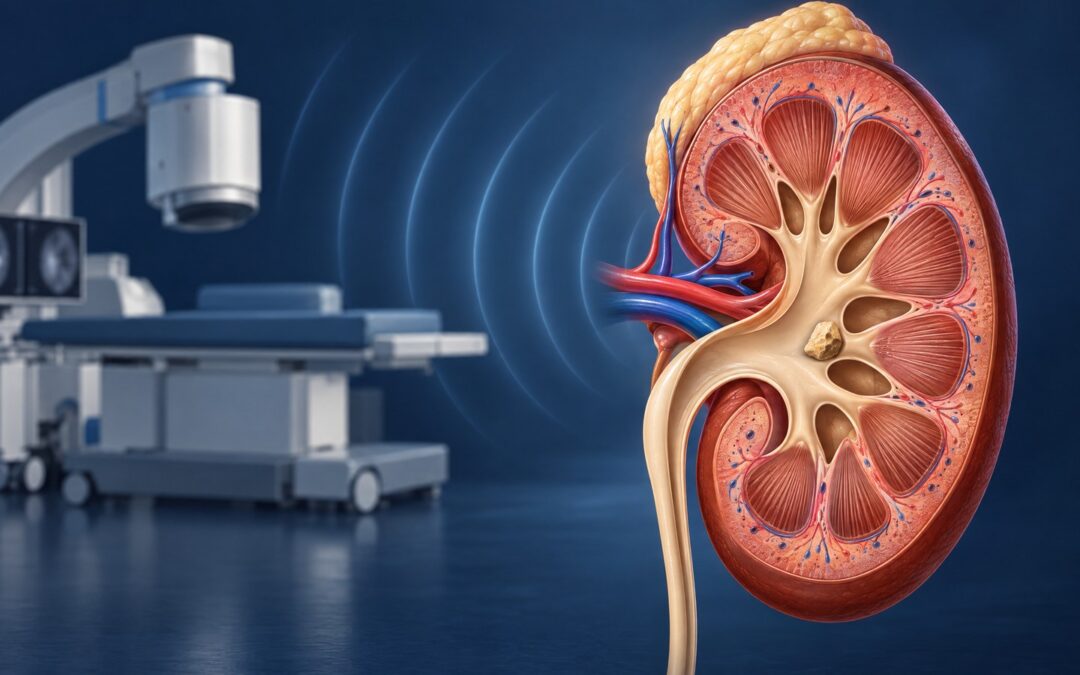
The important discovery was not a higher frequency. In a well-defined set of kidney-stone trials, it was a slower rate of delivering the shocks. A 2008 meta-analysis pooled four randomized trials involving 589 patients. Delivering 60 shocks per minute, rather than 120, improved the studies’ combined measure of treatment success. The result is real, and the physics behind it is more interesting than a slogan about a powerful number.[3] [4]
Quick answer: Medical shock-wave lithotripsy can fragment selected urinary stones using focused pressure pulses generated outside the body. The studied 1 Hz and 2 Hz values mean one or two medical shocks per second, not a tone to play through headphones. The slower-rate advantage belongs to those clinical protocols. It provides a compelling lesson about timing, while the featured BioPhi programme offers a separate wellness listening experience.[3] [11]
Featured programme: Kidney Stone & Shock-Wave BioPhi Matrix 8-Phase Energetics. This guide connects its kidney-stone and shock-wave research theme with the actual medical evidence, then gives readers a clear way to browse related programmes and organize an optional quiet-listening routine. The public listing identifies an eight-phase programme; it does not publish a runtime or the internal signal specification.

What shock-wave lithotripsy actually does
Extracorporeal shock-wave lithotripsy, abbreviated SWL or ESWL, means breaking a stone with shock waves generated outside the body. A clinical system localizes the stone and transmits focused pressure pulses through a coupling medium and the intervening tissues. The aim is fragmentation into pieces that can subsequently pass through the urinary tract. Fragmentation and passage are different steps; follow-up determines what remains.[11] [12] [16]
This is a striking achievement of acoustic engineering. The instrument must deliver useful mechanical stress to a mineral object inside an organ while managing exposure to surrounding tissue. Stone localization, coupling quality, the shape and energy of each pulse, and the interval between pulses all influence the result. An incision-free approach can still require pain control and can produce bleeding, discomfort, obstruction by fragments or a need for another procedure.[11] [12]
The FDA history, down to the actual record
The 1984 date is verifiable. The FDA’s original premarket approval record P840008 lists the Dornier Lithotripter Compact Transportable and an original decision date of December 19, 1984. A contemporaneous U.S. Office of Technology Assessment report describes the approved use as treatment of kidney and upper-ureter stones. That historical report is a summary, rather than the complete original label.[1] [2]
The approval applied to a particular device and its labeled use. Today, the FDA’s extracorporeal shock-wave lithotripter classification lists Class II devices using the 510(k) pathway. Original PMA approval and later clearance are different regulatory events. Neither amounts to independent FDA approval of the numbers 1 Hz or 2 Hz, or of an audio programme bearing a kidney-stone theme.[1] [23]
Why 1 Hz is not the frequency of the sound inside each shock
In the trials discussed here, 60 shocks per minute equals one shock per second. At 120 per minute, the system delivers two shocks per second. These are pulse repetition rates. They describe how often a shock is delivered, not the pitch or spectral content of the individual shock.[4]
A lithotripter’s pulse is a very short, broadband pressure transient. It has a rapid positive-pressure component and a negative, or tensile, component. These act on much shorter timescales than the gap between one clinical shock and the next. Changing the repetition rate changes that gap. It does not turn the pulse into a slow, continuous sine wave.[8] [11]
That distinction is essential to understanding the finding. “Slower worked better” is a statement about a complete clinical delivery process. It is not a claim that any device producing a numerical 1 Hz setting becomes a lithotripter.

The 589-patient finding, without inflating the result
Semins, Trock and Matlaga searched MEDLINE and EMBASE through April 2007. Their 2008 Journal of Urology meta-analysis combined four randomized trials comparing exactly 60 versus 120 shocks per minute. The pooled absolute difference in author-defined treatment success favored 60 per minute by 10.2 percentage points, with a 95% confidence interval of 3.7 to 16.8 percentage points and p = 0.002.[3] [4]
Ten percentage points is an absolute difference, not a 10.2% relative improvement. More importantly, the pooled endpoint was treatment success as defined by each trial. Some trials allowed small residual fragments to count as success. The review did not produce a harmonized pooled estimate of complete stone clearance.[4]
| Trial in the 2008 review | Study definition of success | Assessment time |
|---|---|---|
| Pace, 2005 | Stone-free or asymptomatic fragments smaller than 5 mm | 3 months |
| Madbouly, 2005 | Residual fragments smaller than 2 mm | 3 months |
| Yilmaz, 2005 | Residual fragments smaller than 3 mm | 10 days |
| Davenport, 2006 | Residual fragments smaller than 4 mm | 3 months |
These thresholds and follow-up periods come from the review’s trial table. They explain why “success” and “stone-free” should not be silently exchanged. Only two of the four trials reported strict stone-free rates in that table. Different machines, imaging methods, treatment protocols and populations also limit how broadly the pooled result can be applied.[4] [7]
A useful close-up: the 220-patient Pace trial
The randomized, double-blind Pace trial reported overall three-month composite success of 75% at 60 shocks per minute versus 61% at 120. The slower group required fewer repeat SWL procedures, 18% versus 32%, and received fewer shocks on average. Treatment took longer: 40.6 versus 24.2 minutes. These are results from that trial, not universal predictions for another machine or patient.[5]
The trial also reported a larger advantage in a subgroup with stone area of at least 100 mm². That was a single-trial subgroup, not the pooled 589-patient result. Area in square millimetres is not stone diameter. Presenting that subgroup as the general success rate would exaggerate what the study established.[5]

The physics of the pause: cavitation and coupling
Shock waves can stress a stone directly. Pressure waves travel through it, reflect at interfaces and create tensile stresses that contribute to cracking. A second process, cavitation, involves gas nuclei expanding under the pulse’s negative pressure and then collapsing. Bubble activity can damage the stone surface, enlarge fissures and produce secondary pressure waves.[9] [11]
More rapid shock delivery does not necessarily produce more useful fragmentation per unit of exposure. In laboratory studies, microscopic bubble nuclei can persist after earlier shocks. They can consume energy from the tensile phase of subsequent pulses or disturb the coupling path. A slower rhythm gives the acoustic environment more time to change before the next pulse arrives.[8] [10]
One mechanistic study using model stones found similar positive pressures at slower and faster rates, but less negative pressure at the faster rate. That result helps explain how two exposures with superficially similar “power” can behave differently. The useful question is how much of the relevant pressure waveform reaches the stone, not simply how many pulses the machine can deliver.[8]
These experiments support a physical explanation, not a direct measurement of cavitation inside every treated patient. Cavitation can also contribute to tissue injury. Improving fragmentation and managing unwanted exposure must be considered together; the process is not a harmless form of musical resonance.[9] [11]
Does slower always mean better?
No single rate is established as optimal for every stone and lithotripter. A randomized study comparing 60, 90 and 120 shocks per minute found better success at the two lower rates than at 120, while proposing 90 as its protocol-specific compromise between efficacy and treatment time. It had a different design and a short follow-up endpoint. Its conclusion is not an instruction to override a treating urologist’s settings.[6]
The defensible lesson is strong enough: pulse timing is a meaningful part of the treatment architecture. Coupling, targeting, stone characteristics and waveform delivery remain just as important. The evidence is more useful when those variables stay visible.[11] [12]
Which stones and patients are suitable for SWL?
A stone is not selected for SWL by its name alone. Clinicians consider its size, location, composition and CT density, along with anatomy, infection, bleeding risk and the ability to target it. The EAU guideline notes that stones above 1,000 Hounsfield units on non-contrast CT, especially homogeneous stones, are less likely to disintegrate well. Hard compositions include brushite, calcium oxalate monohydrate and cystine.[12]
For selected stones in the renal pelvis or upper and middle calyces, SWL can be useful up to 20 mm. Lower-pole anatomy can make clearance less favorable. For renal stones above 20 mm, the EAU generally favors percutaneous nephrolithotomy, or PCNL, because SWL is more likely to require repeated treatment and create problems from accumulating fragments. These are clinical selection principles, not a self-treatment threshold.[12]
Ureteroscopy, or URS, is another option: an endoscope accesses the urinary tract so a clinician can treat or retrieve the stone. NICE’s adult renal-stone recommendations distinguish stones below 10 mm, 10 to 20 mm, and above 20 mm, with SWL, URS and PCNL occupying different roles. Which approach offers the best chance of clearance depends on the individual case and local services.[13]
Urgent-care priority: Fever or chills with suspected stone symptoms, inability to urinate, severe uncontrolled pain, or persistent vomiting need urgent medical assessment. An infected obstructed kidney is a urological emergency. It can require urgent drainage and antibiotics before definitive stone treatment. A wellness session should never delay that assessment.[12] [15] [16]
Where the eight-phase BioPhi programme fits
Kidney Stone & Shock-Wave BioPhi Matrix 8-Phase Energetics brings the kidney-stone and shock-wave theme into the platform’s wellness catalogue. Its publicly identified feature is the eight-phase format. The interest of a phased listening design is organization over time, rather than treating a single numerical label as the entire experience.
That is a useful design direction. A structured session can give a listener a beginning, a progression and a point of completion. The reader can approach it as a deliberate listening interval, then decide which related soundscapes fit their preferences. The internal phases, signal inventory and routing are not needed to use the programme and are not disclosed here. Its native playback duration should be read from the current player, not inferred from another BioPhi release.
The connection to SWL is a research theme about timing and delivery, not a claim that the app performs lithotripsy. The clinical trials reviewed above did not test this programme. Their value is to show why the complete exposure matters: what is delivered, how it is delivered, when it is delivered and what outcome is actually measured.[4] [11]
Why this is more informative than “play the kidney frequency”
A continuous tone, a repeating amplitude envelope and a sequence of changing listening sections are different ways to organize sound. A phase-based format allows a creator to organize contrast and progression. That is an aesthetic and workflow distinction; the title alone does not reveal which particular modulation or stereo features this release implements.
Likewise, the slower-rate SWL finding is not evidence that cells become immune to a static tone after a fixed number of minutes. The mechanism investigated here concerns pressure delivery and bubble nuclei. It should not be repackaged as proof that BioPhi avoids cellular adaptation or breaks stones better than a static consumer signal.[8]
The practical advantage of a listening guide is more concrete: save the exact programme, choose a manageable playback window, pair it with a preferred soundscape and keep a simple comfort journal. That creates a repeatable personal routine without confusing it with a medical dose.
| Dimension | Clinical SWL | BioPhi wellness listening |
|---|---|---|
| Physical exposure | Focused pressure transients through a controlled acoustic coupling path | Sound from the selected playback system; any other accessory is a separate delivery path |
| What 1 Hz versus 2 Hz means here | One versus two clinical shocks per second | Not a kidney-targeting setting or an instruction to copy medical rates |
| Evidence and goal | Studies measure fragmentation, treatment success, residual stones and complications | This guide tracks listening comfort, attention and routine preferences, not stone clearance |
| Timing | Set within a clinician-selected treatment protocol | Use current player information and comfortable optional practice windows |
The clinical column is supported by the rate review, device literature and guidelines. The wellness column defines the limited purpose of the routine below, not an efficacy claim.[4] [11] [12]
Exact kidney-stone links and quiet-listening companions
Open the PEMF Healing platform, then save the featured programme and any companions you prefer. The public primary listing and most companion pages currently show subscriber-only access. Do not assume this featured release is free. Some public descriptions expose a duration, but most do not.
The two older kidney-stone entries below are topic-navigation links. Their titles do not establish that they treat a stone, infection or urinary obstruction. The remaining entries offer music or soundscape choices for the separate adult quiet-listening routine.
- Kidney Stones Energetics. Older kidney-stone topic entry; browsing only, not a stone-treatment recommendation.
- Kidney Stones 6 X CAFL Advanced Energetics. Additional kidney-stone catalogue entry; browsing only, not a substitute for urological assessment.
- Bb: Sleep Decent, Deep Rain Rest and Relaxation ASMR. Rain-based closing choice for a quiet interval.
- Bb/A#: 444Hz Relaxation ASMR Meditation, Handpan with Water Soundscape.. Handpan and water soundscape choice.
- E: 444Hz Solfeggio Handpan Meditation Healing, Relaxation, Balance, Focus, Creativity, Harmony. Handpan-based listening contrast.
- D: ASMR Ocean Relaxation 432Hz, Handpan, Tibetan Moon Bowl, Crystal Bowl, Chinese Koto,. Ocean and instrument soundscape choice.
- D: Focus Clarity Pulsation, Soundscape Harmonics. Focus-themed soundscape for a settled interval.
- C: 8min Soulful Soundscape, 528Hz Handpan Meditation. Eight-minute musical soundscape; public description states that duration.
- 432Hz + 12th Sub, Calmness, Balance, Healing, Grounding Energetics. Calmness and grounding-themed listening choice.
- C: Earth Grounding Lock, Wind Magic Harmonics ASMR. Wind soundscape for an opening interval.
A seven-day listening routine with practical follow-through
This optional routine is for adults who want a quiet wellness practice, not for managing an acute stone episode. Start with audio alone so that comfort is easy to assess. Sit somewhere safe, keep the sound comfortably low and stop if the session is unpleasant. Do not listen while driving or when distraction could be hazardous.[19]
Timing for every day: Try the opener for up to 2 minutes. Then open the exact featured programme and use its currently displayed session length if comfortable and convenient. Alternatively, choose a 5-minute familiarization window and stop playback yourself. That shorter window is not the full eight-phase programme, its native runtime or a treatment dose. Finish with up to 3 minutes of the closing companion, with a quiet pause between programmes. These are optional editorial practice windows, not clinical exposure recommendations.
One companion, C: 8min Soulful Soundscape, 528Hz Handpan Meditation, has a publicly stated eight-minute duration. Its shorter use below is an excerpt; a full listen is optional when time and comfort allow. For other companions, follow the current player rather than assuming a full-session duration.
Day 1: Establish a comfortable baseline
- Open: 432Hz + 12th Sub, Calmness, Balance, Healing, Grounding Energetics, up to 2 minutes.
- Primary: Kidney Stone & Shock-Wave BioPhi Matrix 8-Phase Energetics. Use the current player-displayed length if comfortable, or the optional 5-minute familiarization window described above. A partial listen is not the full programme.
- Close: Bb: Sleep Decent, Deep Rain Rest and Relaxation ASMR, up to 3 minutes, then pause quietly.
Practical follow-through: Before listening, note your comfort and whether any symptoms require medical attention. Afterwards, record only how the listening interval felt.
Day 2: Review your personal fluid plan
- Open: C: Earth Grounding Lock, Wind Magic Harmonics ASMR, up to 2 minutes.
- Primary: Kidney Stone & Shock-Wave BioPhi Matrix 8-Phase Energetics. Use the current player-displayed length if comfortable, or the optional 5-minute familiarization window described above. A partial listen is not the full programme.
- Close: Bb/A#: 444Hz Relaxation ASMR Meditation, Handpan with Water Soundscape., up to 3 minutes, then pause quietly.
Practical follow-through: Keep your clinician-approved fluid plan separate from the playlist. If your target is unclear or fluids are restricted, make a note to ask your care team rather than changing intake.
Day 3: Make one practical nutrition note
- Open: D: Focus Clarity Pulsation, Soundscape Harmonics, up to 2 minutes.
- Primary: Kidney Stone & Shock-Wave BioPhi Matrix 8-Phase Energetics. Use the current player-displayed length if comfortable, or the optional 5-minute familiarization window described above. A partial listen is not the full programme.
- Close: Bb: Sleep Decent, Deep Rain Rest and Relaxation ASMR, up to 3 minutes, then pause quietly.
Practical follow-through: Check one food label for sodium and write down a question about your stone-type-specific diet. Do not remove dietary calcium or add supplements from this routine.
Day 4: Prepare better questions for your clinician
- Open: E: 444Hz Solfeggio Handpan Meditation Healing, Relaxation, Balance, Focus, Creativity, Harmony, up to 2 minutes.
- Primary: Kidney Stone & Shock-Wave BioPhi Matrix 8-Phase Energetics. Use the current player-displayed length if comfortable, or the optional 5-minute familiarization window described above. A partial listen is not the full programme.
- Close: D: ASMR Ocean Relaxation 432Hz, Handpan, Tibetan Moon Bowl, Crystal Bowl, Chinese Koto,, up to 3 minutes, then pause quietly.
Practical follow-through: Write down your known stone size, location and any available analysis. If these are unknown, add them to your next clinical discussion. Do not guess a treatment from the programme name.
Day 5: Compare sound preferences, not stone outcomes
- Open: C: Earth Grounding Lock, Wind Magic Harmonics ASMR, up to 2 minutes.
- Primary: Kidney Stone & Shock-Wave BioPhi Matrix 8-Phase Energetics. Use the current player-displayed length if comfortable, or the optional 5-minute familiarization window described above. A partial listen is not the full programme.
- Close: C: 8min Soulful Soundscape, 528Hz Handpan Meditation, up to 3 minutes, then pause quietly.
Practical follow-through: Notice whether wind, rain or musical soundscapes are more comfortable. Keep the volume similar. A preference difference is not evidence of fragmentation or passage.
Day 6: Keep equipment and controls simple
- Open: 432Hz + 12th Sub, Calmness, Balance, Healing, Grounding Energetics, up to 2 minutes.
- Primary: Kidney Stone & Shock-Wave BioPhi Matrix 8-Phase Energetics. Use the current player-displayed length if comfortable, or the optional 5-minute familiarization window described above. A partial listen is not the full programme.
- Close: Bb/A#: 444Hz Relaxation ASMR Meditation, Handpan with Water Soundscape., up to 3 minutes, then pause quietly.
Practical follow-through: Use the same audio-only setup. Check that notifications will not startle you and that the stop control is easy to reach. Save optional accessory questions for model-specific support.
Day 7: Summarize and choose a sustainable routine
- Open: D: Focus Clarity Pulsation, Soundscape Harmonics, up to 2 minutes.
- Primary: Kidney Stone & Shock-Wave BioPhi Matrix 8-Phase Energetics. Use the current player-displayed length if comfortable, or the optional 5-minute familiarization window described above. A partial listen is not the full programme.
- Close: C: 8min Soulful Soundscape, 528Hz Handpan Meditation, up to 3 minutes, then pause quietly.
Practical follow-through: Review which combination fit your day, whether any discomfort occurred and which clinical follow-up items remain. Keep care appointments and prescribed medicines unchanged.
At the end of the week, keep the combination you found most comfortable. If you wish to repeat the experiment, take a seven-day pause from this particular routine first and review your notes. The pause is for reflection and preference comparison, not a medically required washout or a claim about cellular reset. Your clinical treatment and follow-up continue independently.
Audio, haptics and magnetic coils are different paths
Headphones and speakers deliver sound to the auditory system. An audio-linked haptic accessory produces tactile sensation. A driven magnetic coil produces a magnetic-field exposure. Sharing a soundtrack does not make the delivered pressure, vibration or field identical, and none of these consumer paths is equivalent to a medical lithotripter.[11] [21] [22]
If a particular session is confirmed to include binaural audio, preserve its intended left and right channels with an appropriate stereo setup. A 2023 systematic review found inconsistent evidence that binaural beats reliably entrain measured brain oscillations. That research does not show kidney-stone fragmentation. This release’s public heading does not establish its binaural configuration, so this guide does not invent one.[20]

Optional equipment: start simple and verify the setup
Audio alone is sufficient for the listening routine. If you choose a Woojer Vest 4, use the current manual’s supported connection method and adjust audio and tactile sensation separately. Read the device warnings, including those relevant to pacemakers and magnets. Do not increase intensity in pursuit of an imagined stronger stone effect.[21]
If you already own an iTorus or another coil, obtain the model-specific instructions before connecting it. Check the supported source, interface and output requirements. Do not connect a bare coil directly to a phone, improvise wiring, or use this article as permission to place a coil over the kidneys, abdomen, head or neck. No kidney-targeted consumer-coil protocol is established here. Pregnancy, implanted devices, recent procedures or medical concerns require appropriate manufacturer and clinician guidance.[12] [22]
Affiliate disclosure: Some resource links may support PEMF Magazine through affiliate commissions. Equipment is optional. These commercial resources are not the FDA-approved lithotripter described earlier and are not recommended as stone treatment.
| Resource | Link | Practical role |
|---|---|---|
| Platform | Frequency Healing App | Programme browsing, favorites and available playback controls |
| Consumer magnetic device | iTorus i2 | Optional separate wellness accessory; use only model-supported setup and safety guidance |
| Consumer magnetic device | iTorus i5 | Optional separate wellness accessory, not lithotripsy equipment |
| Haptic accessory | Woojer Vest 4. Use code EPEMF10 at checkout. | Audio-linked tactile sensation with separate controls; verify current checkout eligibility for the code |
| Optional ritual accessory | iMPrinter | A personal ritual object only in this guide; not water treatment, a mineral-dissolving system or a stone-prevention intervention |
Daily practices that genuinely belong in kidney-stone care
Stone prevention starts with the stone itself. Calcium stones are the most common, but uric-acid, struvite and cystine stones involve different problems. A prior stone analysis and, when appropriate, a 24-hour urine collection can guide a more specific prevention plan. A programme title is not a substitute for knowing your stone type.[14] [16]
Make hydration specific, not extreme. Discuss an appropriate fluid and urine-volume goal with your clinician. General prevention advice is not the same as rapidly drinking large volumes during severe pain or suspected obstruction. Heart failure, kidney failure and prescribed fluid restrictions change what is appropriate. Persistent vomiting or dehydration may require clinical treatment rather than another glass of water.[16] [17]
Keep dietary calcium in perspective. Removing food calcium can be counterproductive for calcium-oxalate stone prevention, because calcium in food can bind oxalate in the intestine. Reducing excess sodium and tailoring animal-protein or oxalate advice to the stone type are more useful than a universal “detox” diet. Do not self-prescribe citrate, supplements or a restrictive diet from a frequency label.[17] [18]
Track the right things. Use the listening journal for comfort, sound preference, attention and whether the routine fits your day. Keep clinical notes separately: symptoms, imaging results, urine tests, stone analysis, medicines and follow-up instructions. Feeling calmer does not demonstrate that a stone has fragmented or passed. Follow-up and clinical assessment determine that.[12] [16]
Protect hearing and keep expectations proportionate. WHO guidance emphasizes that listening risk depends on sound level and duration. A phone’s volume percentage is not a calibrated ear-level measurement. Use a comfortably low level, take breaks and stop if you develop ringing, muffled hearing or discomfort. An optional ritual with an iMPrinter does not change the safety, chemistry or medical suitability of drinking water.[19]
The lasting lesson: Kidney-stone lithotripsy demonstrates why physical signals deserve precise language. Slowing a clinically delivered pulse train improved treatment success in a defined evidence base. For a wellness programme, the useful next step is different: explore a structured listening practice, choose your companions deliberately and keep medical care on its own evidence-based track.
Educational and wellness disclaimer: This article provides education, not medical advice, diagnosis or treatment. The PEMF Healing platform and the featured BioPhi programme are not equivalent to FDA-authorized lithotripsy equipment and are not established here to fragment, dissolve, remove or prevent kidney stones. Do not delay licensed medical care. Seek urgent assessment for fever or chills with stone symptoms, inability to urinate, severe uncontrolled pain or persistent vomiting. Follow your clinician’s advice and every device’s manufacturer instructions.
References
- FDA. Original PMA record P840008: Dornier Lithotripter Compact Transportable; decision 19 December 1984. Direct source.
- U.S. Office of Technology Assessment. ESWL: Efficacy, Safety, and Regulation by the Food and Drug Administration. 1986. Direct source.
- Semins MJ, Trock BJ, Matlaga BR. The effect of shock wave rate on the outcome of shock wave lithotripsy: a meta-analysis. Journal of Urology. 2008;179:194-197. Direct source.
- Semins MJ, Trock BJ, Matlaga BR. The effect of shock wave rate on the outcome of shock wave lithotripsy: a meta-analysis. Full-text repository copy. Direct source.
- Pace KT and colleagues. Shock wave lithotripsy at 60 or 120 shocks per minute: a randomized, double-blind trial. Journal of Urology. 2005;174:595-599. Direct source.
- Yilmaz E and colleagues. Optimal frequency in extracorporeal shock wave lithotripsy: prospective randomized study. Urology. 2005. Direct source.
- Comparison of High, Intermediate, and Low Frequency Shock Wave Lithotripsy: A Network Meta-analysis. 2016. Direct source.
- Why stones break better at slow shock wave rate than at fast rate. Laboratory mechanistic study. Direct source.
- Cavitation Bubble Cluster Activity in the Breakage of Kidney Stones by Shock Wave Lithotripsy. Mechanistic study. Direct source.
- Turbulent Water Coupling in Shock Wave Lithotripsy. Laboratory coupling study. Direct source.
- The acute and long-term adverse effects of shock wave lithotripsy. Peer-reviewed review. Direct source.
- European Association of Urology. Guidelines on Urolithiasis, current guideline chapter. Accessed 19 November 2026. Direct source.
- NICE. NG118: Renal and ureteric stones: assessment and management. Recommendations. Direct source.
- NIDDK. Definition and Facts for Kidney Stones. Direct source.
- NIDDK. Symptoms and Causes of Kidney Stones. Direct source.
- NIDDK. Treatment for Kidney Stones. Direct source.
- National Kidney Foundation. Kidney Stone Diet Plan and Prevention. Direct source.
- NIDDK. Eating, Diet, and Nutrition for Kidney Stones. Direct source.
- WHO. Deafness and hearing loss: Safe listening. Direct source.
- Binaural beats to entrain the brain? A systematic review of the effects of binaural beat stimulation on brain oscillatory activity. 2023. Direct source.
- Woojer. Vest 4 User Manual. Direct source.
- iPyramids. Model-specific tutorials and setup resources. Direct source.
- FDA. Product classification LNS: extracorporeal shock-wave lithotripter, Class II, 510(k) pathway. Direct source.