
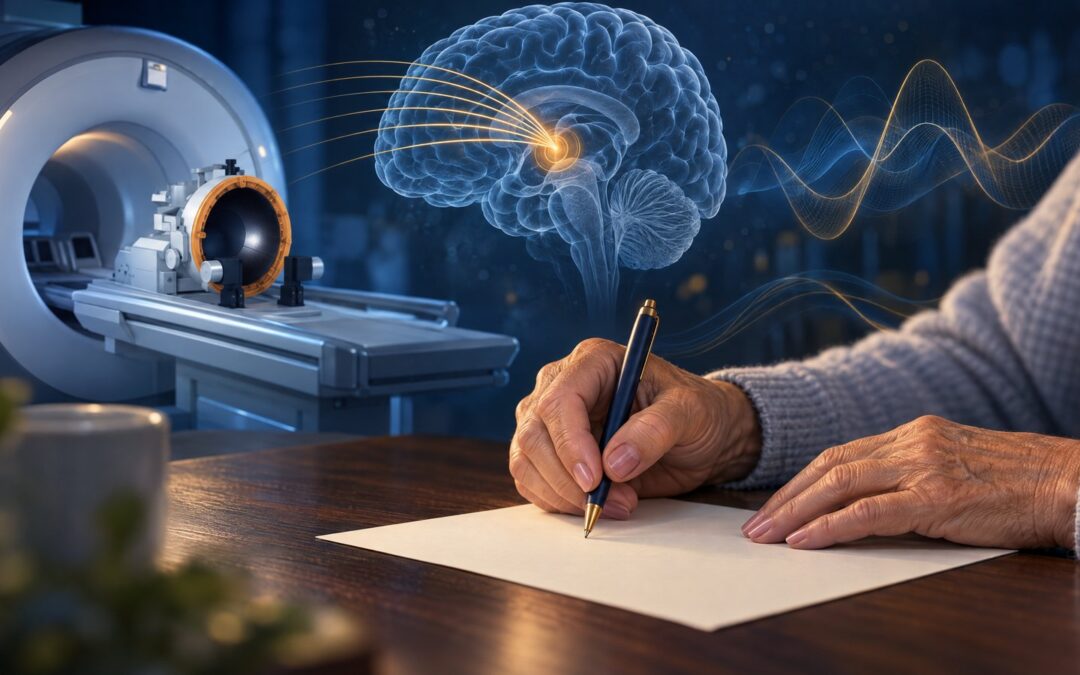
A shaking hand can turn a signature, a spoon or a cup of coffee into a demanding task. One of the most remarkable developments in tremor care is that specialists can now focus ultrasound through the intact skull and treat a precisely selected brain target without a surgical incision. The achievement is not simply a story about a powerful frequency. It is a story about imaging, acoustic engineering and the motor circuits that help organize movement.[1] [9]
The short answer: MRI-guided focused ultrasound is an FDA-approved medical procedure for selected people with medication-refractory essential tremor. The seven-phase BioPhi programme featured here is a separate, research-inspired listening composition. Its value is an organized way to explore sound and attention, not a recreation of the clinical procedure or an established tremor intervention.
Explore Tremor & Ultrasound Resonance BioPhi Matrix 7-Phase Neural Oscillation Energetics through the PEMF Healing platform. Below, we unpack the clinical breakthrough, explain the programme’s creative rationale and provide a practical seven-day listening routine with exact companion links.

Essential tremor is a movement-network problem, not just a shaking hand
Essential tremor commonly appears during action: holding the arms out, writing, eating or lifting a cup. Clinicians distinguish postural tremor, which occurs while maintaining a position, from kinetic tremor, which appears during voluntary movement. These distinctions matter because not every tremor has the same cause. Medicines, metabolic conditions and other neurological disorders can also cause shaking.[11] [13]
The scientific picture extends beyond an isolated muscle. Research implicates a network linking the cerebellum, thalamus and cerebral cortex. The cerebellum contributes to movement coordination; thalamic regions participate in relaying and shaping signals reaching the cortex. Researchers continue to investigate how different parts of this network contribute to different tremor patterns.[12]
This network perspective is important. A visible movement can emerge from interacting neural systems rather than one defective component. It also explains why clinical treatment depends on identifying the condition and choosing an appropriate target, not assigning every shaking hand the same number on a frequency chart.[11] [12]
What the FDA actually approved for essential tremor
On July 11, 2016, the FDA approved ExAblate Neuro under PMA P150038 for unilateral thalamotomy in eligible adults aged 22 or older with idiopathic, medication-refractory essential tremor and an identifiable, accessible target in the ventral intermediate region of the thalamus. Unilateral means treatment on one side. Thalamotomy means deliberately creating a small lesion in a selected thalamic target.[1] [2]
A later essential-tremor supplement, approved on December 8, 2022, added staged treatment of the previously untreated side, at least nine months after the first thalamotomy, in appropriately selected patients. That is a staged clinical pathway, not simultaneous treatment of both sides. Separate approvals involving Parkinson’s disease have different indications and must not be merged with the essential-tremor history.[3] [4]
The positive scientific lesson is precision. The approved intervention brings together patient selection, anatomical targeting, an ultrasound system and medical monitoring. FDA approval belongs to that defined device and procedure, not to a frequency independently.
How focused ultrasound reaches a target through the skull
A published description of the clinical system details a hemispherical array with 1,024 transducer elements operating at a nominal 650 kHz. These are public specifications of that medical system, not settings for the BioPhi programme. The elements are coordinated so that acoustic energy converges at a chosen location. CT-derived information helps account for the way the skull changes the travelling waves, while MRI provides targeting and temperature monitoring.[9]
At the selected target, the clinical procedure uses heating to produce a controlled thermal lesion. That is why “incisionless” is an accurate description but “nothing happens to the tissue” is not. The intervention is physically consequential even though the skull is not opened.[2] [9]
The engineering is more instructive than the frequency by itself. The same nominal rate does not specify acoustic pressure, focusing, skull transmission or thermal exposure. A meaningful description of treatment must account for where the energy goes and what it does there.[9]

What the landmark clinical trial found
The 2016 randomized trial in the New England Journal of Medicine analyzed 76 people with medication-refractory essential tremor: 56 received focused-ultrasound thalamotomy and 20 underwent a sham procedure. Participants had moderate-to-severe symptoms despite previous medication trials.[5]
At three months, the mean treated-hand rating score fell from 18.1 to 9.6 in the active group, compared with 16.0 to 15.8 in the sham group. Higher scores indicated greater impairment. The reported active-group improvement was approximately 47% from baseline; the between-group difference in score change was 8.3 points. That is a group-average rating-scale result, not a claim that 47% of patients were cured or that treatment was “47% better than placebo.”[5] [6]
At twelve months, the active group retained a reported average improvement of about 40% from baseline. By then, most sham participants had crossed over to active treatment, so the later result was no longer a continuing randomized sham comparison. The trial also documented adverse effects: gait disturbance and numbness or tingling occurred, and some persisted at twelve months.[5] [6]
What longer follow-up adds
A five-year follow-up reported sustained average benefit in observed patients. Importantly, 40 of the 75 treated participants were assessed at five years. Its reported improvement in the combined treated-hand tremor and motor score was 40.4%. The result supports durability in the observed group, while the loss of participants to follow-up and absence of a continuing sham group limit broader conclusions.[7]
A separate 2024 staged-bilateral study treated 51 selected people who had previously undergone unilateral treatment. It reported substantial average improvement after the second-side procedure, but it was open-label and uncontrolled. Persistent sensory, speech or coordination effects in some participants reinforce why eligibility and benefit-risk discussions belong with a specialist team.[8]
There is another important branch of research: low-intensity focused-ultrasound neuromodulation, which investigates effects without intentionally making a thermal lesion. It uses different exposure goals and remains a distinct research field. It should not be confused with either clinical thalamotomy or ordinary headphone listening.[10]
What makes this seven-phase BioPhi programme distinctive
Tremor & Ultrasound Resonance BioPhi Matrix 7-Phase Neural Oscillation Energetics takes the research theme into a different medium: a deliberately evolving stereo composition. Its seven phases are compositional sections, not seven medical targets or seven validated treatment stages. The programme offers a structured setting in which to listen closely, notice changing textures and build a personal reflective practice.
The design distinction is between playing a number and composing an experience. A single tone establishes a relatively fixed reference. An evolving composition can organize contrast, harmonic relationships and changes in emphasis over time. That gives the listener something to follow beyond a continuously repeated pitch. This is a concrete creative distinction, not a claim that a more elaborate sound has a stronger medical effect.
Research inspiration can be meaningful without being a clinical replica. A composition can direct curiosity toward neural circuits, acoustic focus and the organization of time. What it offers at home is a listening experience. The clinical literature discussed above evaluates a medical ultrasound procedure, not this recording.
Harmonics, stereo and attention
Harmonics describe relationships within sound. An octave, for example, is a 2:1 frequency relationship recognized in musical acoustics. Such relationships are useful for musical organization; they do not preserve the pressure field, target or thermal effects of a clinical ultrasound exposure.[24] [9]
Stereo also gives a composition a spatial dimension. In passages designed for binaural perception, different tones must be presented separately to the ears. The audible tones and their interaural difference are different quantities. Wired stereo headphones are a straightforward way to preserve separate left and right channels, provided the device’s mono-audio setting is off.[14] [25]
The attraction is an intentional listening format with room for curiosity and preference. A 2023 systematic review found inconsistent EEG-entrainment results across binaural-beat studies, so the listening experience should not be translated into a promise of a particular brain rhythm or a corrected motor circuit.[14]

Why changing sound is different from a fixed tone
A fixed tone can be useful when the task is calibration, a perceptual experiment or a stable musical reference. A long-form listening composition has a different task: arranging an experience through time. Variation can introduce contrast and give attention a new feature to follow. That is the strongest defensible reason to discuss evolving sound here.
Auditory neuroscience does study adaptation. Human experiments show that responses to repeated sounds can change, and that the statistical context of those sounds matters. But auditory adaptation is not interchangeable with a universal “cellular adaptation” problem. These experiments do not establish that a changing wellness programme prevents adaptation, or that fixed tones inevitably stop working after a particular number of minutes.[15]
For the reader, a more useful comparison is practical: Do you prefer an unchanging reference or an evolving texture? Does the presentation feel comfortable? Can you listen without straining to create an effect? Those are questions a personal listening journal can answer.
| Dimension | Clinical focused ultrasound | Fixed-tone listening | Seven-phase BioPhi listening |
|---|---|---|---|
| Physical pathway | Specialist acoustic delivery through the skull, with imaging and temperature monitoring.[9] | Ordinary audio through speakers or headphones. | An evolving stereo composition through supported playback equipment. |
| Role of time | Procedure-specific sonications and monitored thermal exposure. | A comparatively stable audible reference. | Compositional development across seven sections. |
| What is measured | Targeting, temperature, clinical tremor/function scores and adverse events.[2] | Audio output and, where studied, perceptual responses. | For a home practice, personal comfort, attention and preference. |
| Evidence scope | Device-specific regulatory records and clinical trials.[1] [5] | Depends on the exact listening experiment. | Creative design rationale; no direct controlled tremor benefit established. |
Build a small companion library
Start with the featured programme, then choose a quieter opener and a closing soundscape if you enjoy a three-programme routine. The following links preserve their catalogue titles. Words such as “healing,” “focus” or “muscle relaxation” are part of those titles, not clinical claims established by this article. The companions are selected for listening variety, not as interchangeable treatments for essential tremor.
A practical seven-day listening guide
The aim: establish a comfortable, repeatable adult wellness-listening routine while keeping usual care unchanged. Do not try to synchronize with, resist or suppress a tremor using the soundtrack. Keep the device easy to pause, and rest your arms in a supported position if that is comfortable.
- Prepare. Sit in a stable chair, place the phone where it is easy to reach and begin with audio only. Set a low, comfortable volume before putting on headphones. Do not listen while driving or performing a task that requires full attention.[16]
- Choose a short version first. The suggested opener and closer below are optional two-minute excerpts. For the primary, begin with a five-minute listening excerpt. These are editorial familiarization windows, not the programmes’ native runtimes, a research protocol or medical doses.
- Keep the tracks separate. Run them sequentially, not simultaneously. Leave about one quiet minute between selections. Pause or stop earlier whenever you wish.
- Explore more only if comfortable. A short excerpt will not demonstrate the full seven-phase development. On a later day, you may choose the primary’s platform-displayed available session length instead, with companions omitted if preferred. Do not loop the programme to pursue a stronger effect.
- Make one useful note. Record comfort, attention and preference. A pleasant session or a change in how your hands feel is not evidence of a tremor-treatment effect.
Day 1: Start with audio only
- Open: C: Earth Grounding Lock, Wind Magic Harmonics ASMR. Optional two-minute excerpt, then about one quiet minute.
- Primary: Tremor & Ultrasound Resonance BioPhi Matrix 7-Phase Neural Oscillation Energetics. Begin with a five-minute familiarization excerpt, or choose the platform-displayed available length if comfortable on later days. Pause sooner whenever needed.
- Close: Bb: Sleep Decent, Deep Rain Rest and Relaxation ASMR. After about one quiet minute, use an optional two-minute excerpt.
Today’s action: Keep both hands supported. Find a volume that is comfortably quiet. Note whether the primary texture feels pleasant or demanding.
Day 2: Notice contrast
- Open: 432Hz + 12th Sub, Calmness, Balance, Healing, Grounding Energetics. Optional two-minute excerpt, then about one quiet minute.
- Primary: Tremor & Ultrasound Resonance BioPhi Matrix 7-Phase Neural Oscillation Energetics. Begin with a five-minute familiarization excerpt, or choose the platform-displayed available length if comfortable on later days. Pause sooner whenever needed.
- Close: Bb/A#: 444Hz Relaxation ASMR Meditation, Handpan with Water Soundscape.. After about one quiet minute, use an optional two-minute excerpt.
Today’s action: Keep the same headphones and volume as day one. Attend to one broad quality, such as texture or spatial impression, rather than trying to influence your hands.
Day 3: Choose your listening length
- Open: D: Focus Clarity Pulsation, Soundscape Harmonics. Optional two-minute excerpt, then about one quiet minute.
- Primary: Tremor & Ultrasound Resonance BioPhi Matrix 7-Phase Neural Oscillation Energetics. Begin with a five-minute familiarization excerpt, or choose the platform-displayed available length if comfortable on later days. Pause sooner whenever needed.
- Close: C: 8min Soulful Soundscape, 528Hz Handpan Meditation. After about one quiet minute, use an optional two-minute excerpt.
Today’s action: If the introductory excerpt was comfortable, either keep it or use the primary’s platform-displayed available length. The handpan closer has a publicly described eight-minute full version; today’s two-minute excerpt is optional.
Day 4: Make the setting accessible
- Open: C: Earth Grounding Lock, Wind Magic Harmonics ASMR. Optional two-minute excerpt, then about one quiet minute.
- Primary: Tremor & Ultrasound Resonance BioPhi Matrix 7-Phase Neural Oscillation Energetics. Begin with a five-minute familiarization excerpt, or choose the platform-displayed available length if comfortable on later days. Pause sooner whenever needed.
- Close: D: ASMR Ocean Relaxation 432Hz, Handpan, Tibetan Moon Bowl, Crystal Bowl, Chinese Koto,. After about one quiet minute, use an optional two-minute excerpt.
Today’s action: Before playback, move the phone within easy reach and use a supported seated position. Keep the listening setup unchanged and note one practical improvement to the environment.
Day 5: Separate preference from outcome
- Open: 432Hz + 12th Sub, Calmness, Balance, Healing, Grounding Energetics. Optional two-minute excerpt, then about one quiet minute.
- Primary: Tremor & Ultrasound Resonance BioPhi Matrix 7-Phase Neural Oscillation Energetics. Begin with a five-minute familiarization excerpt, or choose the platform-displayed available length if comfortable on later days. Pause sooner whenever needed.
- Close: F#/Gb: Ōmeteōtl, Solfeggio , Sacred Tibetan Moon Bowls, Inner Peace and Deep Handpan Relaxation. After about one quiet minute, use an optional two-minute excerpt.
Today’s action: Try the bowl-and-handpan closer if you enjoy that timbre. Record preference and comfort without interpreting a pleasant session as evidence of motor improvement.
Day 6: Keep the routine simple
- Open: D: Focus Clarity Pulsation, Soundscape Harmonics. Optional two-minute excerpt, then about one quiet minute.
- Primary: Tremor & Ultrasound Resonance BioPhi Matrix 7-Phase Neural Oscillation Energetics. Begin with a five-minute familiarization excerpt, or choose the platform-displayed available length if comfortable on later days. Pause sooner whenever needed.
- Close: E: 444Hz Solfeggio Handpan Meditation Healing, Relaxation, Balance, Focus, Creativity, Harmony. After about one quiet minute, use an optional two-minute excerpt.
Today’s action: Repeat your preferred primary listening length. If you already use optional approved hardware, follow the separate setup checks below and change only one element; remaining audio-only is equally valid.
Day 7: Review what earns a place in your day
- Open: C: Earth Grounding Lock, Wind Magic Harmonics ASMR. Optional two-minute excerpt, then about one quiet minute.
- Primary: Tremor & Ultrasound Resonance BioPhi Matrix 7-Phase Neural Oscillation Energetics. Begin with a five-minute familiarization excerpt, or choose the platform-displayed available length if comfortable on later days. Pause sooner whenever needed.
- Close: Bb: Sleep Decent, Deep Rain Rest and Relaxation ASMR. After about one quiet minute, use an optional two-minute excerpt.
Today’s action: Use the familiar wind opener and rain closer. Write a short conclusion about comfort, attention and whether the routine is worth repeating. Keep clinical treatment and symptom evaluation separate.
After day seven, review what you actually enjoyed and whether listening fitted your life. Keep only the elements that were comfortable. A week away from this routine is an optional reflection break before repeating, not a biological washout requirement or a claim that the body needs a reset.
Audio, haptics and PEMF: three distinct delivery paths
Headphones deliver acoustic information to the auditory system. They are the simplest place to begin because you can evaluate listening comfort without adding another device. Separate-ear presentation matters for binaural perception; a speaker, mono fold-down or a different transmission pathway should not be assumed to preserve it.[14]
A compatible haptic wearable converts supported parts of an audio signal into tactile sensation. Its response depends on the device, fit and controls. Woojer’s manual provides separate volume and sensation controls, so greater vibration does not require louder headphones. Treat the sensation as an optional experience, not a measure of neurological benefit.[20]
A compatible consumer PEMF coil is another physical pathway, shaped by the actual device and its supported setup. A soundtrack does not specify a measured magnetic exposure at the body. Use only the manufacturer-supported connection, output and placement instructions for your model; do not connect an unsupported bare coil directly to a phone or improvise head or neck placement.[21]
Adding devices changes the sensory presentation. It does not establish a larger therapeutic effect, and none of these consumer paths duplicates MRI-guided focused-ultrasound thalamotomy.

If you already own an iTorus or haptic device
First establish that audio alone is comfortable. Before adding a coil, consult the official model-specific iTorus tutorials and check that your intended source and connections are supported. Use the manufacturer’s designated position for that model rather than moving it toward the head in an attempt to target the thalamus. If setup or compatibility is unclear, leave the coil out and ask the manufacturer. This article does not prescribe a coil location or exposure for tremor.
For a Woojer, follow the Vest 4 manual, begin with minimal comfortable sensation and change one setting at a time. You do not need to combine devices to use the listening guide. The manual states that Vest 4 is not suitable for people with pacemakers and advises physician approval during pregnancy.[20]
Optional platform and equipment resources
Affiliate disclosure: some equipment links may generate a commission if you make a purchase. Hardware is optional. These are consumer-wellness resources, not alternatives to a movement-disorder clinic.
| Resource | Practical role | Important boundary |
|---|---|---|
| Frequency Healing App | Open the programme library and supported playback controls. | The featured programme is currently marked subscriber-only. Check access and displayed playback information on the platform. |
| iTorus i2 | Optional consumer-wellness device for owners using a supported setup. | Follow current model instructions and contraindications. No tremor-specific field exposure is established here. |
| iTorus i5 | A separate optional model; consult its own setup instructions. | Do not assume one model’s output or placement instructions apply to another. |
| Woojer Vest 4 | Optional tactile layer with independent sensation controls. | Use code EPEMF10 at checkout; check current applicability there. Follow the manual’s health restrictions. |
| iMPrinter | Optional object-focused symbolic ritual, separate from listening and clinical care. | No established transfer of ultrasound treatment properties or health effects to water, food, medicines or objects. |
A grounded way to approach an optional iMPrinter ritual
If you enjoy a symbolic object-focused practice, keep the device dry, keep liquids away from connections and follow the manufacturer’s handling instructions. Use it as a reminder of an intention, not as a reason to alter prescribed medicine, food safety or drinking-water treatment. A personal ritual can have meaning without being assigned an unmeasured medical mechanism.
Daily practices that provide practical value
Listening is only one optional part of a day. For tasks affected by tremor, try supporting the forearms, using two hands for a cup, adding a non-slip mat or testing a wider pen grip. Adapted utensils help some people, but preference and function vary. An occupational therapist can help identify changes suited to your own tasks.[17] [23]
Pay attention to sleep, fatigue and whether caffeine worsens your symptoms. Keep prescribed treatment consistent unless your clinician advises otherwise, and do not use alcohol as a tremor strategy. If shaking is new, worsening or interfering with daily activities, arrange a clinical review rather than trying to solve it with a different playback setting.[17] [18]
For the listening journal, note the programme, headphones, whether optional hardware was used, comfort before and after, and any unpleasant symptoms. Change one variable at a time. Track whether a routine is pleasant and manageable rather than grading it as a neurological success or failure.
Safety: comfort first, clinical care when needed
Keep audio low and take breaks. WHO advises limiting volume and using exposure-monitoring features where available. A percentage on a volume slider is not a calibrated sound level. Stop for ear pain, new ringing, pressure, dizziness, headache or distress; persistent tinnitus or hearing difficulty warrants professional assessment.[16]
Implanted electronic or magnetic devices require device-specific advice before adding magnetic or haptic hardware. Consumer magnets can interfere with some implants. A generic distance rule should not be treated as clearance for a particular coil, implant or placement. Follow the implant team’s and equipment manufacturer’s instructions.[22]
Seek emergency care for sudden neurological symptoms such as facial droop, one-sided weakness or numbness, speech difficulty or new severe imbalance, even if symptoms improve. Do not use a listening session to wait out a possible stroke.[19]
Educational and wellness disclaimer: This article does not provide medical advice, diagnosis or treatment. The PEMF Healing programme is not the FDA-approved focused-ultrasound procedure and has not been shown to reduce essential tremor. Do not delay neurological assessment, change prescribed treatment or replace licensed care because of a listening experience. Consult a qualified professional for medical conditions, pregnancy, implants or device-safety questions, and follow every manufacturer’s instructions.
References
- FDA. ExAblate Neuro, PMA P150038: original decision and indication (July 11, 2016). Direct source.
- FDA. ExAblate Neuro: original Summary of Safety and Effectiveness Data. Direct source.
- FDA. P150038/S022: essential-tremor labeling supplement (December 8, 2022). Direct source.
- FDA. P150038/S037 Summary of Safety and Effectiveness Data: approval history and distinct Parkinson’s indication (2025). Direct source.
- Elias WJ et al. A Randomized Trial of Focused Ultrasound Thalamotomy for Essential Tremor. New England Journal of Medicine (2016). Direct source.
- NICE. Evidence overview: MRI-guided focused ultrasound thalamotomy for treatment-resistant essential tremor. Direct source.
- Cosgrove GR et al. MRI-guided focused ultrasound thalamotomy for essential tremor: 5-year follow-up results. Journal of Neurosurgery (2023). Direct source.
- Kaplitt MG et al. Safety and Efficacy of Staged, Bilateral Focused Ultrasound Thalamotomy in Essential Tremor. JAMA Neurology (2024). Direct source.
- Transcranial MR-guided focused ultrasound: principles, physics, and imaging findings. Review. Direct source.
- A review of low-intensity focused ultrasound for neuromodulation (2018). Direct source.
- National Institute of Neurological Disorders and Stroke. Tremor. Direct source.
- Clinical Heterogeneity of Essential Tremor: Understanding Neural Substrates of Action Tremor Subtypes. Review (2023). Direct source.
- International Parkinson and Movement Disorder Society. Consensus Statement on the Classification of Tremors. Direct source.
- Binaural beats to entrain the brain? A systematic review of effects on brain oscillatory activity. PLOS ONE (2023). Direct source.
- Statistical context shapes stimulus-specific adaptation in human auditory cortex (2015). Direct source.
- World Health Organization. Deafness and hearing loss: Safe listening. Direct source.
- Mayo Clinic. Essential tremor: Diagnosis and treatment. Direct source.
- NHS. Tremor or shaking hands. Direct source.
- NHS. Stroke symptoms and FAST emergency guidance. Direct source.
- Woojer. Vest 4 User Manual: connection, controls and safety warnings. Direct source.
- iPyramids. Current iTorus model-specific tutorials and setup resources. Direct source.
- FDA. Magnets in Cell Phones and Smart Watches May Affect Pacemakers and Other Implanted Medical Devices. Direct source.
- Managing Essential Tremor. Review (2020). Direct source.
- Auditory Discrimination of Frequency Ratios: The Octave Singularity (2014). Direct source.
- Binaural beats through the auditory pathway: From brainstem to connectivity patterns (2020). Direct source.