
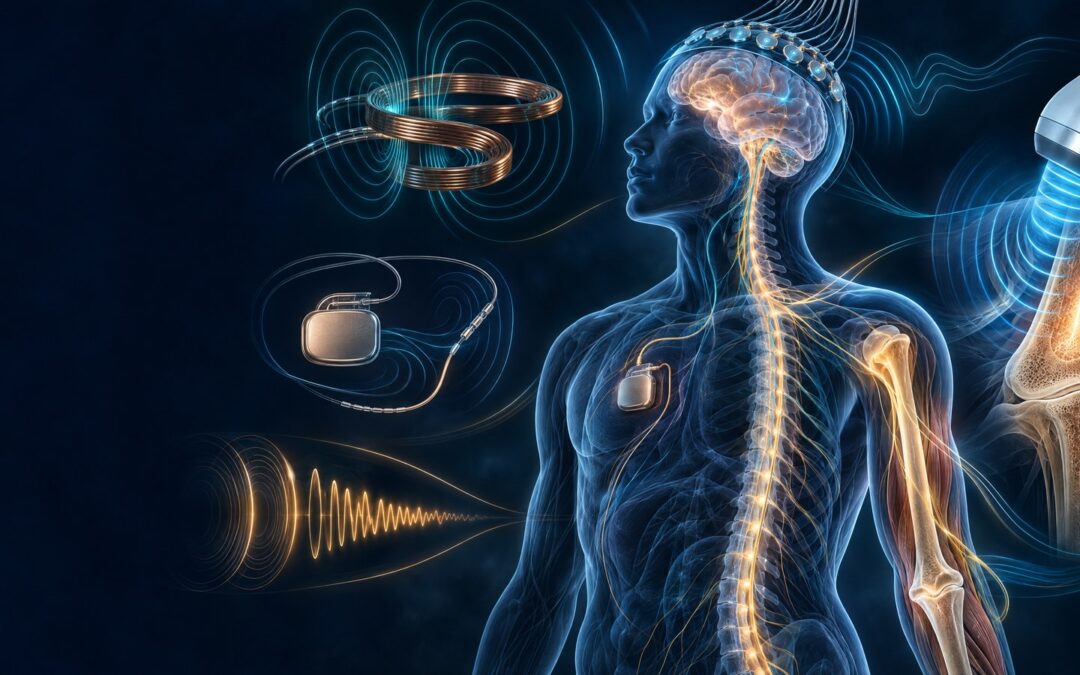
They say frequency healing is not real. Then explain these six FDA-authorized medical devices.
The challenge has a powerful factual core. Magnetic pulses are used in depression care. Implanted electrical stimulation is used for selected chronic pain conditions. Alternating electric fields are used in glioblastoma treatment. Pulsed ultrasound and electromagnetic bone stimulators have their own histories in fracture care. These are real medical technologies, not simply interesting numbers on a frequency chart.
The most revealing detail is what each number actually describes. Ten pulses per second, fifteen bursts per second and a 1.5-megahertz acoustic carrier are different engineering parameters. Their biological meaning comes from how a particular device delivers energy to a particular target. The authorization belongs to that device and its indication, not to the frequency independently.
Quick answer: Frequency medicine, used here as a shorthand for precisely controlled electrical, magnetic and acoustic medical interventions, deserves serious attention. These six examples establish specific clinical applications. They do not establish that playing the same number through an app, headphones, a haptic vest or a consumer coil reproduces those treatments. Understanding that distinction makes the science more compelling, not less.[1]
Six devices that turn physical signals into medical interventions
Here is the corrected record behind the social-media list. The dates identify the original authorizations discussed below, not every later indication or current model. The frequency column is deliberately specific about what repeats.
| Device and medical application | Headline frequency and its role | Verified original FDA milestone |
|---|---|---|
| NeuroStar TMS Adult major depressive disorder after an inadequate response to a prior antidepressant |
10 Hz Magnetic pulse repetition in the original protocol |
Device-type De Novo classification, October 7, 2008; marketed-system 510(k) clearance, December 16, 2008.[2] [3] |
| Bio Osteogen System 204 / EBI lineage PEMF bone-growth stimulation in established nonunion care |
15 Hz Burst repetition in the documented EBI waveform |
PMA approval, November 6, 1979, P790002.[6] [7] [8] |
| Senza HF10 spinal cord stimulation Selected chronic intractable trunk or limb pain |
10,000 Hz Electrical stimulation pulse repetition in implanted HF10 mode |
PMA approval, May 8, 2015, P130022. Painful diabetic neuropathy was added in July 2021.[9] [12] |
| NovoTTF-100A / Optune Glioblastoma tumor treating fields |
200,000 Hz Alternating electric-field frequency for GBM |
PMA approval, April 8, 2011, for recurrent GBM. Newly diagnosed combination use followed in 2015.[13] [15] |
| Sonic Accelerated Fracture Healing System / EXOGEN Specific fracture and nonunion indications |
1,500,000 Hz Acoustic carrier frequency, not burst repetition |
PMA approval, October 5, 1994, P900009. Established nonunions were added in February 2000.[17] [18] |
| Ivivi SofPulse Models 912-M10, Roma3 and Torino II Adjunctive palliative postoperative pain and superficial soft-tissue edema care |
27,120,000 Hz Radiofrequency carrier, not pulse repetition |
510(k) clearance, December 11, 2008, K070541.[21] |
Why the regulatory wording matters: FDA clearance generally refers to a substantial-equivalence determination through 510(k). PMA approval requires evidence supporting reasonable assurance of safety and effectiveness for the intended use. De Novo is a pathway for novel low-to-moderate-risk device types without a suitable predicate. “FDA-authorized” is a useful umbrella term for this article, but these pathways are not interchangeable and do not require identical evidence packages.[1] [28]
1. TMS: a 10 Hz rhythm becomes a targeted brain procedure
Transcranial magnetic stimulation is a clear demonstration that physical signals can have medical applications. A coil produces brief, changing magnetic fields. Those fields induce electrical currents in targeted cortical tissue. In the original NeuroStar depression protocol, the target was the left dorsolateral prefrontal cortex, not the entire brain.[3] [5]
The familiar 10 Hz means ten magnetic pulses per second. It does not describe the shape of a pulse. The original procedure also specified output relative to the patient’s motor threshold, brief trains, pauses between trains and a course of repeated sessions. These details turn a repetition rate into a defined exposure.[5]
The 2008 milestones were an October De Novo classification and a December clearance of the marketed NeuroStar TMS Therapy System. The original indication was adult major depressive disorder after inadequate improvement with one prior antidepressant meeting dose and duration criteria. A 301-person sham-controlled trial reported greater response with active treatment; its week-four primary depression-scale analysis required correction for a baseline symptom-severity imbalance. This was clinical research on that procedure, not on listening to a 10 Hz-labelled recording.[2] [3] [4]
The striking fact: the treatment is calibrated to the person as well as to the signal. Prescription supervision and safety controls matter because the relevant exposure can produce scalp discomfort and carries important risks, including seizure and hearing-related hazards.[2] [5]
2. PEMF bone stimulation: the 1979 history is real, and 15 Hz is only one layer
FDA’s record for P790002 traces the Bio Osteogen System 204, later associated with the EBI Bone Healing System lineage, to November 6, 1979. This is a genuine historical PMA approval for a medical bone-growth stimulator. Its established-nonunion context is very different from a claim that every fracture needs a consumer frequency session.[6] [7]
In the documented EBI waveform, 15 Hz is the burst repetition rate. Each burst contains pulses. Pulse duration, magnetic-field amplitude, burst structure and coil geometry are additional parts of the exposure. Calling the system a “15 Hz device” is a convenient label, but not a complete technical description.[8]
The biological research has investigated how these exposures interact with cell signaling relevant to bone formation. That is an important scientific direction: a physical intervention can influence pathways that cells use during repair. Mechanistic proposals and clinical outcomes still need to be distinguished. FDA’s bone-stimulator review stresses that waveform parameters and device indications cannot be treated as interchangeable.[7]
Published clinical experience includes supportive nonunion findings, but an impressive healing percentage from an uncontrolled, manufacturer-funded observational dataset is not a randomized treatment effect. The useful conclusion is that prescription PEMF bone stimulation has a substantial medical history and device-specific evidence, not that one number guarantees bone union. The later reclassification date now displayed in the FDA database does not change the original 1979 approval date.[6] [8]
3. Senza: 10,000 Hz can be delivered without the usual stimulation tingling
Senza received PMA approval on May 8, 2015 for specified chronic intractable pain of the trunk or limbs, including pain associated with failed back surgery syndrome, intractable low-back pain and leg pain. The painful diabetic neuropathy expansion came later, in July 2021. Keeping those dates separate prevents a real achievement from becoming an inaccurate historical claim.[9] [12]
This is implanted electrical spinal cord stimulation. An implanted pulse generator delivers pulses through epidural leads. In HF10 mode, the rate is 10,000 stimulation pulses per second. Pulse width, current, lead positioning and programming are part of the intervention. A recording, a skin-level vibration and a consumer magnetic coil do not reproduce that exposure.[10]
One especially interesting feature is paresthesia-free therapy: the high-frequency mode can be used without the tingling sensation associated with conventional stimulation. In SENZA-RCT, 198 people were randomized and 171 received permanent implants. Reported three-month responder rates were higher with HF10 than with traditional spinal cord stimulation. That was an active-device comparison, not a sham comparison, and implantation carries surgical, infection and hardware risks.[10] [11]
The practical scientific lesson: sensation is not a reliable measure of therapeutic dosing. Not feeling a stimulus does not make it inactive, and feeling a stronger stimulus does not establish that it is more effective. The clinical meaning comes from the device, programming and outcome evidence.
4. Optune: electric fields can act on cell division, but the treatment is not a “cancer tone”
The original NovoTTF-100A system received PMA approval on April 8, 2011 for recurrent supratentorial glioblastoma in adults aged 22 or older under a defined clinical indication. The later Optune expansion in October 2015 added newly diagnosed GBM use with temozolomide after surgery and radiation. These are different treatment settings.[13] [15]
For GBM, the preset frequency is 200 kHz, or 200,000 Hz. Electrically insulated scalp arrays deliver alternating electric fields, with field directions applied sequentially. FDA’s description discusses interference with mitotic processes, including spindle assembly and forces acting during cell division. The relevant mechanism is the interaction of a specified electric field with dividing cells, not hearing a frequency.[14]
The clinical evidence makes a useful distinction. The original recurrent-GBM trial did not demonstrate a statistically significant overall-survival advantage over active chemotherapy. In the later EF-14 newly diagnosed population, adding tumor treating fields to maintenance temozolomide was associated with median overall survival of 20.9 months versus 16.0 months with maintenance temozolomide alone, measured from randomization. Those results belong to that combination, study population and delivery system.[14] [16]
That is a remarkable example of medicine combining physical and chemical interventions. It is also why a glioblastoma-labelled wellness programme must not be presented as an alternative to oncology care or as an equivalent source of tumor treating fields. Scalp reactions and exact-device contraindications remain relevant to the medical system.[14] [15]
5. EXOGEN: 1.5 million cycles per second is ultrasound, not PEMF
The Sonic Accelerated Fracture Healing System Model 2A, associated with the later EXOGEN system, received PMA approval on October 5, 1994. The original indication concerned specified fresh distal-radius and tibial-diaphysis fractures in skeletally mature individuals managed by closed reduction and casting. A February 2000 supplement added established nonunions, excluding skull and vertebra.[17] [18]
The 1.5 MHz value is an acoustic carrier frequency. The carrier occurs within short ultrasound bursts, which repeat at approximately 1 kHz. Those two numbers describe different layers of the same exposure. Ultrasound is a mechanical acoustic modality, not an electromagnetic field and not an ordinary headphone sound.[18]
The evidence also shows why patient selection matters. Early randomized-study summaries reported accelerated healing in the studied fracture settings. The later 501-person TRUST trial found no improvement in radiographic healing or functional recovery in operatively managed tibial fractures. That operative population differed from the original cast-managed indications. An authorization is not a promise of benefit across every fracture or method of treatment.[19] [20]
The surprising detail: a device can have a megahertz carrier and a much slower burst rhythm at the same time. A one-column frequency chart hides the structure that actually defines its output.
6. SofPulse: 27.12 MHz is a radiofrequency carrier inside a pulsed exposure
The precise 2008 example is Ivivi SofPulse Models 912-M10, Roma3 and Torino II, cleared through K070541 on December 11, 2008. The indication was adjunctive palliative treatment of postoperative pain and edema in superficial soft tissue. This was a 510(k) substantial-equivalence clearance, not a PMA approval, and earlier related models have their own histories.[21]
27.12 MHz is the RF carrier. The carrier oscillates inside a pulsed exposure; it is not the number of treatment bursts per second. The FDA summary also specifies duty cycle and inductive delivery through an applicator. Current regulation requires characterization of output parameters such as pulse width, modulation and deposited energy. The carrier alone cannot define the treatment.[21] [22]
The intended category is nonthermal shortwave therapy, meaning treatment by means other than generation of deep heat. That is a technical distinction, not a statement that RF exposure is automatically safe near every implant or conductive object. Exact-model instructions and postoperative clinical guidance remain essential.[22]
Human pulsed-RF research spans different devices and applications, and evidence quality varies. The 2008 clearance should not be converted into an unsupported promise of tissue regeneration, universal inflammation reduction or exact-model randomized efficacy. Its defensible significance is a specific, authorized adjunctive physical-signal intervention.[21] [23]
The real breakthrough is the complete exposure, not the largest number
These technologies are not arranged on a ladder where higher frequency means greater healing power. They work through different delivery routes and have been studied against different outcomes. A depression response, fracture union, pain response and cancer-survival endpoint cannot be ranked as if they measured the same thing.

Three questions immediately improve a frequency claim. What repeats? A pulse, a burst or a carrier cycle? What reaches the tissue? A magnetic field, injected electrical current, an alternating electric field or ultrasound? What was measured? A clinical outcome in a defined population, or only an engineering output?

What this means for the PEMF Healing Platform
The meaningful opportunity for a consumer platform is to help readers explore structured programmes, understand their intended themes and build a repeatable personal routine. PEMF Healing Platform offers topic-organized catalogue entries, including phase-labelled and haptic programmes. The exact examples below let you follow a subject from the article into the platform without mistaking a matching topic for a matching medical intervention.[24]
That is a useful distinction from thinking of a programme as one isolated number. A named, structured experience can provide a clearer starting point for exploration than a generic frequency list. The platform’s design and organizational role can be discussed on their own merits; clinical claims would require trials of the exact programme and hardware.
Repetitive signals are not automatically obsolete. Several medical successes above use highly repetitive, precisely specified exposures. These cases do not support a claim that static signals inevitably become ineffective, that cellular adaptation defeats every fixed protocol, or that a phase-based wellness programme has solved that problem. Phasing and variation are design choices whose clinical value must be tested, not assumed from novelty.[5] [8] [10]
Topic-matched programmes: explore the subject, do not substitute the treatment
These are thematic catalogue matches, not equivalent FDA-authorized treatments. Names containing a disease, “repair,” “recovery” or “HF-SCS” are the platform’s exact programme titles. They do not establish that a recording or consumer device diagnoses, treats or changes that disease.
| Medical subject | Exact PEMF Healing programme | How to interpret the link |
|---|---|---|
| Depression / TMS | Depression and Feeling Lost | A mood-themed catalogue entry, not a TMS protocol or substitute for mental-health care. |
| PEMF bone stimulation | Bone Growth & Regeneration | A bone-themed resource. The title does not establish fracture union or equivalence to a prescribed bone stimulator. |
| Chronic pain / implanted SCS | Chronic 7-Phase Back Leg & Diabetic Neuropathy HF-SCS Bilateral-Phase Energetics | A haptic-programme title with a clinical research theme, not implanted epidural stimulation. |
| Glioblastoma / Optune | Binaural Glioblastoma Multiforme (GBM) Cancer 115 X Advanced Energetics | The requested tumour-topic match. This entry does not establish antitumour activity and is not Optune or an alternative to oncology treatment. |
| Ultrasound fracture care | Bone Growth & Regeneration | The shared bone topic does not make the programme low-intensity pulsed ultrasound. |
| Postoperative / pulsed-RF context | After Surgery, Post-Operative Recovery Haptic Energetics | A haptic-labelled resource, not a 27.12 MHz medical RF exposure or postoperative-care prescription. |
Two additional related entries are Osteoporosis Bone Repair Energetics and Nerve Disorder Energetics. Osteoporosis is not the same diagnosis as a fracture nonunion, and a nerve-themed title is not a diagnostic assessment.
For the separate general-wellness orientation below, use Muscle Relaxation Energetics as the primary, with Deep Stillness – Submerged Calm Haptic Energetics and Sleep Energetics as companions. These three entries complete the ten-programme menu.
Three days of practical exploration, separate from medical treatment
This is an optional general-wellness observation, not a home version of the six medical procedures. Its goal is to learn whether you find a short, consistent routine comfortable and usable. The times are editorial limits for programme excerpts, not clinically validated doses or the programmes’ verified native runtimes. Detailed programme content is subscriber-gated; do not assume that a ten-minute excerpt includes an entire sequence.
If you have a fracture, recent surgery, active cancer treatment, an implanted electronic device, pregnancy or another relevant medical concern, ask your care team and the device manufacturer about suitability before adding a coil or haptic layer. The audio-only option does not override your clinical team’s advice.
- Choose one route. Start with low-volume audio while seated and awake. If choosing a compatible iTorus route instead, follow the current manufacturer-supported wired connection, adapter and output instructions. Do not set the output by copying a medical-device frequency or by increasing volume until you feel an effect.
- Set the environment. Use the same chair and roughly the same time each day. Keep the phone accessible so you can stop playback. For the i2 example, the current product description supports a desk or bedside placement beside the user. Set it on a stable side table beside your chair, rather than placing it at a fracture, incision, tumour or implant in pursuit of a clinical effect.[25]
- Run the primary first. Use the same short excerpt of the exact linked primary each day. If it ends sooner, let it finish. Do not accelerate it, loop it or add a disease-themed programme to seek a stronger response.
- Separate the companions. Pause for ten quiet minutes. If using a coil, disconnect it before the optional audio-only companions. Keep stereo playback intact when a programme requires it, and keep the listening level comfortable.
- Record, do not diagnose. Note comfort before and after, whether any symptom occurred, and whether the routine was easy to follow. Personal comfort ratings do not establish fracture healing, nerve recovery, tumour response or antidepressant efficacy.
| Day | Primary first | After a 10-minute quiet gap | After another 10-minute quiet gap | What to record |
|---|---|---|---|---|
| Day 1: learn the setup | Muscle Relaxation Energetics Up to 10 minutes, audio or a manufacturer-permitted compatible coil setup |
Deep Stillness – Submerged Calm Haptic Energetics Up to 5 minutes, audio only |
Sleep Energetics Up to 5 minutes, audio only |
Connection method, starting comfort, ending comfort and any reason to stop |
| Day 2: repeat, do not intensify | Muscle Relaxation Energetics Up to 10 minutes, the same route and supported settings |
Deep Stillness – Submerged Calm Haptic Energetics Up to 5 minutes, audio only |
Sleep Energetics Up to 5 minutes, audio only |
Whether the same setup was comfortable, plus sleep, stress or other changes that day |
| Day 3: review usability | Muscle Relaxation Energetics Up to 10 minutes, unchanged |
Deep Stillness – Submerged Calm Haptic Energetics Up to 5 minutes, audio only |
Sleep Energetics Up to 5 minutes, audio only |
What you liked, what you would omit and whether the routine fits your day |
The complete optional session contains up to 20 minutes of playback and 40 minutes including quiet gaps. You may omit either companion or stop sooner. After day three, review the log rather than automatically adding time or devices. There is no established disease-treatment course or required repetition cycle for this editorial orientation.
A useful log is one line per day: date | route | supported settings | minutes | comfort before/after | unexpected symptoms | sleep/stress context. Three days without a sham comparison cannot establish a causal effect; their value is learning about tolerability, consistency and personal preference.
Sound, haptics and consumer coils have different practical roles
Think of these as distinct delivery choices, not interchangeable ways to administer the six medical treatments. A haptic wearable provides mechanical vibration. A compatible consumer coil provides its own device-specific electromagnetic output. Audio is a listening exposure. Combining layers does not automatically create a stronger or clinically superior intervention, and it makes a personal observation harder to interpret.

| Layer | Resource | Practical role in this article |
|---|---|---|
| Platform access | Frequency Healing App and PEMF Healing Platform | Open exact linked programmes and review their available instructions. Access conditions and programme availability may change. |
| Consumer coil | iTorus i2 or iTorus i5 | Optional, only with the manufacturer’s permitted connection, placement and suitability guidance. The i2 off-body example is not a medical target location or measured field dose.[25] |
| Haptic option | Woojer Vest 4 Use code EPEMF10 at checkout. |
A separate vibrotactile experience, not ultrasound, spinal stimulation or tumor treating fields. Keep it outside the initial audio/coil observation and follow manufacturer guidance.[26] |
| Optional ritual layer | Metatronic Flower of Life Dual Frequency Imprinter | Optional personal ritual, not a clinical delivery route. Marketing about imprinting does not establish that water acquires the medical action of any device.[27] |
Affiliate disclosure: Some resource links may earn PEMF Magazine a commission, at no additional cost to you. They are consumer-wellness resources and do not carry the medical authorizations discussed above. Confirm current prices, discounts and suitability with the seller.
Best practices: make the observation simple and keep care intact
Use one route at a time, keep settings unchanged and do not interpret a stronger sensation as a better result. Sit comfortably, remain awake, keep your normal sleep and hydration routine, and avoid adding multiple new supplements or devices during the same observation. Stop if you experience discomfort or an unexpected symptom.
If you use the optional imprinter, keep it separate from the three-day log. Follow its connection and care instructions, use a clean closed container if water is involved, and keep liquids away from electronics. Treat the activity as a ritual, not a method for making medicine, transferring a substance’s pharmacology or replacing prescribed care. No added fluid intake or supplement is required.[27]
Implant compatibility cannot be judged from a frequency number. FDA has warned that magnets in some consumer electronics can interfere with certain implanted devices. That warning does not provide a universal safe-use distance or permission for an iTorus setup; your implant team’s and the exact device manufacturer’s guidance must control.[29]
For cancer, nonunion fractures, significant nerve pain or postoperative symptoms, keep diagnosis, treatment and follow-up with licensed clinicians. Do not copy clinical stimulation settings into an app or use DIY flashing light, electrical stimulation, ultrasound or RF hardware to imitate these systems. If you are in an emotional crisis or having thoughts of suicide, call or text 988 in the United States; in a life-threatening situation, call 911 or your local emergency service.[30]
Educational and wellness disclaimer: This article explains device-specific medical research and an optional general-wellness orientation. It does not provide diagnosis or medical treatment. FDA authorizations apply to the named devices and indications, not frequencies independently. The PEMF Healing App, its programmes and consumer-wellness hardware are not equivalent to these authorized medical systems. Do not delay or replace clinical care, and follow every device’s current manufacturer instructions.
Physical-signal medicine deserves better than a magic-number debate
The six-device story is strongest when told accurately. Modern medicine already uses electrical, magnetic and acoustic interventions. Their value is not that they have impressive-looking frequency numbers, but that their exposures can be specified, tested and applied to defined clinical problems.
That is the genuinely exciting direction: understanding how a controlled physical input interacts with tissue and then measuring the result. A consumer platform can make the wider subject more accessible through organized programmes and practical personal routines. The next step for a medical claim, however, is evidence for the actual intervention. The future is not “chemical versus frequency.” It is choosing and combining the right interventions, with the right evidence, for the right person.
Related Articles
- 10,000 Hz Nerve Pain Research: FDA-Approved Implanted SCS
- Bone Repair & Osteogenic Support: A 5-Phase Research Guide
- Cellular Regulation: PEMF Healing vs Other Frequency Apps
References
- U.S. Food and Drug Administration. Device Approvals and Clearances. Regulatory pathway definitions. Direct source.
- U.S. Food and Drug Administration. NeuroStar TMS System, De Novo DEN070003. October 7, 2008 classification record. Direct source.
- U.S. Food and Drug Administration. NeuroStar TMS Therapy System, K083538. December 16, 2008 clearance letter and summary. Direct source.
- O’Reardon JP and colleagues. (2007). Efficacy and safety of transcranial magnetic stimulation in the acute treatment of major depression: a multisite randomized controlled trial. Biological Psychiatry. Direct source.
- Horvath JC and colleagues. (2010). The NeuroStar TMS Device: Conducting the FDA Approved Protocol for Treatment of Depression. Journal of Visualized Experiments. The source title uses “Approved”; the FDA pathway terminology is clarified in the article. Direct source.
- U.S. Food and Drug Administration. Bio Osteogen / EBI Bone Healing System, PMA P790002. Original approval November 6, 1979. Direct source.
- U.S. Food and Drug Administration. (2020). Executive Summary: Non-Invasive Bone Growth Stimulators. Regulatory history, indications, engineering, evidence and risks. Direct source.
- Murray HB and Pethica BA. (2016). A follow-up study of the in-practice results of pulsed electromagnetic field therapy in the management of nonunion fractures. Orthopedic Research and Reviews. EBI waveform description and observational outcomes. Direct source.
- U.S. Food and Drug Administration. Senza Spinal Cord Stimulation System, PMA P130022. May 8, 2015 original approval and indication. Direct source.
- U.S. Food and Drug Administration. (2015). Senza System Summary of Safety and Effectiveness Data. Device output, clinical study and implant risks. Direct source.
- Kapural L and colleagues. (2015). Novel 10-kHz High-frequency Therapy (HF10 Therapy) Is Superior to Traditional Low-frequency Spinal Cord Stimulation for the Treatment of Chronic Back and Leg Pain: The SENZA-RCT Randomized Controlled Trial. Anesthesiology. Direct source.
- U.S. Food and Drug Administration. (2021). Senza PMA supplement P130022/S039. Painful diabetic neuropathy indication expansion. Direct source.
- U.S. Food and Drug Administration. NovoTTF-100A Treatment Kit, PMA P100034. April 8, 2011 recurrent-GBM approval. Direct source.
- U.S. Food and Drug Administration. (2011). NovoTTF-100A Summary of Safety and Effectiveness Data. Field delivery, recurrent-GBM trial and safety. Direct source.
- U.S. Food and Drug Administration. Optune PMA supplement P100034/S013. October 5, 2015 newly diagnosed GBM combination-therapy expansion. Direct source.
- Stupp R and colleagues. (2017). Effect of Tumor-Treating Fields Plus Maintenance Temozolomide vs Maintenance Temozolomide Alone on Survival in Patients With Glioblastoma: A Randomized Clinical Trial. JAMA. Direct source.
- U.S. Food and Drug Administration. Sonic Accelerated Fracture Healing System Model 2A, PMA P900009. Original approval October 5, 1994. Direct source.
- U.S. Food and Drug Administration. (2022). AccelStim Bone Growth Stimulator, P210035, Summary of Safety and Effectiveness Data. Later FDA document reproducing EXOGEN reference specifications and historical indications. Direct source.
- Busse JW and colleagues. (2016). Re-evaluation of low intensity pulsed ultrasound in treatment of tibial fractures (TRUST): randomized clinical trial. BMJ. Direct source.
- Warden SJ and colleagues. (2000). Acceleration of fresh fracture repair using the sonic accelerated fracture healing system (SAFHS): a review. Calcified Tissue International. Direct source.
- U.S. Food and Drug Administration. Ivivi SofPulse Models 912-M10, Roma3 and Torino II, K070541. December 11, 2008 clearance letter and summary. Direct source.
- Electronic Code of Federal Regulations. 21 CFR 890.5290: Shortwave diathermy and nonthermal shortwave therapy. Device definition, indication and special controls. Direct source.
- Guo L and colleagues. (2011). Pulsed radio frequency energy (PRFE) use in human medical applications. Electromagnetic Biology and Medicine. Direct source.
- PEMF Healing Platform. Public platform and programme catalogue. Programme organization and access, not independent clinical evidence. Individual exact programme links appear in the resource section. Direct source.
- iPyramids. C60 Shungite iTorus i2 product information. Manufacturer’s basic connection and beside-user placement context, not evidence of a medical effect. Direct source.
- Woojer. Vest 4 product information. Vibrotactile hardware description, not medical evidence. Direct source.
- Sacred Ritual Oils. Metatronic Flower of Life Dual Frequency Imprinter. Manufacturer instructions and care information; marketed energetic claims are not adopted as clinical findings. Direct source.
- U.S. Food and Drug Administration. De Novo Classification Request. Explanation of the novel-device authorization pathway. Direct source.
- U.S. Food and Drug Administration. (2021). Magnets in Cell Phones and Smart Watches May Affect Pacemakers and Other Implanted Medical Devices. Interference warning, not consumer-coil authorization. Direct source.
- National Institute of Mental Health. Suicide Prevention. U.S. crisis-support and emergency guidance. Direct source.