BEYOND PEPTIDES: The Bioelectric TB-500 Signal — How to Trigger 14-Phase Tissue Regeneration & Wound Healing Without Injections
This surgical breakdown explores the 14-Phase Advanced Energetics Protocol, a complete frequency map of the TB-500 molecule. By translating the peptide’s molecular resonance into precise electromagnetic and haptic signals, we can now influence the same regenerative pathways—actin sequestering, angiogenesis, and stem cell homing—that were previously only accessible through exogenous administration.
The End of the Rife Era: Why Static Frequencies Fail
For decades, frequency therapy was dominated by “Rife” lists—static, single-tone frequencies aimed at “killing” pathogens or “treating” organs. In the context of complex tissue regeneration, this approach is fundamentally flawed. Biological repair is a sequential cascade, not a single event. A static tone cannot guide a cell through the 14 distinct biochemical transitions required for full structural integration.
The Smooth Sail Protocol moves beyond the Rife era by using Dynamic Frequency Architecture. Instead of a repeating tone, we use a shifting molecular chord that follows the actual amino acid sequence of the TB-500 peptide. This “bio-narrative” prevents cellular adaptation and ensures that the signal remains high-fidelity throughout the entire 123-minute session.
Metabolic Activation: Signaling, Not Attacking
When we talk about bioelectric TB-500, we are not “attacking” an injury. We are signaling the body to do what it was designed to do: repair. The mechanism at work is Actin Dynamics. TB-500 works by sequestering G-actin (globular actin) and making it available for polymerization into F-actin (filamentous actin). This is the literal “engine” of cell movement.
What bioelectric research suggests is that cellular membrane potential and voltage gradients across the injury site play a regulatory role in whether cells remain stagnant or migrate toward the wound. By speaking the electrical language of the cell, we influence these pathways through precise electromagnetic input, essentially “unlocking” the regenerative potential already stored within your own tissues [1].
The 14-Phase Regenerative Cascade: A Surgical Deep-Dive
This protocol is built on the Complete Molecular Frequency Architecture of Thymosin Beta-4. Unlike previous versions, this ultimate program corrects historical errors and adds missing pathways like the Thymus-Immune axis and Nuclear Signaling.
Phase 1-3: Field Preparation & Anti-Fibrotic Clearing
We begin with Cellular Priming (Phase 1) using Schumann anchoring (7.83 Hz) and ATP charging (130.25 Hz). This is followed by the Complete Molecular Signature (Phase 2), an “electromagnetic autobiography” of all 10 confirmed amino acids in the TB-500 chain. Phase 3 (SDKP Domain) targets the N-terminal tetrapeptide (Ser-Asp-Lys-Pro), which is specifically responsible for anti-fibrotic clearing—preventing scar tissue before the repair begins [2].
Phase 4-7: Structural Foundation & The LKETS Core
Phase 4 establishes the Structural Backbone using Lysine (188.22 Hz) as the master carrier. Phase 5 (BCAA Matrix) focuses on muscle repair via Leucine and Isoleucine (177.05 Hz). Phase 6 (Glycine Bridge) activates collagen synthesis pathways. This culminates in Phase 7: The LKETS Core. This is the “healing key”—the specific actin-binding domain that drives cell migration and wound closure [3].
Phase 8-10: Vascular & Nuclear Signaling
Phase 8 (Angiogenesis) uses Copper cofactors (202.41 Hz) to stimulate new blood vessel formation. Phase 9 (Thymus-Immune Axis) maturate T-cells, leveraging TB-500’s origins as a thymic peptide. Phase 10 (Nuclear Signaling) targets gene expression, using Lysine’s role in histone modification to “unlock” regenerative genes at the epigenetic level.
Phase 11-14: Tissue Resurrection & Coherence Lock
The final phases focus on Inflammation Resolution (Phase 11), Cardiac & Muscle Regeneration (Phase 12), and Joint Architecture (Phase 13) using a “Collagen Trifecta” of Proline, Glycine, and Lysine. The session concludes with Phase 14: Stem Cell Homing, using a golden ratio (1.618 Hz) unwinding to lock in the regenerative signal and return the body to a state of coherence.
Visualizing the Cascade: The 14-Phase Neural & Tissue Resonance
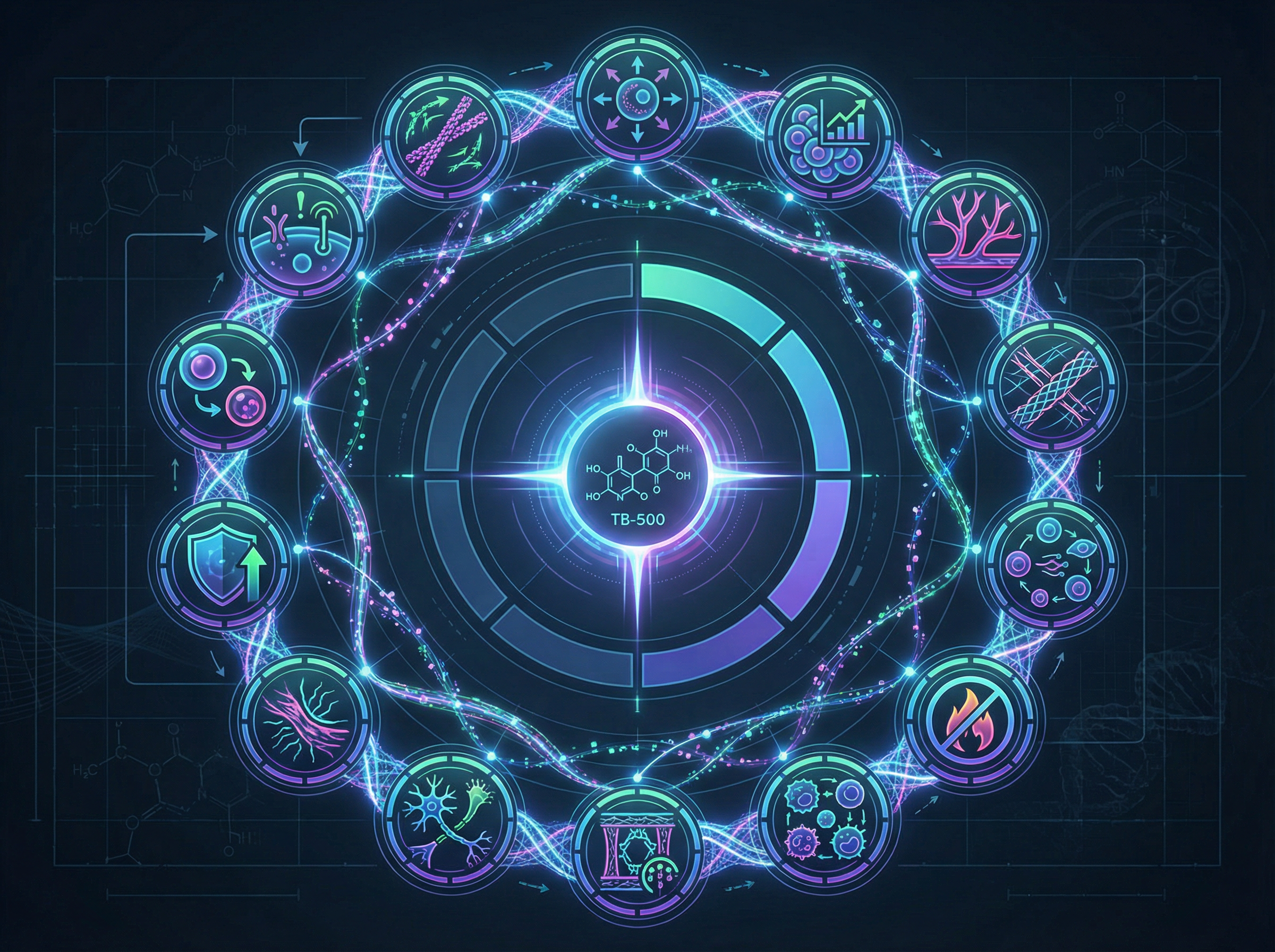
Scientific visualization of the TB-500 frequency architecture, showing the transition from N-terminal anti-fibrotic clearing to C-terminal structural integration.
PEMF Program Recommendations
For the best results, use the following programs from the PEMF Healing App. These are real, high-fidelity signals designed for the hardware listed below.
| Program Name | Target Function | Link |
|---|---|---|
| TB-500 Thymosin Beta-4 (14-Phase) | Complete Tissue & Wound Regeneration | View Program |
| Mitochondrial Support & ATP | Phase 1: Cellular Energy Priming | View Program |
| Collagen Matrix & Joint Support | Phase 6 & 13: Structural Locking | View Program |
| Stem Cell Homing & Integration | Phase 14: Final Coherence Lock | View Program |
30-Day Roadmap: The Tissue Resurrection Protocol
Consistency is the key to structural change. Follow this day-by-day protocol for maximum regenerative impact.
| Phase | Days | Daily Protocol |
|---|---|---|
| Phase 1: Priming | 1 – 7 | Breath Lab + Mitochondrial Support (Morning). TB-500 Protocol (Evening). |
| Phase 2: Reset | 8 – 21 | Breath Lab + TB-500 Protocol (Daily). Focus on iTorus placement directly on the injury site. |
| Phase 3: Lock | 22 – 30 | TB-500 Protocol + Collagen Support. Add post-session movement (light stretching) to lock in structural changes. |
Affiliate Device Protocols: How to Apply the Signal
iTorus i2 / i5 Coils
Placement: Place the coil directly over the site of injury or inflammation. For systemic regeneration, place over the thymus (upper chest) during Phase 9.
iMprinter
Molecular Loading: Use the iMprinter to load the TB-500 frequency signature into water or a topical gel. Apply the gel to the injury site immediately after the PEMF session.
Full Body Integration: Use the mat for Phase 14 (Stem Cell Homing) to allow the regenerative signal to distribute across the entire vascular and lymphatic system.
Woojer Vest / Haptics
Fascial Resonance: The 14-phase program is haptic-compatible. The mechanical vibration helps “shake” the G-actin monomers loose within the fascia, speeding up Phase 3 and 7. Use code EPEMF10 for a discount.
References
- Young, J. D. (2014). The bioelectric code: An ancient computational medium for dynamic control of growth and form. Bioessays, 36(8), 754-765.
- Crockford, D. (2019). Thymosin Beta 4 (TB-500) and its N-terminal tetrapeptide Ac-SDKP in tissue protection and repair. Frontiers in pharmacology, 10, 893.
- Goldstein, A. L., Hannappel, E., & Kleinman, H. K. (1982). Thymosin β4: a new molecular mechanism for the regulation of actin polymerization. Journal of Biological Chemistry, 257(18), 10757-10760.
For advanced users seeking a more powerful spiral geometry, the Archimedean Tesla Spiral Frequency Imprinter delivers an intensified toroidal field imprint using sacred geometric coil winding for deeper water structuring and enhanced bioelectric coherence.