
Can Birdsong Interact With Your Body? The Science of Acoustic Vagal Toning
You step outside into a quiet forest. A robin begins to sing, and almost immediately, your shoulders drop. Your breathing slows. The low-grade hum of anxiety that you didn’t even realize you were carrying suddenly dissipates. This is not just a psychological preference for nature — it is a profound, hardwired bioacoustic response. The human nervous system has evolved over millions of years to recognize the specific frequency spectrum of birdsong as the ultimate biological “all-clear” signal.
While modern life floods our auditory processing centers with the low-frequency rumble of traffic, the harsh dissonance of construction, and the unnatural hum of appliances, natural soundscapes do the exact opposite. Birdsong, in particular, acts as a precise acoustic trigger that interacts directly with the vagus nerve, forcing the autonomic nervous system out of sympathetic dominance (fight-or-flight) and into a state of deep parasympathetic restoration.
But how does a sound wave in the air translate into a physiological shift in the body? The answer lies in the intersection of evolutionary biology, cochlear mechanics, and the Polyvagal Theory.
The Polyvagal Theory: Why Your Brain Scans for Birds
To understand why birdsong is so powerful, we must look at Dr. Stephen Porges’ Polyvagal Theory. The theory introduces the concept of neuroception — the nervous system’s subconscious, continuous scanning of the environment for cues of safety or danger [1].
When you are in an environment where birds are singing, your nervous system registers a profound evolutionary truth: birds do not sing when a predator is hunting. They sing when the environment is safe. For early humans, the sudden cessation of birdsong (the “predator silence”) was a life-saving cue to activate the sympathetic nervous system and prepare to run. Conversely, the return of the dawn chorus signaled that the threat had passed.

Today, our nervous systems still operate on this ancient software. When the auditory cortex processes the complex, melodic, and rhythmic patterns of birdsong, it sends an immediate inhibitory signal to the amygdala (the brain’s fear center). The amygdala quiets down, cortisol production drops, and the ventral vagal complex is activated, allowing the body to enter a state of social engagement and deep rest [2].
The Anatomy of Acoustic Healing: The 1,000–8,000 Hz Sweet Spot
The magic of birdsong is not just in what it represents, but in its physical frequency structure. Most bird calls fall within the 1,000 Hz to 8,000 Hz range [3]. This is not a coincidence; it is exactly the frequency band that the human ear is most sensitive to, as it overlaps perfectly with the frequencies of human speech.
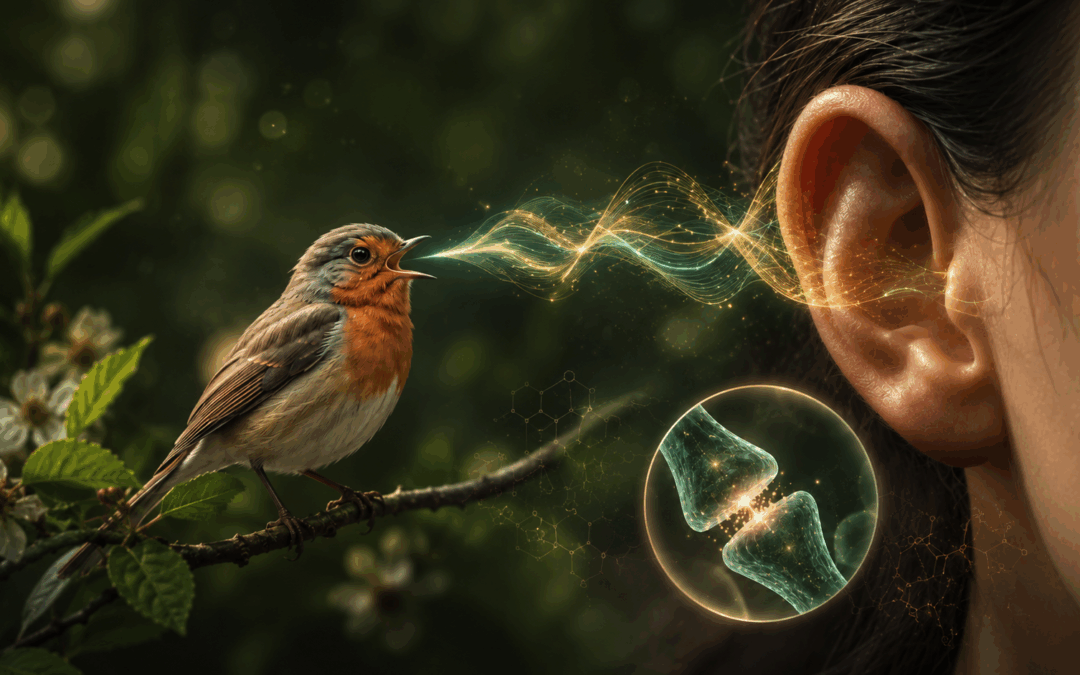
When a bird sings, the sound waves enter the ear canal and strike the tympanic membrane. The vibration is transferred through the ossicles to the cochlea in the inner ear. Because the cochlea is tonotopically organized (different sections respond to different frequencies), the 1,000–8,000 Hz range stimulates a very specific, highly dense region of hair cells.

This stimulation travels up the auditory nerve to the inferior colliculus, and then to the auditory cortex. Crucially, the auditory pathways have direct neural projections to the Nucleus Tractus Solitarius (NTS) in the brainstem — the primary sensory nucleus of the vagus nerve. By stimulating this pathway with the specific frequency patterns of birdsong, we are essentially giving the vagus nerve an acoustic massage, increasing vagal tone and driving Heart Rate Variability (HRV) coherence [4].
Attention Restoration and Cognitive Refresh
Beyond the autonomic nervous system, birdsong has a profound impact on cognitive fatigue. According to the Attention Restoration Theory (ART), modern urban environments require “directed attention” — the exhausting effort of focusing on tasks while actively ignoring distractions (like traffic or notifications) [5].
Natural soundscapes, and birdsong in particular, invoke “soft fascination.” They capture our attention effortlessly, without requiring cognitive strain. This allows the brain’s directed attention mechanisms to rest and replenish. Studies have shown that listening to birdsong for just 6 to 15 minutes can significantly reduce feelings of anxiety, depression, and paranoia, while simultaneously improving cognitive clarity and mood [6].

The higher harmonic frequencies of birdsong (4,000–8,000 Hz) act as a natural stimulant for the brain, promoting Alpha (8–14 Hz) and low Beta (14–30 Hz) brainwave states. This creates a state of “calm alertness” — the exact opposite of the wired, exhausted state caused by caffeine and chronic stress.
Day-by-Day Protocol: Reconnecting to Natural Resonance
You don’t need to live in a forest to harness the biological power of natural frequencies. By integrating specific ePEMF programs that utilize natural soundscapes and vagal toning frequencies, you can artificially recreate the neuroceptive cues of safety in your own home.
Day One: Vagal Reset & Safety Signaling
Begin by establishing a baseline of safety. Run the 584 Hz Nogier, Nerve, Digestion, Respiration, Urinary System, Hearing Energetics program. This targets the physical nerve pathways. Follow it with the 528Hz Meditation Healing Deep Binaural – With Nature Sounds to provide the acoustic cues of environmental safety.
Day Two: Stress Release & Cognitive Restoration
Once the nervous system feels safe, it can begin to release stored tension. Use the 2336 Hz Nogier, Brain, Stress Regulation, Mental Clarity, Emotional Stability Energetics program to clear sympathetic charge. Pair this with the 444Hz Relaxation ASMR Meditation, Handpan with Water Soundscape to invoke soft fascination and cognitive rest.
Day Three: Deep Detox & Cellular Repair
With the body in a parasympathetic state, deep healing can occur. Run the Cellular communication – Rejuvenation program to support systemic clearing and metabolic waste removal. Finish the day with the 2.78Hz Delta Deep Sleep program to ensure the glymphatic system flushes the brain overnight.
Best Practices for Acoustic Vagal Toning
To maximize the biological impact of natural soundscapes and frequency programs, follow these hardware guidelines:
- Use High-Quality Wired Headphones: To capture the full frequency spectrum of natural sounds (especially the delicate upper harmonics of birdsong), avoid Bluetooth compression. Wired headphones ensure the phase relationship remains intact.
- Stack with the iTorus i2 or iTorus i5: While listening to nature sounds, place the iTorus on your chest. The acoustic signal tells the brain it is safe, while the electromagnetic field directly modulates the heart’s rhythm, creating a powerful top-down and bottom-up coherence loop.
- Feel the Resonance with the Woojer Vest 4: Use code EPEMF10. The vest translates the low-frequency components of the soundscape directly into the fascia, activating vagal afferent fibers through physical mechanoreceptors.
- Imprint Your Water: Use the Metatronic iMprinter or Archimedean iMprinter to structure your drinking water with the 528Hz Nature Sounds program before your session.
The Takeaway
Birdsong is not just pleasant background noise; it is an evolutionary key that unlocks the parasympathetic nervous system. By understanding the bioacoustics of how these frequencies interact with the cochlea, the auditory cortex, and the vagus nerve, we can intentionally use natural soundscapes and engineered frequency programs to biohack our way out of chronic stress and back into our natural state of resonance and healing.
References
[1] Porges, S. W. (2009). The polyvagal theory: new insights into adaptive reactions of the autonomic nervous system. Cleveland Clinic journal of medicine, 76(Suppl 2), S86. https://pmc.ncbi.nlm.nih.gov/articles/PMC9131189/
[2] Stobbe, E., et al. (2022). Birdsongs alleviate anxiety and paranoia in healthy participants. Scientific Reports, 12, 16414. https://pmc.ncbi.nlm.nih.gov/articles/PMC9561536/
[3] The Cornell Lab of Ornithology. (n.d.). Do bird songs have frequencies higher than humans can hear? All About Birds. https://www.allaboutbirds.org/news/do-bird-songs-have-frequencies-higher-than-humans-can-hear/
[4] Jo, H., et al. (2019). Physiological and Psychological Effects of Forest and Urban Sounds Using High-Resolution Sound Sources. International Journal of Environmental Research and Public Health, 16(15), 2649. https://www.mdpi.com/1660-4601/16/15/2649
[5] Kaplan, S. (1995). The restorative benefits of nature: Toward an integrative framework. Journal of Environmental Psychology, 15(3), 169-182.
[6] National Geographic. (2022). Listening to birds sing really does soothe your brain. Here’s why. https://www.nationalgeographic.com/health/article/birds-sing-brain-mental-health