
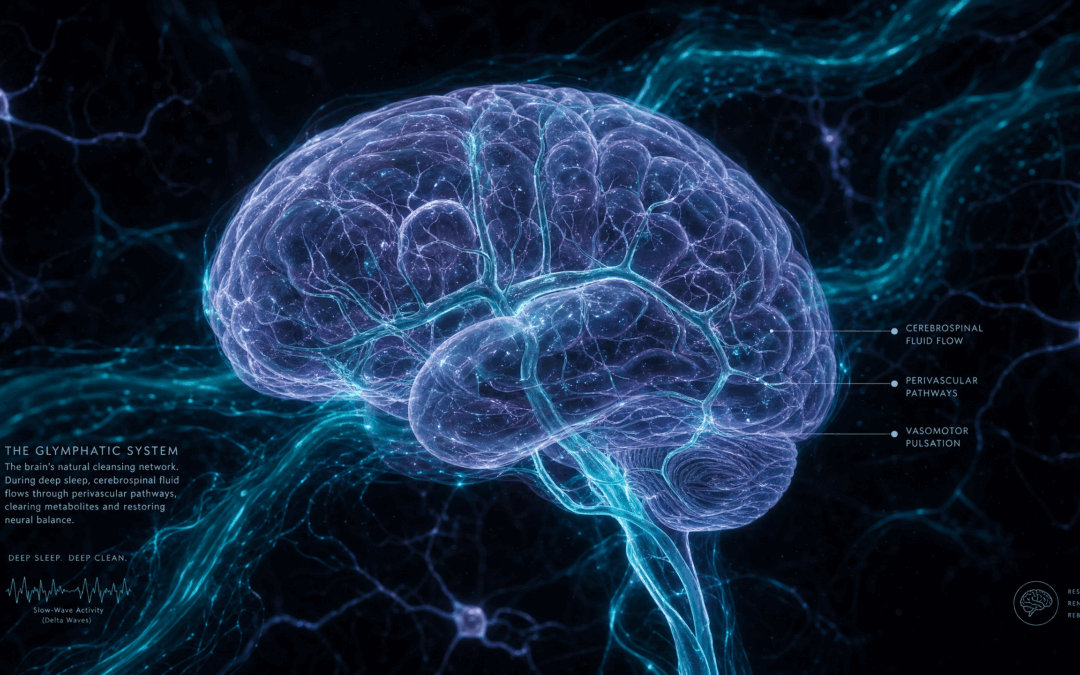
Every night, your brain undergoes a profound, physical transformation. It shrinks slightly, opens microscopic channels, and pumps fluid through its deepest tissues to wash away the toxic metabolic waste accumulated during the day. This is the glymphatic system—the brain’s built-in waste management network [1]. But there is a crisis happening right now: chronic stress, poor sleep architecture, and nervous system dysregulation are shutting this pump down. When the glymphatic system fails, toxins like amyloid-beta and tau proteins build up, leading to brain fog, cognitive decline, and an accelerated path toward neurodegenerative conditions [2].

The Engine of the Pump: Infraslow Vasomotion
For years, science thought the glymphatic pump was driven simply by heartbeats or breathing. But a groundbreaking 2025 study in Cell revealed the true engine: infraslow vasomotion [3]. During deep, non-REM (NREM) sleep, a region in the brainstem called the locus coeruleus releases slow, rhythmic pulses of norepinephrine. These pulses cause the blood vessels in the brain to constrict and dilate in a very slow rhythm (about 0.05 to 0.10 Hz). This slow, powerful vascular pumping is what physically forces cerebrospinal fluid (CSF) into the brain tissue, flushing out the waste.
If you aren’t achieving this deep, rhythmic state—if you are stuck in sympathetic “fight or flight” overdrive even while unconscious—your brain vessels stay rigid. The pump never turns on. You wake up feeling heavy, groggy, and unrefreshed, because you are quite literally waking up with yesterday’s waste still trapped in your neural tissue.
The Spectral Signature of Deep Clearance

Look at the spectral image above. This is not a simple binaural beat or a static frequency. This is the visual fingerprint of the Glymphatic Deep 9-Phase Clearance protocol. Notice the dense, rich lower bands. This represents the infraslow master envelope (0.05 to 0.10 Hz) acting as the structural spine of the signal, mimicking the exact vasomotor rhythm required for clearance. Above it, nested isochronic pulses guide the brainwaves down into deep delta states, while the audible carriers provide a warm, grounding anchor. It is a fully coherent, phi-timed ecosystem designed to support the body’s natural slow-wave descent.
Why So Many People Are Disappointed With Rife: The Cellular Adaptation Problem Nobody Talks About
If you have spent time in the frequency therapy world, you have almost certainly heard some version of this story: someone starts a Rife program, feels something remarkable in the first session or two, and then — nothing. The effect fades. They try a higher intensity. Still nothing. They try a different frequency. A brief flicker, then silence again. They conclude either that it stopped working, or that it never really worked at all, and they walk away disappointed.
This is not a placebo collapse. This is cellular adaptation — one of the most well-documented phenomena in biology — and the Rife architecture is almost perfectly designed to trigger it. When any biological system is exposed to a constant, unchanging stimulus, it down-regulates its response. Ion channels close. Receptor sensitivity decreases. The nervous system literally learns to ignore the signal. This is not a flaw in the body; it is a survival feature. The brain is wired to filter out anything that does not change, because change signals danger and opportunity, while constancy signals background noise.
A standard Rife program for sleep might deliver a single frequency — say, 3.4 Hz delta — for 30 to 60 minutes at a fixed amplitude and a fixed pulse rate. Within the first 3 to 5 minutes, the nervous system has registered the signal. By minute 10, it has begun to habituate. By minute 20, the cortical response is largely extinguished. You are sitting in a field that your brain has already decided is irrelevant. The session ends, and you wonder why you feel no different. This is not a failure of frequency therapy as a concept. It is a failure of static delivery architecture — and that distinction is everything.
The problem compounds when you consider what the glymphatic system actually needs. It does not need a single tone. It needs a rhythm — a slow, evolving, multi-layered oscillation that mirrors the body’s own infraslow vasomotor cycle. Delivering a fixed 3.4 Hz square wave to a system that operates on a 0.055 Hz master envelope is like trying to start a diesel engine with a bicycle pump. The tool is not wrong in category; it is wrong in scale, complexity, and temporal architecture.
Rife vs. This Program: A Bicycle vs. a Spaceship
To understand why this comparison is not hyperbole, consider what a Rife program equivalent to this session would look like if it were built on traditional static architecture. It would deliver a single delta frequency — perhaps 3.4 Hz — at a fixed amplitude, through a single channel, for 90 minutes. No modulation. No phase transitions. No master envelope. No carrier layering. No anti-habituation drift. One note, held for 90 minutes, hoping the brain notices.
| Dimension | Traditional Rife (Static) | Glymphatic Deep 9-Phase (ePEMF) |
|---|---|---|
| Signal architecture | Single fixed frequency (e.g., 3.4 Hz), constant amplitude | Three nested tiers: infraslow master (0.055–0.10 Hz) + isochronic delta (0.8–6.5 Hz) + six warm carriers (45–136 Hz) |
| Anti-habituation | None. Nervous system adapts within 3–5 minutes | Continuous parametric drift across all tiers. Nothing repeats on a predictable cycle for 90 minutes |
| Temporal structure | Flat. Same signal from minute 1 to minute 90 | 9 distinct phases with phi-timed transitions. Descent, plateau, and ascent are physiologically distinct territories |
| Target mechanism | Brainwave entrainment (unproven in static delivery) | Vasomotor pacing — mirrors the 0.05–0.10 Hz infraslow rhythm identified as the glymphatic pump driver in the 2025 Cell study [3] |
| Plateau strategy | None. No concept of a clearance hold | 33-minute deep plateau (Phases 5 & 6) at 0.055 Hz — the longest territory in the session, designed to hold the clearance-favorable state |
| Carrier design | Single tone or square wave | Six carriers chosen for coil and haptic reproduction: 136.10 Hz (Earth-year tone), 68.05 Hz (sub-octave), 45 Hz (haptic warmth), 62.64 Hz (Schumann 8th harmonic), 81 Hz (phi accent), 110 Hz (theta bridge) |
| Stereo field | Mono or simple stereo split | Unified signal in slow phi-timed spatial rotation (L→R, capped at 0.85 pan) — compatible with PEMF coils and haptic vests simultaneously |
| Exit strategy | Abrupt end or simple fade | Phases 7–9 (27 min): gentle ascent from delta back through theta to Schumann return — prevents abrupt sympathetic rebound |
| Sedation vs. pacing | Attempts to force a state | Paces the body’s own rhythm. The 2025 Cell study showed Z-drugs (which force sedation) suppress the norepinephrine vasomotion and reduce clearance [5] |
A bicycle is a legitimate machine. It will get you somewhere. But if the destination requires escaping gravity, a bicycle is not an insufficient version of the right tool — it is a categorically different object. The same is true here. A static Rife program is not a weaker version of this protocol. It is built on a different theory of how the body responds to frequency, and that theory does not account for adaptation, temporal architecture, or the specific vasomotor mechanism that the most current neuroscience has identified as the engine of brain clearance.
Why ePEMF Programs Are in a Category of Their Own
The reason ePEMF programs feel categorically different is not marketing. It is architecture. Every program in the advanced energetics catalog is built on the same foundational principle: the therapy is the rhythm, not the carrier pitch. The specific Hz of a carrier tone is not what changes biology. What changes biology is the temporal pattern — the rate, the shape, the evolution, and the relationship between layers of oscillation over time.
This program in particular operates on three simultaneous modulation tiers, each riding on the one below it in a fractal nesting structure. The infraslow master envelope (0.055 to 0.10 Hz) is the slowest and most powerful layer — it is the entire signal breathing in and out at the rate of vasomotion. Nested inside that is the isochronic delta layer (0.8 to 6.5 Hz), which shifts continuously across the session, guiding the brainwave state from theta at arrival down through slow-wave delta at the plateau. Riding on top of both is the carrier texture — six warm, low tones chosen specifically because they reproduce faithfully through audio, PEMF coils, and haptic transducers simultaneously. Each tier multiplies the one below it, producing self-similar change across timescales from seconds to minutes to the full 90-minute arc.
The result is a signal that the nervous system cannot habituate to, because it is never the same signal twice. The infraslow master is drifting. The isochronic rate is drifting. The stereo rotation period is drifting on a phi-timed schedule. The brain keeps attending, keeps tracking, keeps following — and in following, it descends. This is not a trick. It is the application of what neuroscience knows about attention, novelty, and neural following response to the specific problem of inducing and holding deep slow-wave sleep without sedation.

The End of the Rife Era: Why “Pace, Don’t Sedate” Changes Everything
The final nail in the static-frequency coffin came from an unexpected direction. In 2025, the landmark Cell study by Hauglund et al. [3] not only identified infraslow vasomotion as the glymphatic pump driver — it also showed what happens when you chemically force sleep instead of pacing it. Zolpidem (a Z-drug, one of the most prescribed sleep medications in the world) works by boosting GABA to suppress neural activity. It makes you unconscious. But the study found that it simultaneously suppresses the norepinephrine pulses from the locus coeruleus that drive vasomotion. You are unconscious, but the pump is off. Your brain is not cleaning itself. You wake up sedated, not restored [5].
This is the same failure mode as a static frequency program, just achieved chemically rather than electronically. Both approaches attempt to force a state rather than pace the body into it. The difference between forcing and pacing is the difference between a sedative and a guide. A sedative shuts the system down. A guide walks alongside the system’s own rhythm, gently drawing it deeper. The 9-phase architecture is a guide. It begins at 0.10 Hz — the rate of a slow, deliberate breath — and over the first 30 minutes, draws the vasomotor rhythm down to 0.055 Hz, the deep plateau rate where the research suggests clearance is most favorable. It holds that plateau for 33 minutes. Then it spends 27 minutes walking you back up, so the transition out of deep sleep is as physiologically coherent as the descent into it.
What to Expect: A Session-by-Session Guide
Understanding what you will actually experience during a session — and across multiple nights — is essential for getting the most from this protocol. The effects are real, but they are not dramatic in the way a stimulant is dramatic. They are subtractive. You notice them most by what is no longer there.
During the Session
Phase 1 (0–3.5 min) — Arrival: You will feel the signal begin to pace your breathing. The isochronic rate starts at 6.5 Hz (upper theta) and the stereo field rotates slowly at a 55-second period. Most people notice a gentle slowing of thought and a softening of the body within the first two minutes. This is the theta bridge — the transition from waking beta into the receptive theta state where the descent becomes possible.
Phases 2–4 (3.5–30 min) — Descent: The isochronic rate drops from 4.5 Hz down through 3.5 Hz, then 2.0 Hz, then 1.2 Hz. The master envelope slows from 0.10 Hz to 0.06 Hz. Most people lose track of time somewhere in Phase 3. The stereo rotation slows to an 88-second period, then 110 seconds — long, slow orbits that the nervous system follows without effort. You may notice a heaviness in the limbs, a sensation of sinking, or a complete loss of the boundary between the body and the surface beneath it. This is the slow-wave descent working correctly.
Phases 5–6 (30–63 min) — The Plateau: This is the heart of the session and the reason the program is 90 minutes rather than 30. The isochronic rate drops to 0.8–1.0 Hz — the territory of slow oscillations, the deepest measurable brainwave state. The master envelope holds at 0.055 Hz. Most people have no conscious memory of this phase. If you do have awareness during it, you may notice a profound stillness — not the stillness of relaxation, but the stillness of a system that has fully disengaged from the task of monitoring the environment. This is the state the research associates with maximum CSF influx and metabolic clearance [6].
Phases 7–9 (63–90 min) — Ascent and Release: The program does not end abruptly. Phases 7 through 9 spend 27 minutes walking you back through delta, up through theta, and finally returning to the Schumann resonance (7.83 Hz) as the closing anchor. The phi accent layer re-enters in Phase 7. The stereo rotation accelerates gently back toward a 60-second period. Most people surface from this phase feeling as though they have been somewhere very far away and have returned slowly, with full luggage. The morning after a full session, the most commonly reported experience is not energy — it is clarity. A quietness behind the eyes. A reduction in the background noise of mental chatter that most people have stopped noticing because it has been constant for so long.
Across the First Two Weeks
The first session establishes the pattern. The second session deepens it. By the end of the first week of nightly use, most people report a measurable shift in morning cognitive function — faster word retrieval, reduced brain fog, a shorter transition from sleep to full alertness. This is consistent with what the research predicts: glymphatic clearance is cumulative. Each night of effective clearance reduces the baseline load of metabolic waste, and the brain operates more cleanly on a lower substrate of accumulated toxins [7].
By the end of two weeks, the nervous system has learned the descent pattern. The body begins to recognize the opening of Phase 1 as a cue — a conditioned signal that the descent is beginning — and the time to reach the plateau shortens. This is the opposite of Rife habituation. Instead of the system adapting away from the signal, it adapts toward it, because the signal is coherent with the body’s own biology rather than imposed upon it.
Usage Protocol
Targeted Protocols: The Deep Sleep & Clearance Stack
To rebuild your sleep architecture and support brain clearance, utilize these targeted programs from the ePEMF app. We recommend a structured, day-by-day approach:
- Featured Program — Start Here: Glymphatic Deep 9-Phase Clearance — Infraslow Vasomotor Isochronic Advanced Energetics — The complete protocol. Run this as your primary nightly session for full 9-phase brain clearance.
- Day 1 (Foundation): 3.4Hz Delta Deep Sleep — Establish the slow-wave baseline.
- Day 2 (Nervous System Reset): 2.78Hz Delta Deep Sleep, Nerves & Stress Relief
- Day 3 (Cognitive Detox): Sleep Music Detox Negative Emotions Calm Healing
- Day 4 (Brain Fog Recovery): Brain Fog Recovery, Focus, Memory Clarity Energetics
- Day 5 (Tension Release): Sleep Bruxism Teeth Grinding Jaw Clenching Advanced
- Day 6 (Deep Integration): 4.9Hz Theta DeepSleep, Insomnia, Relax
- Day 7 (Cellular Energy): C1 Brain Nervous System Memory Advanced Energetics
- Day 8 (Respiratory Support): Sleep Apnea Support
Best Practices & Hardware Integration
To fully experience the infraslow vasomotor pacing and deep delta entrainment, hardware delivery is essential. While headphones provide the auditory cues, physical transduction drives the field into the body.
- For Localized Cranial/Vagal Support: Use the iTorus i2 or the iMprinter Tesla Spiral placed near the base of the skull or upper chest to support vagal tone during the descent phase.
- For Deep Haptic Pacing: The Woojer Vest 4 (use code EPEMF10) translates the deep sub-bass carriers into physical vibrations, helping pace the breath and slow the heart rate naturally.
References
[1] Iliff, J. J., et al. (2012). A paravascular pathway facilitates CSF flow through the brain parenchyma and the clearance of interstitial solutes, including amyloid beta. Science Translational Medicine.
For advanced users seeking a more powerful spiral geometry, the Archimedean Tesla Spiral Frequency Imprinter delivers an intensified toroidal field imprint using sacred geometric coil winding for deeper water structuring and enhanced bioelectric coherence.
[2] Corbali, O., & Levey, A. I. (2025). Glymphatic system in neurological disorders and implications for brain health. Frontiers in Neurology.
[3] Hauglund, N. L., et al. (2025). Norepinephrine-mediated slow vasomotion drives glymphatic clearance during sleep. Cell.
[4] Hablitz, L. M., et al. (2019). Increased Glymphatic Influx Is Correlated With High EEG Delta Power and Low Heart Rate in Mice Under Anesthesia. Science Advances.
[5] Commentary on Hauglund et al. 2025 (zolpidem/vasomotion suppression). Pandora’s box: implications of norepinephrine-driven vasomotion for sleep pharmacology. PMC.
[6] Fultz, N. E., et al. (2019). Coupled electrophysiological, hemodynamic, and cerebrospinal fluid oscillations in human sleep. Science.
[7] Eide, P. K., et al. (2021). Sleep deprivation impairs molecular clearance from the human brain. Brain.
Related Articles
They Called It “Cellular Support.” Science Just Named Exactly What It Does.