
IBS is not a single rhythm, a single organ, or a single input-output problem. It is commonly classified as a disorder of gut-brain interaction, where recurrent abdominal pain and changes in bowel habit can occur with constipation, diarrhea, or both. Clinical assessment matters because the same symptom language can overlap with conditions that require a different work-up. That complexity is precisely why a responsible wellness composition should be designed as a layered session architecture, not sold as a one-number cure.
IBS-C, IBS-D, Gut Microbiome, Digestive & Thyroid Support Matrix: 12-Phase BioPhi-Harmonic Energetics is a 42-minute, twelve-phase wellness composition built around a more useful design question: how can a session move deliberately through distinct digestive-context references, sensory framing, and recovery rather than repeat a fixed tone bed from beginning to end?
The answer is architectural. The program begins with a low-demand gut-brain entry, passes through gastric, intestinal, colonic, visceral-sensory, intestinal-environment, bacterial-research, and thyroid-context sections, then resolves through a staged recovery exit. Its BioPhi framework is an engineering language for progressive timing, smooth layer entry and removal, deterministic microvariation, continuous phase, spatial evolution, and coherent return points. It is not a claim that a sound file diagnoses IBS, alters thyroid hormones, eradicates bacteria, or repairs the microbiome.
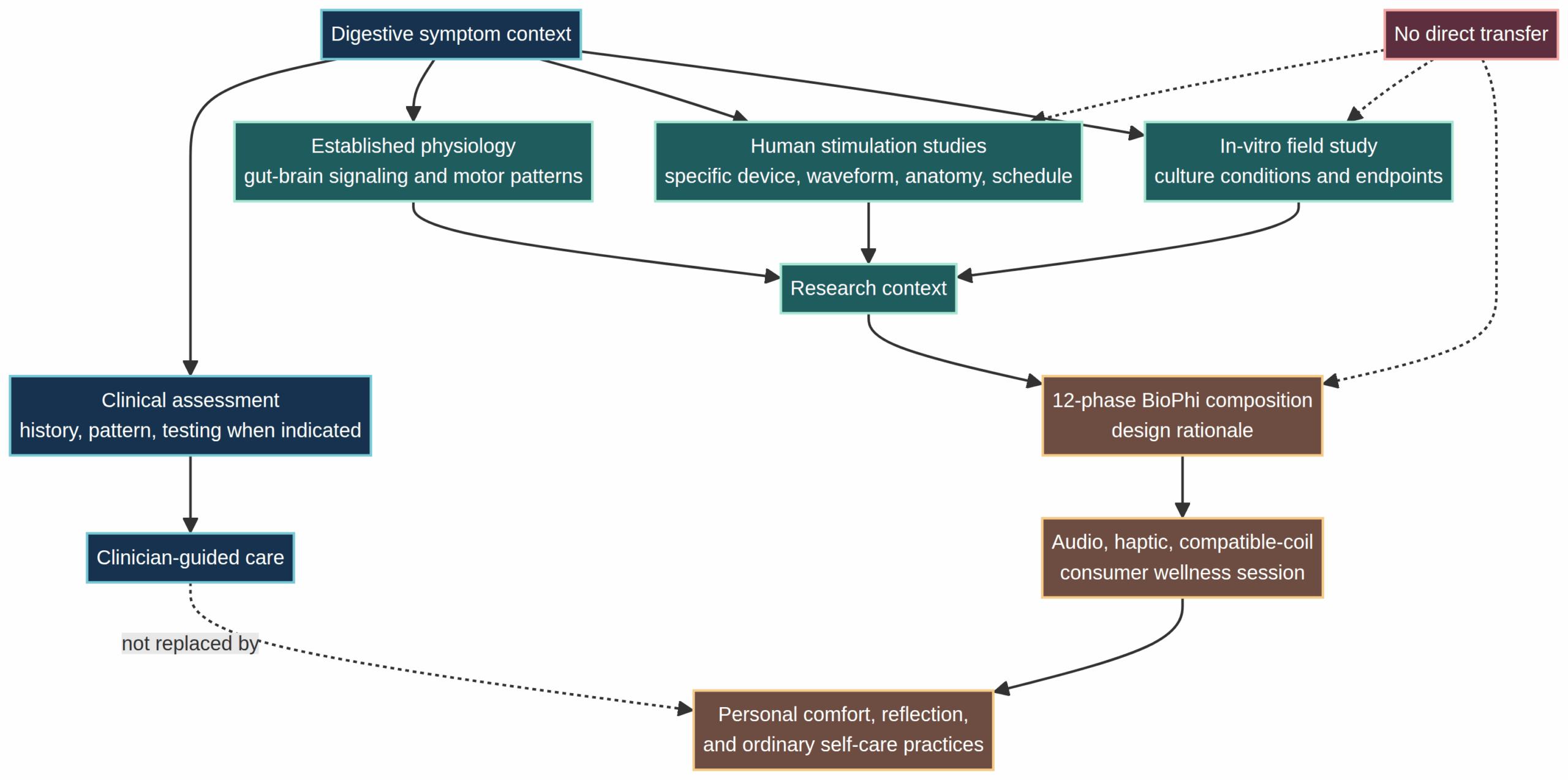
What this 12-phase design is built to organize
The composition is not trying to compress gastroenterology into a playlist. It is designed to organize a time-aware multimodal session around several research-context layers that are often discussed separately: gut-brain signaling, gastric and colonic rhythmicity, visceral sensory processing, and thyroid nutritional context. The program treats those layers as distinct chapters because they are distinct questions in physiology and in lived experience.
That distinction matters. Human gastric slow waves, colonic motor patterns, and gut-brain pathways are real physiological phenomena, but matching a number in an audio or haptic composition does not establish external pacing or clinical entrainment. Clinical stimulation studies also use defined devices, waveforms, intensities, anatomical locations, and schedules. Those details are inseparable from the intervention being studied.456
The BioPhi design therefore uses research as context for composition, not as a shortcut to clinical equivalence. This is a more rigorous position and, ultimately, a more interesting one. A program can be technically intentional without pretending that its sensory outputs are a medical device.
Program architecture: twelve phases, one coherent session
| Program section | Role in the public design | Evidence boundary |
|---|---|---|
| Gut-Brain / Autonomic Entry | Establishes a gentle session frame before denser layers are introduced. | Wellness orientation, not clinical autonomic measurement or stimulation. |
| Gastric, small-intestinal, and colonic context | Uses changing timing relationships as a compositional reference to gastrointestinal physiology. | Not external gastric pacing, transit therapy, or motility control. |
| IBS-C, IBS-D, mixed-IBS, and visceral-sensory context | Separates different study-context chapters rather than treating all digestive experience as one monolithic signal problem. | Not equivalent to transcutaneous electrical acustimulation, percutaneous electrical nerve field stimulation, or auricular vagus stimulation research. |
| Intestinal-environment and bacterial-research context | Places gut-environment and laboratory literature in a distinct late-session reference layer. | Not microbiome modification, infection treatment, biofilm reduction, or antimicrobial therapy. |
| Thyroid nutrient and integration context | Uses nutritional and endocrine concepts as educational design context before the recovery exit. | Not thyroid assessment, hormone replacement, thyroid treatment, or nutrient delivery. |
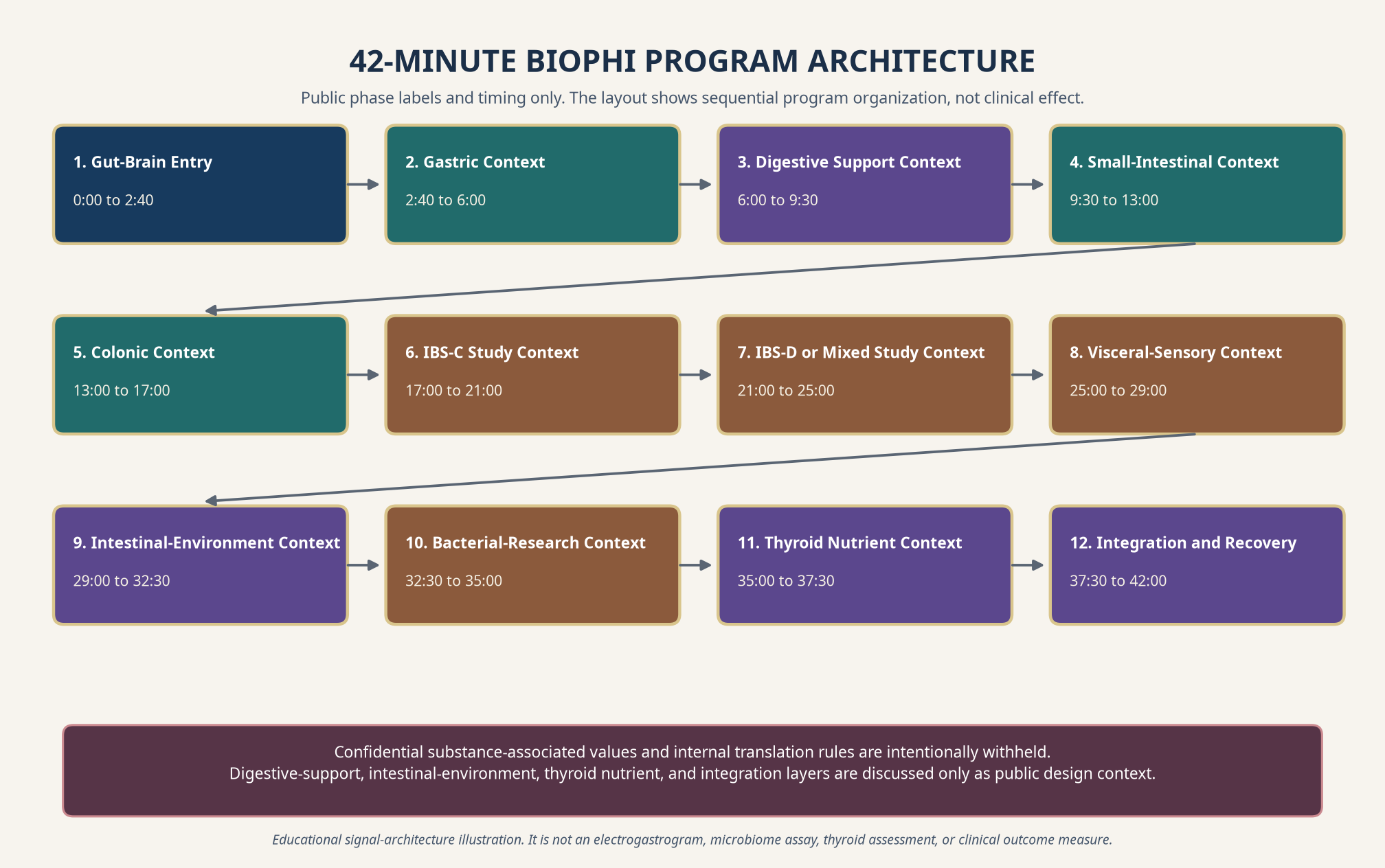
The first third of the session establishes a gradual digestive-context frame. The middle third separates colonic, IBS study-context, and visceral-sensory chapters. The final third moves through intestinal-environment, bacterial-research, thyroid nutrient-context, and recovery. That sequence is the point. A static tone can be measured as a stable output, but a static output alone does not express the same temporal logic as an evolving, phase-based composition.
Why phase progression matters more than a fixed tone bed
A fixed tone is not inherently poor engineering. It is simply a narrow form of engineering. Once a stimulus is stationary, its amplitude, spectral content, stereo relationships, and sensory character remain largely invariant. That can be appropriate for calibration, laboratory controls, or a simple signal demonstration. It is not the only way to compose a long-form wellness session.
This program uses a different compositional grammar. Phase-specific signal families enter and leave gradually. Deterministic microvariation prevents the session from becoming a random-noise collage while avoiding the monotony of an unchanging bed. Smooth crossfades, phase morphs, evolving stereo depth, controlled layer removal, and a progressive final disassembly create an audible and tactile sense of movement across the complete session.
There is a rational sensory-design case for variation. Adaptation research shows that neural responses are shaped by stimulus history and temporal context, not simply by a single isolated input.7 That literature does not establish that a consumer audio, haptic, or compatible-coil program can prevent cellular adaptation, reset the enteric nervous system, or outperform every stationary protocol. It does support the narrower and useful design conclusion: time structure is an important variable worth designing consciously.
BioPhi is the operational language used here. It does not mean that biological complexity has been reduced to a mystical numeric formula. It refers to an engineering approach in which phase timing, layer transitions, left-right relationships, and a bounded set of changing signal elements are organized as one composition. The result is more like a scored movement than a repeated test tone.
The supplied audio spectrogram: what it shows, and what it does not

A spectrogram is the correct signal-analysis term for this visual. It represents how visible audio energy is distributed over time and frequency. In the supplied image, the organized horizontal bands and changing vertical density support a conservative observation: the produced audio changes its spectral organization across the session rather than remaining as one visually invariant tone. The image does not reveal clinical effect, field strength, proprietary internal mappings, or a biological response.
That distinction protects the reader from a familiar error in frequency discourse: confusing a measurement of a created signal with a measurement of a body. The spectrogram validates audio organization, not digestive function.
Substance and nutrient context: why it belongs in the editorial discussion
The digestive-support, intestinal-environment, and thyroid nutrient-context phases include proprietary reference layers. Their associated values, mappings, carrier logic, and translation rules are confidential and are not published here. What can be discussed responsibly is the biological context that makes certain substances and systems meaningful to study.
Consider iodine. It is an essential dietary component of the thyroid hormones T4 and T3, which participate in metabolic regulation. That fact makes iodine a legitimate part of thyroid nutritional education.8 It does not mean a digital signal delivers iodine, substitutes for a dietary assessment, changes thyroid hormone levels, or replaces a clinician’s management of thyroid disease. The same discipline applies to every internal reference layer in this composition: biological relevance does not turn a signal into a nutrient, a drug, or a diagnostic test.
Similarly, an in-vitro electromagnetic study involving bacterial cultures can be useful as a literature reference while remaining non-transferable to a 42-minute consumer session. The featured bacterial-research phase keeps that study category visible, rather than disguising it as clinical microbiome or antimicrobial evidence. The American College of Gastroenterology guideline for H. pylori addresses testing, antimicrobial regimens, and confirmation of eradication in clinical care. A wellness composition is not a replacement for that pathway.9
How the audio, haptic, and compatible-coil layers work together
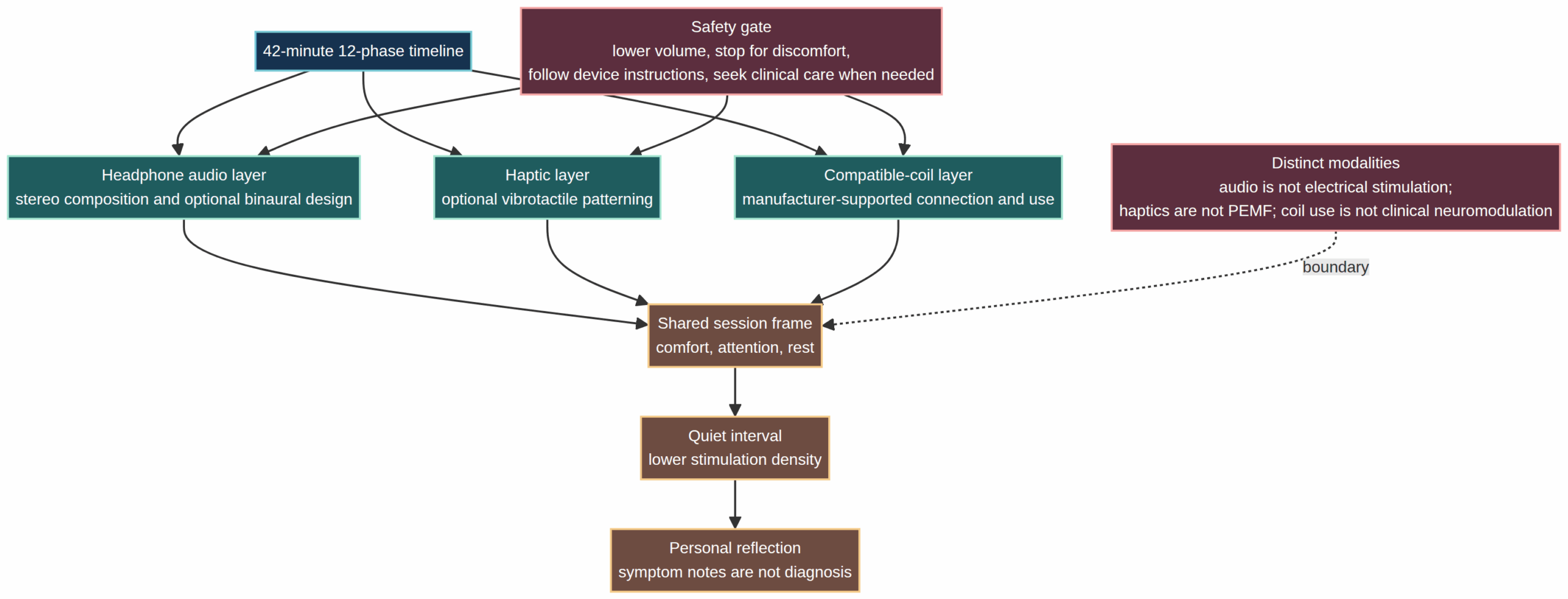
The headphone layer is a stereo audio composition. Where headphones are used, the program can include a binaural design element that depends on separate left and right channels. The haptic layer translates a selected subset of timing architecture into vibration. The compatible-coil layer is hardware-dependent, with real-world output shaped by the device, amplifier, coil, wiring, distance, and frequency response. These are distinct physical pathways.
Keeping them distinct is good technical practice. Audio is not electrical stimulation. Haptics are not PEMF. A compatible coil is not automatically equivalent to the electrical stimulation systems used in clinical studies. The binaural-beat literature itself remains heterogeneous: a 2023 systematic review found mixed and contradictory findings across its included studies, which supports careful language rather than guaranteed brain-state claims.10
A seven-day digestive-context routine
This is a consumer-wellness routine, not a treatment plan. Run the primary program first each day. Leave 10 minutes of quiet space between each linked session. Use a comfortable volume, stop for discomfort, and use only manufacturer-supported hardware connections. After Day 7, take a full week away before considering an optional repeat.
Important: Program titles are exact catalog labels. This article does not endorse the medical or outcome language that may appear in a companion title. If any session feels uncomfortable, stop. The purpose of quiet intervals is ordinary pacing and reflection, not a medical washout period.
Best practices for a thoughtful session
Start with the simplest setup that is comfortable. For headphone use, keep volume below 60% of the device maximum, use well-fitted headphones, and take quiet breaks. WHO emphasizes that risk depends on loudness, duration, and repeated exposure, not on a single volume setting alone.11 If you have sound sensitivity, tinnitus, dizziness, headache, or discomfort, reduce the volume or stop.
For compatible coil use, follow the device manufacturer’s connection, placement, and contraindication guidance. Do not place a coil over the neck or abdomen to self-treat digestive or thyroid symptoms, and do not use consumer hardware as a substitute for medical evaluation. For haptic use, begin with the lowest comfortable intensity. A haptic pattern is a sensory layer, not a biomedical intervention.
Optional tools and platform resources
Affiliate disclosure: Some resources below are affiliate links. They support PEMF Magazine at no additional cost to you. They are optional consumer tools, not medical devices or treatment recommendations in this article.
| Resource | Appropriate use in this workflow |
|---|---|
| Frequency Healing App | Platform access for compatible audio-program listening. |
| iTorus i2 collection | Optional compatible consumer-wellness hardware. Follow all manufacturer instructions and contraindications. |
| iTorus i5 collection | Optional compatible consumer-wellness hardware. Follow all manufacturer instructions and contraindications. |
| Woojer Vest 4 with code EPEMF10 | Optional haptic layer for those who prefer tactile accompaniment at a comfortable intensity. |
| Metatronic Flower of Life Dual Frequency Imprinter | Optional personal ritual layer. This article makes no water-imprinting, therapeutic, or clinical claim. |
Clinical perspective and safety
IBS can involve abdominal pain with constipation, diarrhea, or both, but symptom patterns still need context. NIDDK notes that clinicians may use history, examination, and, when appropriate, testing to distinguish IBS from other problems.1 Seek prompt medical care for blood in stool, black stools, unexplained weight loss, fever, persistent vomiting, dehydration, severe or worsening abdominal pain, new symptoms later in life, or a family history that raises concern. Discuss pregnancy, inflammatory bowel disease, new neck swelling, voice change, thyroid medication questions, and persistent digestive symptoms with a qualified clinician.
Suspected H. pylori infection requires appropriate testing and guideline-directed treatment. Thyroid symptoms and medication questions require appropriate endocrine assessment. This program is designed for wellness use and should not delay or replace clinical care.
Related Articles
- Your Gut Has 500 Million Neurons. Is It Talking to Your Brain?
- Gut ReGenesis Matrix: Microbiome and Mucosal-Barrier Context
- Breathwork for Nervous System Regulation
References
- National Institute of Diabetes and Digestive and Kidney Diseases. Irritable Bowel Syndrome.
- Lacy BE, et al. ACG Clinical Guideline: Management of Irritable Bowel Syndrome. PMID 33315591.
- Zhang S, et al. Transcutaneous auricular vagus nerve stimulation for functional dyspepsia. PMID 37787432.
- Cheng LK, et al. Human gastric electrophysiology study. PMID 19963493.
- Dinning PG, et al. Human high-resolution colonic manometry study. PMID 25131177.
- Selmaoui B, et al. Endocrine functions in young men exposed to one-night magnetic-field conditions. PMID 9247317.
- Wark B, et al. Sensory adaptation. PMC4279707.
- NIH Office of Dietary Supplements. Iodine Fact Sheet for Health Professionals.
- Chey WD, et al. ACG Clinical Guideline: Treatment of Helicobacter pylori Infection. PMID 39626064.
- Ingendoh RM, et al. Binaural beats to entrain the brain? A systematic review. PMID 37205669.
- World Health Organization. Deafness and hearing loss: Safe listening.
- Di Campli C, et al. In-vitro electromagnetic field study involving H. pylori cultures and biofilm. PMID 20033173.