
If you are reading this, your autonomic nervous system is likely locked in a sympathetic state. The modern environment—chronic stress, unresolved emotional grief, digital overload, and trauma—forces the body into a perpetual “fight-or-flight” loop. This chronic sympathetic dominance degrades vagal tone, suppresses immune function, and creates a biochemical cascade of cortisol and adrenaline that exhausts the cellular matrix [1].
For decades, frequency medicine attempted to solve this using static Rife frequencies. But as neuroscience has evolved, a critical flaw in that 1990s technology has been exposed: cellular adaptation. The brain is a predictive engine; when exposed to a single, repeating tone, it habituates within minutes and tunes the signal out. To truly reset the nervous system, the frequency delivery must be as dynamic and complex as the biology it is trying to heal.
Enter the Ignatia 7-Phase Emotional Calm & Tension Release BioPhi Energetics program. By combining the bioelectrical signatures of homeopathic Ignatia amara with dynamic phi-harmonic architecture and heart coherence pacing, this technology represents the end of the Rife era and the dawn of true autonomic nervous system regulation.
The End of the Rife Era: Why Static Frequencies Fail
In the 1990s, frequency healing relied on the Rife model: playing a single, static frequency (e.g., 728 Hz) continuously. While groundbreaking at the time, modern neurobiology reveals why these static tones lose their efficacy so quickly.
The human nervous system is designed to detect novelty and ignore repetition. When a static frequency is applied, the auditory and tactile neural pathways recognize the repeating pattern. Within 3 to 7 minutes, a phenomenon known as neural habituation occurs. The brain categorizes the signal as “background noise” and ceases to respond bioelectrically [2]. The therapeutic window slams shut.

The BioPhi architecture solves this by never allowing the pattern to become predictable. Instead of a flat line, it uses dynamic, morphing sweeps, difference tones, and phi-ratio (1.618) mathematical shifts. This constant, subtle novelty forces the nervous system to remain engaged, allowing for deep, sustained entrainment without adaptation.
The Bioelectrical Science of Ignatia Amara
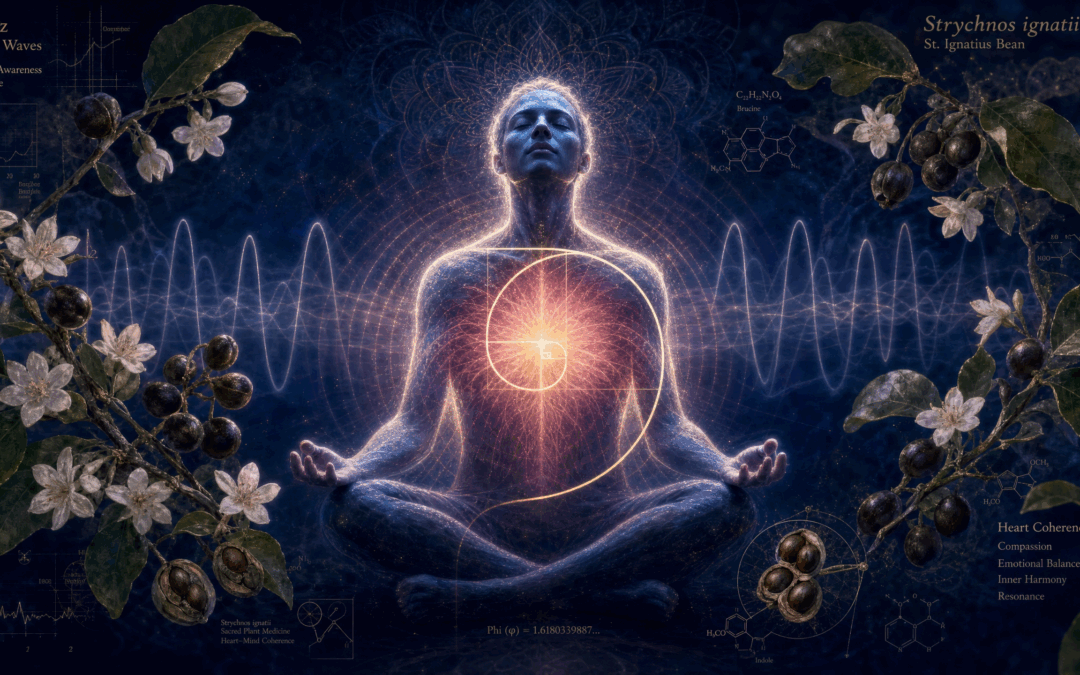
At the core of this program is the energetic signature of Strychnos ignatii (the St. Ignatius bean). In classical homeopathy, Ignatia amara is the premier remedy for acute emotional distress, grief, shock, and internalized tension. But how does a botanical substance translate into a frequency?
The answer lies in molecular vibrational spectroscopy and biophoton emission. Every molecule, including the complex alkaloids found in Ignatia (such as strychnine and brucine), possesses a unique electromagnetic signature. When these molecules are analyzed using Nuclear Magnetic Resonance (NMR) or Raman spectroscopy, their precise vibrational frequencies can be mapped [3].
Pharmacologically, the alkaloids in Ignatia act as competitive antagonists at inhibitory glycine receptors in the central nervous system [4]. While the physical substance in high doses causes overstimulation, the homeopathic and bioelectrical application of these specific molecular frequencies provides the exact inverse effect: profound nervous system regulation and the release of somaticized emotional tension.

These molecular frequencies are not just played back; they are encoded using the Golden Ratio (Phi, 1.618). By applying phi-harmonic mathematics, the frequencies are aligned with the natural resonant windows of human biology, maximizing cellular receptivity and minimizing resistance [5].
The 7-Phase “Valley-and-Return” Architecture
The Ignatia program does not just turn on and off. It takes the nervous system on a precisely engineered 7-phase journey. This “valley-and-return” arc safely guides the user from a state of hyper-arousal down into deep emotional processing, and then brings them back to an alert, balanced state.

| Phase | Action | Bioelectrical Mechanism & Frequencies |
|---|---|---|
| 1. Ground | Anchoring the physical body | Delta brainwave anchor (0.5–4 Hz) establishes safety. Magnesium Sulfate energetic signature relaxes muscular tension. |
| 2. Soften | Lowering the brainwave state | Descent from Alpha into Theta (4–7 Hz). Pantothenic Acid (Vitamin B5) frequencies support adrenal down-regulation. |
| 3. Release | Unlocking somatic tension | Deep Theta states combined with the primary Ignatia amara carrier wave to release trapped emotional grief and shock. |
| 4. Cohere | Heart-brain synchronization | Introduction of the ~0.1 Hz breath pacing envelope to maximize Heart Rate Variability (HRV) and vagal tone. |
| 5. Balance | Neurochemical stabilization | GABA and Glycine energetic signatures are introduced to promote inhibitory neurotransmitter resonance and calm the CNS. |
| 6. Integrate | Ascending from the depth | Gentle binaural sweep moving from Theta back up toward Alpha (8–12 Hz). SAMe and Tyrosine frequencies support mood elevation. |
| 7. Return | Alert, calm readiness | Stabilization at a clear 10 Hz Alpha state. The nervous system is reset, leaving the user relaxed but fully functional for daytime activities. |
Heart Coherence: The Power of ~0.1 Hz
One of the most powerful elements of Phase 4 is the integration of Heart Coherence pacing. Research has consistently shown that breathing at a rate of approximately 6 breaths per minute (which translates to a frequency of ~0.1 Hz) creates maximum resonance in the cardiovascular system [6].
At this specific frequency, the rhythms of the heart, respiration, and blood pressure synchronize. This state of physiological coherence optimizes Heart Rate Variability (HRV) and sends a massive afferent signal through the vagus nerve to the brain, definitively shutting off the sympathetic fight-or-flight response and activating the parasympathetic “rest and digest” system.
Spectral Analysis of the Ignatia Program
The complexity of the BioPhi architecture is clearly visible in the spectral analysis of the audio file.

Recommended Programs on ePEMF.app
To fully address emotional trauma, nervous system dysregulation, and cellular stress, we recommend integrating the following programs from the ePEMF API into your daily protocol:
- Ignatia: 7-Phase Emotional Calm & Tension Release BioPhi Energetics (Primary Program)
- Vagus Nerve Tone & Parasympathetic Reset 7-Phase BioPhi Energetics
- Glutathione Antioxidant Detox Redox Shield 9-Phase Phi-Harmonic Advanced Energetics (Mandatory Detox Support)
- GABA: Inhibitory Calm & Anxiety Release 7-Phase BioPhi Energetics
- Adrenal Fatigue & HPA Axis Support 7-Phase BioPhi Energetics
- Serotonin: Mood Elevation & Joy Synthesis 7-Phase BioPhi Energetics
- Dopamine: Motivation Drive & Reward Pathway 7-Phase BioPhi Energetics
The 7-Day Emotional Reset Protocol
For optimal results, follow this day-by-day structure to gently guide the nervous system out of fight-or-flight:
- Day 1-2: Establish Safety. Begin the day with Vagus Nerve Tone to prime the parasympathetic system. In the afternoon, play Ignatia 7-Phase to release accumulated tension.
- Day 3-4: Clear the Matrix. Play Glutathione Antioxidant Detox in the morning to clear the biochemical byproducts of stress (cortisol/adrenaline metabolites). Follow with Ignatia 7-Phase in the evening.
- Day 5-6: Rebuild Reserves. Morning: Adrenal Fatigue & HPA Axis Support. Evening: GABA Inhibitory Calm to ensure deep, restorative sleep.
- Day 7: Elevate & Integrate. Morning: Serotonin Mood Elevation or Dopamine Motivation Drive. Afternoon: A final session of Ignatia 7-Phase to lock in the emotional reset.
Hardware Integration: How to Deliver the Frequencies
To bypass the auditory processing centers and deliver these frequencies directly into the cellular matrix and nervous system, specialized hardware is required.
- iTorus i2 & i5 (PEMF Coils): Connect your device to the iTorus i2 or iTorus i5. For emotional processing and heart coherence, place the coil directly over the center of the chest (the heart chakra/thymus area) while playing the Ignatia program.
- iMprinter (Water Structuring): Water holds memory and frequency. Use the Metatronic iMprinter or Archimedean iMprinter to imprint your daily drinking water with the Ignatia frequencies. Best Practice: Imprint a glass of water for 3-5 minutes with the Ignatia program and sip it slowly during stressful moments throughout the day.
- Woojer Vest 4 (Haptic Delivery): For full-body somatic release, wear the Woojer Vest 4 (use discount code EPEMF10). The vest translates the low-frequency isochronic floor of the program into physical acoustic waves, vibrating the vagus nerve directly through the chest and spine.
References
[1] Thayer, J. F., & Lane, R. D. (2000). A model of neurovisceral integration in emotion regulation and dysregulation. Journal of Affective Disorders, 61(3), 201-216.
[2] Groves, P. M., & Thompson, R. F. (1970). Habituation: a dual-process theory. Psychological Review, 77(5), 419-450.
[3] Hackshaw, K. V., et al. (2020). Vibrational Spectroscopy for Identification of Metabolites in Biologic Samples. Molecules, 25(20), 4725.
[4] Huang, X., et al. (2015). Crystal structure of human glycine receptor-α3 bound to antagonist strychnine. Nature, 526(7572), 277-280.
[5] Foletti, A., et al. (2013). Bioelectromagnetic medicine: The role of resonance signaling. Electromagnetic Biology and Medicine, 32(4), 484-499.
[6] Lehrer, P. M., & Gevirtz, R. (2014). Heart rate variability biofeedback: how and why does it work? Frontiers in Psychology, 5, 756.