
Ménière’s Vestibular Balance: Inner-Ear Science, Safety, and a 9-Phase Wellness Program Guide
Quick answer: Ménière’s disease is a medical inner-ear condition involving episodic vertigo, fluctuating hearing changes, tinnitus, and/or ear fullness. It deserves assessment by an ENT clinician or audiologist. The Ménière’s Vestibular Balance & Inner Ear BioMatrix 9-Phase BioPhi-Harmonic Energetics is best understood as an experimental wellness and relaxation routine, not a diagnosis, treatment, or replacement for medical care. Its research references explain elements of the design; they do not prove that the app, iTorus, headphones, haptics, or the combined setup treats Ménière’s disease.
This guide separates what is established from what is not. It explains inner-ear and vestibular science, the research context behind the nine-phase design, the program’s spectral structure, safe iTorus-plus-headphones and iTorus-alone workflows, topic-appropriate affirmations, and a conservative 30-day routine template. The central rule is simple: never use a wellness session to push through dangerous dizziness, sudden hearing change, or a new neurologic symptom.
This article uses the exact primary program link supplied for this guide: Ménière’s Vestibular Balance & Inner Ear BioMatrix 9-Phase BioPhi-Harmonic Energetics.

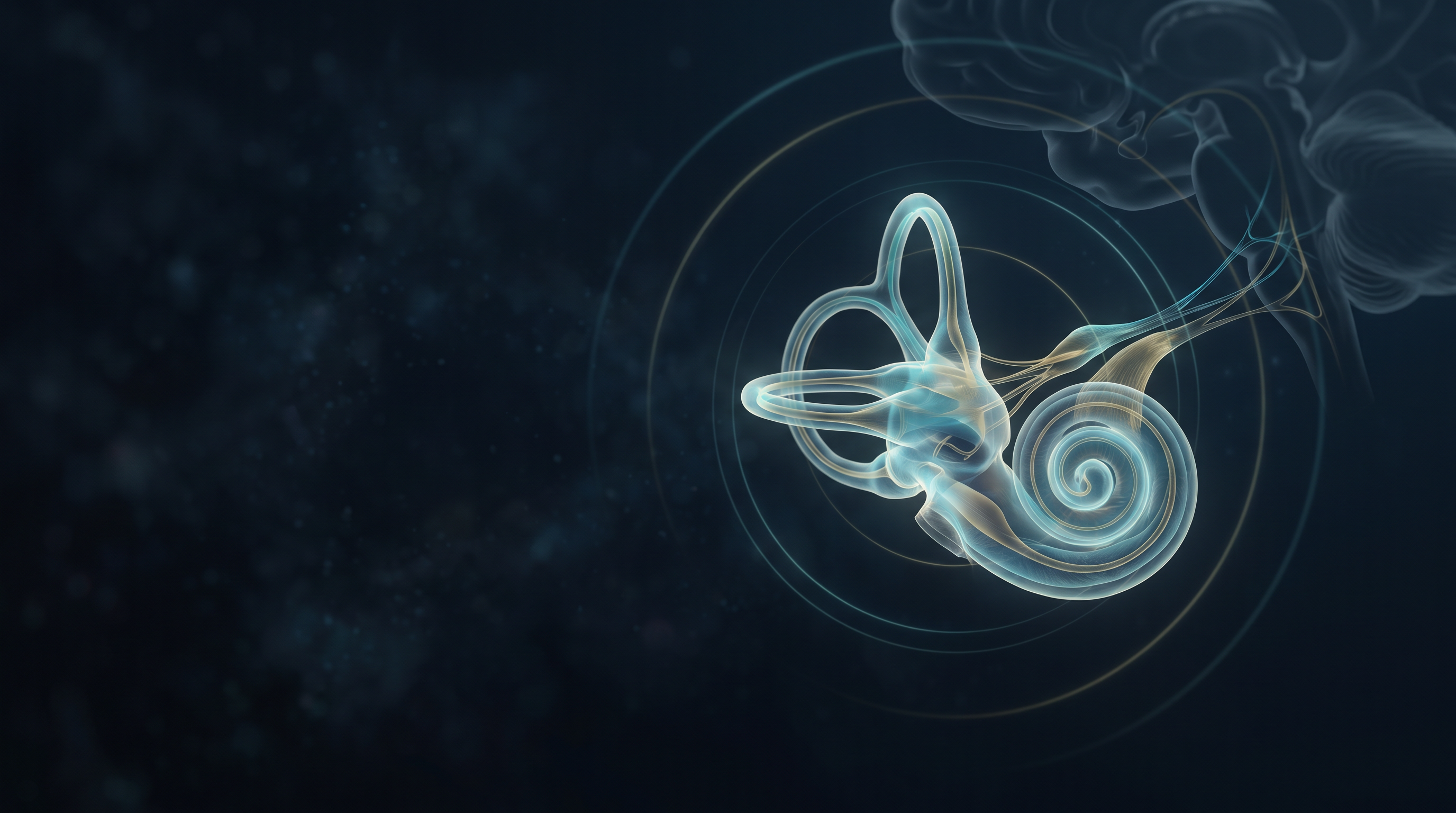
Inner-ear anatomy is complex: the cochlea supports hearing, while the vestibular apparatus helps the brain interpret motion and position. This image is illustrative and does not depict a treatment.
What Ménière’s Disease Is,and Why “Balance” Is Not Just About the Ear
Ménière’s disease is a disorder of the inner ear. Its hallmark symptom cluster includes spontaneous vertigo attacks, fluctuating sensorineural hearing loss, tinnitus, and aural fullness or pressure. The 2020 clinical guideline defines definite Ménière’s disease using both the attack pattern and documented hearing findings; it is not diagnosed from dizziness alone [1]. The National Institute on Deafness and Other Communication Disorders (NIDCD) explains that symptoms are associated with altered fluid regulation in the labyrinth, including the phenomenon called endolymphatic hydrops, but the condition is multifactorial and its underlying causes are not fully settled [2].
The labyrinth includes the cochlea, which transduces sound, plus the vestibule and semicircular canals, which contribute to balance. Endolymph movement helps sensory receptors signal body position and movement to the brain. These signals are then interpreted through vestibular nerve, brainstem, cerebellar, ocular-motor, autonomic, and musculoskeletal systems. That is why a vertigo episode can involve spinning, nausea, sweating, eye-movement changes, anxiety, fatigue, and a temporary loss of confidence in movement,not simply an “ear problem” [2] [8].

Established anatomy and clinical context are shown separately from the program’s wellness design. A visual map of a signal is not evidence that it changes the biology of Ménière’s disease.
What the Research Actually Supports
The most responsible way to discuss a program for a condition-associated topic is to identify the intervention actually studied. A study of electrical auricular vagus-nerve stimulation is not a study of a consumer PEMF coil. A trial of relaxing music is not proof of tinnitus treatment by binaural audio. A study of a medication is not proof that a proprietary substance-reference layer reproduces that medicine. Those distinctions matter.
| Research area | What the evidence supports | What it does not establish for this program |
|---|---|---|
| Clinical definition and care | Ménière’s disease is defined by a specific symptom and hearing-test pattern, and guideline management includes diagnostic work-up, education, lifestyle/medical options, and escalation when appropriate [1]. | That a wellness audio, haptic, or PEMF program diagnoses or manages the disease. |
| Electrical taVNS | A 2023 single-center, single-blind randomized trial studied electrical transcutaneous auricular vagus-nerve stimulation plus betahistine; its reported outcomes favored that protocol over sham plus betahistine at 12 weeks [3]. | That a 9-phase audio file, headphones, haptic vibration, or iTorus is taVNS or produces the same response. |
| Music and binaural audio | In a 30-person chronic-tinnitus trial, both relaxing-music groups improved; music plus an alpha binaural layer was not broadly superior to music alone, although two follow-up subscales differed [4]. | That binaural audio treats tinnitus, Ménière’s disease, or hearing loss. |
| Inner-ear fluid biology | Human endolymphatic-sac tissue research found higher AQP2 expression density in a Ménière’s group, while several other investigated targets did not differ significantly [5]. | That this program changes AQP2, vasopressin signaling, potassium transport, endolymph volume, or hydrops. |
| Vestibular rehabilitation | A 2023 meta-analysis found immediate-term quality-of-life improvement favoring vestibular rehabilitation, but it included only three trials, had high heterogeneity, and found high risk of bias [6]. | That self-directed exercises or a wellness session should be used during an acute vertigo attack. Rehabilitation should be clinician-guided for chronic imbalance. |
| PEMF science | PEMF research shows that biological responses vary materially with waveform, field intensity, frequency, duration, and cell type [7] [12]. | That findings from another device, field dose, tissue model, or clinical indication transfer to the iTorus or this specific program. |
The Program’s Spectral Image: What You Can See,and What You Cannot Conclude
A spectrum is a visual description of signal content over time. It can reveal changing bands, density, transitions, sustained carriers, and the visual shape of an exit. It does not measure the coil’s magnetic flux density at the body, establish the dose received by tissue, or demonstrate a clinical effect.

Supplied spectral view of the 33:33 program. It displays a persistent upper anchor, staged lower and mid-band blocks, purposeful transitions, and a simplified fading exit. The image is a signal-architecture observation, not medical efficacy evidence.
The supplied pitch view shows a relatively persistent narrow higher band across much of the timeline, while denser blocks appear and recede in the lower-to-mid display bands. The lower visual energy is broad rather than frozen: its intensity changes across distinct sections. In the later segment, the image simplifies and fades rather than ending abruptly. That visual pattern is consistent with a deliberately phased audio architecture: a stable orientation reference, changing layered content, then a quieter return to stillness.
It would be inaccurate, however, to infer a biological result from those colors or to identify proprietary substance values from a spectrogram. The appropriate conclusion is more modest: this is not a single static audio loop. It is a changing 33:33 signal design whose visual structure corresponds to the stated nine-phase journey.
The 9-Phase BioPhi-Harmonic Journey
Ménière’s Vestibular Balance & Inner Ear BioMatrix 9-Phase BioPhi-Harmonic Energetics is organized as a 33:33 sequence. The public-facing rationale is not that each phase “fixes” a part of the ear. Rather, the program changes its signal topology over time so the listening and hardware experience moves from orientation into a denser middle passage and then toward a quieter exit.

The nine-phase sequence is an experimental wellness design journey,not a clinical treatment pathway.
| Phase group | Phases | Public design intent | Responsible interpretation |
|---|---|---|---|
| Entry | 1. Orientation Anchor 2. Bilateral Vestibular Field 3. Inner-Ear Calm Matrix |
Create a predictable, less abrupt opening; introduce bilateral and homeostasis-themed signal layers. | A predictable seated listening ritual may feel easier to tolerate for some people. It is not evidence of vestibular correction. |
| Integration | 4. Alpha Auditory Coherence 5. Vagal Settling Field 6. Polarity-to-Torus Transition 7. Vestibular-Auditory Integration |
Use paced sensory design, changing stereo geometry, and the session’s densest layered passage. | The design references relevant research domains, but it does not replicate electrical vagus stimulation or prescribed rehabilitation. |
| Exit | 8. Reorientation & Stabilization 9. Zero-Point Integration |
Reduce complexity and return toward centered quiet. | A deliberate wind-down may support a calmer post-session transition. No disease-specific outcome is established. |
Why Static Lists,and “Classic Rife” Claims,Are a Bad Fit for a Fluctuating Condition
Internet frequency lists often suggest that a diagnosis can be paired with one fixed number and that repeating that number is itself a treatment plan. That is not a clinically supported model for Ménière’s disease. The condition can include fluctuating hearing, episodic vertigo, tinnitus, aural pressure, balance changes, individual triggers, and changing symptom patterns over time. Neither the Ménière’s clinical guideline nor the cited vestibular literature identifies a generic static “Ménière’s frequency” that diagnoses, eliminates, or reverses the condition [1] [13].
For the same reason, historical Rife-style diagnosis-to-number lists should not be treated as validated clinical prescriptions. The historical Rife literature did not establish modern disease-specific frequency lists through reproducible controlled trials, and a title in a consumer library is not proof that its signal has been tested for this condition. It would be irresponsible to tell a person with new, changing, or severe vestibular symptoms to keep escalating or repeating an unverified static signal instead of seeking assessment.
What may be happening when a repeating signal feels less noticeable
People sometimes describe a routine as “working at first” and then seeming less noticeable. That experience is real, but it cannot be assumed to mean that cells have become resistant to a disease frequency. In sensory neuroscience, repeated neutral stimulation can become less salient through habituation; in tinnitus care, supervised habituation approaches are deliberately designed to reduce a person’s distress and attentional reaction to the sound, not to restore hearing or change the inner ear directly [14]. In Ménière’s disease, symptom change can also reflect a naturally variable course, a changing trigger load, regression toward a person’s usual pattern, sleep and stress context, medication changes, or an evolving clinical condition. A 2024 study of 365 people with definite Ménière’s disease documented that vertigo, balance problems, hearing changes, fatigue, and quality-of-life burden can evolve differently over time [13].
There is no direct evidence that “cellular adaptation” explains diminished results from Rife use in Ménière’s disease, nor that static Rife signals generally make Ménière’s disease worse. The concrete safety concern is more practical: a loud or uncomfortable audio signal, excessive attention to symptoms, a session during an active attack, or delaying medical evaluation can aggravate distress or create risk. That is why this guide uses low-volume, fall-safe, symptom-aware procedures rather than promising a stronger dose.
Why this nine-phase design is a different engineering choice
The defensible difference is not a claim that the program discovered a secret “cure frequency.” It is an engineering choice to change the session’s audible density, left-right relationship, haptic pacing, transition pattern, and wind-down rather than repeat one short pattern unchanged. The stated goal is to make the routine more structured, observable, and subjectively varied. The supplied spectrogram supports that modest description: it shows staged blocks and a quieter exit rather than one visually frozen loop.
We arrived at this approach by separating four layers that are often collapsed together online: (1) condition physiology and medical management; (2) research on individual interventions; (3) device and signal parameters; and (4) the user’s practical listening environment. The nine-phase architecture was then treated as a transparent design sequence,orientation, modulation, integration, and wind-down,with a spectral quality check and a fall-safe routine. This does not demonstrate that the sequence prevents cellular adaptation or outperforms a static signal clinically. It defines a more honest process for designing a consumer wellness session that can later be tested rather than assumed to work.
What PEMF and frequency-based wellness can realistically contribute
PEMF research does show that biological responses can depend on waveform, field intensity, exposure duration, frequency, and cell type; the same systematic review also found that many experimental conditions did not show a reported cellular change [7]. That is precisely why evidence cannot be transferred from another device, dose, tissue model, or disease to an iTorus session for Ménière’s disease. A neuroprotection review describes preclinical and preliminary clinical PEMF work in the very different context of acute cerebral ischemia; it is not inner-ear or Ménière’s evidence [15].
Within these limits, the most reasonable role for this program is a conservative wellness ritual: quiet seated time, optional low-volume stereo listening, optional comfortable haptic input, and a consistent check-in before and after use. Those features may support a sense of routine and relaxation for some individuals. They do not establish an effect on endolymphatic hydrops, hearing restoration, tinnitus cure, vestibular compensation, or clinical vagus-nerve stimulation.
Triple Modality: iTorus, Haptic, and Binaural Audio,Without Overclaiming
The platform can be experienced through three distinct delivery layers. Each layer has a different practical function, and none should be represented as an approved treatment for Ménière’s disease. The safest framing is to treat the combination as a structured wellness ritual: a consumer electromagnetic device used according to its instructions, optional body vibration, and careful audio listening.
| Layer | What the user experiences | What can responsibly be said | What cannot be claimed |
|---|---|---|---|
| PEMF / iTorus | A consumer wellness coil operating through the manufacturer-supported connection and placement method. | PEMF parameters matter; external studies cannot be assumed to apply to another device [7]. | That the coil treats hydrops, restores hearing, stimulates the vagus nerve clinically, or duplicates a study on a different device. |
| Wired headphones | Stereo audio, including the program’s binaural design, at a low-to-moderate volume. | Headphones are required to perceive a binaural left-right difference. Relaxing audio may support a personally calming context. | That headphones cure tinnitus or “reset” vestibular pathways. |
| Haptic option | Optional low, comfortable whole-body vibration through a compatible device. | Vibration changes body sensation and may be used as an optional grounding cue. | That vibration mobilizes inner-ear fluid or treats balance dysfunction. |
| iTorus alone | Coil-based use without headphones. | This is a separate consumer-wellness mode for people who prefer no audio. | That the binaural layer is being delivered without stereo headphones. |

Use this as a safety and setup flow, not as a medical decision tree. New or severe symptoms require medical assessment rather than a higher-intensity session.
Why These Substance Themes Are Included,Without Treating Them as Frequencies
The architecture includes proprietary internal reference layers associated with several medicines that appear in the wider clinical literature around vertigo, diuretics, or endolymphatic-hydrops management. The presence of a substance theme does not mean that the program contains the drug, reproduces its pharmacology, or can replace it. Specific proprietary substance-frequency values are intentionally not disclosed.
- Buclizine: This is included as a symptom-management pharmacology theme relevant to dizziness/nausea language. It should never be interpreted as a substitute for clinician-directed medication.
- Hydrochlorothiazide and triamterene: These appear in the conventional diuretic-management context. A placebo-controlled crossover study of the combination reported reduced vestibular complaints in its participant group, while hearing and tinnitus did not significantly change [9]. That supports discussion of the clinical context,not a claim that a signal layer behaves like a diuretic.
- Acetazolamide: A small imaging series described symptom improvement and partial or complete hydrops reversal in some participants receiving acetazolamide [10]. The study does not validate a wellness signal as acetazolamide, nor does it establish that this program reverses hydrops.
The responsible interpretation is therefore: the program’s internal references are experimental design themes chosen because their associated substances have clinical relevance in the topic area. They are not molecular resonances, medication equivalents, or treatment instructions.
Verified ePEMF Program Navigation: Optional, Not a Substitute for Care
The following records were returned by targeted ePEMF API searches for vertigo, tinnitus, hearing, and vagus-related terms. They are included as direct navigation options, not as medical recommendations, evidence of efficacy, or programs to stack during a vertigo episode. Use one familiar session at a time, keep the primary program as the anchor of the 30-day routine, and avoid changing multiple inputs at once if you are trying to understand personal tolerance.
| API-returned program | How to frame it responsibly |
|---|---|
| Tinnitus Relief: 35K Ultra Advanced Energetics | A topic-specific library option for a calm, low-volume wellness session; not an established tinnitus treatment. |
| Hearing Restoration, Tinnitus. Cochlear Regenerate 12 Phase Isochronic Energetics | A title in the program library; its name does not establish hearing restoration or cochlear regeneration. |
| Vagus Nerve & Cortisol Flush 9-Phase Bioelectric Energetics | A separate nervous-system themed program. It is not electrical auricular vagus-nerve stimulation and should not be represented as such. |
| Nervous System 9-Phase BioPhi Orbital Vagus Reset Energetics | An optional relaxation-oriented library option; not a clinical vagus treatment or a substitute for vestibular rehabilitation. |
Do not use these as a “more is better” stack. During an active vertigo attack, with sudden hearing change, severe nausea/vomiting, a fall, fainting, a new neurological symptom, or a new pattern of symptoms, stop experimentation and seek appropriate medical advice instead.
How to Use iTorus, Headphones, and Haptics: Conservative Setup Rules
There is no evidence-based “best” coil position, audio mode, or layered configuration for Ménière’s disease. The right choice is therefore the safest, most tolerable, manufacturer-supported configuration,not the strongest-feeling one. The current official iPyramids tutorial hub lists an iTorus i2 Personal Space Guide and iTorus i5 Full Room Tutorial. Because the published tutorial page does not specify a Ménière’s-specific anatomical placement, this guide does not instruct users to place a consumer coil on the ear, mastoid, temple, head, or neck.
| Question | Conservative answer for this routine |
|---|---|
| Where should the coil go? | Use only the current official setup and placement shown for the iTorus model you own: the i2 personal-space guide or i5 full-room tutorial. Keep the session seated or reclined. Do not create a custom inner-ear, cochlear, vagus, or head placement from this article. |
| How long? | The supplied primary program displays a 33:33 session. Use one complete session only when the day calls for it. For API-returned optional programs whose public duration could not be verified, use one full duration shown in the app,never a guessed exposure length and never a second program on the same day. |
| What time? | Use a consistent daytime window,preferably between 10:00 and 14:00 local or another personally stable daytime period. Do not use immediately before driving, stairs, bathing, cooking, or any activity where an unexpected balance change could create risk. Avoid late-evening use if audio disrupts sleep. |
| Headphones or separate sessions? | Neither is proven superior. Start with separate layers so you can identify what is tolerable. Use wired stereo headphones only for the optional binaural-audio experience; use iTorus alone for a coil-only comparison. Combine them only after each has been comfortable on separate days. |
| What volume or haptic intensity? | Use the first clearly comfortable audio volume and the lowest comfortable haptic setting. Loudness and vibration are not therapeutic doses. Stop rather than increasing intensity if anything provokes discomfort, dizziness, ear pressure, nausea, tinnitus distress, agitation, or faintness. |
The Three-Layer “3D” System Design: What It Is and What It Is Not
“3D” is used here as a design label for three concurrent sensory channels, not as proof of a three-dimensional biological treatment. The layers can be run separately for comparison or carefully combined after tolerability is established. No trial has tested the exact iTorus, Woojer, headphone, and ePEMF combination for Ménière’s disease; no evidence establishes that the combined configuration is clinically better than separate sessions.
| Layer | Practical delivery | Reason to include it in a wellness routine | Critical evidence limit |
|---|---|---|---|
| 1. PEMF / field layer | iTorus i2 personal-space or i5 room setup, following the current official tutorial/manual. | A repeatable, device-supported part of a quiet seated routine. | PEMF biological responses vary with waveform, intensity, duration, frequency, tissue, and device. That does not establish an effect of this device or program on Ménière’s disease [7] [12]. |
| 2. Stereo audio / binaural layer | Wired stereo headphones at a low comfortable level. Separate left/right inputs are required for the binaural percept. | Optional focused-listening structure for people who tolerate sound comfortably. | A systematic review found inconsistent binaural-beat effects across heterogeneous studies. It is not established Ménière’s, tinnitus, or hearing-loss therapy [16]. |
| 3. Haptic / tactile layer | Optional Woojer Vest at its lowest comfortable setting, only after the audio and iTorus layers are independently tolerated. | A tactile cue that some people may find grounding or easy to notice during seated practice. | Haptic wearables can convey tactile information and have been researched in sensory-augmentation contexts, but this does not validate a consumer vest as a treatment for Ménière’s disease or endolymphatic hydrops [17]. |
Combined versus separate sessions: the decision rule
Start separate because it gives cleaner information. If low-volume audio alone is uncomfortable, do not add iTorus or haptics to try to override that response. If iTorus alone is comfortable but audio is not, use the coil-only routine or stop; do not call the result a binaural session. If both are comfortable on separate days, a combined session is an optional experiential choice, not an escalation in medical potency. The haptic layer comes last because it adds a third sensory input and should never be used to “push through” a difficult session.
30-Day Exact Program Order: Two or Three Separate Sessions per Day
This is the operational format requested for the 30-day routine: every day has a Session 1, a Session 2, and on alternating days a Session 3. Sessions are deliberately separated rather than stacked back-to-back. The primary program is linked on every day and remains the first session; the API-returned library programs are used second or third in a repeating, transparent sequence.
Duration rule: The primary program’s supplied runtime is 33:33. The API exposes titles and links for the additional programs but not public runtimes, and subscriber-only program pages do not display a duration. For those programs, the accurate instruction is to run one complete duration shown in the app before you press play; do not guess a number of minutes and do not restart a program for a second pass. The spacing schedule is 10:00 → 15:00 → 18:30 local by default, with a minimum 4-hour gap before Session 2 and 3-hour gap before Session 3.
Safety gate before every session: do not begin during an active severe vertigo episode or if a prior session has increased discomfort. Do not attempt a later session merely because it appears on the schedule. Sit or recline, use a fall-safe environment, and wait until steady before standing. The program titles are direct library navigation, not evidence that the named condition is treated, reversed, or cured.
| Day | Exact program order, time, runtime, and mode | Affirmation | Stop rule |
|---|---|---|---|
| Day 1 |
Primary program link for Day 1: Ménière’s Vestibular Balance & Inner Ear BioMatrix 9-Phase BioPhi-Harmonic Energetics Session 1: 10:00: Ménière’s Vestibular Balance & Inner Ear BioMatrix 9-Phase BioPhi-Harmonic Energetics Session 2: 15:00: Tinnitus Relief: 35K Ultra Advanced Energetics |
I move through this routine with patience and care. | If a session creates meaningful discomfort, do not move to the next session that day. Stop, recover seated or reclined, and use the clinical stop rules below. |
| Day 2 |
Primary program link for Day 2: Ménière’s Vestibular Balance & Inner Ear BioMatrix 9-Phase BioPhi-Harmonic Energetics Session 1: 10:00: Ménière’s Vestibular Balance & Inner Ear BioMatrix 9-Phase BioPhi-Harmonic Energetics Session 2: 15:00: Nervous System 9-Phase BioPhi Orbital Vagus Reset Energetics Session 3: 18:30: Luma Haptic Full Body, Pure Tone, ASMR Guided Meditation |
I can choose comfort over intensity. | If a session creates meaningful discomfort, do not move to the next session that day. Stop, recover seated or reclined, and use the clinical stop rules below. |
| Day 3 |
Primary program link for Day 3: Ménière’s Vestibular Balance & Inner Ear BioMatrix 9-Phase BioPhi-Harmonic Energetics Session 1: 10:00: Ménière’s Vestibular Balance & Inner Ear BioMatrix 9-Phase BioPhi-Harmonic Energetics Session 2: 15:00: Hearing Restoration, Tinnitus. Cochlear Regenerate 12 Phase Isochronic Energetics |
I notice information without needing a conclusion. | If a session creates meaningful discomfort, do not move to the next session that day. Stop, recover seated or reclined, and use the clinical stop rules below. |
| Day 4 |
Primary program link for Day 4: Ménière’s Vestibular Balance & Inner Ear BioMatrix 9-Phase BioPhi-Harmonic Energetics Session 1: 10:00: Ménière’s Vestibular Balance & Inner Ear BioMatrix 9-Phase BioPhi-Harmonic Energetics Session 2: 15:00: Vagus Nerve & Cortisol Flush 9-Phase Bioelectric Energetics Session 3: 18:30: Luma Haptic Full Body, Pure Tone, ASMR Guided Meditation |
My safest routine is a strong routine. | If a session creates meaningful discomfort, do not move to the next session that day. Stop, recover seated or reclined, and use the clinical stop rules below. |
| Day 5 |
Primary program link for Day 5: Ménière’s Vestibular Balance & Inner Ear BioMatrix 9-Phase BioPhi-Harmonic Energetics Session 1: 10:00: Ménière’s Vestibular Balance & Inner Ear BioMatrix 9-Phase BioPhi-Harmonic Energetics Session 2: 15:00: Pain Relief Somatic Neuromuscular 9-Phase Phi-Harmonic Energetics |
I can pause, rest, and return only when ready. | If a session creates meaningful discomfort, do not move to the next session that day. Stop, recover seated or reclined, and use the clinical stop rules below. |
| Day 6 |
Primary program link for Day 6: Ménière’s Vestibular Balance & Inner Ear BioMatrix 9-Phase BioPhi-Harmonic Energetics Session 1: 10:00: Ménière’s Vestibular Balance & Inner Ear BioMatrix 9-Phase BioPhi-Harmonic Energetics Session 2: 15:00: Tinnitus Relief: 35K Ultra Advanced Energetics Session 3: 18:30: Luma Haptic Full Body, Pure Tone, ASMR Guided Meditation |
I move through this routine with patience and care. | If a session creates meaningful discomfort, do not move to the next session that day. Stop, recover seated or reclined, and use the clinical stop rules below. |
| Day 7 |
Primary program link for Day 7: Ménière’s Vestibular Balance & Inner Ear BioMatrix 9-Phase BioPhi-Harmonic Energetics Session 1: 10:00: Ménière’s Vestibular Balance & Inner Ear BioMatrix 9-Phase BioPhi-Harmonic Energetics Session 2: 15:00: Nervous System 9-Phase BioPhi Orbital Vagus Reset Energetics |
I can choose comfort over intensity. | If a session creates meaningful discomfort, do not move to the next session that day. Stop, recover seated or reclined, and use the clinical stop rules below. |
| Day 8 |
Primary program link for Day 8: Ménière’s Vestibular Balance & Inner Ear BioMatrix 9-Phase BioPhi-Harmonic Energetics Session 1: 10:00: Ménière’s Vestibular Balance & Inner Ear BioMatrix 9-Phase BioPhi-Harmonic Energetics Session 2: 15:00: Hearing Restoration, Tinnitus. Cochlear Regenerate 12 Phase Isochronic Energetics Session 3: 18:30: Luma Haptic Full Body, Pure Tone, ASMR Guided Meditation |
I notice information without needing a conclusion. | If a session creates meaningful discomfort, do not move to the next session that day. Stop, recover seated or reclined, and use the clinical stop rules below. |
| Day 9 |
Primary program link for Day 9: Ménière’s Vestibular Balance & Inner Ear BioMatrix 9-Phase BioPhi-Harmonic Energetics Session 1: 10:00: Ménière’s Vestibular Balance & Inner Ear BioMatrix 9-Phase BioPhi-Harmonic Energetics Session 2: 15:00: Vagus Nerve & Cortisol Flush 9-Phase Bioelectric Energetics |
My safest routine is a strong routine. | If a session creates meaningful discomfort, do not move to the next session that day. Stop, recover seated or reclined, and use the clinical stop rules below. |
| Day 10 |
Primary program link for Day 10: Ménière’s Vestibular Balance & Inner Ear BioMatrix 9-Phase BioPhi-Harmonic Energetics Session 1: 10:00: Ménière’s Vestibular Balance & Inner Ear BioMatrix 9-Phase BioPhi-Harmonic Energetics Session 2: 15:00: Pain Relief Somatic Neuromuscular 9-Phase Phi-Harmonic Energetics Session 3: 18:30: Luma Haptic Full Body, Pure Tone, ASMR Guided Meditation |
I can pause, rest, and return only when ready. | If a session creates meaningful discomfort, do not move to the next session that day. Stop, recover seated or reclined, and use the clinical stop rules below. |
| Day 11 |
Primary program link for Day 11: Ménière’s Vestibular Balance & Inner Ear BioMatrix 9-Phase BioPhi-Harmonic Energetics Session 1: 10:00: Ménière’s Vestibular Balance & Inner Ear BioMatrix 9-Phase BioPhi-Harmonic Energetics Session 2: 15:00: Tinnitus Relief: 35K Ultra Advanced Energetics |
I move through this routine with patience and care. | If a session creates meaningful discomfort, do not move to the next session that day. Stop, recover seated or reclined, and use the clinical stop rules below. |
| Day 12 |
Primary program link for Day 12: Ménière’s Vestibular Balance & Inner Ear BioMatrix 9-Phase BioPhi-Harmonic Energetics Session 1: 10:00: Ménière’s Vestibular Balance & Inner Ear BioMatrix 9-Phase BioPhi-Harmonic Energetics Session 2: 15:00: Nervous System 9-Phase BioPhi Orbital Vagus Reset Energetics Session 3: 18:30: Luma Haptic Full Body, Pure Tone, ASMR Guided Meditation |
I can choose comfort over intensity. | If a session creates meaningful discomfort, do not move to the next session that day. Stop, recover seated or reclined, and use the clinical stop rules below. |
| Day 13 |
Primary program link for Day 13: Ménière’s Vestibular Balance & Inner Ear BioMatrix 9-Phase BioPhi-Harmonic Energetics Session 1: 10:00: Ménière’s Vestibular Balance & Inner Ear BioMatrix 9-Phase BioPhi-Harmonic Energetics Session 2: 15:00: Hearing Restoration, Tinnitus. Cochlear Regenerate 12 Phase Isochronic Energetics |
I notice information without needing a conclusion. | If a session creates meaningful discomfort, do not move to the next session that day. Stop, recover seated or reclined, and use the clinical stop rules below. |
| Day 14 |
Primary program link for Day 14: Ménière’s Vestibular Balance & Inner Ear BioMatrix 9-Phase BioPhi-Harmonic Energetics Session 1: 10:00: Ménière’s Vestibular Balance & Inner Ear BioMatrix 9-Phase BioPhi-Harmonic Energetics Session 2: 15:00: Vagus Nerve & Cortisol Flush 9-Phase Bioelectric Energetics Session 3: 18:30: Luma Haptic Full Body, Pure Tone, ASMR Guided Meditation |
My safest routine is a strong routine. | If a session creates meaningful discomfort, do not move to the next session that day. Stop, recover seated or reclined, and use the clinical stop rules below. |
| Day 15 |
Primary program link for Day 15: Ménière’s Vestibular Balance & Inner Ear BioMatrix 9-Phase BioPhi-Harmonic Energetics Session 1: 10:00: Ménière’s Vestibular Balance & Inner Ear BioMatrix 9-Phase BioPhi-Harmonic Energetics Session 2: 15:00: Pain Relief Somatic Neuromuscular 9-Phase Phi-Harmonic Energetics |
I can pause, rest, and return only when ready. | If a session creates meaningful discomfort, do not move to the next session that day. Stop, recover seated or reclined, and use the clinical stop rules below. |
| Day 16 |
Primary program link for Day 16: Ménière’s Vestibular Balance & Inner Ear BioMatrix 9-Phase BioPhi-Harmonic Energetics Session 1: 10:00: Ménière’s Vestibular Balance & Inner Ear BioMatrix 9-Phase BioPhi-Harmonic Energetics Session 2: 15:00: Tinnitus Relief: 35K Ultra Advanced Energetics Session 3: 18:30: Luma Haptic Full Body, Pure Tone, ASMR Guided Meditation |
I move through this routine with patience and care. | If a session creates meaningful discomfort, do not move to the next session that day. Stop, recover seated or reclined, and use the clinical stop rules below. |
| Day 17 |
Primary program link for Day 17: Ménière’s Vestibular Balance & Inner Ear BioMatrix 9-Phase BioPhi-Harmonic Energetics Session 1: 10:00: Ménière’s Vestibular Balance & Inner Ear BioMatrix 9-Phase BioPhi-Harmonic Energetics Session 2: 15:00: Nervous System 9-Phase BioPhi Orbital Vagus Reset Energetics |
I can choose comfort over intensity. | If a session creates meaningful discomfort, do not move to the next session that day. Stop, recover seated or reclined, and use the clinical stop rules below. |
| Day 18 |
Primary program link for Day 18: Ménière’s Vestibular Balance & Inner Ear BioMatrix 9-Phase BioPhi-Harmonic Energetics Session 1: 10:00: Ménière’s Vestibular Balance & Inner Ear BioMatrix 9-Phase BioPhi-Harmonic Energetics Session 2: 15:00: Hearing Restoration, Tinnitus. Cochlear Regenerate 12 Phase Isochronic Energetics Session 3: 18:30: Luma Haptic Full Body, Pure Tone, ASMR Guided Meditation |
I notice information without needing a conclusion. | If a session creates meaningful discomfort, do not move to the next session that day. Stop, recover seated or reclined, and use the clinical stop rules below. |
| Day 19 |
Primary program link for Day 19: Ménière’s Vestibular Balance & Inner Ear BioMatrix 9-Phase BioPhi-Harmonic Energetics Session 1: 10:00: Ménière’s Vestibular Balance & Inner Ear BioMatrix 9-Phase BioPhi-Harmonic Energetics Session 2: 15:00: Vagus Nerve & Cortisol Flush 9-Phase Bioelectric Energetics |
My safest routine is a strong routine. | If a session creates meaningful discomfort, do not move to the next session that day. Stop, recover seated or reclined, and use the clinical stop rules below. |
| Day 20 |
Primary program link for Day 20: Ménière’s Vestibular Balance & Inner Ear BioMatrix 9-Phase BioPhi-Harmonic Energetics Session 1: 10:00: Ménière’s Vestibular Balance & Inner Ear BioMatrix 9-Phase BioPhi-Harmonic Energetics Session 2: 15:00: Pain Relief Somatic Neuromuscular 9-Phase Phi-Harmonic Energetics Session 3: 18:30: Luma Haptic Full Body, Pure Tone, ASMR Guided Meditation |
I can pause, rest, and return only when ready. | If a session creates meaningful discomfort, do not move to the next session that day. Stop, recover seated or reclined, and use the clinical stop rules below. |
| Day 21 |
Primary program link for Day 21: Ménière’s Vestibular Balance & Inner Ear BioMatrix 9-Phase BioPhi-Harmonic Energetics Session 1: 10:00: Ménière’s Vestibular Balance & Inner Ear BioMatrix 9-Phase BioPhi-Harmonic Energetics Session 2: 15:00: Tinnitus Relief: 35K Ultra Advanced Energetics |
I move through this routine with patience and care. | If a session creates meaningful discomfort, do not move to the next session that day. Stop, recover seated or reclined, and use the clinical stop rules below. |
| Day 22 |
Primary program link for Day 22: Ménière’s Vestibular Balance & Inner Ear BioMatrix 9-Phase BioPhi-Harmonic Energetics Session 1: 10:00: Ménière’s Vestibular Balance & Inner Ear BioMatrix 9-Phase BioPhi-Harmonic Energetics Session 2: 15:00: Nervous System 9-Phase BioPhi Orbital Vagus Reset Energetics Session 3: 18:30: Luma Haptic Full Body, Pure Tone, ASMR Guided Meditation |
I can choose comfort over intensity. | If a session creates meaningful discomfort, do not move to the next session that day. Stop, recover seated or reclined, and use the clinical stop rules below. |
| Day 23 |
Primary program link for Day 23: Ménière’s Vestibular Balance & Inner Ear BioMatrix 9-Phase BioPhi-Harmonic Energetics Session 1: 10:00: Ménière’s Vestibular Balance & Inner Ear BioMatrix 9-Phase BioPhi-Harmonic Energetics Session 2: 15:00: Hearing Restoration, Tinnitus. Cochlear Regenerate 12 Phase Isochronic Energetics |
I notice information without needing a conclusion. | If a session creates meaningful discomfort, do not move to the next session that day. Stop, recover seated or reclined, and use the clinical stop rules below. |
| Day 24 |
Primary program link for Day 24: Ménière’s Vestibular Balance & Inner Ear BioMatrix 9-Phase BioPhi-Harmonic Energetics Session 1: 10:00: Ménière’s Vestibular Balance & Inner Ear BioMatrix 9-Phase BioPhi-Harmonic Energetics Session 2: 15:00: Vagus Nerve & Cortisol Flush 9-Phase Bioelectric Energetics Session 3: 18:30: Luma Haptic Full Body, Pure Tone, ASMR Guided Meditation |
My safest routine is a strong routine. | If a session creates meaningful discomfort, do not move to the next session that day. Stop, recover seated or reclined, and use the clinical stop rules below. |
| Day 25 |
Primary program link for Day 25: Ménière’s Vestibular Balance & Inner Ear BioMatrix 9-Phase BioPhi-Harmonic Energetics Session 1: 10:00: Ménière’s Vestibular Balance & Inner Ear BioMatrix 9-Phase BioPhi-Harmonic Energetics Session 2: 15:00: Pain Relief Somatic Neuromuscular 9-Phase Phi-Harmonic Energetics |
I can pause, rest, and return only when ready. | If a session creates meaningful discomfort, do not move to the next session that day. Stop, recover seated or reclined, and use the clinical stop rules below. |
| Day 26 |
Primary program link for Day 26: Ménière’s Vestibular Balance & Inner Ear BioMatrix 9-Phase BioPhi-Harmonic Energetics Session 1: 10:00: Ménière’s Vestibular Balance & Inner Ear BioMatrix 9-Phase BioPhi-Harmonic Energetics Session 2: 15:00: Tinnitus Relief: 35K Ultra Advanced Energetics Session 3: 18:30: Luma Haptic Full Body, Pure Tone, ASMR Guided Meditation |
I move through this routine with patience and care. | If a session creates meaningful discomfort, do not move to the next session that day. Stop, recover seated or reclined, and use the clinical stop rules below. |
| Day 27 |
Primary program link for Day 27: Ménière’s Vestibular Balance & Inner Ear BioMatrix 9-Phase BioPhi-Harmonic Energetics Session 1: 10:00: Ménière’s Vestibular Balance & Inner Ear BioMatrix 9-Phase BioPhi-Harmonic Energetics Session 2: 15:00: Nervous System 9-Phase BioPhi Orbital Vagus Reset Energetics |
I can choose comfort over intensity. | If a session creates meaningful discomfort, do not move to the next session that day. Stop, recover seated or reclined, and use the clinical stop rules below. |
| Day 28 |
Primary program link for Day 28: Ménière’s Vestibular Balance & Inner Ear BioMatrix 9-Phase BioPhi-Harmonic Energetics Session 1: 10:00: Ménière’s Vestibular Balance & Inner Ear BioMatrix 9-Phase BioPhi-Harmonic Energetics Session 2: 15:00: Hearing Restoration, Tinnitus. Cochlear Regenerate 12 Phase Isochronic Energetics Session 3: 18:30: Luma Haptic Full Body, Pure Tone, ASMR Guided Meditation |
I notice information without needing a conclusion. | If a session creates meaningful discomfort, do not move to the next session that day. Stop, recover seated or reclined, and use the clinical stop rules below. |
| Day 29 |
Primary program link for Day 29: Ménière’s Vestibular Balance & Inner Ear BioMatrix 9-Phase BioPhi-Harmonic Energetics Session 1: 10:00: Ménière’s Vestibular Balance & Inner Ear BioMatrix 9-Phase BioPhi-Harmonic Energetics Session 2: 15:00: Vagus Nerve & Cortisol Flush 9-Phase Bioelectric Energetics |
My safest routine is a strong routine. | If a session creates meaningful discomfort, do not move to the next session that day. Stop, recover seated or reclined, and use the clinical stop rules below. |
| Day 30 |
Primary program link for Day 30: Ménière’s Vestibular Balance & Inner Ear BioMatrix 9-Phase BioPhi-Harmonic Energetics Session 1: 10:00: Ménière’s Vestibular Balance & Inner Ear BioMatrix 9-Phase BioPhi-Harmonic Energetics Session 2: 15:00: Pain Relief Somatic Neuromuscular 9-Phase Phi-Harmonic Energetics Session 3: 18:30: Luma Haptic Full Body, Pure Tone, ASMR Guided Meditation |
I can pause, rest, and return only when ready. | If a session creates meaningful discomfort, do not move to the next session that day. Stop, recover seated or reclined, and use the clinical stop rules below. |
What to Expect and What to Treat as a Stop Signal
The most honest expectations are experiential rather than diagnostic. A person may notice a more deliberate period of stillness, a relaxing auditory routine, a preference for one setup over another, no noticeable change, or sensory sensitivity. Do not interpret a short-term change as proof that the condition has improved or worsened. Instead, record the facts: environment, position, audio level, mode, duration completed, and whether a symptom prompted stopping.
Stop the session and seek appropriate care for sudden hearing loss, new facial weakness or other focal neurological symptoms, severe or unusual headache, fainting, chest pain, persistent vomiting, inability to stand safely, or symptoms meaningfully different from your established pattern. NIDCD and MedlinePlus both emphasize that Ménière’s symptoms can overlap with other conditions and that clinical evaluation matters [2] [8].
Hardware Options and Affiliate Links
| Layer | Option | Practical role in this routine |
|---|---|---|
| PEMF | iTorus i2 or iTorus i5 | Use only as a consumer wellness device and follow the manufacturer’s instructions, connection method, warnings, and contraindications. This article does not establish a Ménière’s-specific effect. |
| Haptic | Woojer Vest 4, use code EPEMF10 | Optional low, comfortable vibrotactile layer for body awareness. Avoid if vibration is uncomfortable or symptom-provoking. |
| Imprinting | iMPrinter | Optional ritual/wellness layer. Do not treat imprinted water as a therapy or replacement for normal hydration and clinical care. |
| Platform | frequencyhealing.app | Platform access for the program’s audio and signal architecture. |
Safety and Clinical-Care Context
Do not begin this program during a severe active vertigo episode if sensory input feels likely to worsen symptoms. Use it only while seated, reclined, or lying down. Never use it while driving, on stairs, walking outdoors, bathing, swimming, cooking over heat, operating machinery, or in any setting where an unexpected loss of balance could lead to injury. Maintain a low-to-moderate headphone volume; significant asymmetrical hearing loss can change how stereo audio is perceived.
Obtain clinician and manufacturer guidance before electromagnetic or strong haptic use if you have a pacemaker, implanted defibrillator, neurostimulator, insulin pump, cochlear implant or another implanted electronic hearing device, pregnancy, seizure sensitivity, serious arrhythmia, recent surgery, or active bleeding. The Cleveland Clinic notes that PEMF research and safety are context-specific; manufacturer directions and medical guidance take precedence [11].
Educational and wellness disclaimer: This article is for educational purposes only. It does not provide medical advice, diagnosis, or treatment, and it does not establish that any program or device will produce a particular result. Do not delay or replace licensed medical care. Consult a qualified healthcare professional for symptoms, medical conditions, pregnancy, implanted electronic devices, medication questions, or any concern about whether PEMF is appropriate for you. Follow the manufacturer’s instructions for every device.
References
- Basura, G. J., et al. (2020). Clinical Practice Guideline: Ménière’s Disease. Otolaryngology–Head and Neck Surgery, 162(2 Suppl), S1–S55. PubMed 32267799.
- National Institute on Deafness and Other Communication Disorders. (2024). Ménière’s Disease. NIDCD.
- Wu, D., et al. (2023). Meniere Disease treated with transcutaneous auricular vagus nerve stimulation combined with betahistine Mesylate: A randomized controlled trial. Brain Stimulation, 16(6), 1576–1584. PubMed 37838094.
- Bakhtarikia, S., et al. (2024). Investigating the effectiveness of music therapy combined with binaural beats on chronic tinnitus: A randomized controlled trial. American Journal of Otolaryngology, 45(4), 104308. PubMed 38723376.
- Asmar, M.-H., Gaboury, L., & Saliba, I. (2018). Ménière’s Disease Pathophysiology: Endolymphatic Sac Immunohistochemical Study of Aquaporin-2, V2R Vasopressin Receptor, NKCC2, and TRPV4. Otolaryngology–Head and Neck Surgery, 158(4), 721–728. PubMed 29436285.
- Rezaeian, A., et al. (2023). The effect of vestibular rehabilitation in Meniere’s disease: a systematic review and meta-analysis of clinical trials. European Archives of Oto-Rhino-Laryngology, 280(9), 3967–3975. PubMed 37341761.
- Mansourian, M., & Shanei, A. (2021). Evaluation of Pulsed Electromagnetic Field Effects: A Systematic Review and Meta-Analysis on Highlights of Two Decades of Research In Vitro Studies. BioMed Research International, 2021, 6647497. PubMed 34368353.
- MedlinePlus Medical Encyclopedia. (2025). Meniere disease. U.S. National Library of Medicine. MedlinePlus.
- van Deelen, G. W., & Huizing, E. H. (1986). Use of a diuretic (Dyazide) in the treatment of Menière’s disease. A double-blind cross-over placebo-controlled study. ORL Journal of Oto-Rhino-Laryngology and Its Related Specialties, 48(5), 287–292. PubMed 3537899.
- Sepahdari, A. R., et al. (2016). Endolymphatic Hydrops Reversal following Acetazolamide Therapy: Demonstration with Delayed Intravenous Contrast-Enhanced 3D-FLAIR MRI. American Journal of Neuroradiology, 37(1), 151–154. PubMed 26381561.
- Cleveland Clinic. (2024). Pulsed Electromagnetic Field (PEMF) Therapy: What It Is, Benefits & Risks. Cleveland Clinic.
- Ross, C. L., et al. (2023). Pulsed electromagnetic field therapy: a systematic review of clinical applications and biological mechanisms. Bioelectromagnetics. PubMed 37510998.
- Pyykkö, I., Zou, J., & Vetkas, N. (2024). Changes in symptom pattern in Meniere’s disease by duration: the need for comprehensive management. Frontiers in Neurology, 15, 1496384. PMC11581947.
- Burle, N. L. O., et al. (2021). Effect of Tinnitus Habituation Therapy on Auditory Abilities. International Archives of Otorhinolaryngology, 25(1), e18–e26. PMC7850883.
- Capone, F., et al. (2022). Pulsed Electromagnetic Fields: A Novel Attractive Therapeutic Opportunity for Neuroprotection After Acute Cerebral Ischemia. Neuromodulation, 25(8), 1240–1247. PubMed 34480781.
- Ingendoh, R. M., Posny, E. S., & Heine, A. (2023). Binaural beats to entrain the brain? A systematic review of the effects of binaural beat stimulation on brain oscillatory activity, and the implications for psychological research and intervention. PLOS ONE, 18(5), e0286023. PMC10198548.
- Shull, P. B., & Damian, D. D. (2015). Haptic wearables as sensory replacement, sensory augmentation and trainer – a review. Journal of NeuroEngineering and Rehabilitation, 12, 59. PMC4506766.