
The Miracle Molecule That Opens the Floodgates
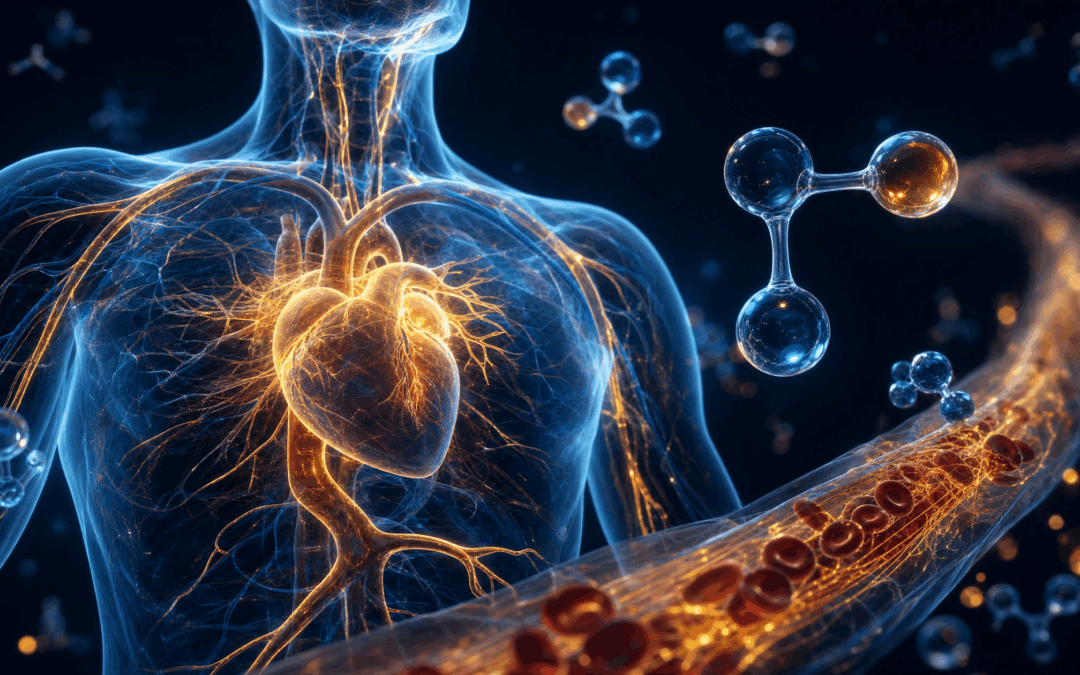
In 1998, three scientists won the Nobel Prize in Medicine for discovering a tiny, ephemeral molecule that controls the cardiovascular system: Nitric Oxide (NO). It is a gas produced by the endothelium—the inner lining of your blood vessels. When released, it signals the smooth muscle cells surrounding the vessels to relax. The vessels widen (vasodilation), blood pressure drops, and oxygen floods the tissues.
But there is a catch. Nitric Oxide has a half-life of just a few seconds. It must be produced constantly, on-demand, everywhere in the body. If the enzymes that make it—specifically Endothelial Nitric Oxide Synthase (eNOS)—become dysfunctional due to stress, aging, or inflammation, the vessels constrict. Blood pressure rises. Circulation slows. The system begins to starve.

The NOS Enzyme Cascade: How the Body Makes NO
The production of NO is not a single step; it is a complex biological cascade requiring precise substrates, cofactors, and triggers [1].

To produce NO, the body requires:
- L-Arginine: The primary amino acid substrate that eNOS converts into NO.
- Calcium & Calmodulin: The trigger that activates the eNOS enzyme.
- ATP & NADPH: The cellular energy required to drive the conversion.
- BH4 (Tetrahydrobiopterin): The critical cofactor that keeps eNOS coupled. If BH4 is missing, eNOS becomes “uncoupled” and produces destructive superoxide radicals instead of NO [2].
The Calculation Methodology: Translating Chemistry to Resonance
The core innovation behind the Nitric Oxide Pathway program is the translation of molecular biology into precise bioenergetic frequencies. How do you tell the body to produce NO using an electromagnetic field? You do not guess. You calculate it using molecular weights, atomic bonds, and harmonic translation.
While the exact proprietary algorithms remain confidential, the foundational science is rooted in molecular resonance. Every molecule has a specific molecular weight and atomic structure. For example, L-Arginine (C6H14N4O2) has a molar mass of 174.2 g/mol. Nitric Oxide (NO) has a molar mass of 30.01 g/mol.
Using advanced physics equations—such as the de Broglie wavelength equation ($$\lambda = \frac{h}{p}$$) and harmonic scaling (often using octaves of $2^n$ to step down Terahertz molecular vibrations into the biologically active extremely low frequency (ELF) range)—we can calculate the exact harmonic resonance of these substances. This allows the ePEMF field to act as an energetic “tuning fork” for the specific enzymes and substrates involved in the NOS cascade.
The 9-Phase program does not just play the frequency for “Nitric Oxide.” It sequences the entire metabolic pathway: first resonating with L-Arginine to increase substrate availability, then pacing the eNOS enzyme, stabilizing the BH4 cofactor to prevent uncoupling, and finally resonating with cGMP (cyclic guanosine monophosphate), the messenger molecule that actually tells the smooth muscle to relax.
Why Static Rife Frequencies Fail: The Cellular Adaptation Problem
For decades, the bioelectric community has attempted to address cardiovascular issues using single, static frequencies (often called “Rife” frequencies). The logic was simple: find the “frequency for blood pressure” and play it constantly.
The biological reality is much harsher. When you expose a cell’s ion channels to a constant, unchanging signal, the cell interprets it as a static environmental pressure. Within 3 to 5 minutes, the cell undergoes habituation. The receptors down-regulate. The ion channels close to protect the cell from energetic exhaustion. The signal is ignored.
This is why so many people experience a brief initial result with static frequency devices, followed by a permanent plateau. It is why the market is flooded with $30,000 used Rife machines selling for $2,000. The devices work mechanically, but they fail biologically because they do not account for cellular adaptation.

The 9-Phase Architecture: A Category Break in Bioenergetics
The Nitric Oxide Pathway 9-Phase Advanced Energetics program is not a single frequency. It is a dynamically shifting, multi-layered architecture designed to pace the entire NOS cascade without ever triggering cellular habituation. Because the signal envelope is constantly evolving through 9 distinct phases, the nervous system and cellular receptors cannot adapt to it. It remains a novel, actionable stimulus for the entire duration of the session.
The 10-Day Cardiovascular Coherence Protocol
To truly rebuild vascular tone and endothelial function, the system must be paced holistically. This 10-day protocol integrates the master NO pathway with supporting circulatory, mitochondrial, and detox energetics.
- Day 1 Play this 20 min per day each day: Nitric Oxide Pathway 9-Phase Advanced Energetics (The Master Switch)
- Day 2: Chlorine Dioxide + 11 Harmonics: Detox
- Day 3: Blood Pressure & Cardiovascular 6-Phase Reset Energetics
- Day 4: Blood Circulation Sluggishness Energetics
- Day 5: High Blood Pressure – Hypertension Advanced Energetics
- Day 6: High Blood Pressure Energetic
- Day 7: T5 Liver Blood Circulation Advanced Energetics
- Day 8: Blood Circulation
- Day 9: Capsaicin, Cayenne, Blood Pressure, Circulation, Eye, Metabolism, Detox Energetics
- Day 10: 4672 Hz Nogier, Brain, Hormonal Balance, Pain, Mood, Bone, Circulation Energetics
- Day 11: 1168 Hz Nogier, Connectivity, Muscle, Bone, Heart, Organ Pain, Circulation Energetics
Best Practices & Hardware Integration
To maximize the efficacy of this protocol, the delivery mechanism matters just as much as the signal architecture. The Nitric Oxide program relies on deep tissue penetration and systemic nervous system pacing.
1. The Vortex 6 Haptic PEMF Mat
For systemic cardiovascular pacing, the is the ultimate delivery vehicle. It provides full-body, high-fidelity scalar wave delivery. Lying on the mat during the Phase 9 HRV Coherence envelope allows the mechanical vibration and magnetic field to synchronize the entire vascular tree simultaneously.
2. Targeted Local Delivery: iTorus
For targeted circulatory support (e.g., cold extremities, localized tissue repair), place an iTorus i2 or iTorus i5 directly over the area of concern. The toroidal field structure drives the energetic information deep into the local capillary beds.
3. Wearable Integration: Woojer Vest
If you need mobility while running the protocol, the Woojer Vest 4 (Use code EPEMF10 for a discount) provides excellent haptic-acoustic transduction directly into the chest cavity, pacing the heart and central aorta.
4. Water Structuring: iMprinter
Hydration is critical for endothelial function and blood volume. Use the iMprinter / Metatronic Flower of Life plate to structure your drinking water with the Nitric Oxide program prior to the session. Drinking structured, frequency-imprinted water provides the intracellular fluid necessary for the vasodilation response.
Access the Complete Bioenergetic Library
The Nitric Oxide Pathway 9-Phase program, along with thousands of other advanced clinical protocols, is available exclusively on the PEMF Healing App.
For advanced users seeking a more powerful spiral geometry, the Archimedean Tesla Spiral Frequency Imprinter delivers an intensified toroidal field imprint using sacred geometric coil winding for deeper water structuring and enhanced bioelectric coherence.
References
[1] Förstermann, U., & Sessa, W. C. (2012). Nitric oxide synthases: regulation and function. European heart journal, 33(7), 829-837. Link
[2] Crabtree, M. J., & Channon, K. M. (2011). Synthesis and oxidation of tetrahydrobiopterin in cardiovascular disease. Trends in cardiovascular medicine, 32(5), 204-210. Link
[3] Moncada, S., & Higgs, A. (1993). The L-arginine-nitric oxide pathway. New England journal of medicine, 329(27), 2002-2012. Link
Related Articles
- Your Nervous System Has a Master Reset Switch. 90% of People Never Use It. The Vagus Nerve Crisis.
- Your Brain Washes Itself While You Sleep. Are You Letting It? The Crisis of Blocked Glymphatic Clearance.
- What Frequency Are You Wearing? The Truth Behind the Viral Fabric Chart
Disclaimer: This article contains affiliate links. If you purchase through these links, we may earn a small commission at no additional cost to you. This helps support our research and publication efforts.