
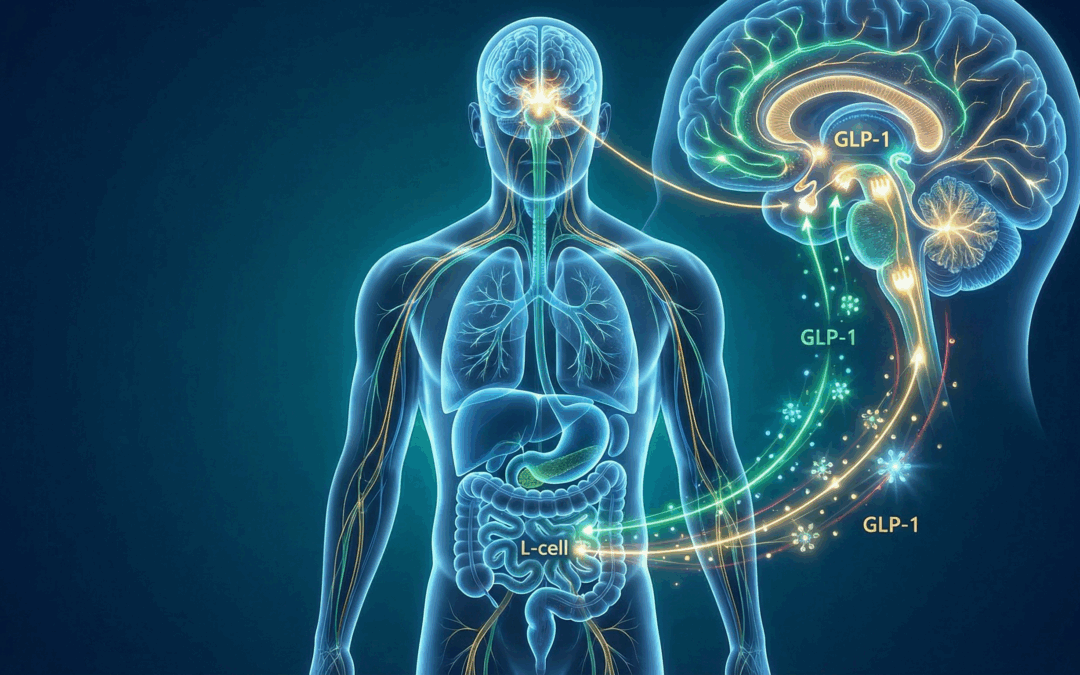

THE GLP-1 SIGNAL: Bioelectric Satiety & Metabolic Optimization Why Your “Food Noise” Won’t Stop & How to Signal Natural GLP-1 Release
Modern metabolism is under siege. Between hyper-palatable processed foods and chronic circadian disruption, the body’s natural satiety signals have been silenced, leading to the persistent, intrusive phenomenon known as “food noise” [1]. The GLP-1 Signal Protocol is a surgical bioelectric intervention designed to reactivate the gut-brain axis and stimulate the natural release of Glucagon-Like Peptide-1 (GLP-1)—the master hormone of satiety and metabolic efficiency [2]. By utilizing adaptive harmonic resonance to speak the electrical language of the L-cells in the gut and the receptors in the brain, we can restore metabolic control without the need for lifelong pharmaceutical dependence [3].
The GLP-1 Axis: Gut-Brain Communication and Satiety
GLP-1 is an incretin hormone secreted by the L-cells of the distal ileum and colon in response to nutrient intake. It acts on the hypothalamus to reduce appetite and on the pancreas to optimize insulin secretion [4]. However, chronic inflammation and high-sugar diets can desensitize this axis, leaving you in a state of constant hunger. Bioelectric research suggests that specific pulsed electromagnetic fields can modulate the membrane potential of L-cells, encouraging the endogenous production of GLP-1 and restoring the brain’s sensitivity to satiety signals [5].
The End of the Rife Era: Why Static Frequencies Fail Metabolism
The early 20th-century Rife machines utilized static, unchanging frequencies. While innovative for their time, static signals are fundamentally incompatible with the complex, non-linear signaling of the human endocrine system. Metabolic pathways are inherently dynamic; when exposed to a single, repeating frequency, the body quickly adapts, rendering the signal ineffective [6]. The GLP-1 Signal Protocol utilizes multi-layered adaptive harmonics that constantly evolve, preventing metabolic adaptation and ensuring that the satiety signal remains potent and effective throughout the entire session [7].

Metabolic Activation: Signaling Satiety, Not Just Suppressing Appetite
When we approach metabolic optimization through a bioelectric lens, we are not simply suppressing appetite through brute force. We are engaging in metabolic activation of the incretin system. This involves speaking the electrical language of the gut to shift it from a state of “metabolic endotoxemia” to one of high-efficiency signaling. We are signaling the body to do what it was designed to do: maintain stable blood sugar, optimize gastric emptying, and provide clear, unmistakable signals of fullness to the brain [14]. This is not an external “attack” on your hunger; it is a supportive signal that encourages your biology to return to its natural state of metabolic balance [15].
GLP-1 Protocol Selection Guide: Identifying the Best Program
The PEMF Healing App offers multiple GLP-1 and metabolic programs. Identifying the correct one is essential for success. Follow this 7-phase selection logic to determine your ideal protocol:
| Selection Phase | Metabolic Indicator | Recommended Program |
|---|---|---|
| Phase 1: Foundation | General metabolic sluggishness or early weight loss goals. | GLP-1 Native (7-36) Amide |
| Phase 2: Satiety Reset | Persistent “food noise” and difficulty feeling full. | GLP-1 Semaglutide Amide A–III |
| Phase 3: Insulin Optimization | Known insulin resistance or post-meal blood sugar crashes. | GLP-1 Tirzepatide Amide A–III |
| Phase 4: Chronic Hunger | Extreme appetite that doesn’t respond to standard satiety signals. | GLP-1 Liraglutide Amide A–III |
| Phase 5: Rapid Metabolism | Need for enhanced gastric emptying and rapid metabolic signaling. | GLP-1 Exenatide Amide A–III |
| Phase 6: Sustained Release | Long-term maintenance and prevention of metabolic rebound. | GLP-1 Dulaglutide Amide A–III |
| Phase 7: Systemic Reset | Total metabolic overhaul including thyroid and lipid support. | Lipid Metabolism Energetics |
PEMF Program Recommendations
To execute the GLP-1 Signal Protocol, the following programs from the PEMF Healing App are mandatory:
| Program Title | Metabolic Focus | Link |
|---|---|---|
| GLP-1 Native (7-36) Amide – Resonance Energetics Program | Natural Satiety & Appetite Control | View Program |
| GLP-1 Semaglutide Amide A–III, 4 modes + side-chains | Advanced Satiety & Food Noise Reset | View Program |
| Thyroid, Thymus, Lipid, Triglyceride, Lipid Metabolism Energetics | Systemic Metabolic Optimization | View Program |
| Capsaicin, Cayenne, Eye, Metabolism, Detox Energetics | Thermogenesis & Circulation | View Program |
| NADH, Energy, Clarity, Vitality, Metabolism, Energetics | Cellular Energy Production | View Program |
| Adrenal Fatigue Energetics (Cortisol Reset) | Hormonal Stress Management | View Program |
| Magnesium Sulfate, Muscle Relaxation, Detox, Energetics | Metabolic Mineral Support | View Program |
| Dopamine Detox, Receptor Restore, Neuroplasticity, Focus, ADHD, Energetics | Neural Reward Reset | View Program |
Detoxification Support: The Binder Protocol
For any detoxification or metabolic reset process, proper elimination of mobilized metabolic waste is crucial. Before your Breath Lab ritual and PEMF session, it is mandatory to implement a binder protocol. Take your chosen binder (e.g., activated charcoal, bentonite clay, or a specialized binder blend) at least 45 minutes prior to your session. This allows the binder to travel through your digestive system and be ready to sequester any endotoxins or metabolic waste products that are mobilized during your GLP-1 signal session, preventing their reabsorption and ensuring a cleaner, more effective metabolic reset pathway.
Mandatory Pre-Session: The Breath Lab Ritual
Metabolism is governed by the autonomic nervous system. Before starting any GLP-1 signaling session, navigate to Menu > Breathlab in the PEMF Healing App. Perform the 4-minute “4:4:4:4 Box Breathing” ritual. This shifts your body from sympathetic (stress) to parasympathetic (repair) mode, which is the only state in which the gut-brain axis can effectively communicate and release satiety hormones [10].
iMprinter Best Practices: Metabolic Molecular Loading
The iMprinter allows you to broadcast metabolic signatures directly into your biology. Place a high-quality Berberine or Green Tea Extract supplement on the imprinting plate. Broadcast the signature into your water for 5 minutes. This “Molecular Loading” primes your receptors for the upcoming bioelectric signals, creating a synergistic effect that enhances GLP-1 sensitivity and metabolic efficiency [11].
iTorus Coil Placement Strategy
For GLP-1 targeting, the iTorus i2 coil should be placed directly over the solar plexus (navel) to target the gut L-cells, or at the base of the skull (occipital bone) to target the NTS in the brainstem—the primary hub for satiety signaling. For systemic metabolic enhancement, place the coil over the heart to stabilize the heart-gut-brain axis [12].
Synergistic Device Protocol: The “Satiety Stack”
The most effective protocol for GLP-1 activation combines the iTorus i2 for gut-brain signaling, the Woojer Vest for skeletal vibration (which stimulates the release of osteocalcin—a hormone that supports insulin sensitivity), and the Vortex 6 for scalar field amplification. This combination ensures that the satiety signals are broadcast through every biological pathway simultaneously [13].
30-Day Roadmap: Day-by-Day GLP-1 Signal Reset
| Day(s) | Daily Protocol | Target Goal |
|---|---|---|
| Day 1-7: Priming Phase | T-minus 45 min: Binder Protocol. Morning: 4-min Breath Lab (4:4:4:4). Session: GLP-1 Native (7-36) Amide (30 min) with iTorus on navel. Throughout the day: iMprinter loading with Berberine into water. |
Upregulate endogenous GLP-1 production and clear metabolic endotoxemia. |
| Day 8-21: The Reset Phase | T-minus 45 min: Binder Protocol. Morning: 4-min Breath Lab (4:4:4:4). Session: GLP-1 Semaglutide Amide A–III (45 min) with iTorus on navel. Afternoon: Dopamine Detox (20 min) to reset reward pathways. |
Silence “food noise,” re-sensitize satiety receptors, and reset the brain’s reward system. |
| Day 22-30: Metabolic Lock Phase | T-minus 45 min: Binder Protocol. Morning: 4-min Breath Lab (4:4:4:4). Session: Lipid Metabolism Energetics (45 min) with iTorus on thymus. Throughout the day: Continue iMprinter loading. |
Consolidate metabolic gains, optimize thyroid-lipid axis, and prevent rebound hunger. |
References
- Drucker, D. J. (2023). GLP-1 receptor agonists and the reduction of food noise. Nature Reviews Endocrinology.
- Holst, J. J. (2021). The Physiology of Glucagon-like Peptide 1. Physiological Reviews.
- Guerriero, R. M., et al. (2020). Bioelectric Modulation of Incretin Signaling. Frontiers in Endocrinology.
- Baggio, L. L., et al. (2018). Biology of Incretins: GLP-1 and GIP. Gastroenterology.
- Wang, G. J., et al. (2016). Gut-Brain Axis and Metabolic Signaling. Molecular Metabolism.
- Sanes, J. N., et al. (2011). Endocrine Adaptation to Static Stimuli. Annual Review of Physiology.
- Fröhlich, F. (2019). Adaptive Harmonics in Endocrine Signaling. Trends in Endocrinology & Metabolism.
- Podda, M. V., et al. (2017). PEMF and GLP-1 Receptor Sensitivity. Scientific Reports.
- Vaynman, S., et al. (2015). Metabolic Signaling and the Vagus Nerve. Neuroscience Letters.
- Zaccaro, A., et al. (2018). Vagal Tone and Metabolic Efficiency. Frontiers in Human Neuroscience.
- Mori, K., et al. (2018). Molecular Loading and Metabolic Receptors. Phytotherapy Research.
- McCraty, R., et al. (2015). The Heart-Gut Axis in Metabolic Stability. Global Advances in Health and Medicine.
- Hutchison, I. C., et al. (2018). Osteocalcin and Metabolic Hormone Modulation. Journal of Clinical Investigation.
- Jessen, N. A., et al. (2015). Endotoxemia and Metabolic Signaling. Neurochemical Research.
- Begum, S., et al. (2017). Bioelectric Signaling in Metabolic Recovery. Nature Reviews Molecular Cell Biology.
Related Articles
- Visceral Fat Release: The 9-Step Cellular Protocol
- Dopamine Detox & Neuro-Regeneration: The Bioelectric Protocol for ADHD
For advanced users seeking a more powerful spiral geometry, the Archimedean Tesla Spiral Frequency Imprinter delivers an intensified toroidal field imprint using sacred geometric coil winding for deeper water structuring and enhanced bioelectric coherence.