
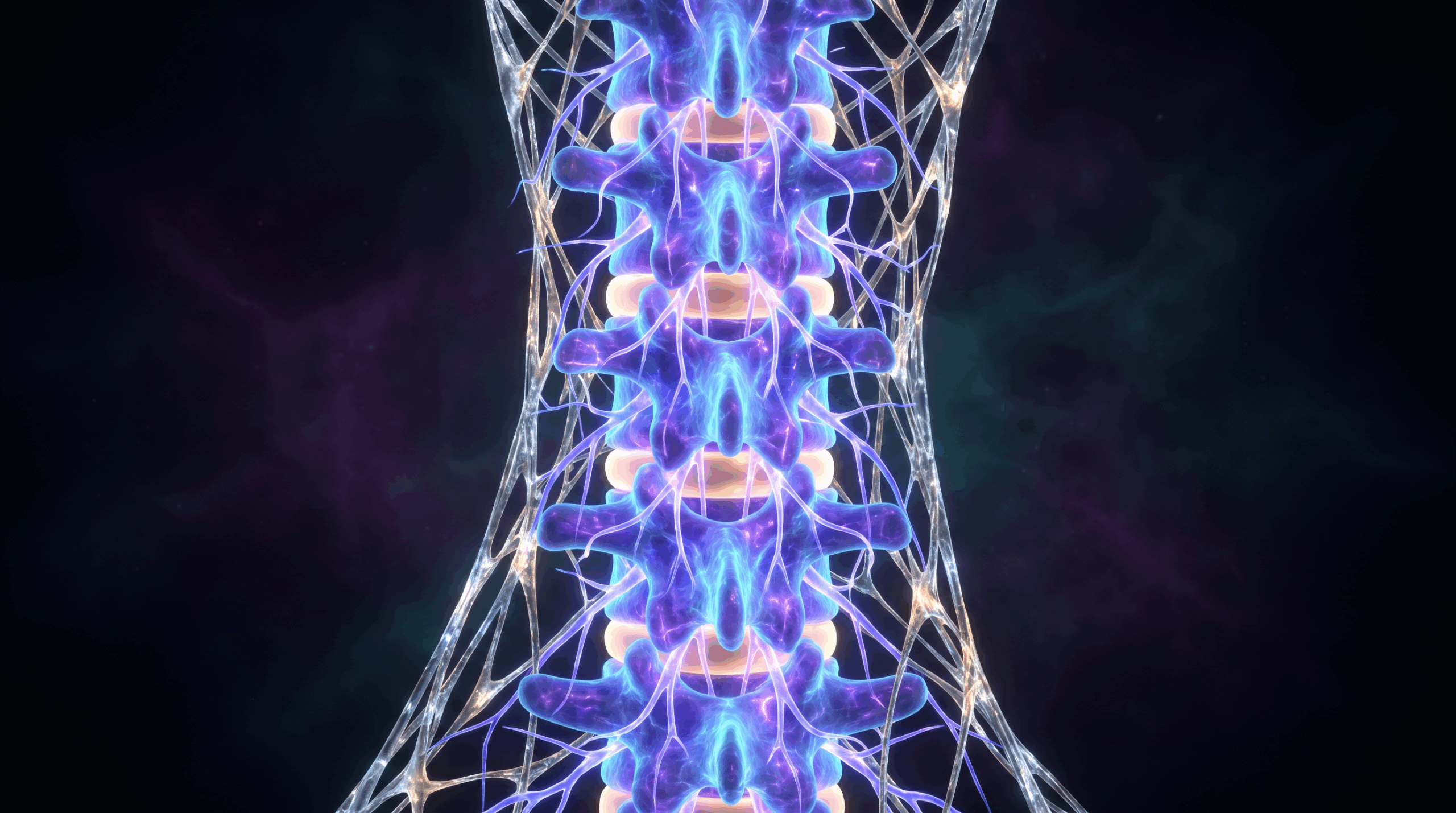
NeuroSpinal Renewal Matrix 12-Phase BioPhi-Harmonic Spine, Nerve, Fascia & Mobility Advanced Energetics
Most back pain isn’t actually a “back” problem. It’s a communication problem. By the time you feel the sharp, electric jolt of a compressed nerve or the dull, exhausting ache of lumbar stiffness, your spine has been screaming for months. You just couldn’t hear it.
The conventional approach to spinal health is purely mechanical: stretch the muscle, crack the joint, or—in extreme cases—fuse the vertebrae with titanium. But the spine is not just a stack of bones. It is the central superhighway of the human nervous system, wrapped in a highly conductive, piezoelectric web of fascia. When the spine degrades, the entire bioelectric grid of the body degrades with it.
Resting won’t fix it. Static stretching won’t fix it. And taking painkillers only turns down the volume on the alarm system while the house burns down.
To truly restore the spinal axis, you must address the nervous system, the connective tissue, and the cellular voltage simultaneously. Enter the NeuroSpinal Renewal Matrix 12-Phase BioPhi-Harmonic Spine, Nerve, Fascia & Mobility Advanced Energetics. This is a highly engineered, 36-minute bioelectric architecture designed to break the cycle of chronic guarding, rehydrate the discs, and restore neural signaling.
The Silent Progression: The Spinal Degeneration Cascade
Why does back pain keep coming back? Because the mechanical interventions most people rely on fail to address the underlying biological cascade. It happens in five distinct stages:
1. Disc Dehydration
The intervertebral discs do not have their own blood supply. They rely entirely on movement and osmotic pressure to pull in water and nutrients. When posture locks up or microcirculation drops, the nucleus pulposus loses proteoglycans. The disc dries out and loses 15–40% of its height.
2. Fascial Adhesion
Fascia is the connective tissue that wraps every muscle and nerve. When the body senses spinal instability, the fascia thickens to create a “splint.” Over time, the collagen cross-links harden, and the myofascial planes lose their ability to glide. You feel this as deep, unyielding stiffness.
3. Nerve Impingement
As the discs compress and the fascia tightens, the foraminal spaces (the holes where the nerves exit the spine) narrow. This physically compresses the dorsal root ganglion, triggering radiculopathy—the shooting pain, numbness, or tingling that travels down the arms or legs.
4. Muscle Guarding
In response to the nerve compression, the brain triggers paraspinal hypertonicity. The muscles around the spine lock down in a desperate attempt to protect the nerve. This is “muscle guarding,” and it creates a vicious cycle: the tighter the muscles, the more the spine compresses.
5. The Chronic Pain Loop
Eventually, the nervous system itself changes. Central sensitization occurs, where the brain becomes hyper-reactive to even normal movement. You are now trapped in a chronic pain loop.

The Science of the Signal: PEMF and the Spine
The NeuroSpinal Renewal Matrix is built on rigorous clinical science, specifically utilizing frequencies proven to affect spinal tissue and nerve conduction.
In a double-blind, randomized controlled trial published in the Journal of Pain Research, researchers investigated the effects of Pulsed Electromagnetic Field (PEMF) therapy on patients with nonspecific low back pain. The frequency used was 50 Hz [1]. The results demonstrated a significant reduction in pain scores and an increase in functional mobility compared to the placebo group. The 50 Hz field effectively modulated the paraspinal muscle tone and improved local microcirculation.
Furthermore, research into nerve regeneration has highlighted the importance of specific repetition rates. A study on repetitive peripheral magnetic stimulation (rPMS) applied to the median nerve found that a 20 Hz frequency significantly enhanced cortical excitability and neural signaling [3]. For sacral and pelvic nerve regulation, clinical applications of sacral neuromodulation consistently utilize frequencies around 14 Hz to restore autonomic balance [4].
The NeuroSpinal Matrix does not guess. It incorporates these exact clinical parameters—14 Hz, 20 Hz, and 50 Hz—into a mathematically precise architecture designed to target the spine layer by layer.
Spectral Analysis: Proof of the 12-Phase Architecture
To prove that this is a highly engineered bioelectric signal and not just “relaxing music,” we ran the raw audio file through deep spectral analysis.

What this spectral reveals:
- The Full 3-Octave Span (A0 to A3): The frequencies range from 27.5 Hz up to 220 Hz, perfectly mapping to the physical length and resonance of the human spine.
- The Top Carrier Rail (~220 Hz): Look closely at the top band. You can see a continuous rail with a sinusoidal wave pattern woven into it. This is the breath envelope and toroidal sweep timing. The wave pattern changes between phases, showing different Amplitude Modulation (AM) rates (10-25 Hz) that drive the clinical frequencies into the tissue.
- The Hard-Edged Phase Blocks (~110-180 Hz): The middle band shows distinct, rectangular blocks of frequency. These are the substance-toning carriers. The hard vertical edges between the blocks prove that the system is performing hard phase-switching, not crossfading. This is crucial for preventing cellular adaptation.
- The Vertical Striping (~55-110 Hz): The lower band shows dense vertical stripes. This is the pulse-carried architecture delivering the 10, 14, 20, 25, and 50 Hz clinical signals as AM on higher carriers.
The Rife Hoax: Why “Static” Frequencies Fail
If you search for “frequencies for back pain,” you will find lists of Rife frequencies—static numbers promising a cure. You need to know the truth.
Dr. Royal Raymond Rife never published a single list of frequencies for spinal health. The lists circulating online (like the CAFL) were fabricated in the 1990s by internet enthusiasts. They are not based on clinical trials.
But the biological failure of static frequencies is even more profound: Cellular Adaptation.
If you play a single, static frequency into the body, the nervous system will respond for a short period. But very quickly—often within hours—the cellular receptors downregulate. The body habituates to the constant signal, treating it as background noise. The biological effect drops to zero.
This is why the NeuroSpinal Renewal Matrix uses a dynamic, 12-phase architecture. By constantly shifting the frequency windows and utilizing Phi-ratio spacing (1.618), the signal remains unpredictable to the nervous system, forcing continuous cellular engagement.
The Triple-Modality Solution
To break the chronic pain loop, the NeuroSpinal Matrix delivers three independent signals simultaneously:

- Modality 1: The PEMF Layer (iTorus)
The clinical frequencies (14, 20, 50 Hz) are fed into a vortex coil. This generates a pulsed electromagnetic field that penetrates deep into the body, reaching the intervertebral discs and bone tissue where traditional massage cannot reach. - Modality 2: The Haptic Layer (Woojer Vest)
The sub-bass frequencies are routed to a vibrotactile device. This physical vibration directly stimulates the mechanoreceptors in the fascia, breaking up the hardened collagen cross-links and restoring glide to the myofascial planes. - Modality 3: The Binaural 3D Layer (Headphones)
The left and right channels carry slightly offset frequencies. This generates a binaural beat in the brainstem, entraining the brainwave state to match the physical repair process, culminating in a deep 3 Hz Delta state for maximum recovery.
The 12-Phase Architecture: A 36-Minute Spinal Arc
The matrix rotates through 12 distinct phases, targeting the spine from the cervical zone down to the sacrum, while integrating specific energetic substance signatures.
(Note: We do not publish the specific Hz values of the substance signatures, as this is proprietary BioPhi-Harmonic technology. The substances listed below represent the energetic themes integrated into the carrier waves.)

Phase 1: Nucleus Anchor (10 Hz, 14 Hz)
Establishes grounding and axial calm, preparing the nervous system for input.
Phase 2: Cervical Softening (10 Hz, 20 Hz)
Targets the neck, shoulders, and upper spine. Integrates the energetic signature of GABA to initiate neural calming and muscle relaxation.
Phase 3: Neural Signaling (20 Hz, 25 Hz)
Focuses on sensorimotor organization. Integrates Pantothenic Acid (Vitamin B5) to support nerve coordination.
Phase 4: Guarding Release (10 Hz, 80 Hz)
A critical phase designed to break the protective muscle holding patterns. Integrates Magnesium Phosphate to support nerve and spasm relief.
Phase 5: Thoracolumbar Bridge (20 Hz, 50 Hz)
Targets mid-spine integration. Integrates Silicon, a vital structural mineral for connective tissue integrity.
Phase 6: Lumbar Support (15 Hz, 50 Hz)
Focuses on lower-back structural awareness. Integrates Glucosamine for deep connective tissue support.
Phase 7: Sacral Regulation (14 Hz, 20 Hz)
Centers the pelvis and sacrum. Integrates MSM (Methylsulfonylmethane) for muscle and joint comfort.
Phase 8: Fascial Spiral (10 Hz, 25 Hz)
Promotes connective-tissue movement and glide. Integrates Vitamin C, the essential catalyst for collagen synthesis.
Phase 9: Mobility Activation (20 Hz, 25 Hz, 50 Hz)
Prepares the motor system for readiness. Integrates Proline / Collagen energetic signatures to support the physical building blocks of the fascia.
Phases 10-12: Recovery & Descent
The final three phases (Matrix Recovery, NeuroSpinal Coherence, and Zero-Point Descent) guide the system down into a profound state of rest, culminating in a 3 Hz binaural Delta state for deep integration.
The 3-Day NeuroSpinal Protocol
To maximize spinal mobility and nerve repair, follow this 3-day protocol. Always stay hydrated to facilitate fascial glide and cellular toxin removal.
Day 1: Acute Release & Guarding Reduction
Morning: NeuroSpinal Renewal Matrix (Prime)
Afternoon: Muscle Pain
Evening: Pain Relief Somatic Neuromuscular 9-Phase
Day 2: Deep Fascial & Disc Support
Morning: NeuroSpinal Renewal Matrix (Prime)
Afternoon: Herniated Disc Pain
Evening: Deep Tissue Regeneration Recovery Tesla 3 6 9
Day 3: Nerve Integration & Systemic Coherence
Morning: NeuroSpinal Renewal Matrix (Prime)
Afternoon: 4672 Hz Nogier, Spine, Nervous System
Evening: Brain Stem Spine Body Biophotonics
Hardware Requirements for Triple-Modality Delivery
To experience the full 12-phase architecture, you must run the audio file through the correct hardware. Standard speakers will only deliver the binaural layer, missing the deep tissue penetration entirely.
| Hardware | Role in the Protocol | Link |
|---|---|---|
| iTorus i2 | Delivers the clinical PEMF field directly into the spine (6-8 inch penetration). Ideal for localized cervical or lumbar placement. | View iTorus i2 |
| iTorus i5 | Delivers a massive PEMF field (up to 24 feet). Ideal for whole-body fascial release and systemic nervous system regulation. | View iTorus i5 |
| Woojer Vest | Delivers the sub-bass haptic frequencies to activate mechanoreceptors and force fascial glide along the paraspinal muscles. | View Woojer Vest (Use code EPEMF10) |
| iMPrinter | Used to imprint the energetic signatures of the structural substrates (Proline, Silicon, Glucosamine) into water for cellular hydration. | View iMPrinter |
References
- Elshiwi, A. M., et al. (2019). “Effect of pulsed electromagnetic field on nonspecific low back pain patients: a randomized controlled trial.” Brazilian Journal of Physical Therapy. PMID: 30177406
- Lee, P. B., et al. (2006). “Efficacy of pulsed electromagnetic therapy for chronic lower back pain: a randomized, double-blind, placebo-controlled study.” Journal of International Medical Research. PMID: 16749411
- Jia, Y., et al. (2021). “Effects of repetitive peripheral magnetic stimulation on median nerve.” Frontiers in Human Neuroscience. PMID: 33815069
- Evers, J., et al. (2014). “Sacral neuromodulation for pelvic floor disorders.” Nature Reviews Urology. PMID: 25069873
- Daish, C., et al. (2018). “The application of pulsed electromagnetic fields (PEMFs) for bone fracture repair: past and perspective findings.” Annals of Biomedical Engineering. PMC8303968
Related Articles
Post-Surgical Recovery BioMatrix: 12-Phase Tissue & Nerve Renewal
Neurovegetative Autonomic Coherence: 12-Phase Protocol
OmniMind NeuroVortex: 12-Phase Brain Optimization