
Program guide. Sedentary Metabolic Reset: 8-Phase Metabolic, Mitochondrial & Circulatory BioPhi-Harmonic Energetics is a 45-minute BioPhi-Harmonic composition built around a practical question: if prolonged sitting changes the rhythm of a day, why should a recovery-oriented sensory routine be a single unchanging tone?
The program’s answer is architectural. Its eight phases move from priming through a long muscle-mitochondrial research-context dwell, two clearly separated electrical-stimulation reference stages, a layered integration block, and controlled disassembly. The design is not presented as exercise, clinical PEMF, neuromuscular electrical stimulation, RF treatment, or metabolic therapy. It is a structured wellness composition that can make a movement transition feel deliberate, repeatable, and easier to protect on a crowded day.
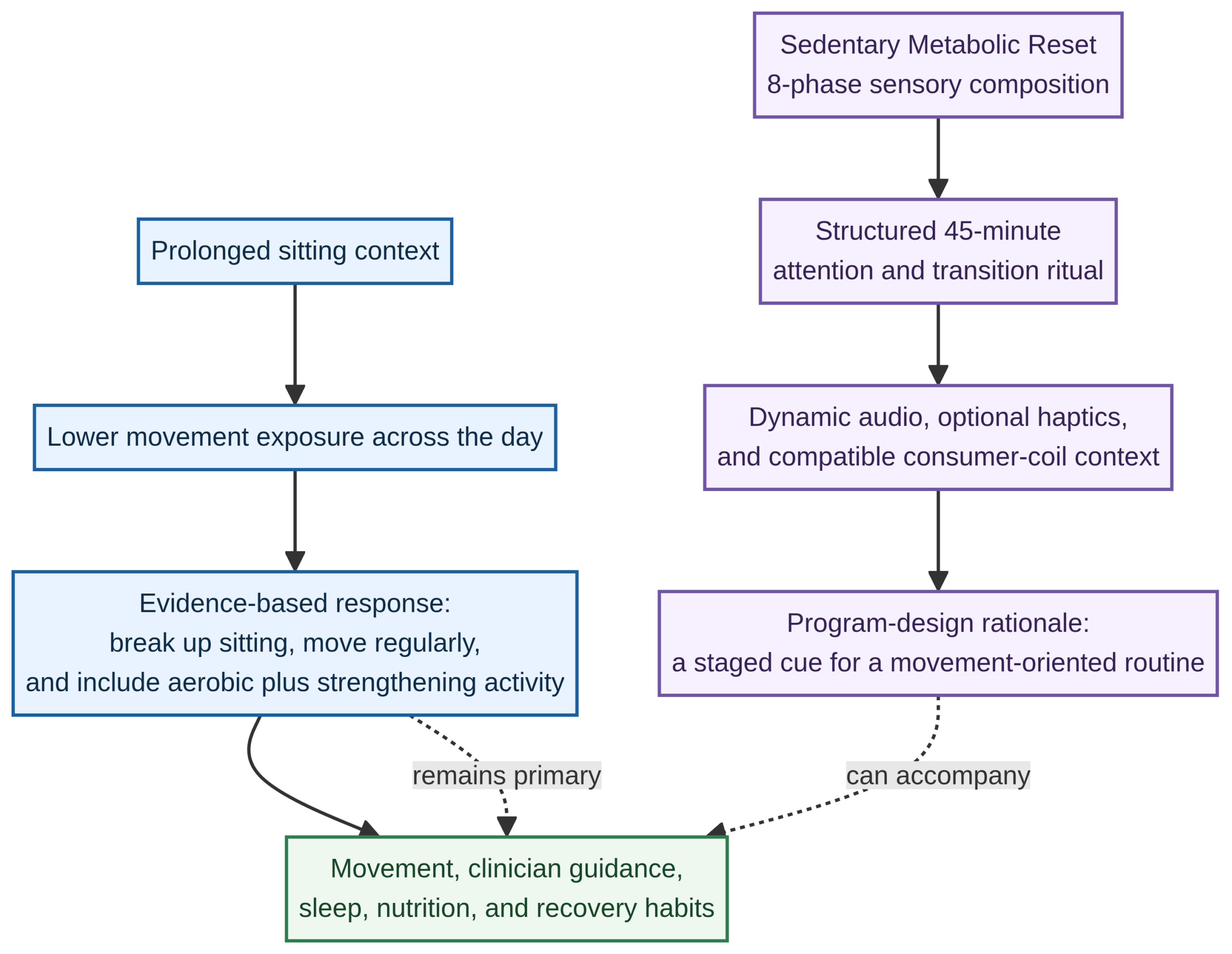
The central idea: movement remains the primary evidence-based response to sedentary time. This composition supplies a designed sensory container around the decision to stand, reset posture, walk, stretch, or return to a clinician-approved activity practice.
Why sedentary recovery deserves an architecture, not a generic “metabolism frequency”
Sedentary behavior is a behavioral and physiological context, not one isolated deficit. It involves long intervals with little skeletal-muscle movement, low energy expenditure, posture-specific loading, and a daily pattern that can become self-reinforcing. The World Health Organization recommends reducing sedentary time, accumulating 150 to 300 minutes of moderate-intensity aerobic activity or 75 to 150 minutes of vigorous activity weekly, and including regular muscle-strengthening activity. It also emphasizes that some activity is better than none.[1]
That is the first reason the Sedentary Metabolic Reset is different from a one-number wellness track. The featured design does not try to collapse movement science, human magnetic-field research, surface-electrode stimulation, sound engineering, and haptics into a single asserted mechanism. It organizes them as distinct layers of context. The practical result is a 45-minute progression with a beginning, a central dwell, a transition, and an exit, rather than a static audio loop presented as a complete metabolic strategy.
What the 45-minute design is built to organize
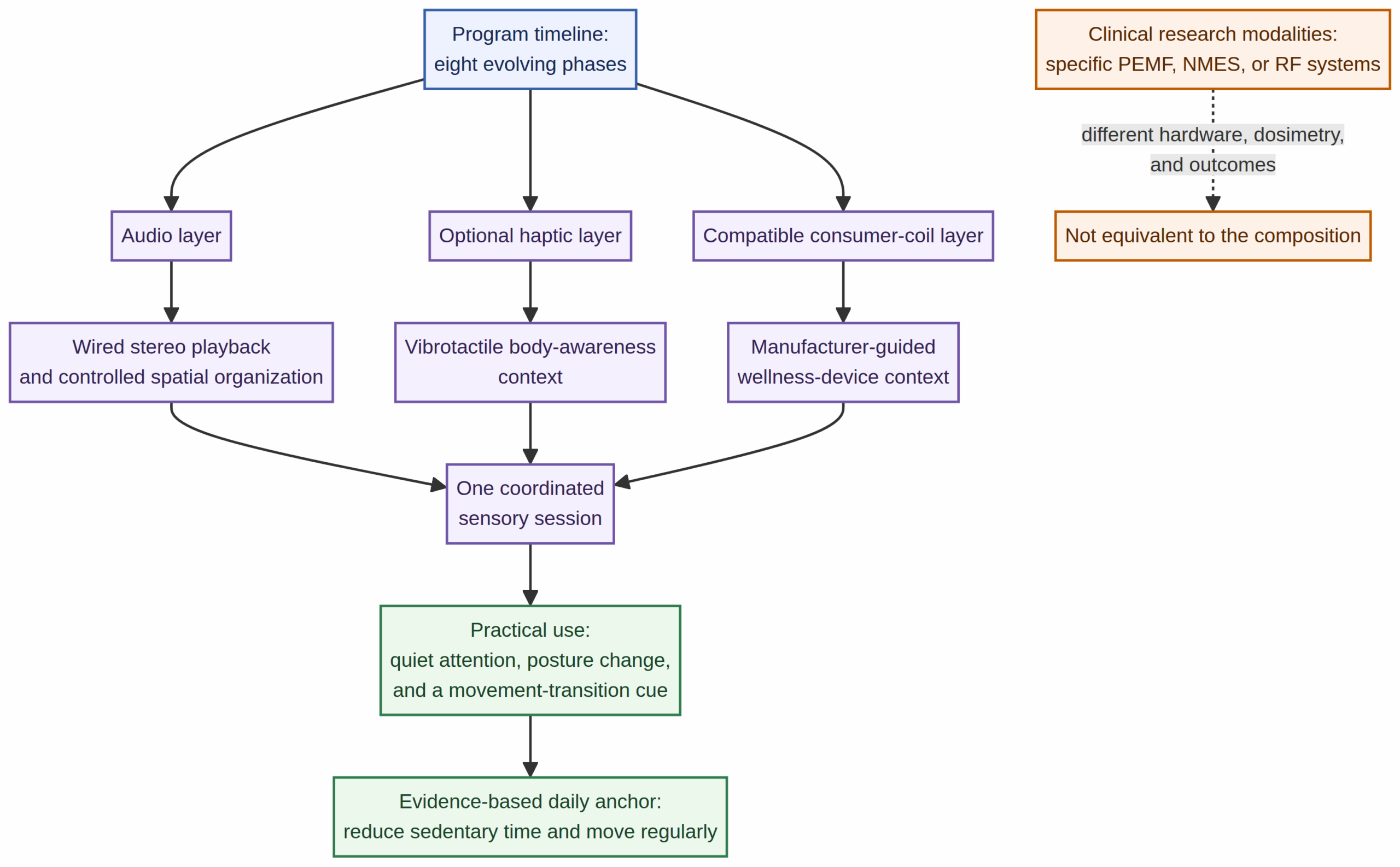
The composition is technically specific in a way that a generic tone stack is not. Its public production format is 44.1 kHz, 16-bit PCM stereo. Within that format, the architecture uses continuous oscillator phase, bounded amplitude modulation, smooth phase crossfades, controlled gain, Mid/Side spatial organization, and evolving layer weights. BioPhi is used here as an engineering organization language: smooth phase-relative evolution, coherent return points, controlled asymmetry, progressive assembly, and deliberate disassembly. It is not presented as an established biomedical frequency theory.
That distinction creates reader value. A frequency label by itself does not characterize a physical or sensory intervention. In biomedical research, waveform, intensity or field strength, carrier structure, pulse width, anatomy, coil or electrode geometry, exposure duration, and hardware transfer function all matter. The design therefore treats its low-frequency research references, audible translations, tactile translations, and spatial-stereo relations as different components of a coordinated composition, rather than as interchangeable claims.
The eight public phases

| Phase | Duration | Public function |
|---|---|---|
| 1. Priming | 3 minutes | Creates a measured entry into the session. |
| 2. Circulation research context | 5 minutes | Stages a human-PEMF research context without presenting a vascular intervention. |
| 3. Muscle-mitochondrial dwell | 12 minutes | Provides the longest deliberate dwell around the featured muscle-bioenergetics research context. |
| 4. NMES-reference organization | 5 minutes | Holds a surface-electrical-stimulation reference as a separate organizational layer. |
| 5. Electrical-stimulation reference organization | 6 minutes | Introduces a second distinct reference without implying induced contraction. |
| 6. Integrated architecture | 5 minutes | Combines the evolving audio, spatial, and optional tactile layers. |
| 7. Integrated metabolic field | 6 minutes | Continues the designed session toward closure; this is a program-design label, not a measured metabolic field. |
| 8. Controlled disassembly | 3 minutes | Reduces the layers with a deliberate, non-abrupt exit. |
How the research anchors are used with discipline
The central muscle-mitochondrial phase is anchored to a research family that investigated muscle-targeted magnetic-field exposure and bioenergetic measures in specific human and translational settings.[2] A separate randomized trial in adults with metabolic syndrome studied a particular PEMF intervention around a 30 ± 3 Hz reference family and reported selected nitric-oxide and cardiovascular-response findings under its own intervention conditions.[3] These studies are useful because they encourage parameter-aware thinking. They do not turn a consumer audio, haptic, or compatible-coil session into the same intervention.
The architecture also preserves a separate place for surface electrical stimulation research. One study of sedentary adults used neuromuscular electrical stimulation with electrodes and found a condition-specific postprandial glycemic effect under the tested protocol.[4] Earlier electrical-stimulation research similarly examined muscle contraction, oxygen consumption, and glucose uptake with surface electrodes.[5] Those are valuable physiological references, but the program does not claim to supply electrical current through electrodes or to reproduce contraction-producing NMES.
Additional research contexts strengthen the same point. A muscle-targeted PEMF study examined mobility and body-composition measures in its own population and protocol.[7] A sedentary-cycling study used a loop-antenna exposure with a 27.12 MHz carrier, burst structure, and exercise condition, so its repetition rate cannot be detached and represented as a standalone metabolic intervention.[8] An acute quadriceps-NMES study in adults with hyperglycemia also remains a contraction-producing electrical-stimulation protocol, rather than evidence about audio or consumer-coil use.[9]
This separation is a strength, not a weakness. It enables the reader to see the real design decision: the session acknowledges several research neighborhoods while refusing to mislabel one modality as another. The result is a richer, more intellectually honest wellness architecture.
Muscle, mitochondria, circulation, and the benefit of a movement cue
Skeletal muscle is central to movement and energy expenditure. Mitochondrial respiration, calcium signaling, high-energy phosphate metabolism, PGC-1α-associated signaling, and nitric-oxide-associated vascular physiology are all meaningful research terms in this broader landscape. A preclinical magnetic-field study, for example, investigated a TRPC1-associated pathway and mitochondrial adaptation in a model system.[6] That supports discussion of research context; it does not show that a wellness composition produces a cellular outcome in a listener.
The practical value of the program is therefore behavioral as much as sensory. A structured 45-minute transition can create a reliable moment to leave a chair, perform a comfortable walk, add brief mobility work, schedule a resistance session, or reset a work rhythm. For sedentary adults, that movement transition is not an afterthought. It is the evidence-supported anchor around which the composition is most responsibly used.[1]
The produced audio: a time-frequency view of an evolving composition

The supplied visualization is useful precisely because it stays in its lane. It makes the program’s temporal organization visible: broad band structure persists while lower-frequency regions and layer density change over the course of the composition. That visual supports the claim that the audio is staged rather than static. It does not identify what a body receives, measure a coil field, reveal confidential values, or establish metabolic change.
Why the program uses evolving layers rather than a static loop
The eight-phase form lets the design change the relative prominence of layers over time without hard switching, clipping, random glitches, or abrupt phase resets. The goal is not to assign a biological meaning to every harmonic. It is to translate a small set of research-informed organizational relationships into transducer-friendly audible, haptic, and compatible-coil contexts while retaining smoothness and coherence.
That is the BioPhi-Harmonic differentiator. The program has a beginning that prepares attention, a long central dwell that gives the muscle-mitochondrial research context structural priority, two modality-separated organizational references, an integration phase, and an exit. It is a deliberately composed experience, not a claim that one static tone can stand in for movement physiology.
Seven-day Sedentary Metabolic Reset routine
Use the primary program first every day. Leave a 10-minute quiet gap between programs. Pair the session with a comfortable posture change, walking break, or clinician-approved movement practice when appropriate. The companion titles below are linked exactly as named; their title language is not proof of a health outcome. After Day 7, take a one-week pause before any optional repeat.
Optional device and sensory setup
Run the primary program first. For headphone listening, use a comfortable volume and take breaks if sound causes discomfort; the WHO-ITU safe-listening standard emphasizes practical listening habits that protect hearing exposure.[10] For compatible consumer PEMF devices, follow the manufacturer’s connection, placement, output, and contraindication guidance. A haptic vest can add optional vibrotactile context, but it is not needed for the program to function as an audio-led routine.
The most productive setup is often simple: begin after standing from a work block, keep water nearby, select a comfortable and safe listening level, and use the end of the session as a cue for an easy walk or other personally appropriate movement. Do not use the routine as a reason to postpone medical care, skip prescribed exercise or rehabilitation, or disregard new symptoms.
Wellness resources and affiliate links
| Resource | Role in this feature |
|---|---|
| Frequency Healing App | Platform resource for the linked composition and related programs. |
| iTorus i2 | Optional compatible consumer-wellness device. Follow manufacturer instructions and contraindications. |
| iTorus i5 | Optional compatible consumer-wellness device. Follow manufacturer instructions and contraindications. |
| Woojer Vest 4 | Optional vibrotactile layer. Use code EPEMF10 where accepted. |
| Metatronic Flower of Life Dual Frequency Imprinter | Optional ritual or wellness layer; not a metabolic, medical, or water-treatment claim. |
Safety and scope
This feature is educational wellness content, not medical advice, diagnosis, or treatment. Seek timely clinical care for chest pain, fainting, unexplained shortness of breath, unilateral leg swelling, or new neurologic symptoms. If you are pregnant, have an implanted electronic device, live with known cardiovascular disease, are adjusting diabetes medication, or are unsure about exercise or PEMF, speak with a qualified clinician and follow device-manufacturer guidance before use.
Related Articles
- Adaptive Frequency Healing in 2026
- IBS-C, IBS-D, Gut Microbiome, Digestive & Thyroid Support Matrix: 12-Phase BioPhi-Harmonic Energetics
- Burnout & Mental Exhaustion: Evidence, 9-Phase Design, and a Cognitive-Recovery Protocol
References
- Bull FC et al. World Health Organization 2020 guidelines on physical activity and sedentary behaviour. British Journal of Sports Medicine. 2020.
- Muscle-targeted magnetic field exposure, high-energy phosphate metabolism, and mitochondrial bioenergetics research.
- Human double-blind randomized study of pulsed electromagnetic fields, nitric oxide, cardiovascular responses, and metabolic syndrome.
- Guzmán-González et al. Neuromuscular electrical stimulation frequency and postprandial glycemia in sedentary participants.
- Hamada et al. Surface electrical stimulation, muscular oxygen consumption, and glucose uptake.
- Preclinical magnetic-mitohormesis research on TRPC1-associated signaling and mitochondrial adaptation.
- Muscle-targeted PEMF research on mobility and body-composition measures.
- PEMF exposure during cycling in sedentary participants: device-specific exercise-context study.
- Acute quadriceps NMES study in adults with hyperglycemia.
- World Health Organization and ITU. Global standard for safe listening devices and systems.