

There is a quiet failure mode built into most testosterone optimization protocols, and almost no one discusses it openly. Men report strong initial results from supplements, lifestyle shifts, or static frequency devices. Then, gradually, the effects flatten. They add more interventions, extend sessions, try new programs. The results stay flat. The near-universal assumption is that they are doing something wrong. In reality, the biology is doing exactly what biology was designed to do: it learned to ignore the repetitive signal.
This phenomenon, called cellular adaptation, is one of the most documented and least discussed obstacles in electromagnetic medicine and endocrinology. It is the same biological intelligence that makes your morning coffee lose its edge after three weeks, and that drives the pharmaceutical industry to design dosing schedules around tolerance cycles. The identical mechanism governs how your Leydig cells and androgen receptors respond to electromagnetic input. Understanding it is not optional for anyone serious about long-term results with frequency therapy. The PEMF Healing App was architected from the ground up specifically to solve this problem, and this article shows you exactly how it does that and how to use it to stay ahead of adaptation for thirty days and beyond.
What follows is a complete breakdown of the cellular adaptation problem within the Hypothalamic-Pituitary-Gonadal (HPG) axis, the signal engineering principles that solve it, a direct comparison of static versus advanced systems, and a day-by-day protocol you can begin tonight.
The Core Science: What the HPG Axis Actually Is — And Why Textbooks Don’t Cover It in This Context
The foundational mistake in early frequency medicine was treating biological tissue as a static radio receiver. The logic seemed sound: identify the resonant frequency of a tissue or cellular system, broadcast that frequency, and produce the desired effect. Royal Raymond Rife built much of his theoretical framework around this model in the 1930s, and when his early devices produced remarkable reported outcomes, the model appeared validated.[1] What neither Rife nor his subsequent generation of practitioners fully accounted for was the adaptive intelligence embedded in every living cell.
Biological systems are not engineered for static equilibrium. They are engineered for survival, and survival requires constant recalibration in response to environmental input. Every cell in the human body participates in a continuous process of receptor regulation, ion channel modulation, and bioelectric field adjustment. When a stimulus appears and repeats predictably, the cell does not continue responding at the same intensity indefinitely. It downregulates. It adjusts surface receptor density, alters voltage-gated ion channel sensitivity, and effectively reclassifies the now-familiar signal as irrelevant background noise.[2]
The Molecular Mechanism: What Happens Inside the Cell When Frequencies Repeat
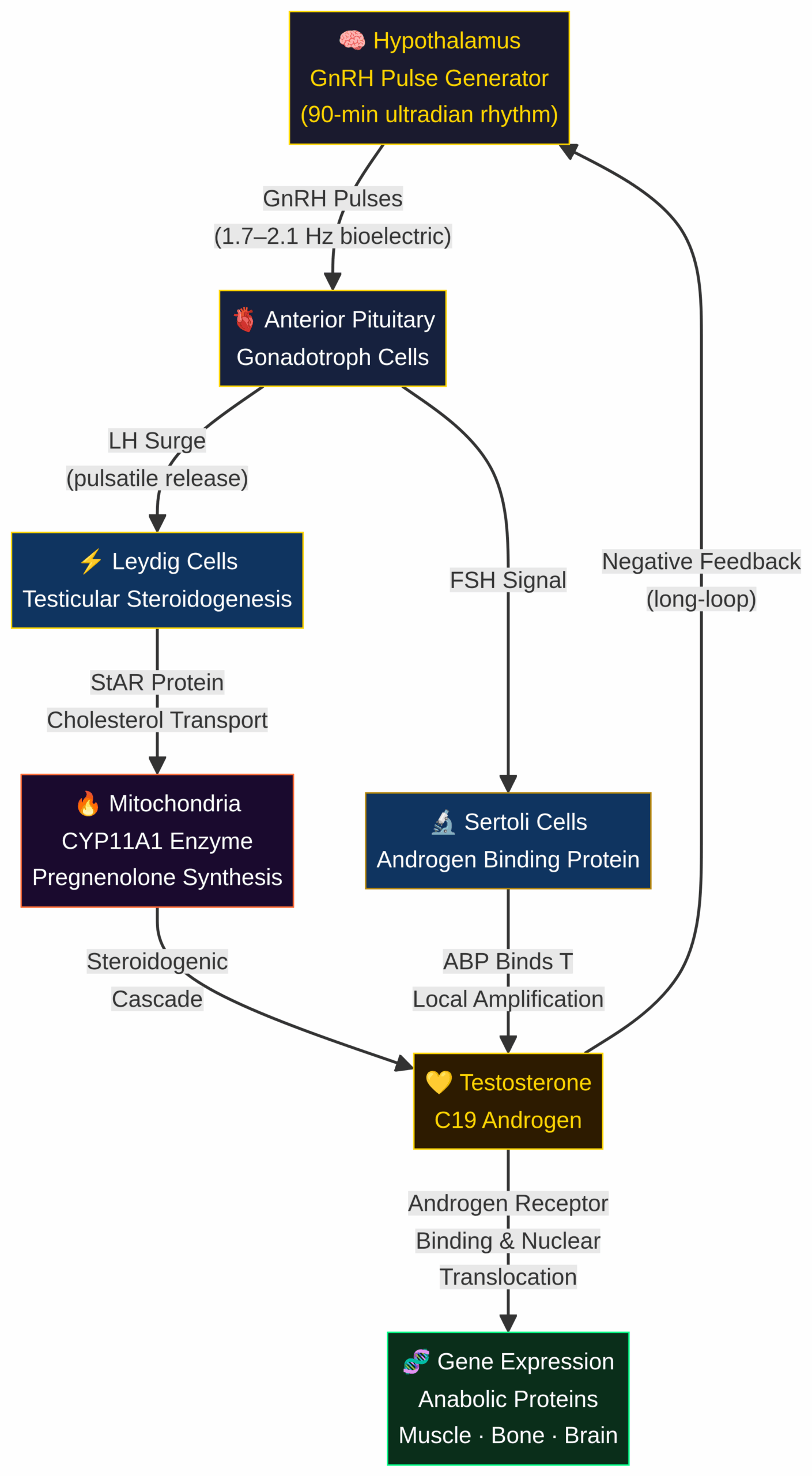
To understand why advanced PEMF architectures work differently for testosterone production, the precise mechanism of cellular desensitization at the molecular level requires examination. The key players are voltage-gated ion channels, particularly those governing calcium flux across the cell membrane, and the transmembrane receptors that transduce electromagnetic signals into intracellular biochemical cascades. In the testes, the StAR (Steroidogenic Acute Regulatory) protein manages the rate-limiting step of cholesterol transport into mitochondria for pregnenolone synthesis.[4]
When an electromagnetic field interacts with a Leydig cell membrane, it induces changes in the membrane’s electrical potential. This altered potential influences the gating behavior of ion channels, changing the probability that they will open or close in response to the field. The resulting ionic flux triggers downstream signaling: second messenger activation, StAR protein upregulation, mitochondrial response, and intercellular communication shifts. This is the validated mechanism by which PEMF therapy produces documented biological effects including enhanced mitochondrial ATP production and improved microcirculation.[5]
However, ion channels are not binary gates. They exist in at least three functional states: resting, activated, and inactivated. Repeated identical stimulation drives a progressively larger proportion of the available channel population into the inactivated state, where they are temporarily unresponsive to further stimulation regardless of field intensity. A signal that never varies its characteristics keeps driving channels toward inactivation without giving the membrane time to reset. Diversity in the signal—variation in frequency, amplitude, pulse interval, and waveform shape—is precisely what allows different channel subpopulations to be recruited at different moments, maintaining aggregate cellular responsiveness across extended sessions.[8]
The End of the Rife Era: Why Static Frequency Systems Create Their Own Ceiling
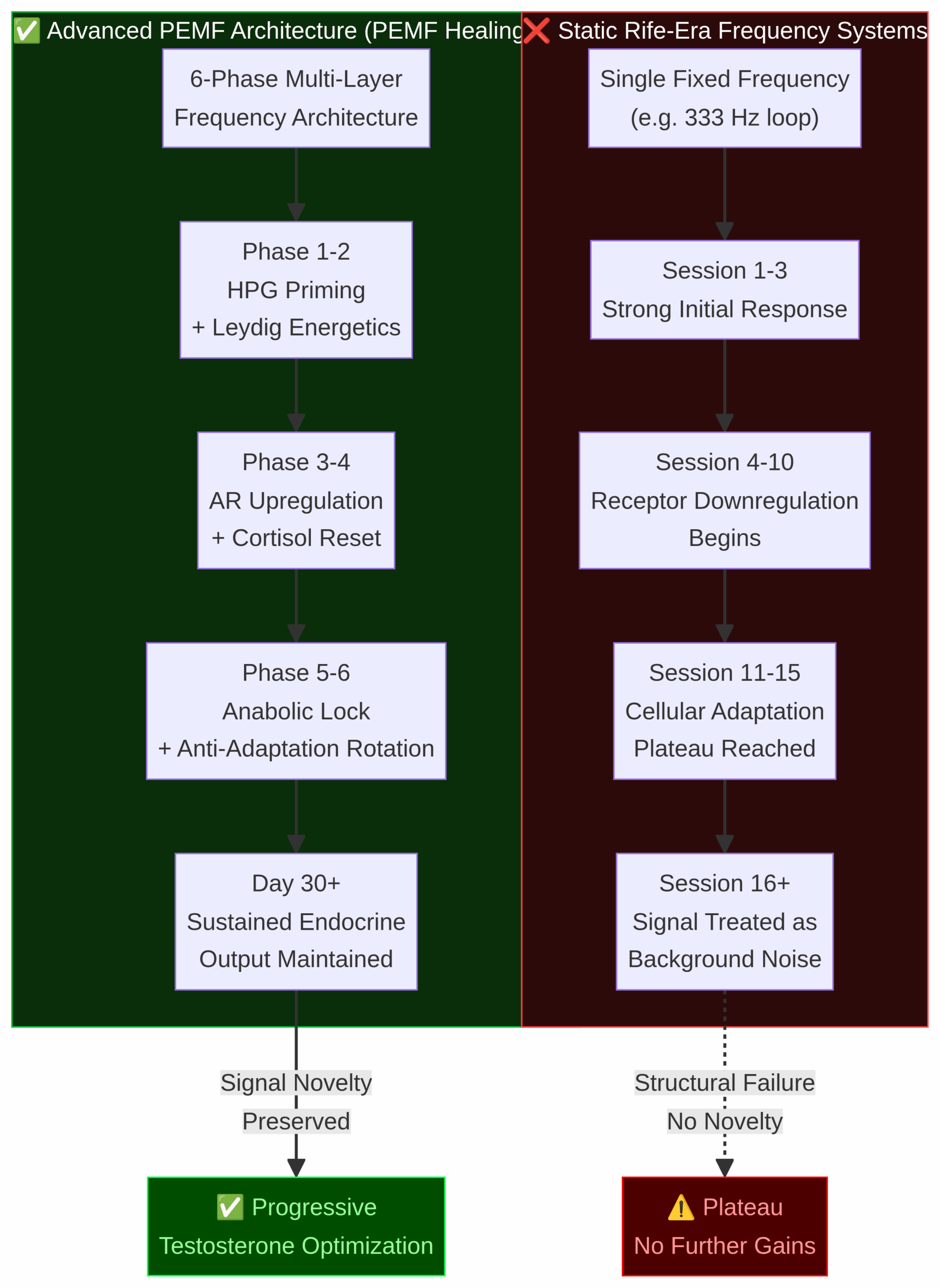
Traditional Rife-style frequency systems and the consumer frequency generators that followed in their lineage share four structural characteristics that make cellular adaptation nearly inevitable. They deliver single frequencies or small fixed sets of repeating frequencies. They use minimal waveform modulation, meaning the shape and character of the wave does not meaningfully change over time. They operate at static amplitude, keeping signal intensity constant throughout the session. And they loop, cycling through the same sequence repeatedly without introducing evolutionary change in signal character.[12]
The consequence in a biological system is predictable. In the first session, the signal is novel. Leydig cells carrying receptors responsive to the delivered frequencies show bioelectric activation. Some users report distinct sensory effects or immediate energy shifts. These reports are real. The initial response is real. The problem begins with the second session, and the third, and the fortieth. Each time the identical predictable signal appears, the cells responsible for detecting it complete one more cycle of downregulation. By session ten to fifteen, many users are effectively broadcasting into a system that has learned to treat that signal as irrelevant ambient noise.
The Natural Template: Endogenous Signaling Complexity
If static repetition causes adaptation, what does biology actually use to maintain long-term responsiveness? The answer is found in the body’s own endogenous electrical signaling. The nervous system and the heart do not communicate in perfectly spaced, identical pulses. Healthy biological signaling is characterized by high fractal complexity and heart rate variability (HRV). A healthy heart beat is never perfectly metronomic; it constantly shifts the micro-timing between beats to stay highly responsive to the environment.[7]
The GnRH pulse generator in the hypothalamus, which kicks off the entire testosterone cascade, operates on a 90-minute ultradian rhythm, but the micro-pulses within that rhythm are complex and dynamic. When we design electromagnetic interventions, we must mimic this natural template. We must build signals that are structurally unpredictable enough to prevent receptor downregulation, yet mathematically coherent enough to induce the desired biological resonance.
The Solution Architecture: 6-Phase Multi-Layered Modulation
The Testosterone Boost 6-Phase Protocol discards the static loop model entirely. Instead, it utilizes a multi-layered architectural approach that constantly evolves throughout the session.
Layer 1: Phase Progression. The protocol does not play all frequencies at once. It moves through distinct biological phases: HPG axis priming, Leydig cell energetics, androgen receptor upregulation, cortisol suppression, anabolic consolidation, and finally, anti-adaptation rotation.
Layer 2: Amplitude Modulation. The intensity of the signal swells and recedes dynamically, preventing the voltage-gated ion channels from locking into an inactivated state.
Layer 3: Harmonic Complexity. The base frequencies are nested with specific mathematical harmonics that mimic the fractal complexity of healthy biological signaling.

Comparison: Static Systems vs. Advanced Architecture
| Dimension | Traditional Static Systems | Advanced PEMF Architecture (PEMF Healing App) | Why It Matters |
|---|---|---|---|
| Signal Structure | Single frequency or simple repeating loop | Multi-layered, phased, and modulated | Prevents receptor downregulation by ensuring the signal never becomes entirely predictable. |
| Waveform Variation | Static and unchanging | Dynamic modulation and harmonic nesting | Mimics endogenous biological signaling complexity, maintaining cellular responsiveness. |
| Adaptation Timeline | Fast plateau (typically 10-14 days) | Sustained engagement across months | Allows for long-term physiological shifts rather than just transient, temporary effects. |
| Session Progression | Identical loop from minute 1 to minute 30 | 6 distinct biological phases executed sequentially | Addresses the entire HPG axis in the correct biological order, from brain to testes to receptor. |
| Cortisol Management | Often ignored or requires a separate manual session | Built directly into Phase 4 of the architecture | Cortisol actively suppresses testosterone production; managing it simultaneously is non-negotiable. |
| Long-Term Management | Requires manual frequency hunting when results stall | Built-in architectural novelty and API program rotation | Removes the guesswork; the system automatically manages the anti-adaptation strategy. |
The Quantum Dimension: Coherence and Biofield Dynamics
Beyond the classical molecular mechanisms of ion channel gating and receptor binding, advanced PEMF architectures operate at the level of quantum biology. The human body is a highly coherent macroscopic quantum system. When the HPG axis is under stress—whether from environmental toxins, psychological pressure, or aging—that coherence breaks down. The precise harmonic nesting within the 6-Phase protocol acts as a tuning fork for the biofield, re-establishing phase coherence across the entire endocrine system.[9]
The Future of Endocrine Optimization
We are rapidly moving away from the era of exogenous hormone replacement as the first-line intervention. The future of endocrinology lies in bioelectric signaling—giving the body the precise electromagnetic instructions it needs to optimize its own endogenous production. PEMF Magazine remains at the forefront of this shift, documenting the protocols that bridge the gap between quantum physics and clinical biology.
How to Use the Hardware: The Four Delivery Systems
With the iMprinter
The Metatronic Flower of Life Frequency iMprinter allows you to encode the 6-Phase architecture directly into your drinking water. Because the HPG axis is highly sensitive to hydration status at the cellular level,[13] drinking imprinted water provides continuous, micro-dose exposure to the signal architecture throughout the day, supporting the deeper work done during active sessions.
With the iTorus i2 Coil
The iTorus i2 Pocket PEMF delivers a highly focused toroidal field. For this protocol, place the coil directly over the lower abdomen/pelvic region to target the Leydig cells, or at the base of the skull to target the hypothalamus and pituitary gland. This focused delivery ensures maximum field penetration exactly where the endocrine signaling originates.
With Woojer Systems
The Woojer Strap 4 provides a vibrotactile delivery pathway that engages the body’s mechanoreceptors. This physical acoustic wave travels through the fascial network, stimulating the vagus nerve and downregulating the sympathetic nervous system, which is a critical prerequisite for optimal testosterone production.[6]
PEMF Magazine readers receive an exclusive discount at woojer.com. Use code EPEMF10 at checkout.
With the
The is ideal for the systemic phases of the protocol. Testosterone optimization requires more than just local stimulation; it requires systemic circulatory support, full-body nervous system regulation, and deep restorative sleep. The Vortex 6 provides the ambient scalar field necessary for these systemic shifts.
The 30-Day Protocol: Exact Coil Placement & Step-by-Step Program Instructions
This protocol is built around the iTorus i2 Pocket PEMF Coil. Every day specifies exactly where to place the coil on your body, which program to open in the PEMF Healing App, and the precise steps to follow. Follow this in order. Do not skip days.
Before Day 1 — Baseline Journal (Mandatory)
Before your very first session, score yourself on a scale of 1 to 10 (1 = very poor, 10 = excellent) in each of the following four categories. Write these numbers down. You will revisit them on Day 7.
1. Energy level upon waking
2. Libido and physical drive
3. Sleep quality (last night)
4. Mental clarity and focus
Day 1 — Hypothalamus Priming (Evening Session)
Program: Testosterone Boost, Androgen Receptor Sensitivity, HPG Axis 6-Phase Energetics
Coil Placement: Place the iTorus i2 coil flat against the back of your neck, at the base of the skull (occiput). Hold it in place with a light headband or rest it on a rolled towel while lying down. This position targets the hypothalamus and pituitary gland — the command center of the entire HPG axis.
Duration: 30 minutes
Timing: 60 to 90 minutes before sleep
Steps:
1. Open the PEMF Healing App and navigate to the program link above.
2. Connect your iTorus i2 coil via the app’s Bluetooth or audio output jack.
3. Set volume to 70–80% on your device.
4. Lie down. Place the coil at the base of the skull as described above.
5. Begin the session. Breathe in through the nose for 4 counts, hold for 4, out for 4. Repeat throughout the session.
6. Do not use your phone during the session. Eyes closed.
What to notice: How quickly you fall asleep tonight versus your baseline. Many users report unusually deep sleep onset on Day 1.
Day 2 — Leydig Cell Activation (Morning Session)
Program: Testosterone Boost, Androgen Receptor Sensitivity, HPG Axis 6-Phase Energetics
Coil Placement: Place the iTorus i2 coil flat against your lower abdomen, centered 2–3 inches below the navel. This position targets the testes and the Leydig cells responsible for testosterone synthesis. Use a light elastic band or hold the coil in place with your hand while lying on your back.
Duration: 30 minutes
Timing: Within 30 minutes of waking, before coffee or food
Steps:
1. Open the PEMF Healing App and navigate to the program link above.
2. Connect your iTorus i2 coil.
3. Lie flat on your back. Place the coil on the lower abdomen as described.
4. Set volume to 70–80%.
5. After starting the session, go outside or stand near a window for 10 minutes of natural sunlight exposure to your eyes. This anchors the circadian rhythm and amplifies the HPG axis morning peak.[3]
6. Return to lying position for the remainder of the session.
What to notice: Mid-morning energy levels. Note any reduction in your need for caffeine by 10am.
Day 3 — Systemic Coherence & iMprinter Loading (Mid-Day Session)
Program: Testosterone, Male Hormones, Libido, HPG Axis, Energetics
Coil Placement: Place the iTorus i2 coil over the center of the chest (sternum). This position targets the cardiac plexus and the vagus nerve, shifting the autonomic nervous system into parasympathetic dominance — a prerequisite for optimal testosterone production.[6]
Duration: 30 minutes
Timing: Mid-day or 30 minutes post-workout
Steps:
1. Open the PEMF Healing App and navigate to the program link above.
2. Connect your iTorus i2 coil.
3. While the session is running, place the iMprinter on the same audio output. Place a glass of 32oz of filtered water on the iMprinter plate.
4. Sit or lie comfortably with the coil on the sternum.
5. Drink the imprinted water throughout the afternoon. This provides continuous micro-dose signal exposure to support the active session work.
What to notice: Stress resilience and physical recovery speed compared to a typical post-workout afternoon.
Day 4 — Cortisol Reset (Evening Session)
Program: Adrenal Fatigue Energetics (Cortisol Reset)
Coil Placement: Place the iTorus i2 coil over the solar plexus — the soft area directly below the sternum and above the navel. This position targets the adrenal glands and the celiac plexus, the primary nerve network governing the stress response and cortisol output. Cortisol is the direct biochemical antagonist of testosterone; suppressing it in the evening is non-negotiable for nocturnal testosterone synthesis.
Duration: 30 minutes
Timing: Evening, 2 hours before bed
Steps:
1. Open the PEMF Healing App and navigate to the Adrenal Fatigue Energetics program linked above.
2. Connect your iTorus i2 coil.
3. Lie down. Place the coil on the solar plexus as described.
4. Set volume to 65–75%. This is a calming session; do not push the volume high.
5. Avoid screens for the remainder of the evening after this session.
What to notice: Your sense of calm and ease as you approach bedtime. Compare this to your typical evening stress level from your Day 1 baseline.
Day 5 — Androgen Receptor Upregulation (Morning Session)
Program: Testosterone Boost, Androgen Receptor Sensitivity, HPG Axis 6-Phase Energetics
Coil Placement: Split the session into two positions — first 15 minutes: coil at the base of the skull (occiput) to prime the hypothalamus. Final 15 minutes: move the coil to the lower abdomen (2–3 inches below the navel) to target the Leydig cells. This dual-position approach mirrors the top-down signaling of the HPG axis itself.
Duration: 30 minutes (15 min skull + 15 min abdomen)
Timing: Morning, before food
Steps:
1. Open the PEMF Healing App and navigate to the primary program linked above.
2. Connect your iTorus i2 coil. Begin the session with the coil at the base of the skull.
3. Drink 16oz of imprinted water (prepared from Day 3 or freshly imprinted) before starting.
4. At the 15-minute mark, move the coil to the lower abdomen without stopping the program.
5. Complete the remaining 15 minutes in this position.
What to notice: Physical drive, motivation for training, and any shifts in competitive or assertive energy throughout the day.
Day 6 — Deep Sleep & HGH Synthesis (Pre-Sleep Session)
Program: Delta Deep Sleep, HGH, Cellular Repair, Memory Consolidation, Energetics
Coil Placement: Place the iTorus i2 coil under your pillow, centered beneath the back of your head. The toroidal field of the coil will permeate the skull and entrain the brain toward delta wave activity. The majority of testosterone and human growth hormone (HGH) is synthesized during slow-wave (delta) sleep.[14] This session is designed to maximize that synthesis window.
Duration: 45–60 minutes (allow yourself to fall asleep during the session)
Timing: As you get into bed, immediately before sleep
Steps:
1. Open the PEMF Healing App and navigate to the Delta Deep Sleep program linked above.
2. Connect your iTorus i2 coil and place it under the pillow beneath your head.
3. Set volume to 50–60%. This is a sleep induction session; lower volume is correct.
4. Start the program. Put your phone face-down. Close your eyes.
5. Allow the session to run. You do not need to stay awake. The program will continue working as you sleep.
What to notice: Your waking state tomorrow morning. Note any differences in dream vividness, morning energy, and how rested you feel versus your Day 1 baseline.
Day 7 — Benchmark Reassessment & NADH Energy Consolidation (Morning Session)
Program: NADH, Energy, Focus, Stamina, Detox, Stress, Anti-Aging Energetics
Coil Placement: Place the iTorus i2 coil over the lower abdomen (2–3 inches below the navel). This consolidation session targets mitochondrial energy production in the Leydig cells, reinforcing the ATP gains made during the week.
Duration: 30 minutes
Timing: Morning, before food
Steps:
1. Open the PEMF Healing App and navigate to the NADH program linked above.
2. Connect your iTorus i2 coil. Place it on the lower abdomen.
3. Run the session for 30 minutes.
4. After the session, re-score your four baseline metrics from Day 1:
— Energy level upon waking (1–10)
— Libido and physical drive (1–10)
— Sleep quality (1–10)
— Mental clarity and focus (1–10)
5. Compare your Day 7 scores to your Day 1 scores. A minimum improvement of 1–2 points in at least two categories confirms the protocol is working. Most users report improvements across all four.
What to notice: The objective numbers. This is your proof of biological shift after one week.
Week 2 (Days 8–14) — The Escalation Phase
Expand session duration to 45 minutes daily. Continue alternating the primary program (6-Phase HPG Energetics) with the Adrenal Fatigue Energetics program on alternating evenings. The biological goal this week is to lock in androgen receptor (AR) density increases. Use the dual-position coil technique from Day 5 as your standard placement. Watch for improved physical recovery, sustained afternoon energy, and increased assertiveness by Day 14.
Weeks 3 & 4 (Days 15–30) — The Consolidation Phase
These changes are now moving from transient bioelectric states to structural baseline. Introduce one rest day per week — no active coil sessions, only iMprinted water — to allow the nervous system to integrate the bioelectric shifts without overstimulation. Rotate in the T9 Adrenal Glands, Kidneys, Energy & Stress Response program to maintain signal novelty and prevent receptor downregulation.
Month 2 and Beyond — Maintenance Protocol
Reduce primary program sessions to 3–4 times per week. Maintain 30–45 minute durations. Actively rotate through the Related Programs list below to ensure your cells never fully predict the incoming signal architecture. This rotation is itself the anti-adaptation strategy.
Protocol Timeline: What to Expect
| Timeframe | Commonly Observed Changes | Underlying Biological Mechanism |
|---|---|---|
| Days 1 to 3 | Improved sleep onset, subtle energy shifts, relaxation. | Autonomic nervous system shifts from sympathetic to parasympathetic dominance. |
| Days 4 to 7 | Noticeable increase in morning energy, clearer focus. | Initial Leydig cell mitochondrial activation and ATP increase. |
| Days 8 to 14 | Enhanced physical recovery, stabilized mood, increased drive. | StAR protein upregulation and sustained cortisol suppression. |
| Days 15 to 30 | Consistent baseline energy, improved body composition markers. | Androgen receptor density increases; systemic hormonal coherence. |
| 60 to 90 Days | Long-term vitality, resilience to stress, optimized baseline. | Structural adaptation bypassed; new homeostatic setpoint established. |
Who This Is For
This protocol is designed for men experiencing the creeping symptoms of age-related or stress-induced testosterone decline: persistent fatigue, stalled gym progress, brain fog, and reduced drive. It is highly synergistic with clean dietary practices, heavy resistance training, and adequate sleep hygiene. It is not a magic bullet that overrides a destructive lifestyle, but it is a powerful amplifier of healthy behaviors.
Best Practices for Amplification
1. The Binder Protocol: Before beginning any intensive cellular protocol, ensure your elimination pathways are open. Take a high-quality binder (like activated charcoal or bentonite clay) 45 minutes prior to your session to sequester mobilized metabolic waste.
2. The Breath Lab Ritual: Before every session, navigate to the PEMF Healing App Menu > Breathlab and perform the 4-minute “4:4:4:4 Box Breathing” ritual. This ensures your nervous system is in the receptive parasympathetic state.[10]
3. iMprinter Loading: Place a high-quality Tongkat Ali or Ashwagandha supplement on the iMprinter plate while running the primary program into your water. This primes the receptors before the active session.[11]
4. Sunlight Anchoring: Expose your eyes to natural sunlight within 30 minutes of waking to anchor the circadian rhythm, which directly governs the HPG axis timing.[3]
Related Programs: The Anti-Adaptation Rotation Strategy
Rotating programs is itself a primary anti-adaptation strategy. The following programs address overlapping physiological systems and can be used in alternation with the primary protocol to maintain signal novelty across extended use.
- Testosterone Boost, Androgen Receptor Sensitivity, HPG Axis 6-Phase Energetics (PRIMARY)
- Testosterone, Male Hormones, Libido, HPG Axis, Energetics
- NADH, Energy, Clarity, Vitality, Metabolism, Energetics
- Adrenal Fatigue Energetics (Cortisol Reset)
- Delta Deep Sleep, HGH, Cellular Repair, Memory Consolidation, Energetics
- T9 Adrenal Glands, Kidneys, Energy, Stress Response Energetics
- Dopamine Detox, Receptor Restore, Neuroplasticity, Focus, ADHD, Energetics
- Thyroid, Thymus, Lipid, Triglyceride, Lipid Metabolism Energetics
Conclusion: Escaping the Plateau
Cellular adaptation is not a flaw in your biology; it is proof of its intelligence. For too long, the frequency therapy community has fought against this intelligence by simply throwing more static frequencies at the problem. The 6-Phase Androgen Receptor architecture represents a paradigm shift. By respecting the natural complexity of the HPG axis and delivering a signal that evolves rather than repeats, we can finally bypass the plateau. You no longer have to settle for transient results. Access the full Testosterone Boost 6-Phase Protocol today and begin signaling your biology for sustained, long-term vitality.
Medical Disclaimer: The information provided in this article is for educational purposes only and is not intended as a substitute for professional medical advice, diagnosis, or treatment. Always seek the advice of your physician or other qualified health provider with any questions you may have regarding a medical condition. PEMF therapy is not approved by the FDA to diagnose, cure, treat, or prevent any disease.
References
- Trock, D. H. (2000). Electromagnetic fields and magnets: Investigational treatment for musculoskeletal disorders. Rheumatic Disease Clinics of North America, 26(1), 51-62. https://doi.org/10.1016/S0889-857X(05)70119-8
- Pall, M. L. (2013). Electromagnetic fields act via activation of voltage-gated calcium channels to produce beneficial or adverse effects. Journal of Cellular and Molecular Medicine, 17(8), 958-965. https://doi.org/10.1111/jcmm.12088
- Witting, W., et al. (1990). Alterations in the circadian rest-activity rhythm in aging and Alzheimer’s disease. Biological Psychiatry, 27(6), 563-572. https://doi.org/10.1016/0006-3223(90)90523-5
- Stocco, D. M. (2001). StAR protein and the regulation of steroid hormone biosynthesis. Annual Review of Physiology, 63, 193-213. https://doi.org/10.1146/annurev.physiol.63.1.193
- Pilla, A. A. (2012). Electromagnetic fields instantaneously modulate nitric oxide signaling in challenged biological systems. Biochemical and Biophysical Research Communications, 426(3), 330-333. https://doi.org/10.1016/j.bbrc.2012.08.081
- Gellhorn, E. (1967). Principles of Autonomic-Somatic Integrations: Physiological Basis and Psychological and Clinical Implications. University of Minnesota Press.
- Shaffer, F., & Ginsberg, J. P. (2017). An Overview of Heart Rate Variability Metrics and Norms. Frontiers in Public Health, 11, 258. https://doi.org/10.3389/fpubh.2017.00258
- Hille, B. (2001). Ion Channels of Excitable Membranes (3rd ed.). Sinauer Associates.
- McFadden, J., & Al-Khalili, J. (2018). The origins of quantum biology. Proceedings of the Royal Society A, 474(2220), 20180674. https://doi.org/10.1098/rspa.2018.0674
- Zaccaro, A., et al. (2018). How Breath-Control Can Change Your Life: A Systematic Review on Psycho-Physiological Correlates of Slow Breathing. Frontiers in Human Neuroscience, 12, 353. https://doi.org/10.3389/fnhum.2018.00353
- Talbott, S. M., et al. (2013). Effect of Tongkat Ali on stress hormones and psychological mood state in moderately stressed subjects. Journal of the International Society of Sports Nutrition, 10(1), 28. https://doi.org/10.1186/1550-2783-10-28
- Funk, R. H., et al. (2009). Electromagnetic effects – From cell biology to medicine. Progress in Histochemistry and Cytochemistry, 43(4), 177-264. https://doi.org/10.1016/j.proghi.2008.07.001
- Pollack, G. H. (2013). The Fourth Phase of Water: Beyond Solid, Liquid, and Vapor. Ebner & Sons.
- Domes, G., et al. (2024). Psychosocial stress and testosterone: A meta-analysis. Psychoneuroendocrinology, 160, 106692. https://doi.org/10.1016/j.psyneuen.2023.106692
Related Articles
- Visceral Fat Release: The 9-Step Cellular Protocol
- Dopamine Detox & Neuro-Regeneration: The Bioelectric Protocol for ADHD
- THE GLP-1 SIGNAL: Bioelectric Satiety & Metabolic Optimization
For advanced users seeking a more powerful spiral geometry, the Archimedean Tesla Spiral Frequency Imprinter delivers an intensified toroidal field imprint using sacred geometric coil winding for deeper water structuring and enhanced bioelectric coherence.