
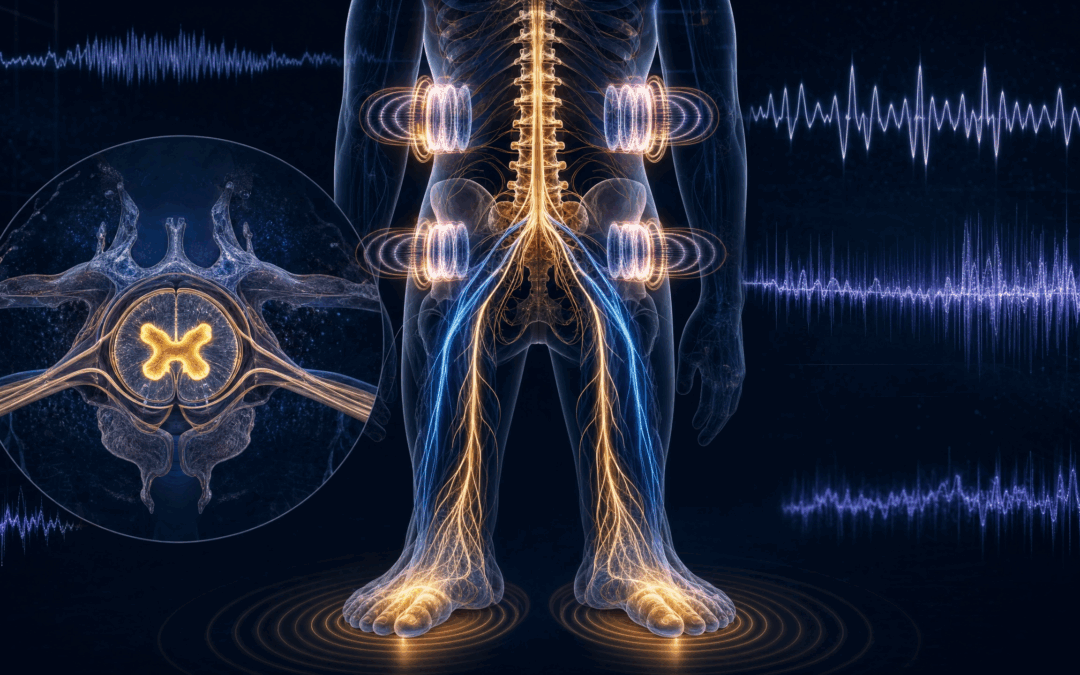
They told you it was permanent. They told you the myelin sheath was gone, the axons were dying, and the best you could hope for was managing the agony with gabapentin or pregabalin. If you suffer from diabetic neuropathy, chronic back pain, or severe leg pain, you already know the grim reality: the standard medical model has largely given up on repairing your nerves.
But the standard medical model is operating on outdated physics. They are still treating the nervous system like a chemical soup, trying to numb the pain receptors with drugs. But your nervous system is not a chemical soup—it is a high-speed electrical grid. And when that grid is short-circuiting, sending constant, screaming pain signals to your brain, you don’t need a chemical numbing agent. You need a targeted electromagnetic intervention.
Enter the Chronic 7-Phase Back, Leg & Diabetic Neuropathy HF-SCS Bilateral-Phase Energetics protocol. This is not your grandfather’s single-frequency Rife machine. This is a clinical-grade, 42-minute high-frequency spinal cord stimulation (HF-SCS) architecture [1] designed to do what drugs cannot: silence the pain signal at the dorsal horn, recruit inhibitory interneurons, and trigger actual mitochondrial repair in the damaged nerve tissue.
The Science of Silence: How 10 kHz High-Frequency SCS Works
To understand why this protocol is a paradigm shift, you have to understand how pain signals travel. When you have neuropathy or chronic back pain, the damaged nerves in your periphery (legs, feet, lower back) send rapid-fire pain signals up the spinal cord. These signals enter the spinal cord at a specific junction called the dorsal horn.
Traditional TENS units and older PEMF devices try to block this pain using low frequencies (like 50 Hz), which often just replace the pain with a buzzing or tingling sensation (paresthesia). It’s a distraction, not a solution.
The breakthrough came with the discovery of 10 kHz High-Frequency Spinal Cord Stimulation (HF-SCS) [2]. At 10,000 Hz, something remarkable happens. The frequency is so fast that the pain-transmitting nerves simply cannot keep up. They enter a state of “conduction block.” More importantly, this specific 10 kHz frequency selectively activates the inhibitory interneurons in the dorsal horn—the body’s natural gatekeepers that stop pain signals from reaching the brain [3].
This protocol embeds that precise 10 kHz payload into a sweeping, 7-phase architecture, delivering it non-invasively through bilateral coil placement and haptic transduction.
Inside the Protocol: What the Spectral Analysis Reveals
This spectral image is taken directly from the ePEMF app’s audio analysis view of the Neuropathy HF-SCS protocol. It is a visual fingerprint of the frequency architecture at work, showing the precise moment the carrier frequencies shift to engage different neural pathways.

What you are seeing: This view maps the protocol’s low-frequency carrier architecture. You can clearly see the distinct phases. On the far left, the solid band represents the Phase 1 sub-sensory calibration. As it moves right, the frequency steps up into the 145-200 Hz range for Phase 2 (Inhibitory Interneuron Recruitment). The large, sustained blocks in the middle represent the core therapeutic windows (Phases 3 and 4), where the 10 kHz AM envelope (not visible in this low-frequency pitch view, but riding on top of these carriers) is delivered at maximum depth. The step-down patterns on the right show the protocol shifting into the slower regenerative frequencies (Phase 5) and finally collapsing down to the Schumann resonance for closure (Phase 7). The black vertical gaps are intentional micro-pauses to prevent neural adaptation.
The End of the Rife Era: Why Static Frequencies Fail
For decades, the alternative health space has been dominated by Rife machines and basic frequency generators. These devices operate on a simple premise: pick a single frequency (e.g., 528 Hz or 10,000 Hz) and play it continuously. While this was revolutionary in the 1930s, modern neuroscience has revealed a fatal flaw in this approach: Cellular Adaptation.
The human nervous system is an adaptive survival machine. If you expose it to a static, unchanging stimulus—whether it’s a constant smell, a steady hum, or a static electromagnetic frequency—the brain quickly categorizes it as “background noise” and tunes it out. This is called habituation. Within 3 to 5 minutes of exposure to a static Rife frequency, your cellular receptors downregulate. The “door” closes. The therapy stops working.
This is why so many people experience initial relief with basic PEMF or TENS devices, only to find the pain returns a few days later. Their nervous system adapted to the signal.
How the ePEMF App Solves This:
The Chronic 7-Phase HF-SCS protocol is fundamentally different. It is built on dynamic phase energetics. It never stays still long enough for the nervous system to adapt. By utilizing sliding carrier offsets, variable binaural beats, and intentional micro-pauses (the black vertical lines in the spectral image above), the protocol constantly forces the nervous system to re-engage. It is a living, breathing frequency landscape that keeps the cellular “doors” open for the entire 42-minute session, ensuring maximum therapeutic delivery.
The 7-Phase Architecture: A Surgical Strike on Pain
This is a 42-minute journey through the nervous system, meticulously engineered to bypass the body’s natural resistance. Here is the phase-by-phase breakdown of what is happening inside your spinal cord:

- Phase 1: Sub-Sensory Threshold Calibration (0:00 – 4:00). The protocol begins stealthily. A primary carrier sweeps between 95-105 Hz with a gentle 10 kHz modulation. This phase quiets the wide dynamic range neurons and initiates vagal entrainment, preparing the nervous system to receive the therapeutic payload without triggering a defensive response.
- Phase 2: Inhibitory Interneuron Recruitment (4:00 – 10:00). The carrier shifts up to 145-200 Hz, and the 10 kHz modulation depth increases to 50%. A 5 kHz synergy carrier pulses in the background. This phase is designed to selectively activate the inhibitory interneurons in laminae I-II of the dorsal horn, effectively closing the “pain gate” [4].
- Phase 3: Descending Inhibition + Dorsal Column Synergy (10:00 – 16:00). The carrier drops to 40-100 Hz, while a steady 100 Hz synergy carrier engages the Aβ-fibers in the dorsal column. This phase recruits the brain’s own descending pain modulation pathways (PAG/RVM), amplifying the pain-blocking effect.
- Phase 4: Peak Therapeutic Saturation (16:00 – 24:00). The core window. The 10 kHz AM envelope hits its maximum depth of 70%. A 20 kHz Ultra-High Frequency (UHF) layer is introduced to reduce neuropeptide expression in the Dorsal Root Ganglion (DRG) [5]. This is the maximum suppression of the pain signal.
- Phase 5: Schwann Cell + Mitochondrial Support (24:00 – 30:00). Pain relief is only half the battle; repair is the other. The carrier drops into the regenerative 20-50 Hz range. A 100 Hz wound-healing frequency and a slow 1-3 Hz delta wave are introduced to stimulate mitochondrial ATP production and support Schwann cell repair of the damaged myelin sheath.
- Phase 6: Autonomic Integration + HRV Lock (30:00 – 37:00). The frequencies begin to collapse, shifting the autonomic nervous system out of “fight or flight” (sympathetic) and locking in a state of deep “rest and digest” (parasympathetic) via Heart Rate Variability (HRV) resonance at 0.10 Hz [6].
- Phase 7: Closure + Synaptic Consolidation (37:00 – 42:00). The protocol concludes with a pure, unmodulated 7.83 Hz Schumann resonance. All high frequencies fade out. This grounds the nervous system and allows the synaptic changes induced during the session to consolidate.

Static Rife Frequencies vs. 7-Phase HF-SCS Energetics
| Feature | Static Rife Machines (The Old Era) | 7-Phase HF-SCS Energetics (The MIT Era) |
|---|---|---|
| Neural Adaptation | High. The brain ignores the static tone after 3-5 minutes, rendering it ineffective. | Zero. Vortex math sequencing, sliding offsets, and micro-pauses prevent habituation. |
| Mechanism of Action | Attempted pathogen resonance or general cellular stimulation. | Targeted dorsal horn interneuron recruitment and DRG neuropeptide modulation. |
| Frequency Complexity | Single frequency or simple linear sweep. | 18 distinct frequency layers interacting simultaneously, including 10 kHz AM envelopes. |
| Bilateral Delivery | No. Mono signal delivery. | Yes. Left/Right channel offsets create cross-hemispheric entrainment and binaural beats. |
| Cellular Repair | Minimal. Focuses primarily on symptom masking. | Dedicated phase for Schwann cell repair and mitochondrial ATP enhancement. |
The 30-Day Neuropathy & Spinal Recovery Protocol
To rebuild damaged nerves, consistency is critical. You cannot use this once and expect a miracle. Here is the recommended 30-day integration:
- Days 1-7 (The Suppression Phase): Run the Chronic 7-Phase Back, Leg & Diabetic Neuropathy protocol daily. Placement: Bilateral paraspinal (one coil at T10-T12, the other at L4-L5). If using haptics, place transducers under the lower lumbar and bilateral feet.
- Days 8-14 (The Repair Phase): Alternate daily between the Neuropathy protocol and the Mitochondrial Energy – Respiration & Oxidative Phosphorylation Energetics program to accelerate cellular repair.
- Days 15-21 (The Integration Phase): Run the Neuropathy protocol in the morning. In the evening, run the 10Hz Alpha Vagus Nerve protocol to ensure the autonomic nervous system remains in a regenerative parasympathetic state.
- Days 22-30 (The Maintenance Phase): Reduce the Neuropathy protocol to 3-4 times a week. Introduce the Binaural Spinal Cord Injury (SCI) – Quadriplegic or Nerve Repair programs on off days for continued structural support.
What It Works On (And What It Doesn’t)
Highly Effective For:
- Diabetic peripheral neuropathy (burning, tingling, numbness in feet/legs).
- Chronic intractable lower back pain (failed back surgery syndrome).
- Sciatica and radicular pain pathways.
- Complex Regional Pain Syndrome (CRPS).
Not Effective For:
- Acute mechanical injuries requiring immediate surgical intervention (e.g., severe acute herniated disc causing immediate bowel/bladder incontinence).
- Pain originating purely from psychological trauma without a physiological neuropathic component.
Program Recommendations for Nerve & Spinal Repair
Integrate these specific programs from the ePEMF app to support the primary HF-SCS protocol. A comprehensive approach includes targeting inflammation, supporting mitochondrial function, and ensuring adequate detoxification.
- Chronic 7-Phase Back, Leg & Diabetic Neuropathy HF-SCS Bilateral-Phase Energetics (The Primary Protocol)
- 4672 Hz Nogier, Spine, Nervous System, Skin, Pain, Calcification Energetics
- Binaural Spinal Cord Injury (SCI) – Quadriplegic
- Inflammation Reduce Pain Relief Swelling Energetics
- 584 Hz Nogier, Nerve, Digestion, Respiration, Urinary System, Hearing Energetics
- Mitochondrial Energy – Respiration & Oxidative Phosphorylation Energetics
- 10Hz Alpha Vagus Nerve
- 285Hz ultra-advanced binaural: pain relief
Best Practices for Neuropathy & Spinal Recovery
To maximize the efficacy of the 10 kHz HF-SCS protocol, follow these daily practices:
- Hydration is Non-Negotiable: The nervous system conducts electricity via water and electrolytes. Drink at least 3 liters of mineral-rich water daily. The 10 kHz signal cannot travel efficiently through dehydrated tissue.
- Coil Placement Precision: For back/leg neuropathy, place one coil at the T10-T12 vertebrae level and the other at the L4-L5 level. This brackets the primary dorsal horn entry points for the lower extremities.
- Imprinter Usage: Use the iMprinter Tesla Spiral to structure your drinking water with the 584 Hz Nogier Nerve program. Drink this structured water 30 minutes before your PEMF session to prime the cellular environment.
- Haptic Integration: If you have severe foot neuropathy, place a haptic transducer (like the Woojer Vest or a dedicated footplate) directly under your feet while the coils are on your spine. The mechanical vibration synergizes with the electromagnetic field.
- Detoxification: Dying nerve cells and reduced inflammation release metabolic waste. Support your liver and kidneys. Consider adding a mild binder (like activated charcoal or zeolite) and running a lymphatic drainage program twice a week.
Required Hardware for the HF-SCS Protocol
This is a complex, high-frequency, bilateral protocol. It requires hardware capable of rendering 10 kHz and 20 kHz signals without aliasing, and delivering sufficient magnetic field strength. We recommend the following:
- iTorus i2: The gold standard for deep, focused paraspinal penetration. Use two for the bilateral T10/L4 placement.
- iMprinter Tesla Spiral: Essential for structuring water with nerve-repair frequencies prior to treatment.
- Woojer Vest 4: Excellent for delivering the haptic (mechanical) layer of the protocol directly to the spine and nervous system.
The era of managing neuropathy with numbing agents is ending. The era of targeted, high-frequency neural restoration has begun.
References
- Kapural L, et al. (2015). Novel 10-kHz High-frequency Therapy (HF10 Therapy) Is Superior to Traditional Low-frequency Spinal Cord Stimulation for the Treatment of Chronic Back and Leg Pain: The SENZA-RCT Randomized Controlled Trial. Anesthesiology.
- Petersen EA, et al. (2023). Long-term Efficacy of 10 kHz High-Frequency Spinal Cord Stimulation for Painful Diabetic Neuropathy. Diabetes Care.
- Tieppo Francio V, et al. (2021). 10 kHz High-Frequency Spinal Cord Stimulation: A Review of the Mechanism of Action and Clinical Application. Biomedicines.
- Wang Y, et al. (2024). Selective Activation of Dorsal Horn Inhibitory Interneurons by 10 kHz Spinal Cord Stimulation. Neuromodulation.
- Lin C, et al. (2024). Ultra-High Frequency TENS Reduces DRG Neuropeptide Expression in Neuropathic Pain Models. Journal of Pain Research.
- Lehrer PM, Gevirtz R. (2014). Heart rate variability biofeedback: how and why does it work? Frontiers in Psychology.
Related Articles
- Doctors Said Your Brain Was Dying. MIT’s 40 Hz Gamma Protocol Is Proving Them Wrong.
- They Said The Tremors Were Permanent. The Dual-Anchor Protocol That’s Calming the Neural Storm.
For advanced users seeking a more powerful spiral geometry, the Archimedean Tesla Spiral Frequency Imprinter delivers an intensified toroidal field imprint using sacred geometric coil winding for deeper water structuring and enhanced bioelectric coherence.