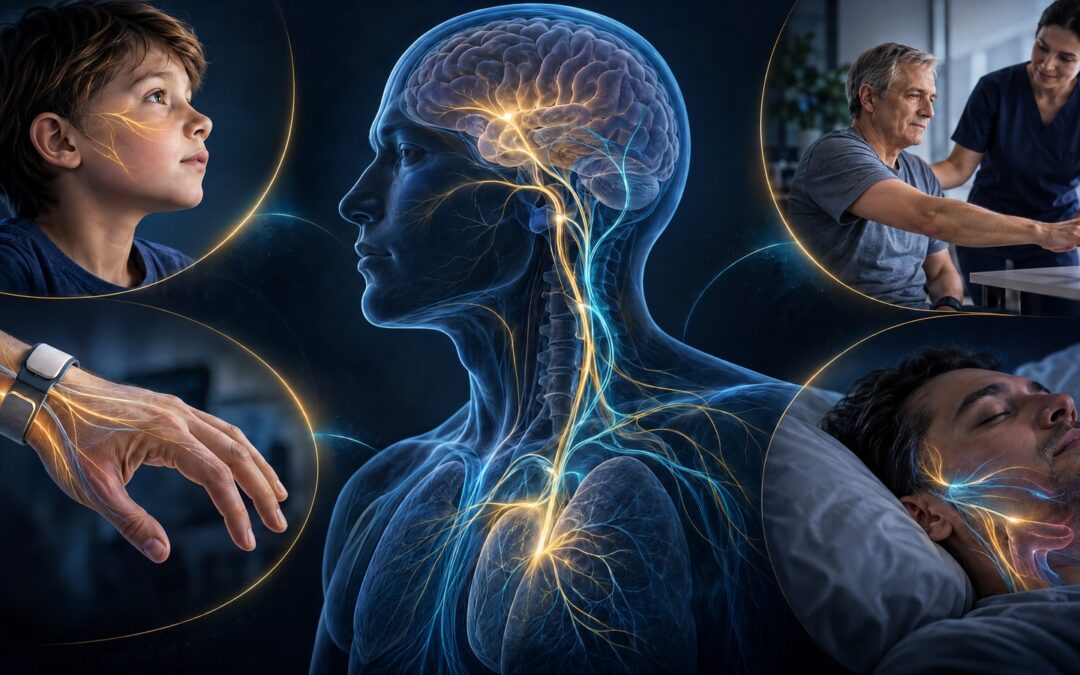
Four medical breakthroughs. One overlooked lesson: a signal becomes useful when it reaches the right target in the right form and context. A forehead patch, a wrist-worn stimulator, a surgically implanted vagus-nerve system and a breath-sensing upper-airway implant look very different. Yet all four use carefully engineered electrical stimulation to address a defined clinical problem. Their FDA records make the story real, and their differences make it more interesting than a list of frequency numbers.[2] [5] [10] [12]
The quick answer: Monarch eTNS, Cala, Vivistim and Inspire have FDA authorizations for specific uses involving ADHD, hand tremor, chronic-stroke arm rehabilitation and obstructive sleep apnea. These are electrical nerve-stimulation systems, not four PEMF devices. Their results belong to the particular device, patient population and protocol. The important connection is targeted, structured signal delivery, not an FDA-approved frequency that can be transferred unchanged to headphones or a consumer coil.[1] [17]
For readers exploring the subject through a wellness platform, the PEMF Healing App offers separately labeled listening programmes. Below, we link the actual 120 Hz and 30 Hz-labelled catalogue entries, distinguish those numerical matches from condition-themed selections, and give a practical adult listening routine. The medical-device story comes first so that the programme links have an honest context.

What the FDA actually authorized
“FDA-authorized” is a useful umbrella phrase here, but the pathways are not identical. Monarch and the original Cala ONE entered through De Novo classification. Later versions received 510(k) clearances. Vivistim and Inspire received premarket approval, or PMA. Registration and listing alone are different administrative facts. None of these pathways authorizes an isolated Hz number independently of its device and indication.[1]
| Device and original milestone | What it delivers | Clinical context | What the frequency label means |
|---|---|---|---|
| Monarch eTNS: 2019 De Novo authorization | Forehead electrodes stimulate trigeminal nerve branches. | Prescription monotherapy for ADHD in children ages 7 to 12 who are not currently taking prescription ADHD medication. | 120 Hz is electrical pulse repetition, with specified pulse width and on/off cycling.[2] [4] |
| Cala ONE: 2018 De Novo authorization | Wrist electrodes stimulate median and radial nerves. | Temporary relief of hand tremor in the treated hand following stimulation in adults with essential tremor. | The original protocol used a 150 Hz pulse train and separate tremor-calibrated nerve-alternation timing.[5] [6] [7] |
| Vivistim: 2021 PMA approval | An implanted left-vagus lead delivers stimulation during rehabilitation. | Chronic ischemic stroke with moderate-to-severe arm impairment. | The pivotal trial used brief 30 Hz trains paired with movement practice.[10] [11] |
| Inspire UAS: 2014 PMA approval | An implanted hypoglossal lead stimulates tongue-related airway muscles, with respiratory sensing. | Selected patients with obstructive sleep apnea and PAP failure or intolerance, subject to anatomy and other labeling criteria. | Respiratory synchronization is distinct from electrical pulse rate. STAR-era work documented 33 Hz, not a universal current-model setting.[12] [14] [15] |
The Cala chronology deserves precision: FDA received the original application on May 17, 2017 and granted the De Novo decision on April 26, 2018. The received date is not the authorization date.[6]

1. Monarch: a forehead patch for a defined pediatric ADHD population
Monarch’s engineering makes use possible at home under caregiver supervision during sleep. A disposable forehead patch reaches the supraorbital and supratrochlear branches of the trigeminal nerve, a sensory route into the nervous system. The original FDA authorization was granted on April 19, 2019 for children ages 7 through 12 who are not currently taking prescription ADHD medication. This is a prescribed device pathway, not an invitation to place a consumer coil or improvised electrical electrodes on a child’s forehead.[2] [3]
The pivotal evidence was a four-week, sham-controlled pilot in 62 medication-free children ages 8 to 12. FDA reported average clinician-rated ADHD symptom scores falling from 34.1 to 23.4 in the active group, compared with 33.7 to 27.5 in the sham group. That is a positive, specific short-term result on an ADHD rating scale. The study’s size and duration leave longer-term outcomes as a separate question.[2] [3]
Why 120 Hz matters here: it describes how often electrical pulses repeat, not the entire intervention. Public documentation also specifies 250-microsecond pulse width and cycling around 30 seconds on and 30 seconds off. The Generation 2.0 FDA clearance in 2024 documents ramp transitions while retaining the same indication. Sleep is the use window; the reviewed records do not establish sleep-stage feedback control.[3] [4]
2. Cala: personalization is in the pattern, not just the number
Cala’s wrist approach is called transcutaneous afferent patterned stimulation, or TAPS. “Transcutaneous” means through the skin; “afferent” refers to sensory signals traveling toward the central nervous system. The device targets the median and radial nerves rather than simply vibrating the wrist. Its adult essential-tremor indication is temporary relief in the treated hand following stimulation.[5] [7]
In the original protocol, motion sensors measured tremor during a postural hold. That measured rhythm set the timing of alternating stimulation between the two nerves. The electrical pulses themselves repeated at 150 Hz. This distinction is the genuinely interesting part: a slower, person-specific timing pattern can organize a faster pulse train. The measured tremor rhythm and the pulse rate are not interchangeable.[7]
The acute randomized report included 77 people in the effectiveness analysis. Its primary spiral-drawing endpoint did not significantly separate active treatment from sham, while other hand/arm and daily-activity outcomes favored treatment. Later, a one-month pragmatic randomized trial found better device-measured tremor-power and daily-activity outcomes with TAPS plus standard care than standard care alone. Those are useful clinical findings with different study designs, not a claim that every tremor is cured.[5] [7] [8]
As of this feature’s November 2026 review, the current Cala kIQ Plus FDA summary lists three therapy modes, session-start calibration, automatic intensity setting and a 50 to 150 Hz output range. Those changes should not be flattened into the original 150 Hz protocol or described as a proven continuous feedback loop.[9]
3. Vivistim: the signal is paired with the work of rehabilitation
Vivistim represents a different idea: deliver a brief vagus-nerve signal while the person practices an arm movement. FDA approved it on August 27, 2021 for chronic ischemic stroke with moderate-to-severe arm impairment, used during rehabilitation. The implanted lead targets the left cervical vagus. In clinic, stimulation is timed to rehabilitation movements; the therapy is not simply continuous vagus stimulation while someone rests.[10] [11]
The pivotal VNS-REHAB trial randomized 108 implanted participants to active or sham stimulation, with both groups receiving the same intensive rehabilitation. Immediately after the in-clinic treatment phase, average upper-extremity Fugl-Meyer motor-score improvement was 5.0 points with active paired VNS and 2.4 with sham. The Fugl-Meyer scale is a structured assessment of motor impairment, not a percentage of the arm “recovered.”[11]
The 47% versus 24% finding: at 90 days after the six-week in-clinic phase, 25 of 53 active-group participants and 13 of 55 sham-group participants had improved by at least six points on that scale. This was a clinically meaningful secondary responder endpoint. The comparison was active stimulation plus rehabilitation versus sham stimulation plus rehabilitation, not a literal therapy-only, unimplanted control group.[10] [11]
The trial used 30 Hz in brief half-second trains paired with practice. “Up to 30 Hz” describes a programmable device capability, whereas 30 Hz is the documented pivotal-trial pulse rate. The opportunity is the combination of a targeted signal and active motor practice. It is not evidence that listening to a 30 Hz programme produces the same nerve exposure or rehabilitation outcome.[11] [22]
4. Inspire: airway support timed to respiratory effort
Inspire uses hypoglossal nerve stimulation to activate tongue-related airway muscles in selected patients with obstructive sleep apnea. Older systems combine an implanted pulse generator, a stimulation lead and a separate respiratory-sensing lead. The sensing information helps time stimulation to respiratory effort. That timing, the nerve target and an appropriate airway assessment are central to the therapy.[12] [15]
In the 126-person STAR cohort, median apnea-hypopnea index, or AHI, fell from 29.3 to 9.0 breathing events per hour at 12 months, a reported 68% reduction. AHI counts apneas and hypopneas per hour of sleep. This substantial change came from a selected implanted cohort. It is a reduction in median severity, not a 68% cure rate, and the main one-year result was not a parallel-group randomized comparison.[13]
The original FDA approval was in 2014, and later labeling expanded eligible populations. Current candidacy depends on PAP failure or intolerance, apnea type, anatomy and the applicable labeling, not just snoring. Official manufacturer materials describe Inspire V as incorporating the respiratory sensor into the neurostimulator, removing the separate sensing lead. Integrated sensing does not mean sensor-free.[15] [16]
STAR-era research documented a 33 Hz electrical setting. That number describes pulses during stimulation, not breaths per minute or one pulse per breath. It is not a verified universal frequency for every current Inspire V programme. “Synced to every breath” describes the role of respiratory timing much better than treating the implant as a single-frequency device.[14] [16]
The invisible connection: structured stimulation
The common thread is not that all four devices have the same architecture. Monarch uses an overnight exposure window and on/off cycling. Cala calibrates a stimulation pattern to measured tremor. Vivistim pairs brief trains with movement practice. Inspire uses respiratory sensing. Calling all of these “closed-loop” would blur useful engineering distinctions. The clearer lesson is that how, where and when a signal is delivered can matter as much as its nominal repetition rate.[3] [7] [11] [14]

A simple tone is still a real physical signal. A changing programme can add transitions, layering and a planned sequence. Neither fact alone proves a medical effect or clinical superiority. These devices make the case for evaluating a complete intervention, not for declaring that static signals universally fail or that changing signals automatically prevent cellular adaptation. Device studies do not establish a universal “20-minute adaptation” threshold for consumer listening or PEMF.[17] [18]
Find the frequencies and relevant programmes in the PEMF Healing App
Open the PEMF Healing App platform or use the direct programme links below. The platform provides iOS, Android and web access. The selected public programme pages currently show premium or subscriber content; check access and the available playback information before beginning.[25]
Numerical matches, clearly identified: Parasite Rife 120hz / 1150Hz, Solfeggio 285Hz & Sacred 444hz and 30Hz Gamma Perform Rich Task – Complex Information Processing. The 120 Hz-labelled entry has a parasite/Rife catalogue title, not an ADHD indication. The 30 Hz-labelled entry has a cognitive theme, not Vivistim’s implanted delivery or movement-paired protocol. These are links to existing catalogue entries, not recommendations to treat the conditions in their names. No dedicated essential-tremor entry was confirmed, and neither Cala’s calibrated pattern nor Inspire’s respiratory sensing has a single-number app equivalent.
Condition-themed navigation: the ADHD, stroke and sleep-apnea entries in the table are topic matches only. Their titles do not establish constituent frequencies, nerve targeting, FDA authorization or clinical effectiveness. This lets you explore the catalogue while keeping the medical evidence attached to the actual medical device.
| Exact programme title | Why it appears here |
|---|---|
| Attention Fragmentation Recovery Matrix 8-Phase Bioelectric BioPhi-Harmonic Energetics | General adult attention-focused wellness anchor; no exact-program clinical trial is established here. |
| ADHD, Attention Deficit, Focus, Hyperactivity Energetics | ADHD topic navigation, not a Monarch-equivalent treatment. Public page heading is the shorter ADHD Energetic. |
| Binaural Ischemic Stroke : Neural Repair, Motor Function, Cognitive advanced energetics | Stroke topic navigation, not rehabilitation instructions or an acute-stroke intervention. |
| Sleep Apnea, Disorder, Snoring Energetic | Sleep-apnea topic navigation, not airway treatment or a replacement for PAP. |
| Sleep Apnea Pro Support, Advanced Respiratory Night Protocol Energetics | Sleep-apnea topic navigation; Night Protocol is the catalogue title, not this article recommending overnight use. |
| Parasite Rife 120hz / 1150Hz, Solfeggio 285Hz & Sacred 444hz | 120 Hz-labelled numerical match only. Unrelated parasite/Rife title; not an ADHD recommendation or evidence for its disease claims. |
| 30Hz Gamma Perform Rich Task – Complex Information Processing | 30 Hz-labelled numerical match only. Not the electrical exposure or event pairing used in Vivistim. |
| Vagus Nerve Polyvagal 9-Phase Advanced BioPhi Energetics | Vagus-themed wellness selection; title does not establish direct stimulation of that nerve. |
| Breath, Vagus Nerve & CO2 Balance Matrix: 6-Phase Bioelectric Energetics | Breath-themed wellness companion; keep normal comfortable breathing, not gas-balance manipulation. |
| 432Hz + 12th Sub, Calmness, Balance, Healing, Grounding Energetics | Grounding-themed opener. The title is a catalogue label, not proof of healing. |
| Muscle Relaxation Energetics | Muscle-relaxation-themed quiet-break companion, not treatment for essential tremor. |
| Bb: Sleep Decent, Deep Rain Rest and Relaxation ASMR | Rain soundscape for an optional closing listening excerpt, not apnea therapy. |
A practical wellness anchor: Attention Fragmentation Recovery Matrix 8-Phase Bioelectric BioPhi-Harmonic Energetics offers an attention-focused theme and an eight-phase title. The public page does not expose its full runtime or phase map, so no hidden architecture or dose is inferred here. The guide below uses optional short listening excerpts for an adult quiet break, not a treatment protocol for ADHD, tremor, stroke or apnea.
A seven-day adult listening guide
Keep the routine simple: sit somewhere quiet, breathe normally and choose comfortable audio. Use up to two minutes of an opener, up to five minutes of the primary, then up to two minutes of a closing companion, with a thirty-second quiet gap between programmes. The maximum suggested sequence totals ten minutes including the two gaps. These are editorial time boxes, not full programme runtimes, therapeutic doses or a requirement to complete every step.
Use the platform’s available playback controls and displayed session information. A five-minute excerpt is not represented as the complete eight-phase programme. Start shorter, omit a companion or choose silence if preferred. This routine is for adults; it is not borrowed from Monarch’s pediatric labeling. Do not use the condition-titled entries to replace rehabilitation, PAP, prescribed medication or a device-care plan. No equipment is required.
Day 1: establish a baseline
- Open, up to two minutes: 432Hz + 12th Sub, Calmness, Balance, Healing, Grounding Energetics. Pause for thirty seconds.
- Primary, up to five minutes: Attention Fragmentation Recovery Matrix 8-Phase Bioelectric BioPhi-Harmonic Energetics. This is an optional excerpt; use available playback controls. Pause for thirty seconds.
- Close, up to two minutes: Bb: Sleep Decent, Deep Rain Rest and Relaxation ASMR. End the sequence rather than leaving accessories running.
- Daily action: Before listening, rate your comfort and willingness to take a quiet break. Afterward, write one sentence about the experience without attributing a medical effect.
Day 2: notice tension without chasing sensation
- Open, up to two minutes: 432Hz + 12th Sub, Calmness, Balance, Healing, Grounding Energetics. Pause for thirty seconds.
- Primary, up to five minutes: Attention Fragmentation Recovery Matrix 8-Phase Bioelectric BioPhi-Harmonic Energetics. This is an optional excerpt; use available playback controls. Pause for thirty seconds.
- Close, up to two minutes: Muscle Relaxation Energetics. End the sequence rather than leaving accessories running.
- Daily action: Sit with feet supported and shoulders comfortable. Record whether the sound is pleasant; lower volume or stop rather than trying to feel more.
Day 3: let breathing stay ordinary
- Open, up to two minutes: Breath, Vagus Nerve & CO2 Balance Matrix: 6-Phase Bioelectric Energetics. Pause for thirty seconds.
- Primary, up to five minutes: Attention Fragmentation Recovery Matrix 8-Phase Bioelectric BioPhi-Harmonic Energetics. This is an optional excerpt; use available playback controls. Pause for thirty seconds.
- Close, up to two minutes: Bb: Sleep Decent, Deep Rain Rest and Relaxation ASMR. End the sequence rather than leaving accessories running.
- Daily action: Breathe normally through the routine. Do not hold your breath or seek tingling. Note whether listening makes ordinary breathing feel easier to attend to.
Day 4: keep one setup consistent
- Open, up to two minutes: 432Hz + 12th Sub, Calmness, Balance, Healing, Grounding Energetics. Pause for thirty seconds.
- Primary, up to five minutes: Attention Fragmentation Recovery Matrix 8-Phase Bioelectric BioPhi-Harmonic Energetics. This is an optional excerpt; use available playback controls. Pause for thirty seconds.
- Close, up to two minutes: Muscle Relaxation Energetics. End the sequence rather than leaving accessories running.
- Daily action: Use the same quiet place and comfortable volume as Day 1. Keep accessories off if you have not checked their instructions and restrictions.
Day 5: follow the break with one small action
- Open, up to two minutes: Breath, Vagus Nerve & CO2 Balance Matrix: 6-Phase Bioelectric Energetics. Pause for thirty seconds.
- Primary, up to five minutes: Attention Fragmentation Recovery Matrix 8-Phase Bioelectric BioPhi-Harmonic Energetics. This is an optional excerpt; use available playback controls. Pause for thirty seconds.
- Close, up to two minutes: Bb: Sleep Decent, Deep Rain Rest and Relaxation ASMR. End the sequence rather than leaving accessories running.
- Daily action: After the closing excerpt, put the phone down and choose one ordinary task. Note whether you start it; this is a follow-through observation, not an ADHD rating test.
Day 6: choose a quiet wind-down
- Open, up to two minutes: 432Hz + 12th Sub, Calmness, Balance, Healing, Grounding Energetics. Pause for thirty seconds.
- Primary, up to five minutes: Attention Fragmentation Recovery Matrix 8-Phase Bioelectric BioPhi-Harmonic Energetics. This is an optional excerpt; use available playback controls. Pause for thirty seconds.
- Close, up to two minutes: Bb: Sleep Decent, Deep Rain Rest and Relaxation ASMR. End the sequence rather than leaving accessories running.
- Daily action: Listen while awake before your usual wind-down. Stop the audio afterward. Keep your prescribed sleep-apnea care and bedtime routine unchanged.
Day 7: review preference, not disease outcomes
- Open, up to two minutes: 432Hz + 12th Sub, Calmness, Balance, Healing, Grounding Energetics. Pause for thirty seconds.
- Primary, up to five minutes: Attention Fragmentation Recovery Matrix 8-Phase Bioelectric BioPhi-Harmonic Energetics. This is an optional excerpt; use available playback controls. Pause for thirty seconds.
- Close, up to two minutes: Muscle Relaxation Energetics. End the sequence rather than leaving accessories running.
- Daily action: Compare the seven journal notes. Which opener or closer did you prefer? Keep only the parts that were comfortable and useful to your personal quiet-break habit.
Record comfort, attention to the session and which setup you used. Do not interpret an enjoyable session as a change in tremor severity, airway obstruction or stroke motor function. After seven days, take a week away from the routine if you want to reflect, then decide whether to repeat. This is an optional journaling pause, not a biological washout requirement.
Optional equipment: three distinct physical delivery paths
Headphones deliver acoustic pressure. A haptic vest produces mechanical vibration. A compatible powered coil produces a time-varying magnetic field. Skin electrodes and implanted leads deliver electrical stimulation to their specified tissues. The same numerical frequency can describe each, while the physical exposure remains different. Mechanical skin stimulation and electrical afferent stimulation even recruit the sensory system differently.[17] [18]
If using iTorus: choose a manufacturer-supported model and connection, then follow the official model-specific setup and placement resources. A personal-space device and a room-use device need not have the same workflow. This article does not prescribe a body placement for targeting the trigeminal, vagus or hypoglossal nerve. Do not improvise forehead, neck or airway placements, attach a bare coil to a phone, or use a phone audio output as an improvised electrical stimulator.[26]
If using Woojer: the Vest 4 has separate audio and sensation controls and a manufacturer-listed tactile range of 1 to 250 Hz. That range does not mean that every programme component will be reproduced, or that a felt 120 Hz or 30 Hz pattern is the equivalent of nerve stimulation. Begin with gentle sensation, follow its current manual and add only one optional layer at a time. The manual excludes pacemaker use and requires physician approval during pregnancy.[20]

Affiliate disclosure: some links below may support PEMF Magazine through a referral commission. Equipment is optional, and purchase does not confer medical-device equivalence.
| Resource | Role in this guide | Practical boundary |
|---|---|---|
| Frequency Healing App | Browse exact programmes and access supported playback. | Use displayed access requirements and session controls. Wellness use, not these prescription treatments. |
| iTorus i2 | Optional consumer magnetic-field hardware. | Use only manufacturer-supported connections, placement and output guidance. |
| iTorus i5 | Optional room-oriented consumer hardware. | Do not assume that room use targets a named nerve or creates a clinical dose. |
| Woojer Vest 4 | Optional tactile listening experience. | Use code EPEMF10 at checkout; confirm current eligibility. Follow pacemaker, pregnancy and other manual restrictions. |
| Metatronic Flower of Life iMPrinter | Optional symbolic intention accessory. | No claim of retained therapeutic frequencies, medicine alteration, water purification or disease treatment. |
Best practices that keep the routine useful
Choose a consistent quiet break rather than chasing a stronger sensation. Keep audio comfortably low and use supported exposure controls. WHO recommends limiting loudness and listening duration, taking quiet breaks and seeking a hearing assessment for persistent tinnitus or hearing difficulty. A percentage-volume setting alone is not a calibrated exposure measurement.[19]
Change one variable at a time: first the programme, later the headphones or an optional accessory. Label each entry in your journal with the programme and setup so that preference is not confused with device performance. Keep clinical rehabilitation and prescribed sleep-apnea care separate from the wellness routine. Do not run accessories overnight merely because one of the medical devices is used during sleep.
Daily practice if you choose an iMPrinter
Use it as a visible reminder of an intention, such as “take a quiet break.” Follow its care and supported connection instructions, keep liquids away from electronics and write down the intention before the session. Return to that note afterward. Do not modify medications, claim that a beverage now delivers a therapeutic signal, or replace ordinary safe food and water handling. The value described here is the ritual and reflection, not an established material or medical transformation.
Clinical decisions stay with the appropriate care team
These four interventions require specific eligibility checks and device-specific instructions. Cala’s current labeling includes restrictions involving implanted electrical devices, seizures, pregnancy and unsuitable wrist skin. Inspire has anatomical and apnea-type criteria, while implanted VNS requires specialist assessment of surgical, cardiac, swallowing, respiratory and device-interaction considerations. A short article cannot replace those labels or a prescribing team.[22] [23] [24]
New stroke symptoms are an emergency. Sudden facial weakness, arm weakness or speech difficulty requires urgent emergency assessment, not a listening session or a trial of consumer stimulation. Vivistim’s chronic rehabilitation indication is separate from acute-stroke care. Likewise, witnessed breathing pauses and persistent daytime sleepiness deserve clinical assessment; do not stop prescribed PAP or adjust an implanted system because of an app programme.[21] [15]
The worthwhile takeaway: medicine is already using engineered signals for specific clinical tasks. The most informative question is no longer merely “Which frequency?” It is “Which target, delivery path, timing strategy and evidence?” Understanding that question makes both the medical achievements and your optional wellness choices clearer.
Educational and wellness disclaimer: This article is for informational purposes only and does not provide medical advice, diagnosis or treatment. FDA authorizations apply to specific devices and indications, not frequencies independently. The PEMF Healing App and the optional consumer accessories are not equivalent to the four medical systems discussed. Continue licensed medical care and consult a qualified professional about symptoms, pregnancy, implanted devices, medications or device suitability. Follow manufacturer instructions and stop optional use for discomfort.
References
- FDA. Are There FDA Registered or FDA Certified Medical Devices? Regulatory pathways and terminology. Direct source.
- FDA (2019). FDA permits marketing of first medical device for treatment of ADHD. Direct source.
- McGough et al. (2019). Double-Blind, Sham-Controlled, Pilot Study of Trigeminal Nerve Stimulation for ADHD. Direct source.
- FDA (2024). Generation 2.0 Monarch eTNS System, 510(k) K233293 summary. Direct source.
- FDA. Cala ONE De Novo decision summary, DEN170028. Direct source.
- FDA. Cala ONE De Novo database record: received May 17, 2017; decision April 26, 2018. Direct source.
- Pahwa et al. (2019). An Acute Randomized Controlled Trial of Noninvasive Peripheral Nerve Stimulation in Essential Tremor. Direct source.
- Comparative Effectiveness of Transcutaneous Afferent Patterned Stimulation Therapy for Essential Tremor: A Randomized Pragmatic Clinical Trial (2023). Direct source.
- FDA (2026). Cala kIQ Plus, 510(k) K253587 summary. Direct source.
- FDA (2021). Vivistim PMA P210007: approval record and indication. Direct source.
- Dawson et al. (2021). Vagus nerve stimulation paired with rehabilitation for upper limb motor function after ischaemic stroke: VNS-REHAB pivotal trial. Direct source.
- FDA (2014). Inspire Upper Airway Stimulation, PMA P130008 original approval record. Direct source.
- Strollo et al. (2014). Upper-airway stimulation for obstructive sleep apnea. New England Journal of Medicine. Direct source.
- Strollo et al. (2015). Upper Airway Stimulation for Obstructive Sleep Apnea: Durability at 18 Months. Direct source.
- FDA (2023). Inspire Upper Airway Stimulation P130008/S090: expanded indication and patient selection. Direct source.
- Inspire Medical Systems. Inspire V: integrated respiratory sensing and no separate sensing lead. Manufacturer explanation. Direct source.
- FDA. Guidance Document for Powered Muscle Stimulator 510(k)s: waveform, pulse, burst, output and exposure parameters. Direct source.
- Temporal patterns in electrical nerve stimulation: Burst gap code shapes tactile frequency perception (2020). Direct source.
- WHO (2026). Deafness and hearing loss: Safe listening. Direct source.
- Woojer. Vest 4 user manual: specifications, connections and safety restrictions. Direct source.
- CDC (2026). Signs and Symptoms of Stroke: emergency recognition and immediate response. Direct source.
- Vivistim. Paired VNS System implantable device manual for healthcare professionals, revision 4 (2025). Direct source.
- Cala Health. Current model indications and safety information. Direct source.
- Inspire. Current professional indications and contraindications. Direct source.
- Frequency Healing. Official platform access and wellness disclaimer. Manufacturer source, not clinical validation. Direct source.
- iPyramids Academy. Official iTorus model-specific setup and tutorial resources. Direct source.