
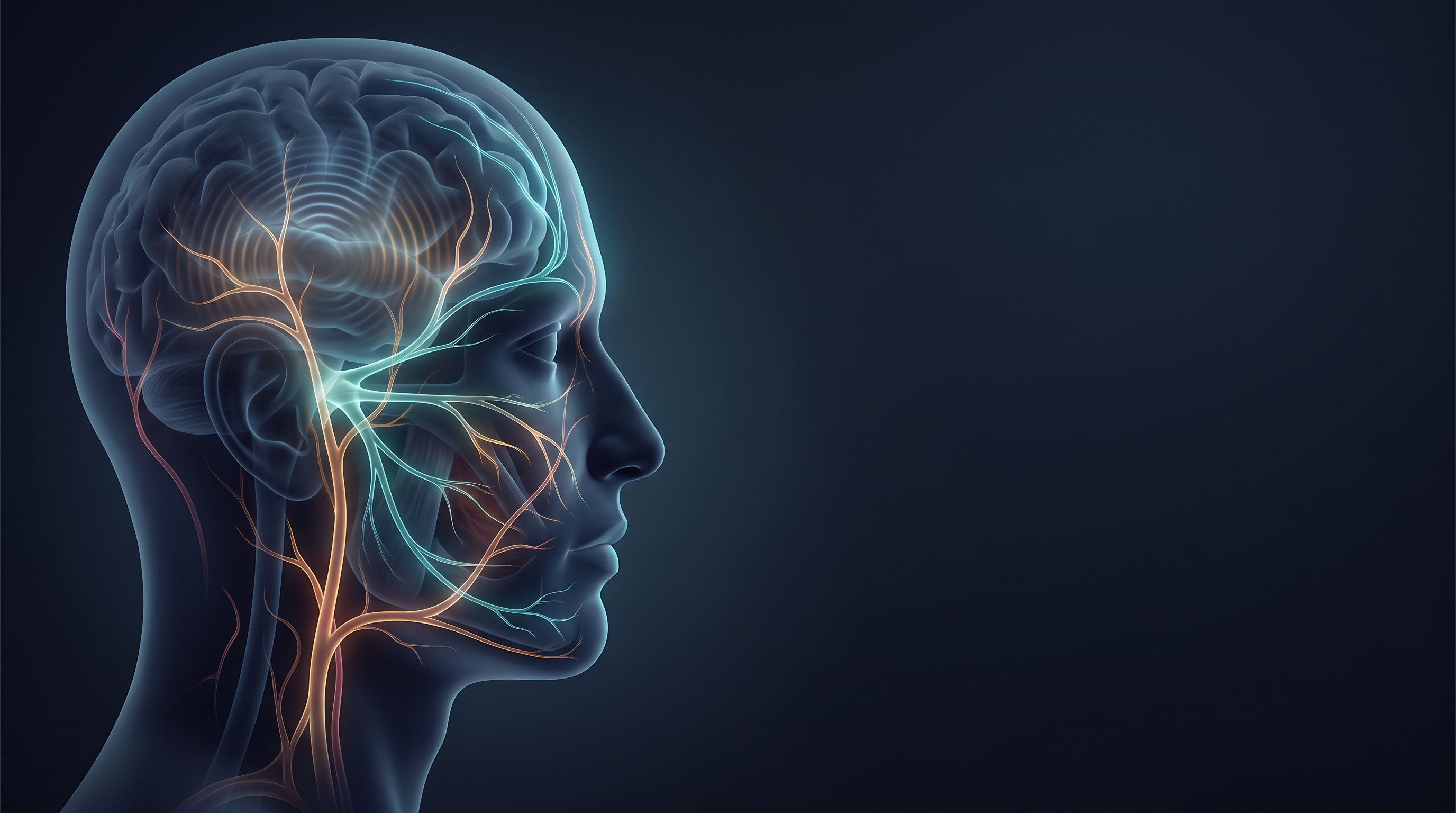
Head & Migraines NeuroReset 9-Phase BioPhi-Harmonic Neurovascular & Trigeminal Energetics
Clinical safety note: This article is educational and is not a diagnosis, a treatment plan, or a substitute for medical care. A new sudden severe headache, weakness or numbness, difficulty speaking, fainting, seizure, severe visual change, fever with stiff neck, or worsening headache after head injury needs urgent medical evaluation. The program discussed below is a consumer wellness experience. It is not rTMS, external trigeminal nerve stimulation, non-invasive vagus nerve stimulation, remote electrical neuromodulation, or an FDA-cleared migraine device.
Migraine is not simply “a bad headache.” It is a neurological disorder involving sensory processing, trigeminal pathways, neurovascular signalling, and, for some people, aura-related cortical phenomena. The practical consequence is important: a single copied “migraine frequency” cannot stand in for diagnosis, medication review, a clinician-selected preventive plan, or a cleared neuromodulation device. The Head & Migraines NeuroReset 9-Phase BioPhi-Harmonic Neurovascular & Trigeminal Energetics program takes a different design approach. It is a structured 45-minute, nine-phase wellness session that changes its sound field, haptic context, and optional consumer-coil input over time. That is an engineering architecture, not a claim to treat migraine.
What migraine science actually describes
The trigeminovascular system is central to modern migraine biology. Trigeminal sensory pathways communicate through the trigeminal ganglion and trigeminocervical complex, while calcitonin gene-related peptide, commonly called CGRP, is an important part of the clinical and experimental migraine landscape.[1][8] Experimental work also links cortical spreading depression, a phenomenon relevant to some aura research, with downstream oxidative and trigeminal nociceptive signalling.[2] These observations explain why migraine care is broader than a pain score. They do not demonstrate that a consumer sound, haptic, or coil session changes CGRP, vascular tone, cortical spreading depression, or any disease pathway.

Diagram 1. A simplified research-context map. The pathway is included to explain migraine biology and to distinguish the program from cleared clinical neuromodulation devices. It is not a claimed mechanism of this wellness session.
Why the clinical-device comparison matters
There is real neuromodulation research in migraine, but its relevance depends on the actual device, dose, target, waveform, current or magnetic-field characteristics, and protocol. A randomized study of high-rate repetitive transcranial magnetic stimulation reported a prophylaxis signal under a defined clinical rTMS protocol.[3] That does not make consumer PEMF equivalent to rTMS. rTMS uses a defined high-intensity, focal magnetic stimulus and specific coil positioning.
Likewise, FDA-cleared or authorized migraine devices are precise device categories, not generic “frequency therapy.” Cefaly Acute is an external trigeminal electrical stimulator using a forehead electrode and defined electrical output.[4] Relivion uses transcutaneous electrodes to address supraorbital, supratrochlear, and greater occipital branches under its cleared configuration.[5] Nerivio is a separate upper-arm electrical stimulation system with a defined waveform, current range, safety testing, and treatment duration.[6] gammaCore is another distinct medical-device category, with its own cleared labelling and contraindications.[9] These examples are useful because they show why a number alone is never a complete dose.
Frequency alone is not a complete exposure. Field intensity, pulse width, waveform, duty cycle, geometry, electrode or coil location, contact quality, distance, duration, and the person’s physiology all matter. A numerical overlap between modalities does not establish biological equivalence.
Inside Head & Migraines NeuroReset
This program is designed as a 45-minute arc rather than a static loop. It begins with a quieter cortical-entry section, moves through vagal and trigeminal reference themes, develops a trigeminal-occipital orbit, reaches a higher-density middle passage, and then reduces density into a breath-paced integration and silence fade. The phase names are an explanatory map of the composition: Cortical Entry, Vagal Reference, Trigeminal Preventive Reference, Trigeminal-Occipital Orbit, Acute Trigeminal Reference, Remote Neuromodulation Reference, Multi-Pathway Rebalance, Neural Reorganization, and Phi Integration.
Its reference library is deliberately separated into three categories. First are literature-informed clinical-device reference families. Second are internal substance-reference themes. Third are BioPhi engineering choices such as phase timing, movement, and binaural pacing. This separation is the point: a clinical device citation is not a transferable dose, a substance name is not pharmacology, and an internal engineering relationship is not a validated migraine-treatment parameter.

Diagram 2. The nine-phase composition journey. The reference categories and geometry labels explain design intent. They do not disclose proprietary substance values or establish therapeutic targets.
Reading the supplied spectral image

Supplied spectral view. The pitch display shows a persistent upper anchor, repeated stepped low and mid-band blocks, visible phase transitions, a changing-density middle arc, and a simplified closing segment. This is an observation of signal architecture, not evidence of clinical efficacy.
The spectral image is useful because it makes the design difference visible. Rather than one unchanged band repeated for the entire session, the composition changes its density, spacing, lower-band emphasis, and movement as the session progresses. It is reasonable to call that a multi-phase listening architecture. It would not be reasonable to call the image proof of a neurovascular effect.
Why the substance themes are included
The program’s internal reference library includes names associated with acute and preventive migraine pharmacology. Those names are included as research-context themes only. No drug is present in the session. No listening or coil configuration reproduces a prescription drug’s receptor activity, metabolism, dose, absorption, contraindications, or interaction profile. No proprietary substance-frequency values are published here.
Acute-care reference themes: acetaminophen, ergotamine, dihydroergotamine, and zolmitriptan appear because migraine care has a substantial acute-treatment literature. These agents belong to different pharmacologic families and have different safety considerations. Triptans and ergot derivatives are not interchangeable, and vascular or cardiovascular risk can matter. They are mentioned to give the design team a clinically literate reference vocabulary, not to suggest that a signal can substitute for medication or professional guidance.
Preventive-care reference themes: propranolol, timolol, nadolol, divalproex, and related historical anti-migraine entries appear because migraine prevention often requires a clinician-selected plan rather than a one-off response to pain. The American Headache Society notes that preventive treatment may be considered for people with frequent headache days, but choice requires attention to the person’s history, contraindications, comorbidities, and preferences.[7] The program does not claim to mimic beta blockers, anticonvulsants, or any other preventive medicine.
The practical value of this separation is intellectual honesty. The program can be discussed as a designed, multi-phase wellness experience informed by the vocabulary of migraine research. It should not be marketed as an encoded drug cabinet.
The three-layer, or “3D,” delivery design
The word “3D” here refers to three coordinated delivery channels, not a three-dimensional clinical therapy. Each channel contributes a different experiential layer and each has separate evidence limits.
| Layer | What it adds | What it does not establish |
|---|---|---|
| Stereo and binaural layer | Headphones preserve left-right channel separation, spatial movement, and the program’s changing auditory context. | It is not an electrical trigeminal stimulator and has not been validated as a migraine treatment dose. |
| Optional haptic layer | Compatible haptic hardware can add tactile rhythm and body-level timing cues. | It is not a cleared occipital, vagal, or trigeminal device. Use low intensity during sensory sensitivity. |
| Optional consumer PEMF layer | A coil can translate compatible hardware input into a field whose output is shaped by its geometry, amplifier, gain, distance, orientation, and response. | It cannot be assumed to match rTMS, eTNS, nVNS, or a cleared migraine device. |
When all three are used, the result is a coordinated sound, tactile, and optional field context. That can be a meaningful way to structure a personal relaxation practice. It is not proof that three channels produce three medical mechanisms. General PEMF references emphasize that effects and safety questions are parameter-specific, and a broad consumer overview should not be generalized to every signal or device.[10][11]

Diagram 3. The three-layer design and the appropriate evidence boundary. A changing phase architecture is different from a copied static list, but difference in architecture is not proof of clinical efficacy or prevention of biological adaptation.
Natural recovery, temporary symptom change, and static lists
It is useful to separate three ideas that are often blended together. Natural recovery means the body’s own course of adaptation, sleep, hydration, trigger management, movement, and medically appropriate care. Temporary symptom change means that a person may notice a short-lived shift in comfort, attention, arousal, or sensory load. Disease treatment requires evidence that a defined intervention changes outcomes in the target condition. These are not interchangeable claims.
Classic Rife-style lists usually make a different kind of promise: that a fixed number or repeated numerical set has condition-specific effects. There is no guideline-validated disease-specific Rife list for migraine. The concern is not that every static signal necessarily makes symptoms worse. The concern is that a static list provides no demonstrated migraine dose, no verified match to cleared device output, and no reliable way to separate symptom fluctuation from intervention effect. Migraine is inherently variable, so a diary and clinician-guided care remain more informative than a number list.
Some people call fading results “cellular adaptation.” Habituation and changing sensory response are real concepts in neuroscience, but there is no direct clinical evidence that cellular adaptation explains response changes to consumer Rife-style programs in migraine, or that a nine-phase wellness program prevents it. This program approaches repetition differently at the engineering level: it changes phase order, stereo movement, rhythmic density, and intensity arc instead of copying a single flat loop. That is an honest design distinction, not a biological outcome claim.
Verified ePEMF program options
Use the primary program first. The following are optional, API-returned navigation links for a separate wellbeing session on a different day. They are not a recommendation to stack multiple full programs during a migraine episode, and they do not replace care for changing or severe symptoms.
- Head & Migraines NeuroReset 9-Phase BioPhi-Harmonic Neurovascular & Trigeminal Energetics
- Migraines Headache
- Binaural Headache
- Trigeminal Nerve Binaural 7 Phase Neuromodulation Energetics
- Vagus Nerve & Cortisol Flush 9-Phase Bioelectric Energetics
- Nervous System 9-Phase BioPhi Orbital Vagus Reset Energetics
A conservative three-day orientation
This is a consistency routine, not acute-migraine treatment. Run no more than one complete wellness program in a day while learning your sensory tolerance. If symptoms are active, severe, or changing, choose medical evaluation over experimentation.
| Day | Program and setup | What to record |
|---|---|---|
| Day 1 | Run Head & Migraines NeuroReset 9-Phase BioPhi-Harmonic Neurovascular & Trigeminal Energetics once, through the full in-app session, with low-volume headphones only. Keep the setting quiet and do not add haptics or a coil on the first session. | Before and after: head-pain rating, nausea, light sensitivity, sound sensitivity, sleep, and any unexpected response. |
| Day 2 | Run Head & Migraines NeuroReset 9-Phase BioPhi-Harmonic Neurovascular & Trigeminal Energetics once, through the full in-app session. If Day 1 was comfortable, compare either low haptic intensity or the iTorus using only the manufacturer’s general safety guidance. Do not put a consumer coil on the forehead, temple, eye, or neck to imitate a cleared medical device. | Compare the chosen layer with Day 1. Stop if it worsens headache, dizziness, nausea, visual symptoms, agitation, palpitations, numbness, or unusual neurological sensations. |
| Day 3 | Run Head & Migraines NeuroReset 9-Phase BioPhi-Harmonic Neurovascular & Trigeminal Energetics once, through the full in-app session. Combine layers only if each was independently comfortable. Prefer wired headphones, low listening level, and low haptic intensity. Do not turn a consumer coil into a head-targeted treatment. | Use the same notes and preserve one variable at a time. A clinician can use a diary to evaluate patterns more reliably than memory alone. |
Hardware and setup options
For any consumer hardware, follow its official instructions and contraindications. Do not use a consumer coil to recreate forehead, scalp, neck, or limb placement from a cleared device’s label. Do not use while driving or operating machinery. Consult a qualified clinician before electromagnetic or strong-haptic use with pregnancy, seizure sensitivity, serious rhythm disorders, an implanted electronic device, cochlear implant, insulin pump, pacemaker, or defibrillator.
| Hardware | Role in this wellness setup | Link |
|---|---|---|
| iTorus i2 | Optional personal-space consumer coil. Use only the manufacturer’s general instructions and do not treat it as clinical rTMS or a trigeminal stimulator. | View iTorus i2 |
| iTorus i5 | Optional room-scale consumer coil. Follow the official setup guide and keep expectations in the wellness category. | View iTorus i5 |
| Woojer Vest 4 | Optional haptic layer. Start at low intensity, especially with touch sensitivity or active headache. | View Woojer Vest 4 Use code EPEMF10. |
| iMPrinter | Optional companion hardware. It is not a substitute for medication, emergency care, or a cleared migraine device. | View iMPrinter |
What to expect, and what not to expect
A person may experience the program as a structured, private period of lower-volume listening, sensory pacing, and intentional rest. It should not be expected to abort an acute migraine, replace prescribed rescue medicine, prevent all future attacks, or replicate cleared neurostimulation. The most useful measure is a consistent diary: time of session, associated symptoms, sleep, hydration, stress context, medication use, and next-day status. That record is also more useful to a clinician than a claim that a particular number “worked.”
If the session is uncomfortable, stop. If a headache pattern is new, unusually severe, neurologically different, or concerning, seek care instead of continuing a wellness experiment.
References
- Melo-Carrillo A, et al. Selective inhibition of trigeminovascular neurons by fremanezumab. Journal of Neuroscience. 2017. PubMed.
- Shatillo A, et al. Cortical spreading depression induces oxidative stress in the trigeminal nociceptive system. Neuroscience. 2013. PubMed.
- Misra UK, Kalita J, Bhoi SK. High-rate repetitive transcranial magnetic stimulation in migraine prophylaxis: a randomized, placebo-controlled study. Journal of Neurology. 2013. PubMed.
- U.S. Food and Drug Administration. Cefaly Acute, K171446. FDA 510(k) summary and indications.
- U.S. Food and Drug Administration. Relivion, K203419. FDA 510(k) summary and indications.
- U.S. Food and Drug Administration. Nerivio Migra, DEN180059. FDA De Novo classification request.
- American Headache Society. Preventive migraine treatment. American Headache Society resource.
- Storer RJ, Akerman S, Goadsby PJ. CGRP modulates nociceptive trigeminovascular transmission in the cat. British Journal of Pharmacology. 2004. PubMed.
- U.S. Food and Drug Administration. gammaCore Sapphire, K211856. FDA 510(k) documentation.
- Cleveland Clinic. Pulsed electromagnetic field therapy: uses, evidence, and safety. Cleveland Clinic overview.
- Ross CL, et al. The effect of pulsed electromagnetic field on cellular response. Journal of Cellular Physiology. 2023. PubMed.