
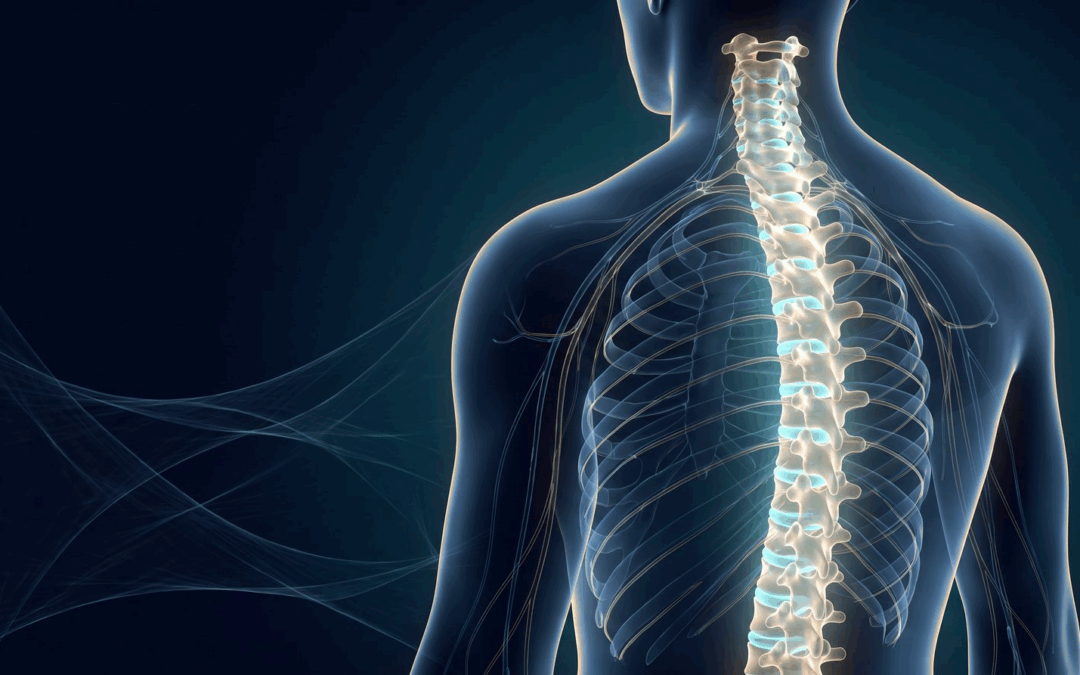
Spinal Health and PEMF: Disc Science, Safety, and a 9-Phase Wellness Program Guide
Clinical safety note: This article is educational. It is not a diagnosis, treatment plan, or substitute for a clinician who can examine the spine and nervous system. Progressive weakness, a changing gait, repeated falls, bowel or bladder changes, saddle numbness, a major new neurological deficit, fever with severe spinal pain, or significant trauma requires prompt medical assessment. The consumer wellness program discussed below is not spinal decompression, surgery, a cleared spinal treatment device, or treatment for spinal-cord compression.
The spine is not merely a stack of bones. It is a load-sharing axis in which vertebrae, discs, endplates, ligaments, muscles, sensory pathways, and the nervous system constantly exchange information. That complexity is exactly why a copied “spine frequency” is not a credible substitute for a diagnosis, movement assessment, imaging when indicated, physical therapy, medication review, or specialist care. Spinal Axis Renewal 9-Phase BioPhi-Harmonic Advanced Energetics is best understood as a 33-minute, nine-phase consumer wellness composition built around paced sound, optional haptic rhythm, and optional consumer-coil context. Its design can be described. Its medical efficacy cannot be assumed.
What spinal research actually tells us
Intervertebral-disc research provides an instructive example of why details matter. In a laboratory and animal study, Zheng and colleagues used a calibrated Helmholtz-coil exposure system and reported extracellular-matrix-related, SIRT1, and autophagy findings in degenerated nucleus-pulposus cells, alongside findings in a rat disc-degeneration model.[1] This is real, interesting preclinical research. It does not mean that any consumer speaker, audio file, amplifier, or coil recreates the laboratory waveform, field intensity, coil geometry, duration, tissue dose, or outcome.
Clinical work has the same parameter problem. A randomized cervical-disc study evaluated a medical PEMF protocol alongside TENS and hot packs, and its design excluded cervical myelopathy and neurological deficits.[2] A more recent systematic review found biologically relevant signals and possible potential in disc-degeneration research, but concluded that inconsistent protocols, risk of bias, and limited clinical evidence still prevent standardized recommendations.[3] The conclusion is not that spinal research is meaningless. It is that device, waveform, exposure, anatomy, diagnosis, and outcome measure cannot be collapsed into one number or one generic claim.
The contrast between studies makes the point even sharper. One lumbar-stenosis trial used a defined medical protocol and measured clinical outcomes under its own design.[5] Peripheral-nerve studies in rats have reported protocol-dependent findings in opposite directions, including a positive regeneration report and a different exposure that did not improve regeneration and was associated with oxidative stress.[6][7] Osteoblast research likewise uses controlled experimental conditions rather than an interchangeable consumer dose.[8] These studies support careful interest in mechanism and parameters. They do not authorize a diagnosis-to-number formula.

Diagram 1. A research-context map, not a treatment map. It distinguishes parameter-specific studies from the urgent neurological situations in which a wellness session should never delay assessment.
Spinal safety comes before experimentation
Degenerative cervical myelopathy is a useful safety benchmark because it reminds us that not all spine symptoms are wellness problems. The evidence-based guideline for degenerative cervical myelopathy recommends operative treatment for moderate or severe disease and recommends surgical intervention when neurological deterioration occurs during nonoperative management.[4] No sound track, haptic accessory, or consumer coil should be positioned as a way to decompress the cord, reverse stenosis, remove osteophytes, correct spondylolisthesis, or restore objectively lost strength.
Frequency is not a complete exposure. Field intensity, pulse characteristics, waveform, geometry, orientation, distance, duration, tissue state, and the person’s diagnosis all change what a device does. A numerical overlap does not establish device equivalence.
Inside Spinal Axis Renewal
The supplied program documentation describes a 33:33 session arranged as a sequence rather than a flat loop. Its design begins with a quieter entry, moves through bilateral orientation and paraspinal reference themes, develops disc, bone, and nerve-pathway context, reaches a higher-density mobility arc, then reduces density into breath-paced and quiet integration. This is a coherent compositional journey. It should not be confused with a clinical protocol for disc repair, nerve regeneration, or structural correction.
The labels used in this article are intentionally separated into three categories. First are published research contexts, including disc cells, osteoblasts, nerve-regeneration models, and spine-related clinical studies. Second are internal design themes, such as phase timing, density, spatial movement, and integration. Third are personal wellbeing observations, such as whether a session feels comfortable, movement-ready, neutral, or overstimulating. A research context is not a transferable dose, and a design label is not a diagnosis.

Diagram 2. The program is organized as a changing nine-phase composition. The labels explain signal architecture and research context without disclosing proprietary values or claiming medical targets.
What the supplied spectral image shows

Supplied spectral view. The pitch display shows a stable upper anchor, stepped low-band passages, a denser middle plateau, visible phase transitions, and a simpler descent toward the close. It is visual evidence of changing audio architecture. It does not show field intensity, pulse waveform, tissue penetration, or clinical effect.
This distinction is important. The image makes it possible to see why the session is not a single static audio band repeated for the entire runtime. Its pattern changes across time. That is a valid observation about the composition. It is not proof that a spectral pattern reaches a disc, changes a nerve, or repairs spinal tissue.
Why no substance-frequency values are published
Substance names and biomedical vocabulary are often used in frequency-wellness marketing as if a named compound were equivalent to a pharmacologic exposure. It is not. The supplied documentation for Spinal Axis Renewal foregrounds structural and neurovascular research themes rather than presenting a public substance-frequency list. We will not invent a list or publish internal proprietary mappings.
That restraint matters. A sound or field reference is not collagen, a mineral, a vitamin, an anti-inflammatory medicine, an analgesic, or a prescription drug. It has none of the absorption, distribution, metabolism, receptor binding, contraindications, interactions, or dose-response characteristics of a substance. The most useful way to discuss the program is therefore through its published spinal research context and its design architecture, not as an “encoded supplement” or a replacement for nutrition, medication, rehabilitation, or medical care.
The three-layer, or “3D,” wellness design
“3D” in this guide means three coordinated sensory channels. It does not mean three medical mechanisms or a three-dimensional clinical therapy. The first layer is stereo and binaural audio, which preserves left-right separation and the program’s moving auditory context. The second is optional haptic input, which can add a low, comfortable tactile rhythm. The third is optional consumer PEMF hardware, whose output depends on the actual coil, amplifier, geometry, gain, distance, orientation, and operating conditions.
| Layer | Practical role | Evidence boundary |
|---|---|---|
| Stereo and binaural audio | Provides the program’s phase changes, spatial movement, and paced listening context. | It is not a clinical neuromodulation device or a verified disc-treatment dose. |
| Optional haptic input | Adds tactile timing cues at an individually comfortable intensity. | It is not a cleared spinal, nerve, or bone therapy. |
| Optional consumer PEMF | Adds hardware-specific field context when used according to its official instructions. | It cannot be assumed to match laboratory coils, medical PEMF, TENS, rTMS, or a cleared spinal device. |
Reviews of PEMF research repeatedly emphasize parameter dependence. Biological observations vary with factors such as waveform, exposure duration, intensity, and cell type.[9][10] Combining the three layers can create a more structured personal experience. It does not establish that combining them multiplies medical benefit.

Diagram 3. A changing phase sequence is an engineering distinction from a flat repeated list. It does not establish prevention of adaptation, disc repair, decompression, or treatment of a spinal diagnosis.
Natural recovery, temporary change, and static lists
Natural recovery is not a single technology. It includes diagnosis, sleep, activity pacing, appropriately prescribed movement, nutrition, rehabilitation, medication when indicated, and treatment of the condition actually present. Temporary symptom change is different: a person may notice a short-lived shift in attention, comfort, muscle tone, relaxation, or sensory load. Disease treatment requires evidence that a defined intervention changes clinically meaningful outcomes in a defined population.
Static Rife-style lists tend to collapse these distinctions by treating a copied number as a condition-specific dose. There is no guideline-validated static Rife list for spinal degeneration, stenosis, disc disease, or myelopathy. The concern is not that every repeated signal necessarily worsens a person’s symptoms. The concern is that a static list does not supply diagnosis, device equivalence, calibrated dose, clinical outcome data, or a reliable way to distinguish spontaneous fluctuation from intervention effect.
Some users call a fading subjective response “cellular adaptation.” Habituation and changing sensory response are real neuroscientific concepts, but there is no direct clinical evidence that cellular adaptation explains changing response to consumer Rife-style spine programs, or that a nine-phase program prevents it. Spinal Axis Renewal approaches repetition differently at the composition level by changing phase order, density, spatial movement, and integration. That is an honest design distinction, not proof of a biological outcome.
30-Day Exact Program Order: Two or Three Separate Sessions per Day
This is the operational schedule requested for this guide. Every day keeps Spinal Axis Renewal 9-Phase BioPhi-Harmonic Advanced Energetics as Session 1, then adds one fresh API-returned spine-related program at Session 2. On alternating days, Session 3 adds a separate API-returned program. These are organized library sessions, not a clinical spine-treatment regimen. The titles are direct navigation links, not evidence that any named condition is treated, reversed, or cured.
Duration rule: the supplied primary program runtime is 33:33. The current API returns program titles and direct URLs for Session 2 and Session 3 but does not provide a public runtime field. For every support program, run one complete duration displayed in the app before you press play. Do not guess minutes, restart a program, or run two copies back-to-back. The daily time template is 10:00, 15:00, and, on three-session days, 18:30 local. Keep at least a 4-hour gap before Session 2 and a 3-hour gap before Session 3.
Safety gate before every session: do not begin if the previous session produced meaningful discomfort, new weakness, gait change, spreading numbness, bladder or bowel change, severe escalating pain, or any unusual neurological symptom. Skip all remaining sessions that day and seek the appropriate assessment for a red flag. Use iTorus only according to the current official tutorial. Do not use this schedule to create a neck, cervical-spine, or head placement protocol.
| Day | Exact program order, time, run time, and mode | Stop rule |
|---|---|---|
| Day 1 |
Primary program link for Day 1: Spinal Axis Renewal 9-Phase BioPhi-Harmonic Advanced Energetics Session 1: 10:00: Spinal Axis Renewal 9-Phase BioPhi-Harmonic Advanced Energetics Session 2: 15:00: Brain Stem Spine Body Biophotonics Energetics |
If any session causes pain, dizziness, spreading tingling, weakness, new numbness, palpitations, distress, or another unexpected neurological symptom, stop and do not continue to the next session that day. |
| Day 2 |
Primary program link for Day 2: Spinal Axis Renewal 9-Phase BioPhi-Harmonic Advanced Energetics Session 1: 10:00: Spinal Axis Renewal 9-Phase BioPhi-Harmonic Advanced Energetics Session 2: 15:00: Cervical Vertebral Spine Body Biophotonics Energetics Session 3: 18:30: Spine Body as Sound Energy Aspects Biophotonics Energetics |
If any session causes pain, dizziness, spreading tingling, weakness, new numbness, palpitations, distress, or another unexpected neurological symptom, stop and do not continue to the next session that day. |
| Day 3 |
Primary program link for Day 3: Spinal Axis Renewal 9-Phase BioPhi-Harmonic Advanced Energetics Session 1: 10:00: Spinal Axis Renewal 9-Phase BioPhi-Harmonic Advanced Energetics Session 2: 15:00: Lumbar Vertebral Spine Body Biophotonics Energetics |
If any session causes pain, dizziness, spreading tingling, weakness, new numbness, palpitations, distress, or another unexpected neurological symptom, stop and do not continue to the next session that day. |
| Day 4 |
Primary program link for Day 4: Spinal Axis Renewal 9-Phase BioPhi-Harmonic Advanced Energetics Session 1: 10:00: Spinal Axis Renewal 9-Phase BioPhi-Harmonic Advanced Energetics Session 2: 15:00: Back Pain Health Energetics Session 3: 18:30: Cerebral Spinal Fluid Spine Body Biophotonics Energetics |
If any session causes pain, dizziness, spreading tingling, weakness, new numbness, palpitations, distress, or another unexpected neurological symptom, stop and do not continue to the next session that day. |
| Day 5 |
Primary program link for Day 5: Spinal Axis Renewal 9-Phase BioPhi-Harmonic Advanced Energetics Session 1: 10:00: Spinal Axis Renewal 9-Phase BioPhi-Harmonic Advanced Energetics Session 2: 15:00: Myofascial Release & Pain Advanced Energetics |
If any session causes pain, dizziness, spreading tingling, weakness, new numbness, palpitations, distress, or another unexpected neurological symptom, stop and do not continue to the next session that day. |
| Day 6 |
Primary program link for Day 6: Spinal Axis Renewal 9-Phase BioPhi-Harmonic Advanced Energetics Session 1: 10:00: Spinal Axis Renewal 9-Phase BioPhi-Harmonic Advanced Energetics Session 2: 15:00: Pain Relief Somatic Neuromuscular 9-Phase Phi-Harmonic Energetics Session 3: 18:30: Back Pain Energetics |
If any session causes pain, dizziness, spreading tingling, weakness, new numbness, palpitations, distress, or another unexpected neurological symptom, stop and do not continue to the next session that day. |
| Day 7 |
Primary program link for Day 7: Spinal Axis Renewal 9-Phase BioPhi-Harmonic Advanced Energetics Session 1: 10:00: Spinal Axis Renewal 9-Phase BioPhi-Harmonic Advanced Energetics Session 2: 15:00: Deep Tissue Regeneration, Recovery Tesla 3 6 9 Energetics |
If any session causes pain, dizziness, spreading tingling, weakness, new numbness, palpitations, distress, or another unexpected neurological symptom, stop and do not continue to the next session that day. |
| Day 8 |
Primary program link for Day 8: Spinal Axis Renewal 9-Phase BioPhi-Harmonic Advanced Energetics Session 1: 10:00: Spinal Axis Renewal 9-Phase BioPhi-Harmonic Advanced Energetics Session 2: 15:00: L4 Sciatic Nerve Session 3: 18:30: Neck Pain Advanced |
If any session causes pain, dizziness, spreading tingling, weakness, new numbness, palpitations, distress, or another unexpected neurological symptom, stop and do not continue to the next session that day. |
| Day 9 |
Primary program link for Day 9: Spinal Axis Renewal 9-Phase BioPhi-Harmonic Advanced Energetics Session 1: 10:00: Spinal Axis Renewal 9-Phase BioPhi-Harmonic Advanced Energetics Session 2: 15:00: Cervical Nerve Reset, Neck-Arm Neural Decompression & Parasympathetic Energetics |
If any session causes pain, dizziness, spreading tingling, weakness, new numbness, palpitations, distress, or another unexpected neurological symptom, stop and do not continue to the next session that day. |
| Day 10 |
Primary program link for Day 10: Spinal Axis Renewal 9-Phase BioPhi-Harmonic Advanced Energetics Session 1: 10:00: Spinal Axis Renewal 9-Phase BioPhi-Harmonic Advanced Energetics Session 2: 15:00: Herniated Disc Pain Session 3: 18:30: Spine Body Energetics as SEA Base 12 |
If any session causes pain, dizziness, spreading tingling, weakness, new numbness, palpitations, distress, or another unexpected neurological symptom, stop and do not continue to the next session that day. |
| Day 11 |
Primary program link for Day 11: Spinal Axis Renewal 9-Phase BioPhi-Harmonic Advanced Energetics Session 1: 10:00: Spinal Axis Renewal 9-Phase BioPhi-Harmonic Advanced Energetics Session 2: 15:00: Brain Stem Spine Body Biophotonics Energetics |
If any session causes pain, dizziness, spreading tingling, weakness, new numbness, palpitations, distress, or another unexpected neurological symptom, stop and do not continue to the next session that day. |
| Day 12 |
Primary program link for Day 12: Spinal Axis Renewal 9-Phase BioPhi-Harmonic Advanced Energetics Session 1: 10:00: Spinal Axis Renewal 9-Phase BioPhi-Harmonic Advanced Energetics Session 2: 15:00: Cervical Vertebral Spine Body Biophotonics Energetics Session 3: 18:30: Spine Body as Sound Energy Aspects Biophotonics Energetics |
If any session causes pain, dizziness, spreading tingling, weakness, new numbness, palpitations, distress, or another unexpected neurological symptom, stop and do not continue to the next session that day. |
| Day 13 |
Primary program link for Day 13: Spinal Axis Renewal 9-Phase BioPhi-Harmonic Advanced Energetics Session 1: 10:00: Spinal Axis Renewal 9-Phase BioPhi-Harmonic Advanced Energetics Session 2: 15:00: Lumbar Vertebral Spine Body Biophotonics Energetics |
If any session causes pain, dizziness, spreading tingling, weakness, new numbness, palpitations, distress, or another unexpected neurological symptom, stop and do not continue to the next session that day. |
| Day 14 |
Primary program link for Day 14: Spinal Axis Renewal 9-Phase BioPhi-Harmonic Advanced Energetics Session 1: 10:00: Spinal Axis Renewal 9-Phase BioPhi-Harmonic Advanced Energetics Session 2: 15:00: Back Pain Health Energetics Session 3: 18:30: Cerebral Spinal Fluid Spine Body Biophotonics Energetics |
If any session causes pain, dizziness, spreading tingling, weakness, new numbness, palpitations, distress, or another unexpected neurological symptom, stop and do not continue to the next session that day. |
| Day 15 |
Primary program link for Day 15: Spinal Axis Renewal 9-Phase BioPhi-Harmonic Advanced Energetics Session 1: 10:00: Spinal Axis Renewal 9-Phase BioPhi-Harmonic Advanced Energetics Session 2: 15:00: Myofascial Release & Pain Advanced Energetics |
If any session causes pain, dizziness, spreading tingling, weakness, new numbness, palpitations, distress, or another unexpected neurological symptom, stop and do not continue to the next session that day. |
| Day 16 |
Primary program link for Day 16: Spinal Axis Renewal 9-Phase BioPhi-Harmonic Advanced Energetics Session 1: 10:00: Spinal Axis Renewal 9-Phase BioPhi-Harmonic Advanced Energetics Session 2: 15:00: Pain Relief Somatic Neuromuscular 9-Phase Phi-Harmonic Energetics Session 3: 18:30: Back Pain Energetics |
If any session causes pain, dizziness, spreading tingling, weakness, new numbness, palpitations, distress, or another unexpected neurological symptom, stop and do not continue to the next session that day. |
| Day 17 |
Primary program link for Day 17: Spinal Axis Renewal 9-Phase BioPhi-Harmonic Advanced Energetics Session 1: 10:00: Spinal Axis Renewal 9-Phase BioPhi-Harmonic Advanced Energetics Session 2: 15:00: Deep Tissue Regeneration, Recovery Tesla 3 6 9 Energetics |
If any session causes pain, dizziness, spreading tingling, weakness, new numbness, palpitations, distress, or another unexpected neurological symptom, stop and do not continue to the next session that day. |
| Day 18 |
Primary program link for Day 18: Spinal Axis Renewal 9-Phase BioPhi-Harmonic Advanced Energetics Session 1: 10:00: Spinal Axis Renewal 9-Phase BioPhi-Harmonic Advanced Energetics Session 2: 15:00: L4 Sciatic Nerve Session 3: 18:30: Neck Pain Advanced |
If any session causes pain, dizziness, spreading tingling, weakness, new numbness, palpitations, distress, or another unexpected neurological symptom, stop and do not continue to the next session that day. |
| Day 19 |
Primary program link for Day 19: Spinal Axis Renewal 9-Phase BioPhi-Harmonic Advanced Energetics Session 1: 10:00: Spinal Axis Renewal 9-Phase BioPhi-Harmonic Advanced Energetics Session 2: 15:00: Cervical Nerve Reset, Neck-Arm Neural Decompression & Parasympathetic Energetics |
If any session causes pain, dizziness, spreading tingling, weakness, new numbness, palpitations, distress, or another unexpected neurological symptom, stop and do not continue to the next session that day. |
| Day 20 |
Primary program link for Day 20: Spinal Axis Renewal 9-Phase BioPhi-Harmonic Advanced Energetics Session 1: 10:00: Spinal Axis Renewal 9-Phase BioPhi-Harmonic Advanced Energetics Session 2: 15:00: Herniated Disc Pain Session 3: 18:30: Spine Body Energetics as SEA Base 12 |
If any session causes pain, dizziness, spreading tingling, weakness, new numbness, palpitations, distress, or another unexpected neurological symptom, stop and do not continue to the next session that day. |
| Day 21 |
Primary program link for Day 21: Spinal Axis Renewal 9-Phase BioPhi-Harmonic Advanced Energetics Session 1: 10:00: Spinal Axis Renewal 9-Phase BioPhi-Harmonic Advanced Energetics Session 2: 15:00: Brain Stem Spine Body Biophotonics Energetics |
If any session causes pain, dizziness, spreading tingling, weakness, new numbness, palpitations, distress, or another unexpected neurological symptom, stop and do not continue to the next session that day. |
| Day 22 |
Primary program link for Day 22: Spinal Axis Renewal 9-Phase BioPhi-Harmonic Advanced Energetics Session 1: 10:00: Spinal Axis Renewal 9-Phase BioPhi-Harmonic Advanced Energetics Session 2: 15:00: Cervical Vertebral Spine Body Biophotonics Energetics Session 3: 18:30: Spine Body as Sound Energy Aspects Biophotonics Energetics |
If any session causes pain, dizziness, spreading tingling, weakness, new numbness, palpitations, distress, or another unexpected neurological symptom, stop and do not continue to the next session that day. |
| Day 23 |
Primary program link for Day 23: Spinal Axis Renewal 9-Phase BioPhi-Harmonic Advanced Energetics Session 1: 10:00: Spinal Axis Renewal 9-Phase BioPhi-Harmonic Advanced Energetics Session 2: 15:00: Lumbar Vertebral Spine Body Biophotonics Energetics |
If any session causes pain, dizziness, spreading tingling, weakness, new numbness, palpitations, distress, or another unexpected neurological symptom, stop and do not continue to the next session that day. |
| Day 24 |
Primary program link for Day 24: Spinal Axis Renewal 9-Phase BioPhi-Harmonic Advanced Energetics Session 1: 10:00: Spinal Axis Renewal 9-Phase BioPhi-Harmonic Advanced Energetics Session 2: 15:00: Back Pain Health Energetics Session 3: 18:30: Cerebral Spinal Fluid Spine Body Biophotonics Energetics |
If any session causes pain, dizziness, spreading tingling, weakness, new numbness, palpitations, distress, or another unexpected neurological symptom, stop and do not continue to the next session that day. |
| Day 25 |
Primary program link for Day 25: Spinal Axis Renewal 9-Phase BioPhi-Harmonic Advanced Energetics Session 1: 10:00: Spinal Axis Renewal 9-Phase BioPhi-Harmonic Advanced Energetics Session 2: 15:00: Myofascial Release & Pain Advanced Energetics |
If any session causes pain, dizziness, spreading tingling, weakness, new numbness, palpitations, distress, or another unexpected neurological symptom, stop and do not continue to the next session that day. |
| Day 26 |
Primary program link for Day 26: Spinal Axis Renewal 9-Phase BioPhi-Harmonic Advanced Energetics Session 1: 10:00: Spinal Axis Renewal 9-Phase BioPhi-Harmonic Advanced Energetics Session 2: 15:00: Pain Relief Somatic Neuromuscular 9-Phase Phi-Harmonic Energetics Session 3: 18:30: Back Pain Energetics |
If any session causes pain, dizziness, spreading tingling, weakness, new numbness, palpitations, distress, or another unexpected neurological symptom, stop and do not continue to the next session that day. |
| Day 27 |
Primary program link for Day 27: Spinal Axis Renewal 9-Phase BioPhi-Harmonic Advanced Energetics Session 1: 10:00: Spinal Axis Renewal 9-Phase BioPhi-Harmonic Advanced Energetics Session 2: 15:00: Deep Tissue Regeneration, Recovery Tesla 3 6 9 Energetics |
If any session causes pain, dizziness, spreading tingling, weakness, new numbness, palpitations, distress, or another unexpected neurological symptom, stop and do not continue to the next session that day. |
| Day 28 |
Primary program link for Day 28: Spinal Axis Renewal 9-Phase BioPhi-Harmonic Advanced Energetics Session 1: 10:00: Spinal Axis Renewal 9-Phase BioPhi-Harmonic Advanced Energetics Session 2: 15:00: L4 Sciatic Nerve Session 3: 18:30: Neck Pain Advanced |
If any session causes pain, dizziness, spreading tingling, weakness, new numbness, palpitations, distress, or another unexpected neurological symptom, stop and do not continue to the next session that day. |
| Day 29 |
Primary program link for Day 29: Spinal Axis Renewal 9-Phase BioPhi-Harmonic Advanced Energetics Session 1: 10:00: Spinal Axis Renewal 9-Phase BioPhi-Harmonic Advanced Energetics Session 2: 15:00: Cervical Nerve Reset, Neck-Arm Neural Decompression & Parasympathetic Energetics |
If any session causes pain, dizziness, spreading tingling, weakness, new numbness, palpitations, distress, or another unexpected neurological symptom, stop and do not continue to the next session that day. |
| Day 30 |
Primary program link for Day 30: Spinal Axis Renewal 9-Phase BioPhi-Harmonic Advanced Energetics Session 1: 10:00: Spinal Axis Renewal 9-Phase BioPhi-Harmonic Advanced Energetics Session 2: 15:00: Herniated Disc Pain Session 3: 18:30: Spine Body Energetics as SEA Base 12 |
If any session causes pain, dizziness, spreading tingling, weakness, new numbness, palpitations, distress, or another unexpected neurological symptom, stop and do not continue to the next session that day. |
Optional related program links
The live program API was unavailable while this article was prepared. These are previously verified spine-related program links from an earlier cache. They are navigation options, not evidence-based recommendations, and they should not be stacked with a new unfamiliar session.
- Brain Stem Spine Body Biophotonics Energetics
- Neck Pain Advanced
- Herniated Disc Pain
- Pain Relief Somatic Neuromuscular 9-Phase Phi-Harmonic Energetics
- Deep Tissue Regeneration Recovery Tesla 3-6-9 Energetics
Hardware integration and affiliate links
Follow the current manufacturer instructions, warnings, and contraindications for every device. Do not use consumer electromagnetic or strong-haptic hardware while driving or operating machinery. Consult an appropriate clinician and the manufacturer before use with an implanted electronic device, pacemaker, defibrillator, insulin pump, cochlear implant, seizure history, pregnancy, serious rhythm condition, or any contraindication listed by the hardware maker. A general consumer overview of PEMF also stresses that evidence and safety depend on the particular application rather than on a broad label alone.[11]
| Layer | Hardware | Responsible role |
|---|---|---|
| Consumer PEMF | iTorus i2 or iTorus i5 | Optional hardware layer used only according to official instructions. Neither device is presented as a spinal decompression or clinical treatment device. |
| Haptic | Woojer Vest 4 Use code EPEMF10. |
Optional tactile rhythm. Start low and use it as a comfort-oriented sensory layer, not as a structural therapy. |
| Imprinting | iMPrinter | Optional personal-wellness accessory. It does not replace rehabilitation, medical care, medication, or emergency assessment. |
What to expect, and when to stop
The most reasonable expectation is a structured period of low-volume listening, optional comfortable tactile pacing, and a deliberate pause in the day. Some people may find it calming, neutral, or overstimulating. It should not be expected to correct spinal alignment, eliminate a diagnosis, reverse degeneration, decompress a nerve or cord, replace guided rehabilitation, or remove the need for evaluation.
Stop the session and seek appropriate assessment if there is progressive weakness, a new gait problem, repeated falls, bowel or bladder changes, saddle numbness, severe or rapidly escalating pain, unexplained fever, significant trauma, or a new major neurological symptom. Do not use a wellness program to “push through” a red flag.
References
- Zheng K, et al. Pulsed electromagnetic field alleviates intervertebral disc degeneration by activating the Sirt1-autophagy signaling network. Frontiers in Bioengineering and Biotechnology. 2022. Open article.
- Hattapoğlu E, et al. Efficiency of pulsed electromagnetic fields on pain, disability, anxiety, depression, and quality of life in cervical disc herniation. Turkish Journal of Medical Sciences. 2019. Open article.
- Veronesi F, et al. Impact of pulsed electromagnetic fields on intervertebral disc degeneration: a systematic review of preclinical and clinical evidence. 2026. PubMed.
- Fehlings MG, et al. A clinical practice guideline for the management of patients with degenerative cervical myelopathy. Global Spine Journal. 2017. Open guideline.
- Aydın EO, Paker N, Buğdaycı D. Efficacy of pulsed electromagnetic field therapy in patients with lumbar spinal stenosis: a randomised controlled study. Turkish Journal of Geriatrics. 2018. Journal abstract.
- Sisken BF, et al. Stimulation of rat sciatic nerve regeneration with pulsed electromagnetic fields. Brain Research. 1989. PubMed.
- Kanje M, et al. A different pulsed electromagnetic field protocol did not improve nerve regeneration and increased oxidative stress. Journal article indexed in PubMed. PubMed.
- Tsai MT, et al. Pulsed electromagnetic fields affect osteoblast proliferation and differentiation in bone tissue engineering. Bioelectromagnetics. 2007. PubMed.
- Vadalà M, et al. Mechanisms and therapeutic effectiveness of pulsed electromagnetic field therapy in oncology, wound healing, and neurological diseases. International Journal of Molecular Sciences. 2021. PubMed.
- Ross CL, et al. Pulsed electromagnetic fields: a review of physiological response and therapeutic application. Journal article indexed in PubMed. 2023. PubMed.
- Cleveland Clinic. Pulsed electromagnetic field therapy: uses, evidence, and safety. Cleveland Clinic overview.
Related Articles
- NeuroSpinal Renewal Matrix: Spine, Nerve, Fascia, and Mobility
- Fascial Mobility: Connective-Tissue Science and a 10-Phase Program Guide
- Migraine Neuromodulation: Trigeminal Science and a 9-Phase Wellness Program Guide